

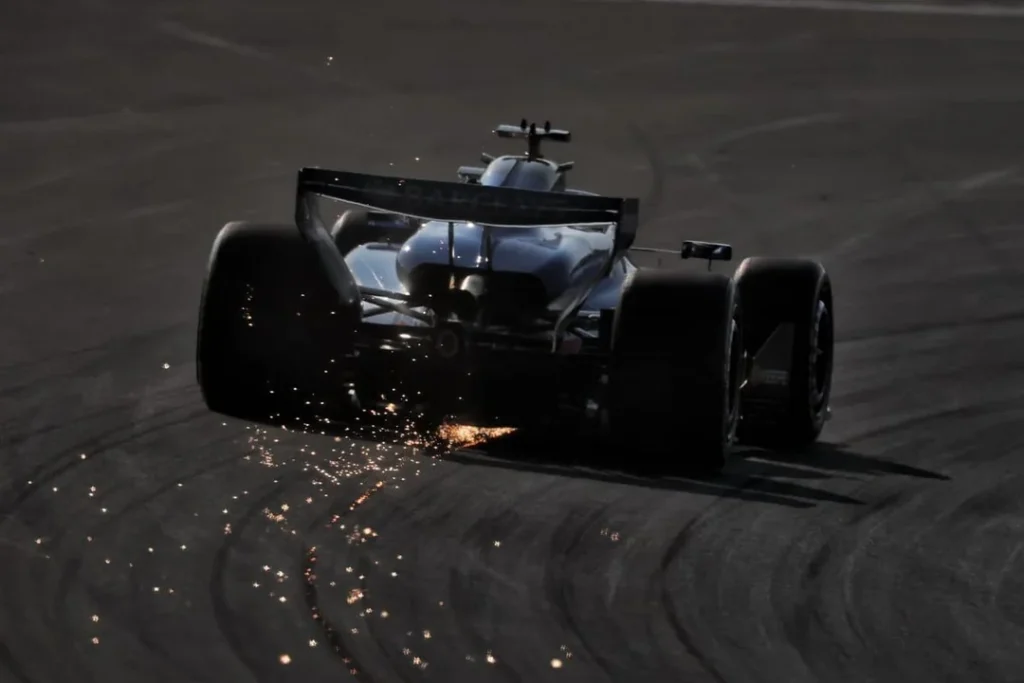
Williams’ difficult start to the 2026 Formula 1 season has taken another turn, with a newly highlighted issue—described as “three-wheeling”—emerging as perhaps the team’s most concerning limitation yet. While early-season narratives have largely centered on other struggling teams, particularly Aston Martin, a growing sentiment is that Williams’ problems may be both more fundamental and less excusable.
At the core of the issue is a car characteristic that sees one wheel—typically the inside rear—lift significantly off the ground through corners. While not always fully airborne, the unloading is enough to reduce the effective contact patch, compromising mechanical grip and destabilizing the aerodynamic platform. The result is a car that lacks consistency and predictability, particularly through cornering phases where balance is critical.
From a technical standpoint, this isn’t just a visual quirk—it has cascading consequences. Reduced contact at one corner of the car affects load distribution, which in turn disrupts both traction and aero efficiency. In a formula so dependent on stable airflow and precise energy deployment, that instability can be devastating over a lap.
What makes the situation more troubling is not just the presence of the issue—but the context in which it exists.
There is a strong view that, unlike some of their rivals, Williams lacks a clear external explanation for their struggles. While Aston Martin’s early-season difficulties have been widely attributed to power unit limitations and integration challenges, Williams is running what many consider the benchmark Mercedes power unit. That contrast has sharpened scrutiny: if others have identifiable structural disadvantages, Williams appears to be underperforming relative to its baseline.
That disparity has not gone unnoticed. There is a growing perception that Williams’ underperformance has flown under the radar largely because Aston Martin’s struggles have dominated the narrative. In effect, one team’s crisis has shielded another’s.
But internally, the expectations were far higher. Team principal James Vowles had repeatedly framed the 2026 regulations as a key inflection point—one where Williams’ long-term rebuild would begin to pay off. Instead, the team finds itself near the back of the grid, in close proximity to a brand-new Cadillac entry and a faltering Aston Martin outfit. For many observers, that gap between expectation and reality is the most damning aspect of all.
The technical nature of the problem has also raised eyebrows. In modern Formula 1, where suspension geometries, anti-roll bars, and setup windows are meticulously optimized, a persistent wheel-lift issue suggests either a deeper architectural limitation or a compromise elsewhere in the setup. Some interpretations point toward a scenario where the car’s optimal performance window inherently induces the instability—meaning that solving the issue could come at the cost of outright pace.
That trade-off, if true, would place Williams in a difficult position: either accept a fundamentally unstable car or dial back performance to regain consistency.
There is also a potential interaction with the 2026 power unit regulations to consider. With hybrid systems playing an even more critical role, especially in energy recovery and deployment, losing consistent rear contact—particularly during traction phases—could directly impact efficiency. If the unloaded wheel coincides with moments of power delivery, the loss of usable grip becomes even more costly.
Some perspectives suggest that wheel lift in isolation is not always catastrophic—certain setups can tolerate it, especially if the unloaded tire is already contributing minimally. But the key distinction here is frequency and context. If Williams is experiencing this behavior in scenarios where competitors are not, it points to a systemic imbalance rather than a marginal setup quirk.
The broader competitive picture only amplifies the concern. Comparisons to midfield teams like Haas—now seen as increasingly stable under new leadership—highlight how quickly the order has shifted. Even Cadillac, entering as a true new team, is viewed as meeting or even exceeding realistic expectations simply by avoiding embarrassment and showing incremental progress.
By contrast, Williams’ position feels more like regression than transition.
There is also an undercurrent of frustration tied to the development framework. While struggling power unit manufacturers may benefit from mechanisms like Additional Development and Upgrade Opportunities (ADUO)—which allow for performance catch-up through homologation adjustments—Williams does not have that lever available in the same way. Their challenges are not rooted in engine deficit but in chassis and setup execution, meaning solutions must come from within their own engineering processes.
That distinction matters. It removes any regulatory safety net and places full responsibility on internal development.
Despite all of this, there are still flashes of individual performance that complicate the narrative. Extracting points from a difficult car has been possible, suggesting that the ceiling—while low—is not nonexistent. But those moments feel more like exceptions than indicators of underlying strength.
Ultimately, the concern around Williams is not just that they are struggling—it’s that they are struggling without a clear, external reason why. In a season where multiple teams are navigating new regulations, supplier changes, and structural resets, most have identifiable constraints or transitional explanations.
Williams, by comparison, was supposed to be ready.
Instead, they are fighting a car that, quite literally, is not staying grounded.