

Formula 1’s summer break is supposed to be the quiet part of the season. Instead, the driver market is beginning to move, Red Bull may be forced into another mid-season driver shuffle, Sergio Pérez is confidently reassessing his place among the grid’s best, the FIA is preparing to revisit one of the strangest controversies of the season, and motorsport has once again found itself caught in a geopolitical argument.
And somehow, after all of that, one of the biggest questions might be whether Williams is preparing to pay Carlos Sainz €30 million per year.
Albon is staying at Williams — although apparently that counts as “BREAKING”
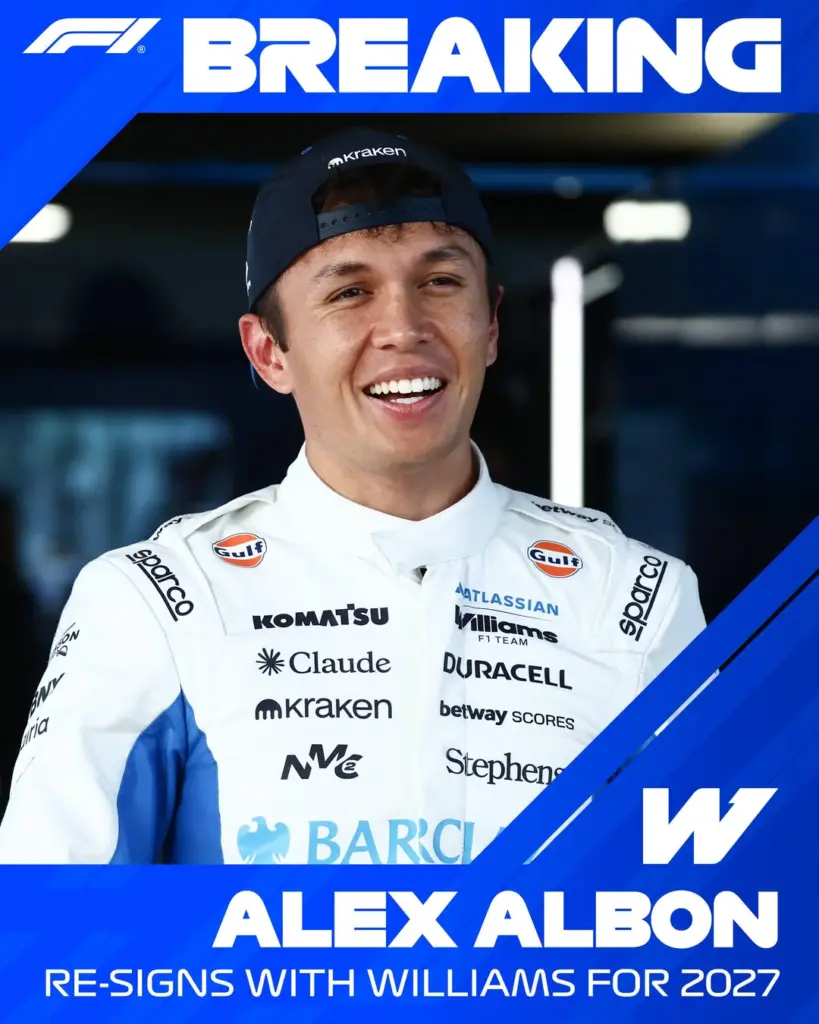
Williams has confirmed that Alex Albon will remain with the team for 2027.
The announcement itself was considerably less surprising than the presentation of it as breaking news. Formula 1 has used the “BREAKING” treatment so frequently that seeing it attached to Albon staying at Williams almost felt like a meme rather than an actual announcement.
There is also an important wrinkle to the news. According to information attributed to The Race, Albon’s existing multi-year agreement was already believed to cover 2027. No new racing contract has reportedly been signed. Instead, the confirmation concerns exit clauses in his existing deal, something particularly relevant given Williams’ struggles with the FW48 under the new regulations. In other words, the meaningful development may not be that Williams convinced Albon to sign another contract. It may be that Albon has effectively committed himself to staying despite having contractual mechanisms that could potentially have allowed him to look elsewhere. And realistically, where was he going?
That sounds harsher than intended, because Albon remains a perfectly credible Formula 1 driver. But he occupies an awkward place in the driver market: good enough that Williams has every reason to keep him, but without an obvious superior destination waiting. Carlos Sainz has also made that position more uncomfortable. Sainz has reportedly outqualified Albon 9-1 this season, a record difficult to explain away entirely through Williams’ problems. There is context: Albon has suffered DNFs, a DNS and races in which his car has been used for additional testing, while the pair have remained relatively close in the points.
Still, qualifying is one of the cleaner comparisons available between teammates, and 9-1 is emphatic. That creates an interesting benchmark for Albon. For a period, his reputation benefited enormously from what he was accomplishing at Williams. Now he has a proven multiple-race winner sitting alongside him, and suddenly we have a much clearer reference point. Albon might effectively be Formula 1’s measuring stick for a solid modern driver: comfortably good enough to belong on the grid, capable of excellent performances, but not necessarily someone a championship contender is reorganizing its lineup to acquire. For Williams, that is hardly a problem. Stability has value.
Especially if the team’s next move is what has been reported.
Would Williams really pay Carlos Sainz €30 million?
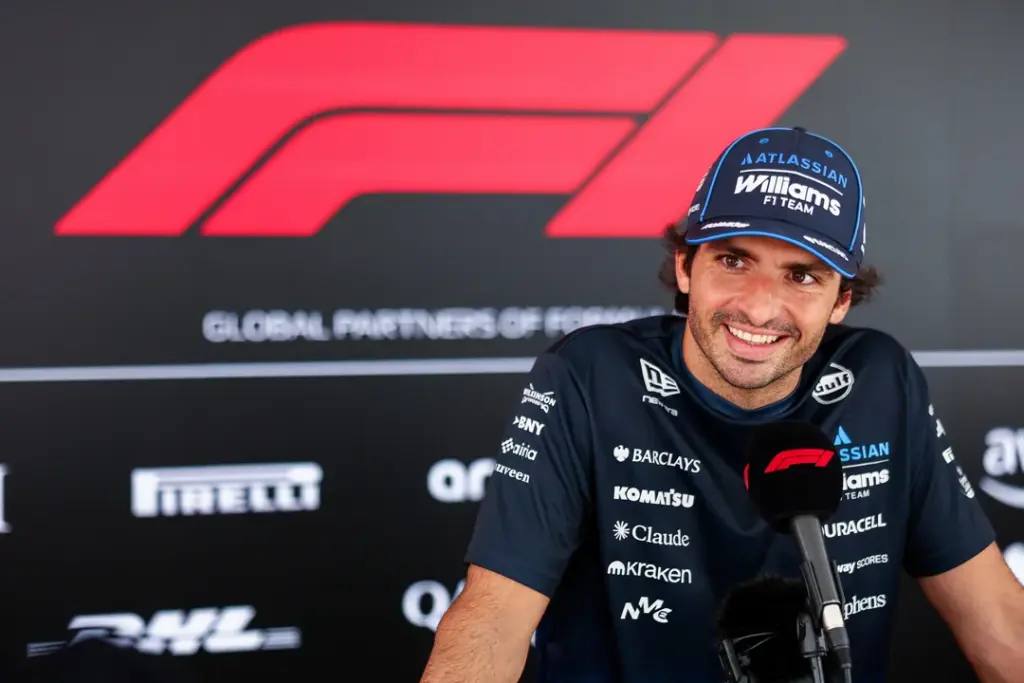
A report from SoyMotor claims Williams is preparing to confirm Sainz on a multi-year extension worth approximately €30 million per season, with James Vowles apparently determined to make the Spaniard a central part of the team’s rebuilding project.
The report describes it as a fixed salary without performance bonuses, which is unintentionally one of the funniest details imaginable when paired with the explanation that Williams cannot currently promise the performance necessary to earn them. More than doubling your money to do the same job is a fairly compelling employee-retention strategy. But the obvious question is why Williams would need to offer that much.
Where is Sainz going? The top teams appear relatively settled. Moving elsewhere in the midfield would offer questionable sporting benefits. Williams therefore seems, at least from the outside, to be bidding aggressively against a market that does not appear particularly interested in bidding back. If the €30 million figure is accurate — and it should absolutely be treated as rumor rather than established fact — then Williams must believe Sainz’s value extends considerably beyond the points he scores.
There is a reasonable argument for that. Sainz brings experience from Toro Rosso, Renault, McLaren and Ferrari. Williams reportedly values his technical feedback, collaboration with engineers, strategic thinking and leadership. He also carries commercial value and sponsor appeal. Driver salaries sit outside the cost cap, so Williams can spend heavily on Sainz without directly sacrificing capped development expenditure. For a rebuilding organization, there is value in eliminating uncertainty around the cockpit and keeping a driver capable of telling engineers precisely what the car is doing.
That doesn’t necessarily make €30 million a bargain. It just makes the logic more complicated than comparing Sainz’s points total against a cheaper midfielder. There is another reason for skepticism: the tone of the report itself is extraordinarily complimentary toward Sainz. Even some of his supporters could reasonably read it as something designed to make an impending Williams extension sound like a major career victory rather than the most logical available option. If it happens, Sainz gets an enormous payday and Williams gets the driver it apparently considers fundamental to its reconstruction. Everybody wins.
Unless Sainz’s performance clauses eventually give him an escape route and a top team calls. In that scenario, Williams may discover that €30 million buys commitment right up until somebody offers a faster car.
Silly Season might actually be… boring
Williams retaining both Albon and Sainz would also remove two potentially interesting pieces from the 2027 driver market.
The information provided alongside the Sainz report says Audi is expected to retain Nico Hülkenberg and Gabriel Bortoleto, while reports that Audi considered paying Hülkenberg to leave in order to accommodate Sainz are described as false. That leaves fewer obvious openings. Pierre Gasly’s Alpine teammate remains a question, although Franco Colapinto is suggested as the likely incumbent. Racing Bulls remains unsettled. Haas still has a decision surrounding Esteban Ocon. Fernando Alonso’s future at Aston Martin remains another potentially significant variable.
For a sport that has trained us to expect an elaborate summer driver-market soap opera, Williams simply saying “same guys again” would be almost disappointingly sensible.
Red Bull, however, apparently refuses to allow anything involving its drivers to be sensible.
Isack Hadjar’s wrist could produce the most Red Bull weekend imaginable
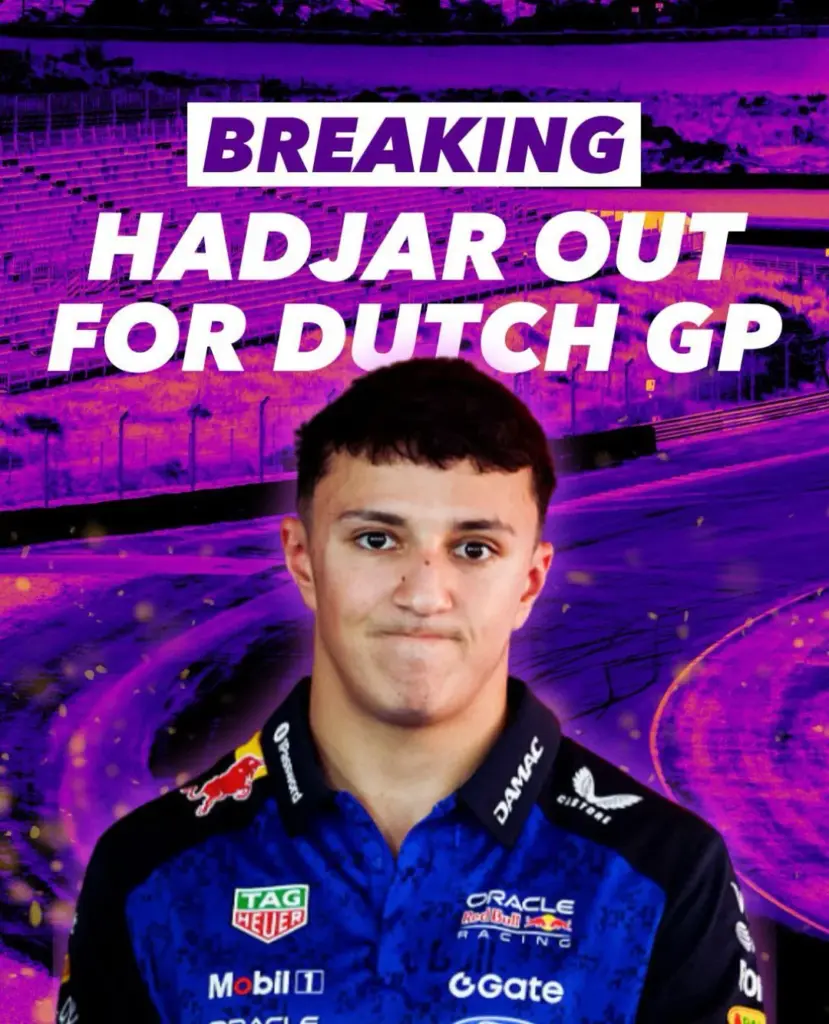
There is reportedly a good chance Isack Hadjar will miss the Dutch Grand Prix because of a wrist injury, with Erik van Haren reporting that Liam Lawson would temporarily move to Red Bull if Hadjar cannot race and Yuki Tsunoda would step into Lawson’s Racing Bulls seat.
Importantly, the information provided does not make Hadjar’s absence certain. The injury has reportedly occurred extremely recently and has been linked to a gym session. Other speculation has suggested boxing, but there has been no detail provided here from Red Bull establishing exactly what happened, so that should remain firmly in the rumor pile. The potential replacement scenario, however, is almost too perfect.
Liam Lawson made his Formula 1 debut at the 2023 Dutch Grand Prix after Daniel Ricciardo injured his wrist at Zandvoort. Now another Red Bull-family driver could miss Zandvoort with a wrist injury, sending Lawson back up the Red Bull ladder. Apparently Liam Lawson’s Formula 1 career is governed by a very specific law: every few years, somebody needs to hurt their wrist in the Netherlands.
It would also continue an absurd run in which Lawson seemingly cannot spend an entire season in one place. He has bounced around the Red Bull ecosystem so much that going from potentially being under pressure for his own future to temporarily driving for the senior team barely registers as unusual anymore. And then there is Tsunoda. After leaving the active lineup, Yuki could suddenly find himself back in Formula 1 for Racing Bulls. Recent discussion about Red Bull keeping him available rather than allowing outside racing opportunities suddenly looks rather less excessive when an injury elsewhere in the organization can create an immediate need for another driver.
There is an uncomfortable logic to Red Bull’s enormous driver pool after all. For Lawson, a temporary Red Bull return would also be fascinating. It shouldn’t be treated as a definitive judgment about his future — Red Bull has limited alternatives with appropriate experience — but another opportunity alongside Max Verstappen would inevitably become an audition whether the team calls it one or not. First, Hadjar actually has to be ruled out.
Until then, Formula 1 is waiting on a wrist.
Sergio Pérez would like everyone to know Sergio Pérez is still one of the best
While the Red Bull driver machine continues turning, one former occupant of its most infamous seat is feeling pretty good about himself.
Sergio Pérez has admitted that he had doubts about returning to Formula 1 before concluding that his performances since coming back have proven something important to himself.
“I proved to myself that I’m still one of the best out there.”
Source: Sergio Pérez. You have to respect the self-belief. Pérez’s reputation took an enormous hit during the latter stages of his Red Bull career, and his Cadillac return has not provided an especially clean environment in which to reassess him. The car has its own problems, Pérez has made mistakes, and comparing him with Valtteri Bottas does not suddenly provide an obvious answer about where either veteran belongs in the hierarchy.
Even their qualifying comparison has been close enough that sweeping conclusions seem premature. Pérez also deserves more historical credit than his Red Bull ending sometimes allows. Before becoming the guy everyone compared unfavorably with Verstappen, he built a strong career as a midfield driver and collected numerous podiums in Sauber and Force India machinery. That doesn’t make him one of the very best drivers on the current grid.
“One of the best 22 Formula 1 drivers in 2026” is considerably easier to defend.
But Pérez’s confidence may be exactly what he needs. The Red Bull experience appeared to consume more than one driver’s reputation, and Cadillac’s difficult first season is unlikely to reward anyone who arrives already questioning whether they still belong.
Perhaps the actual lesson is simpler: love yourself as much as Sergio Pérez loves Sergio Pérez.
Somehow, we are still litigating the Monaco Grand Prix
If you thought the 2026 Monaco Grand Prix results were settled, Formula 1 has another surprise.
McLaren and Red Bull’s appeals against the decision to rescind Pierre Gasly’s two five-second penalties will be heard by the FIA International Court of Appeal on August 25. Gasly was originally penalized twice for pit-lane speeding, with recorded speeds of 60.1 km/h and 60.4 km/h. Alpine subsequently petitioned for a review, and the stewards determined that a significant and relevant new element justified rescinding both penalties, changing the race classification and recalculating championship points. McLaren and Red Bull appealed.
So months after Monaco, we are still discussing who actually deserves what from the race. At this rate, somebody in 2057 is going to be explaining that historians remain divided over who finished third at Monaco in 2026. The frustrating part is that the controversy exposes a genuinely difficult hole in sporting procedure.
During the race, penalties were issued using data supplied to the stewards. Concerns over the data were raised, it was checked, and the information was initially treated as valid. Some affected drivers served their penalties. Gasly didn’t. When Alpine later successfully demonstrated the problem, his unserved penalties could be removed. But Formula 1 cannot simply rewind the race for competitors who already served theirs.
That creates an absurd incentive. If a team genuinely believes an objective penalty is based on faulty information, serving it protects the team from further punishment but may make the damage irreversible. Refusing to serve it carries enormous sporting risk, but Gasly’s case demonstrates how that gamble can potentially leave a driver better off once the underlying error is established. Neither outcome feels satisfactory.
George Russell is an especially painful example from the wider mess because once a penalty has materially changed someone’s race, correcting the underlying information later cannot recreate all the decisions, positions and opportunities that followed. This therefore feels less like a simple question of whether the stewards were “bad” and more like a procedural system encountering a situation it wasn’t equipped to undo.
The International Court of Appeal now gets the unenviable task of deciding what fairness looks like when the clock cannot actually be turned back.
Ukraine challenges the FIA over Russian competitors
Away from the driver market, Ukraine has urged the FIA to reverse its change concerning Russian competitors in motorsport.
The reaction has immediately expanded beyond the specific decision into the much broader and seemingly unavoidable debate about how international sporting organizations apply moral standards. Criticism of the FIA quickly runs into accusations of inconsistency: Formula 1 and international motorsport compete in countries routinely criticized over human-rights issues, which makes attempts to draw a clean moral boundary extraordinarily contentious. That doesn’t automatically invalidate Ukraine’s argument. Nor does pointing toward another country answer the specific question surrounding Russia. But it does illustrate the problem the FIA creates whenever geopolitical participation is decided on ethical grounds: every decision becomes a precedent against which every other decision can be compared.
There is also a practical commercial question beyond the ethical one. Even if Russian competitors are permitted, which Western companies would currently want to associate their brands with them? Russian businesses and wealthy backers could potentially fill that gap, but permission to compete does not necessarily mean the commercial environment surrounding participation immediately returns to normal. The online discussion around the issue is predictably toxic, filled with whataboutism, accusations of propaganda and competing attempts to establish which countries are sufficiently immoral to make the FIA hypocritical. And that may ultimately be the most familiar part of the entire story.
The FIA can write sporting regulations. It can decide eligibility rules. What it cannot create is a universally accepted formula for separating international sport from geopolitics.
Formula 1’s summer break remains undefeated
Taken together, this is an impressively Formula 1 collection of stories for a period supposedly defined by everyone taking a vacation.
Williams has confirmed a driver who was apparently already contracted while potentially preparing to give his teammate a spectacular raise. Red Bull may need to temporarily promote a driver because another driver injured his wrist before the exact Grand Prix where a wrist injury originally gave that replacement his Formula 1 opportunity. Pérez has returned from questioning his comeback to declaring himself one of the best. Monaco’s classification remains a legal storyline months after the checkered flag. And the FIA has another geopolitical controversy to navigate. Perhaps the funniest development would now be nothing happening. Hadjar gets cleared to race. Sainz quietly signs. The Williams lineup remains unchanged. The appeal produces no dramatic championship alteration.
After all this noise, the biggest story of Formula 1’s summer could ultimately be continuity. But this is Formula 1.
Continuity rarely gets to stay boring for long.