


Max Verstappen won the race. Kimi Antonelli won the championship. Ferrari left Mexico City confronting how a weekend with race-winning speed became an argument over responsibility, respect, and a victory that slipped away.
Verstappen took the 2026 Mexico City Grand Prix ahead of Lewis Hamilton and Antonelli, whose third-place finish secured his first Formula One World Drivers’ Championship. At 20, the Italian became the youngest world champion in F1 history, celebrating on a podium alongside two drivers with 11 titles between them. It was a moment worthy of the championship it marked. Yet the race that delivered it was dominated by Ferrari’s opening-lap confrontation, a disputed five-second penalty for Charles Leclerc, and Hamilton’s increasingly pointed criticism of his teammate’s approach. Ferrari finished second and fourth. Those were substantial results, but they offered little comfort to a team that believed it had the performance to win. Fred Vasseur’s verdict captured the frustration.
“I’m struggling to swallow it because, honestly, I think it’s a lack of respect—a lack of respect for the brand, a lack of respect for all the people working here and for the efforts we’re putting in,” he said. “We’ve taken a real step forward in terms of performance. And I think throwing away a win like that is tough.”
Ferrari had brought the speed. It failed to turn that advantage into the result it wanted. The opening lap established both the opportunity and the problem. Hamilton started from pole, while George Russell’s challenge immediately unraveled as his Mercedes lost momentum on the run toward the opening corners. Ferrari emerged with its two drivers fighting at the front, but their contest escalated through Turns 4 and 5. Both Hamilton and Leclerc went off the track. Leclerc emerged ahead, while Verstappen threaded through into second.
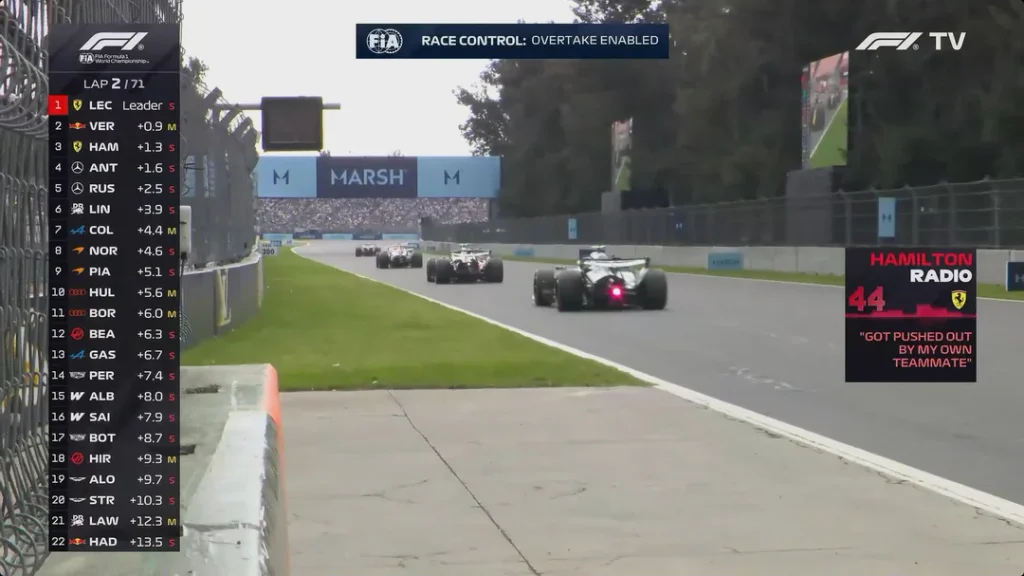
Hamilton’s radio response was immediate: “Got pushed out by my own teammate.”
That message became the center of a dispute that required more precision than the initial broadcast provided. Hamilton’s account, the positioning of the cars through the preceding corners, and the specific offense for which Leclerc was penalized were related issues, but they were not interchangeable. The stewards determined that both Ferraris entered Turn 4 with excessive speed and that neither could make the corner on the track. Leclerc then completed an overtake off the circuit and gained a lasting advantage. Their explanation explicitly stated that Leclerc was not entitled to claim the corner because of his entry speed. It also established why the penalty was five seconds rather than the 10-second baseline: Hamilton had also gone off on Leclerc’s inside, and the incident occurred early on the first lap.
That distinction matters. The official finding did not support a simple account in which one Ferrari negotiated the corner correctly while the other alone overshot it. Both drivers went too deep. Leclerc’s punishable offense was completing the overtake off the track. But the explanation did little to resolve the broader question of whether the sanction adequately discouraged the move. On a circuit where track position proved exceptionally valuable, five seconds could be a manageable price for retaining the lead and controlling the race in clean air. Returning the positions would have put Leclerc behind both Verstappen and Hamilton. Keeping the lead allowed Ferrari to preserve an advantage on the road while accepting a time penalty.
That created an uncomfortable incentive. A penalty can be consistent with the stewards’ assessment of an incident while still leaving the offending driver in a strategically preferable position. The first-lap mitigation was particularly contentious given the pre-race emphasis, reflected in the supplied discussion, on preventing drivers from gaining an advantage by leaving the track. If the expectation was strict enforcement, invoking the opening lap as a reason for leniency was always likely to undermine confidence in that message. Hamilton was in no doubt about what he thought the decision meant.
“The stewards are basically handing Charles this win,” he said over the radio, also referencing what had been agreed in the drivers’ briefing.
Leclerc, however, described a situation that became complicated as soon as Verstappen separated the Ferraris.
“In Turns 4 and 5, Lewis and I both braked late,” he explained. “We were fighting for the win, and I expected Lewis not to give me much room, just as I wouldn’t give him much room either. But we both went too far.”
He acknowledged cutting the track and said he asked Ferrari what to do.
“The situation was confusing enough for me to keep the position and accept the deserved penalty. After that, I focused on my own race.”
That admission establishes an important limit to the argument: Leclerc accepted that the penalty was deserved. The dispute was over its severity, Ferrari’s response, and whether the opening-lap aggression should have happened in the first place. There is a credible racing argument for Leclerc’s urgency. Mexico City offered few straightforward opportunities to pass cars of comparable performance. Against a teammate in identical machinery, securing the lead early could determine both access to clean air and the preferred strategic position. The suggestion that the opening corners were too early to fight for victory does not fully reflect how this race developed. Norris later struggled to pass a Ferrari carrying substantial tire damage. Hamilton could not convert his pursuit of Verstappen into a winning move. Waiting did not necessarily promise a better opportunity.

But that does not make every opening-lap risk worthwhile. Ferrari’s two drivers had an opportunity to establish control together. Instead, their fight allowed Verstappen between them and left Leclerc carrying a penalty. The same difficulty overtaking that explains why Leclerc attacked also explains why losing that formation was so costly. A Ferrari one-two was an opportunity, not a guaranteed result. The subsequent interruptions and strategy still mattered. Nevertheless, Ferrari made its own task harder before the race had settled. Hamilton’s strongest criticism went beyond the individual corner.
“The guy’s 28 years old, so I don’t think it’s an age thing,” he said in comments shared by The Race. “I think it’s a mentality thing. It’s like do or die: either I win or none of us do, and it shouldn’t be that. It should be us getting that one-two.”
That was Hamilton’s characterization of Leclerc’s approach, rather than proof of his teammate’s intent. Even so, it exposed the central management problem: Ferrari’s drivers did not appear to share an understanding of where their individual ambitions should yield to the team’s position. Vasseur’s full comments are important here. Asked whether he was specifically pointing at Leclerc, he rejected that interpretation.
“No, no, I didn’t target anyone; I want to talk with them. Lewis was running very wide too,” he said, before emphasizing that the drivers represented a brand, sponsors, and 2,000 people working behind them.
Vasseur was entitled to address the matter privately rather than publicly assign blame. The test of his authority will be what changes afterward. A forceful interview achieves little if the next contested opening lap produces the same uncertainty. Ferrari does not necessarily need to designate a permanent number one to solve this. It needs clear expectations for racing between teammates, an understood response when one gains a position illegally, and confidence that protecting the team will not simply leave the more cautious driver exposed. Equally, declaring Leclerc incapable of ever winning a championship goes far beyond what this race establishes. His mistakes deserve scrutiny. His entire career does not need to be reduced to them. Mexico also provided a striking example of his ability to recover something from a compromised situation.
The race was interrupted by Valtteri Bottas’s suspension failure on the main straight, which brought out the red flag. It was an alarming failure and an unwelcome reliability concern for Cadillac. Being a new team provides context for the difficulties of establishing consistent performance. It does not make a high-speed suspension failure something to dismiss as routine. The supplied material does not establish its underlying cause, and comparisons with other alleged failures cannot substitute for that explanation. The interruption also changed the strategic contest at the front. Verstappen had been running soft tires against the medium-shod Ferraris and Antonelli. A free tire change under the red flag removed the opportunity to discover how that difference would play out over a long stint.
That does not prove Verstappen would otherwise have lost. It means an unresolved part of the race disappeared. For Ferrari, the restart brought another costly error. Leclerc described a “very significant lock-up” at the second start, after which his race became much more difficult. The resulting flat spot on his front-left tire became one of the defining images of the afternoon. Having already compromised his race with the opening-lap penalty, Leclerc now had to defend with a badly damaged tire.

He ultimately held fourth ahead of Norris. There were two valid ways to read that contest. One was as an indictment of how difficult overtaking had become: Norris could remain close to a visibly compromised car without finding a way past. The other was as evidence of Leclerc’s precision under pressure. Both can be true.
Leclerc repeatedly protected the exits that mattered and continued braking effectively into Turn 1. A poor final-corner exit or another significant lock-up could have opened the door. He avoided giving Norris that opportunity. McLaren’s difficulties also mattered. The supplied accounts describe limitations in traction, straight-line performance, and braking confidence, with Piastri likewise struggling to clear cars ahead. Norris’s inability to pass cannot be explained solely as insufficient aggression. Nor should Mexico’s overtaking problem be described as absolute. Antonelli passed Leclerc, and other drivers made progress through the field. Lawson’s provisional climb from 22nd to ninth was a notable recovery before the post-race order changed.
The more precise criticism is that passing cars of similar performance was difficult enough to magnify the value of the opening lap, clean air, and defensive positioning. Power deployment at the end of the straights compounded that frustration. Drivers could close in the slipstream, pull out, and find the expected acceleration advantage disappearing. The Leclerc-Norris battle concentrated those problems into one prolonged contest. It also showed why Leclerc had been so determined to secure track position at the start—and why Ferrari needed a better plan for managing that determination. Verstappen was the driver best placed to capitalize on the disorder.
Starting fifth, he seized second when the Ferraris went off and ultimately converted his opportunity into victory. Hamilton finished behind him, while Antonelli completed the podium and secured the championship. The win also moved Verstappen into second in the drivers’ standings, continuing a recovery that looked difficult to imagine during the early part of the season. Ferrari’s mistakes and the red flag were important to the race’s shape, but Verstappen still had to exploit the opening and finish the job. Russell experienced the opposite trajectory.
His loss of momentum at the start was especially visible because it happened among a group of accelerating cars. Accounts supplied from the broadcast attributed the problem to power delivery, with Bradley Lord reported as saying it was not Russell’s fault. Russell finished sixth and fell to fourth in the championship. That result added to the contrast between his season and Antonelli’s, but it also demonstrated why the comparison cannot be made from finishing positions alone. A technical problem on the opening straight directly compromises a driver’s race before pace, tire management, or strategy can meaningfully separate him from his teammate. Antonelli still deserves full credit for the championship he won. Russell’s difficulties do not diminish that achievement. They do complicate sweeping conclusions about Russell’s ability.
Behind the leading six, the result required a further distinction between the order at the finish and the revised classification. Post-race penalties for Piastri, Franco Colapinto, and Pierre Gasly changed the lower points positions. The supplied correction places Gabriel Bortoleto eighth, Isack Hadjar ninth, and Ryo Hirakawa tenth. The television coverage did not always make the wider race easy to follow. The long wait for a useful replay of the opening-lap incident left viewers debating Hamilton’s radio message before they had seen the sequence clearly. When replays did arrive, the timing drew further criticism for obscuring live action around the end of a virtual safety car. A race built around a disputed incident needs prompt, clear visual explanation. Without it, the loudest interpretation can become established before the evidence catches up. The focus on Ferrari also risked overshadowing recoveries and battles elsewhere in the field.
Ultimately, though, the afternoon’s most enduring moment belonged to Antonelli. At 20 years and 73 days old, he became Italy’s third world champion and its first in 73 years. Mercedes’ decision to entrust him with Hamilton’s former seat had delivered the sport’s biggest prize. Junior results and early expectations could only ever offer an incomplete picture. Antonelli still had to translate the opportunity into a championship. In Mexico City, he completed that task.

Standing alongside Hamilton and Verstappen gave the celebration unusual weight: a first-time champion beside two drivers whose combined achievements already accounted for 11 world titles. With Antonelli’s championship secured, the podium held 12. It was tempting to frame the scene as a passing of the torch. But Verstappen had just won the race and climbed to second in the championship, while Hamilton had finished runner-up after starting on pole. Neither was simply there to represent the past. The image was powerful because the generations were still competing. Hamilton, despite everything that had happened with Ferrari, recognized what deserved the spotlight. Asked afterward about Leclerc, he initially redirected the conversation.
“I’d rather not. I’d rather talk about Kimi, you know? Kimi just won the World Championship. Youngest world champion ever, you know? I’d love to keep it on a positive.”
He did not withdraw his criticism, adding that the incident showed why Ferrari had lost the win. But he also made room for the achievement beside him.
“Really happy and really honored to be up there with Kimi and with Max,” Hamilton said. “Three world champions, pretty cool moment.”
Ferrari’s argument will continue behind closed doors. The questions over penalties, overtaking, and race management will continue beyond Mexico. But the podium offered something more lasting than the dispute that helped shape it: Verstappen celebrating another victory, Hamilton acknowledging a new champion, and Antonelli standing among them with a world title of his own.