

Max Verstappen secured pole position for the 2026 Singapore Grand Prix by just 0.054 seconds over Charles Leclerc, with Lewis Hamilton completing a Ferrari double top-three finish. But with Red Bull’s recent starting difficulties, Ferrari’s impressive pace, and memories of Singapore 2017 resurfacing, Sunday’s race could be decided long before the field settles into a rhythm.
Max Verstappen continued his remarkable Singapore Grand Prix weekend by taking pole position at the Marina Bay Street Circuit, narrowly defeating Charles Leclerc and Lewis Hamilton in one of the closest qualifying battles of the season. The Red Bull driver delivered a 1:31.373 to beat Leclerc by just 0.054 seconds, with Hamilton another 0.069 seconds behind his Ferrari teammate. Kimi Antonelli qualified fourth for Mercedes, ahead of Lando Norris in fifth and George Russell in sixth. However, Russell’s substantial grid penalties mean his qualifying position will not translate into a sixth-place start.
Verstappen has now topped Sprint qualifying, won the Sprint, and secured pole position for the Grand Prix. Only Sunday’s victory remains to complete a sweep of the weekend’s headline results. Yet despite Verstappen’s perfect record so far, qualifying left a lingering question: was Red Bull actually the fastest car around Singapore, or did Ferrari let pole position slip through its fingers?
Both Ferrari drivers demonstrated the speed to challenge Verstappen, and Hamilton’s own explanation of his qualifying struggles suggests the result could have been very different.
Singapore Grand Prix Qualifying Results
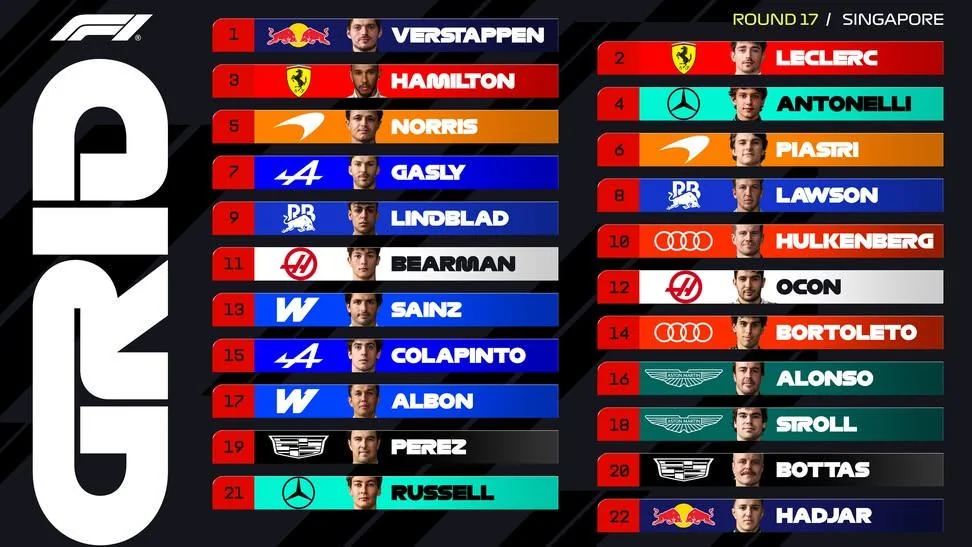
The top six were separated by less than four-tenths of a second, with the first four drivers covered by just 0.189 seconds.
| Position | Driver | Gap to Pole |
|---|---|---|
| 1 | Max Verstappen | 1:31.373 |
| 2 | Charles Leclerc | +0.054 |
| 3 | Lewis Hamilton | +0.123 |
| 4 | Kimi Antonelli | +0.189 |
| 5 | Lando Norris | +0.339 |
| 6 | George Russell | +0.374 |
Oscar Piastri qualified seventh, followed by Pierre Gasly, Liam Lawson, and Nico Hülkenberg in the top 10. However, the qualifying classification tells only part of the story. Russell faces significant grid penalties following component changes after his Sprint crash, while Isack Hadjar failed to set a classified qualifying time following further technical trouble with his Red Bull.
The resulting starting grid places Verstappen ahead of Leclerc, Hamilton, Antonelli, Norris, Piastri, Gasly, Lawson, Arvid Lindblad, and Hülkenberg in the top 10. For Verstappen, the achievement is particularly significant given how competitive Ferrari appeared throughout qualifying.
For Ferrari, it represents another opportunity that came agonizingly close to delivering pole.
Ferrari Had the Pace, but Verstappen Delivered When It Mattered

Ferrari entered the final stages of qualifying looking like a genuine threat to Red Bull.
Hamilton was particularly impressive during Q1 and Q2, consistently demonstrating the pace to challenge for the fastest lap. Leclerc, meanwhile, endured a more difficult progression through qualifying. He appeared unhappy with the car’s setup during the earlier sessions and looked unlikely to match Hamilton’s performance. Then came Q3.
Leclerc produced another of his trademark late-session improvements, jumping ahead of Hamilton and coming within 0.054 seconds of denying Verstappen pole. The result highlighted one of Leclerc’s most recognizable strengths: his ability to find additional performance when the pressure reaches its highest point. Even when the Ferrari looks difficult to manage earlier in qualifying, Leclerc has repeatedly demonstrated a capacity to deliver a decisive final lap.
But Singapore also illustrated the fine margins separating an exceptional lap from a pole-winning one. Leclerc’s improvement was substantial, yet Verstappen had already established a benchmark that proved just beyond his reach. The more frustrating aspect for Ferrari is that Hamilton also appeared to possess enough pace to challenge for pole.
Rather than a straightforward case of Red Bull having a superior qualifying package, the session suggested that Ferrari’s drivers struggled to combine their strongest sectors into a single clean lap. That distinction matters. Having a car capable of pole position is not the same as delivering pole position, particularly around a street circuit where mistakes can be costly and opportunities to overtake are limited.
Verstappen ultimately extracted the lap that counted.
Hamilton Explains Why His Ferrari Became Difficult in Q3

Hamilton’s qualifying performance was one of the weekend’s biggest missed opportunities.
The seven-time world champion had looked extremely comfortable during the first two sessions, prompting expectations that he could challenge Verstappen for pole. But his final Q3 attempts were noticeably less convincing. Hamilton subsequently explained that a setup adjustment between sessions changed the behavior of his Ferrari.
“The car felt good, my team, the engineers did a fantastic job as well as the mechanics between the session,” Hamilton said.
“The car felt amazing in Q1 and Q2 and when I finished the laps I was like she’s got more in her, the only way to extract that is to add more wing and in doing so I think it just tipped it over the edge, then the car was just snappy.”
His explanation provides important context for what otherwise appeared to be a series of uncharacteristically untidy laps. Hamilton believed the Ferrari had more performance available and attempted to unlock it through an adjustment to the front wing. Instead, the change appears to have upset the balance that had made the car so effective earlier in qualifying.
The resulting instability made it more difficult to extract the available pace. It is a familiar dilemma in Formula 1. When a car feels competitive, should a driver and team preserve a known setup or pursue the final fraction of performance that might make the difference between pole and second place? Hamilton chose the latter.
The decision did not produce the desired result.
Did Hamilton Push Too Hard?
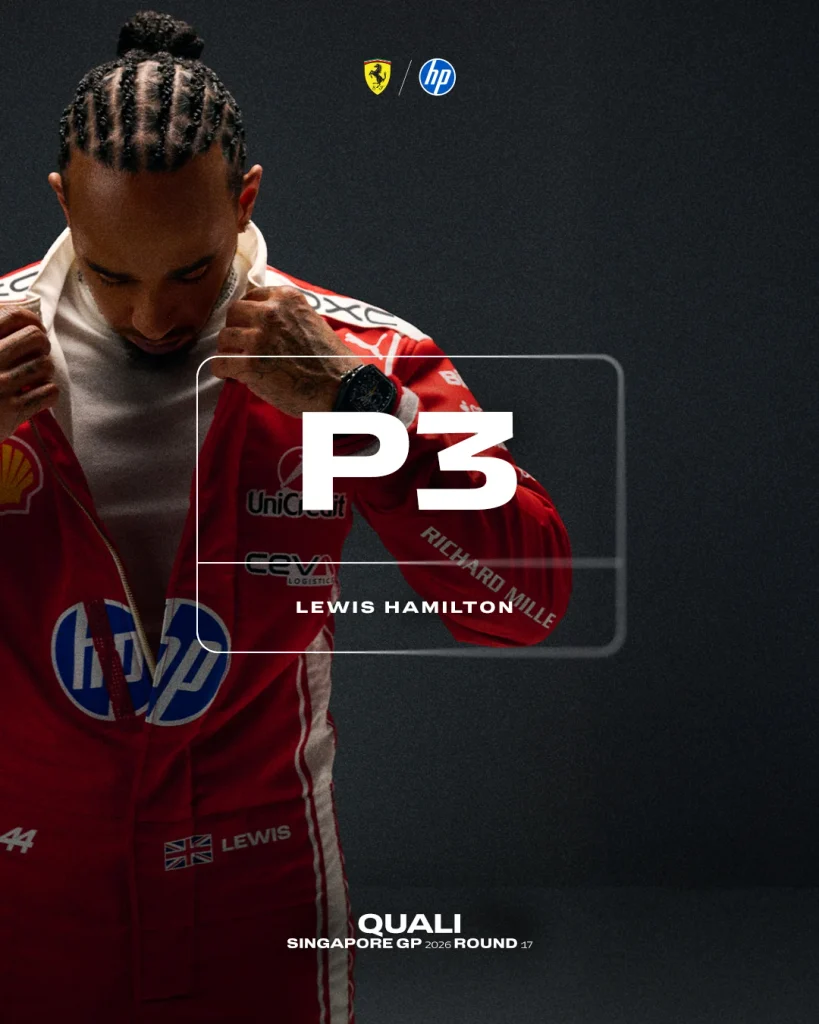
Hamilton’s Q3 laps prompted considerable discussion about whether he was overdriving the Ferrari.
His first attempt included a mistake at Turn 3, costing valuable time in the opening sector. Despite that error, he still produced an exceptionally competitive middle sector, suggesting significant underlying pace remained. On his final attempt, Hamilton improved the opening portion of the lap but could not reproduce his strongest middle-sector performance.
The sector comparisons shared after qualifying illustrated the inconsistency. One analysis placed Hamilton’s first-run middle sector at approximately 38.2 seconds, compared with 38.4 seconds on his final attempt. His final-sector time also reportedly deteriorated from approximately 25.97 seconds to 26.1 seconds. Those differences are substantial when pole position is decided by hundredths of a second.
There is also the question of tire management. An aggressive approach through the opening corners can compromise grip later in the lap, particularly when a driver is already struggling with an unstable balance. However, Hamilton’s explanation suggests the problem was not simply a matter of pushing too hard. The Ferrari’s altered behavior made executing a clean lap more difficult. It would therefore be overly simplistic to attribute the entire result to driver error.
The car had demonstrated the required speed, but the combination of setup changes and imperfect execution prevented Hamilton from converting that potential into pole.
Is Hamilton Still Chasing Too Much Performance?
The result also revived a broader debate about Hamilton’s qualifying approach.
At his peak, Hamilton developed a reputation for producing extraordinary laps when the stakes were highest. His performances during the 2012 and 2018 seasons remain particularly memorable examples of his single-lap ability. At 41, he remains capable of competing with the strongest qualifiers on the grid, as demonstrated by his third-place result and his pace throughout the Singapore weekend. But there is a distinction between possessing outright speed and consistently assembling the perfect lap.
Hamilton’s qualifying performances have occasionally been characterized by attempts to find an additional fraction of performance when the existing package was already competitive. Singapore provided another example. The temptation is understandable. A driver fighting for pole position is naturally inclined to pursue every available advantage.
But there is also a cost to repeatedly chasing the theoretical optimum if the changes make the car less predictable. The counterargument is equally important: Hamilton was trying to win qualifying, not merely secure a respectable starting position. A driver who stops searching for performance risks surrendering the very competitive edge that made him successful.
Furthermore, interpreting every Hamilton mistake through the lens of age applies a standard that is not always imposed on younger drivers. Leclerc and Verstappen also make qualifying mistakes. Those errors are generally treated as individual incidents rather than evidence of an inevitable decline. Hamilton’s Singapore performance should be assessed with the same balance. He demonstrated exceptional pace, made an adjustment that did not work, and still qualified third.
The missed opportunity is real, but so is the underlying competitiveness.
Ghost Car Comparison Reveals Red Bull’s Straight-Line Advantage
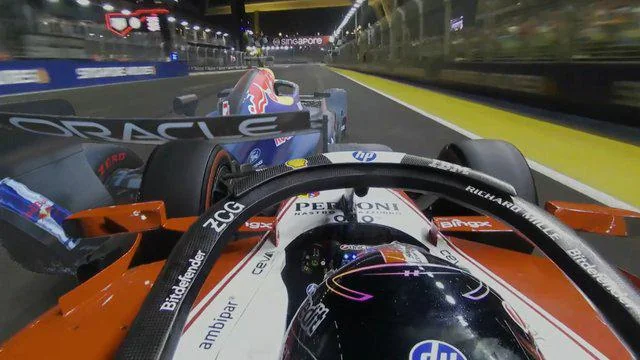
A ghost-car comparison between Verstappen and Leclerc provided another perspective on how the Red Bull driver secured pole.
The visualization highlighted Red Bull’s impressive performance on the straights, with Verstappen gaining significant ground as the cars accelerated away from corners. Leclerc was competitive through several sections of the lap and appeared to have an advantage at certain points. However, Verstappen’s performance toward the final sector proved decisive.
The comparison also illustrated how effective corner exits can be, particularly when combined with strong straight-line speed. Verstappen has long favored an approach that prioritizes positioning the car for acceleration out of a corner rather than maximizing entry speed at all costs. That driving style can make a car appear less spectacular at the apex while delivering a substantial advantage down the following straight.
At Singapore, where traction out of slower corners is crucial, the approach appears particularly effective. However, separating driver technique from the characteristics of the Red Bull remains difficult. A strong exit can reflect driving style, mechanical grip, traction, power delivery, or some combination of those factors.
The 2026 power-unit regulations add another layer of complexity. Battery deployment and engine mapping can substantially influence where a car gains or loses speed during a lap. Without detailed information about the respective deployment strategies, it is difficult to determine precisely how much of Verstappen’s advantage came from the power unit, aerodynamic efficiency, or driving technique.
Nevertheless, the visible straight-line performance of the Red Bull was difficult to ignore. That could also become important during Sunday’s race. Even if Ferrari takes the lead at the start, Verstappen’s ability to remain close on the straights could prevent either Ferrari driver from building a comfortable advantage.
Conversely, if Verstappen retains the lead, the same characteristics could make his Red Bull particularly difficult to overtake.
Verstappen Complains About Downshifts Again — Then Takes Pole
Despite his outstanding qualifying result, Verstappen was far from satisfied with every aspect of his Red Bull.
During the session, he delivered an emphatic complaint over team radio.
“INSANELY, INSANELY BAD SHIFTS. DOWNSHIFTS ARE SO BAD,” Verstappen exclaimed.
It was another entry in what has become a familiar collection of Verstappen complaints about downshifting. The contrast between his radio frustration and his results has become almost comical. Verstappen can sound deeply dissatisfied with the car’s behavior, only to deliver the fastest lap moments later.
The situation invites comparisons with Hamilton’s famous complaints about tire performance, which have sometimes preceded unexpectedly strong lap times. But the underlying explanation may be more interesting than the humor. Elite drivers are exceptionally sensitive to changes in how their cars respond.
A relatively minor inconsistency that another driver might tolerate can be particularly disruptive to someone operating at the limit. Verstappen’s complaints do not necessarily indicate that the entire car is performing poorly. They may instead reflect how precisely he expects the transmission and power delivery to behave under braking. Singapore demonstrated that those frustrations were not enough to prevent another pole position.
If anything, the result reinforced how effectively Verstappen can extract performance even when the car does not behave exactly as he wants.
Verstappen’s Perfect Weekend Faces One Major Threat: The Start
Verstappen has been the benchmark throughout the competitive sessions at Singapore.
He secured Sprint pole, won the Sprint, and followed that with Grand Prix pole. But converting those results into Sunday’s victory is far from guaranteed. The biggest concern is Red Bull’s starting performance.
Verstappen lost the lead at the beginning of the Sprint before George Russell’s crash changed the race. Following that event, Verstappen expressed frustration with the team’s starting procedure, particularly its decision to use second gear in wet conditions.
“The race was fine, but again a fucked up start,” Verstappen said.
He explained that he had anticipated problems following the team’s decision about the starting procedure.
“Hopefully next time we’ll do a start in first gear, in Malaysia we also did it in second gear. That didn’t work either. So hopefully we learn from it this time around.”
When asked whether he had wanted to start in first gear, Verstappen confirmed that he had.
“Yeah, but, ultimately they have to decide what they think is the best option. But this clearly wasn’t.”
Those comments add an intriguing dimension to Sunday’s race. The team’s approach to wet-weather starts has involved attempting to manage wheelspin through its gear selection. However, starting in a higher gear can create its own difficulties if the engine struggles to deliver sufficient acceleration.
The distinction between wet and dry conditions is important. Red Bull’s recent dry-weather starts have been viewed more favorably than its wet-weather launches, meaning the Sprint result may not accurately predict Sunday’s getaway.
Still, with two Ferraris immediately behind him, Verstappen cannot afford to lose significant ground.
Ferrari Could Turn P2 and P3 Into a Three-Way Battle at Turn 1
Ferrari’s starting performance has been a recurring strength during the season, although individual starts have varied.
Leclerc will line up alongside Verstappen, while Hamilton starts directly behind the Red Bull in third. That creates an intriguing tactical situation. If either Ferrari gets a significantly better launch, Verstappen could find himself defending against one car while the other attempts to capitalize.
There is also the question of which side of the grid offers more grip. The odd-numbered positions have generally been regarded as the cleaner side in dry conditions, while the rubbered-in racing line can become more slippery when wet. That means any advantage may depend heavily on the weather and track surface at the start.
Leclerc’s second-place starting position may not necessarily offer the same traction as Verstappen’s pole slot. Hamilton, meanwhile, could benefit from starting third if the odd-numbered side provides superior grip. With Antonelli fourth and Norris fifth, there is little room for error among the leaders.
The opening sequence could be decisive.
Singapore 2017 Memories Return With Verstappen and Two Ferraris at the Front

A Red Bull on pole, two Ferraris immediately behind, and a driver named Kimi starting fourth.
It is an arrangement that inevitably brings back memories of the 2017 Singapore Grand Prix. That race became infamous for the opening-lap collision involving Sebastian Vettel, Max Verstappen, and Kimi Räikkönen. The similarities have not gone unnoticed.
This time, Verstappen is the Red Bull driver starting ahead of the Ferraris, while Leclerc and Hamilton occupy the positions immediately behind him. Antonelli adds another coincidence by starting fourth. The parallels have inspired plenty of humor, but there is a serious sporting question beneath the nostalgia.
How aggressively should the drivers approach the opening corners when track position is so valuable? Marina Bay is notoriously difficult for overtaking, and a driver who emerges from the opening sequence in front can potentially control the race. That creates an incentive to attack immediately.
It also creates a substantial risk. A collision among the leading cars could transform the race for everyone behind them. Antonelli, Norris, and Piastri would all have opportunities to benefit from trouble ahead. Of course, there is no reason to assume history will repeat itself simply because the grid looks familiar.
But the combination of close qualifying gaps, differing starting characteristics, and the difficulty of overtaking makes the opening lap particularly significant.
Verstappen and Leclerc Share the Front Row for the First Time Since Miami 2024
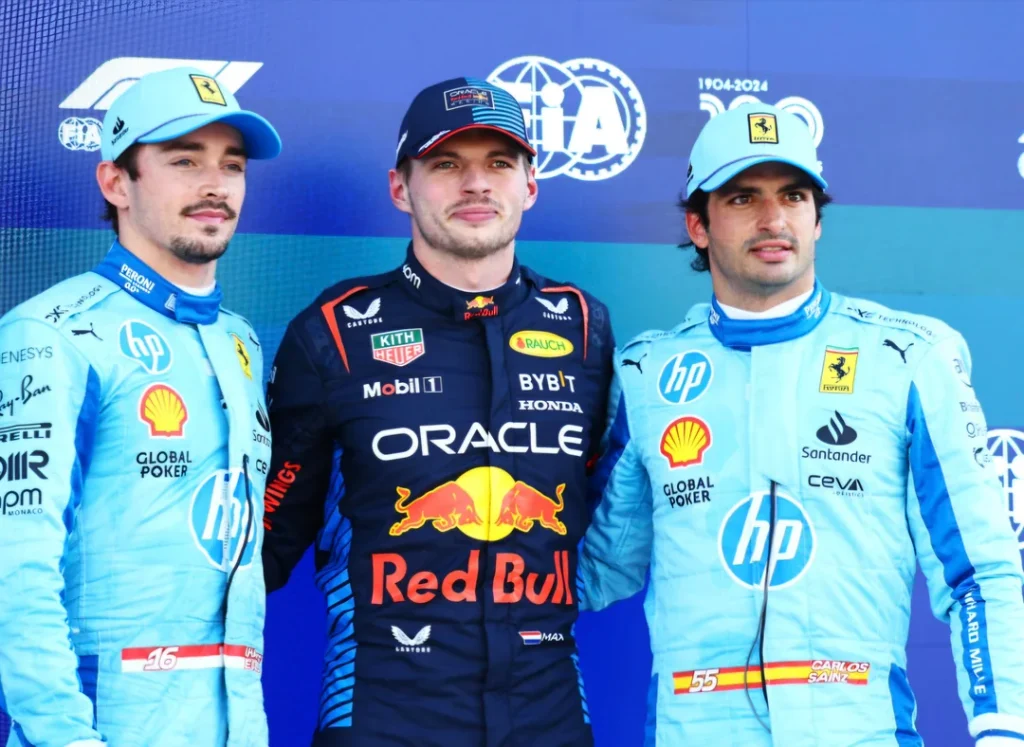
Beyond the historical Singapore comparison, qualifying also marked a notable reunion between Verstappen and Leclerc.
According to Daniel Valente, this is the first time the pair have occupied the front row together since the 2024 Miami Grand Prix, and their 16th shared front-row appearance. The statistic highlights a rivalry that has produced memorable battles but has not developed into the sustained championship confrontation many anticipated. Their early exchanges during the 2022 season appeared to promise a prolonged fight between two of Formula 1’s most exciting talents.
Instead, the championship contest evolved differently. Ferrari’s competitiveness, operational challenges, and the changing balance between teams prevented the rivalry from becoming the defining championship battle of the era. Singapore offers another opportunity to see the two drivers fighting directly at the front.
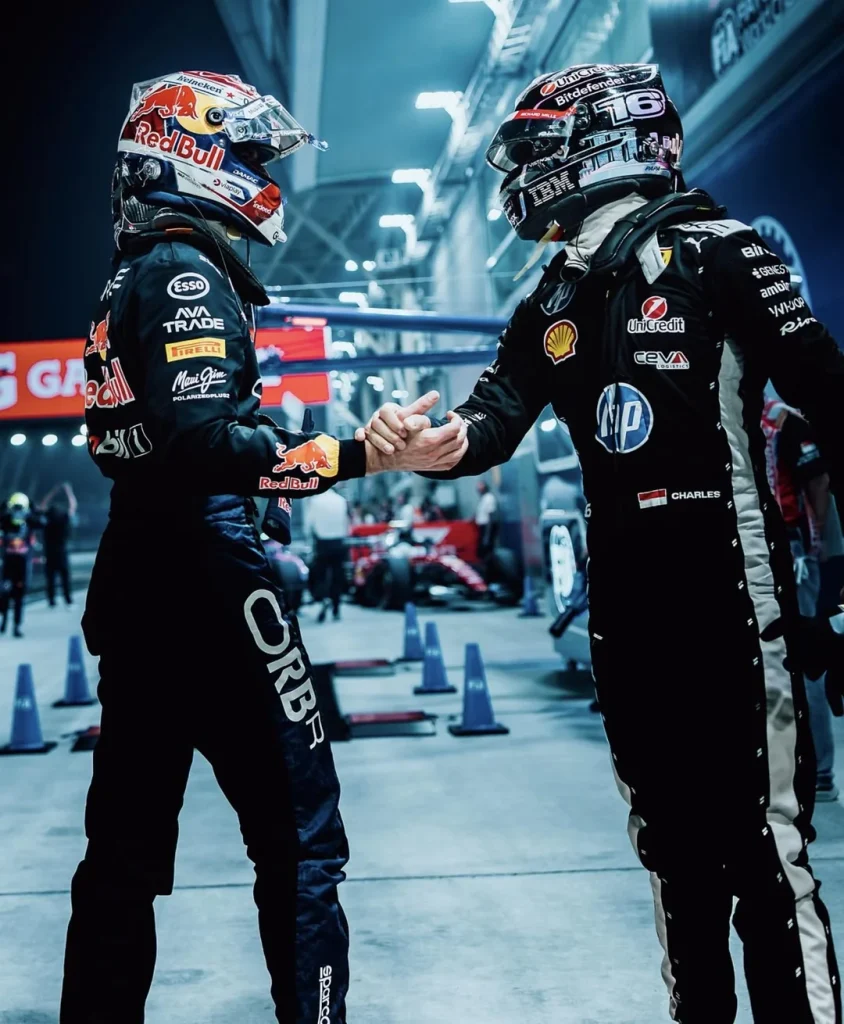
The mutual respect between them was also evident following the Sprint, when they were photographed shaking hands. That interaction occurred after the Sprint rather than Grand Prix qualifying, but it provides a reminder of the relationship between two drivers who have competed against one another for years. Leclerc’s special Singapore race suit and helmet also attracted considerable attention, with the black-and-white design proving popular even as Ferrari’s prominent HP branding divided opinion.
The visual spectacle may be memorable, but both drivers will be far more interested in what happens when the lights go out.
Mercedes’ Weekend Takes Another Turn as Russell Faces Major Grid Penalties
Mercedes arrived at Grand Prix qualifying dealing with the consequences of a difficult Sprint.
Russell had crashed out after experiencing what he described as an unexpected surge of power, which contributed to his car running wide onto a wet painted line before hitting the barriers. The team subsequently faced a significant repair job. Russell was able to participate in qualifying and recorded the sixth-fastest time, 0.374 seconds behind Verstappen.
However, his weekend has been further complicated by substantial grid penalties resulting from component changes. The penalties have been reported as totaling at least 40 places, with discussion of additional changes potentially increasing that figure. Rather than risk another accident, Russell’s qualifying participation appeared to serve partly as an opportunity to evaluate the repaired car and ensure that it was behaving as expected.
Given the circumstances, there was little incentive to take unnecessary risks chasing a qualifying position he would not retain on the starting grid. The result creates a stark contrast within the Mercedes garage. Antonelli will start fourth, within striking distance of the Ferraris and Verstappen.
Russell, meanwhile, faces the challenge of recovering from the back of the field.
Questions Remain About Mercedes’ Upgrades
Mercedes’ recent development direction has also attracted scrutiny.
The team’s updated specification has prompted questions about whether its performance is available only within a particularly narrow setup window. Such a characteristic could explain why a car appears highly competitive under certain conditions but becomes difficult to manage when the balance shifts. However, the available information does not establish that the upgrades have fundamentally failed.
There is a difference between an unsuccessful development package and one that requires a different approach to setup. Antonelli’s fourth-place qualifying result demonstrates that the updated car can still deliver competitive performance. It remains unclear how the team will approach its package for the upcoming United States Grand Prix at Circuit of the Americas.
For now, Mercedes faces two very different objectives on Sunday: Antonelli fighting near the front and Russell attempting to recover as much ground as possible.
Antonelli Has Another Opportunity to Capitalize
Antonelli’s fourth-place qualifying result could prove particularly valuable.
He finished second in the Sprint after Russell’s retirement, extending his championship advantage over his teammate by five points. Now he will start the Grand Prix ahead of both McLarens, with only Verstappen and the two Ferraris in front. That places him in a position to capitalize on any mistakes among the leading trio.
He is also close enough on outright qualifying pace to remain a factor. Antonelli finished just 0.189 seconds behind Verstappen, demonstrating that Mercedes was not far removed from the leading battle over a single lap. His challenge will be converting that pace into a clean race. Singapore’s demanding layout leaves little margin for error, and the threat of changing conditions or safety-car interruptions could complicate strategy.
But if the leading three become involved in a fight, Antonelli may be ideally placed to benefit.
McLaren Qualifies Fifth and Seventh After Sprint Collision
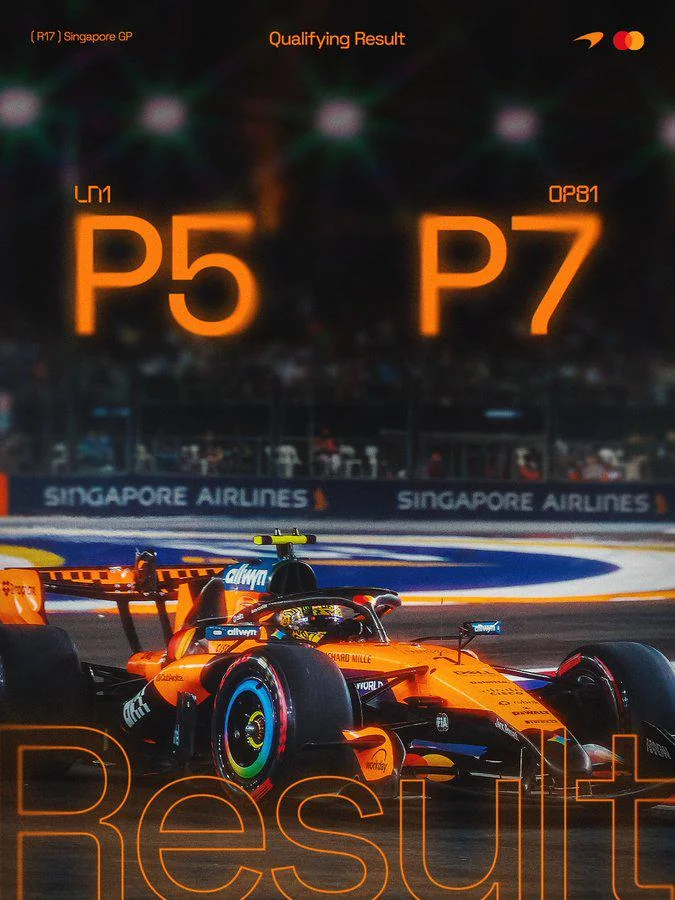
McLaren’s difficult Singapore weekend continued in Grand Prix qualifying.
Norris secured fifth place, while Piastri qualified seventh. Russell’s grid penalty subsequently promotes Piastri to sixth on the starting grid, placing the two McLarens alongside one another. That arrangement is particularly notable following their controversial Sprint collision.
During the final lap of the Sprint, Norris attempted to overtake Piastri at Turn 5, resulting in contact that eliminated Piastri and left Norris finishing eighth. The stewards determined that neither driver was predominantly responsible and imposed no penalty. However, the incident created considerable debate about whether the potential reward justified the risk, particularly with McLaren competing for constructors’ championship points. Now, less than a day later, Norris and Piastri will once again start close together.
McLaren will be hoping the pair can avoid another costly encounter.
Piastri’s Seventh-Place Qualifying Pattern Continues
Piastri’s qualifying result also reinforced a curious pattern.
Seventh place has become an unusually familiar position for the Australian, with discussion suggesting this was his eighth seventh-place qualifying result of the season. The more consequential statistic is the qualifying comparison with Norris. Figures shared following the session placed Norris ahead 16–7 across the combined qualifying and Sprint qualifying head-to-head.
The exact breakdown varies depending on how Sprint sessions are counted, but the overall trend favors Norris. That represents a challenge for Piastri, who has struggled to match his teammate consistently over a single lap. Yet Singapore also provides an opportunity for recovery.
With Russell moving down the grid, Piastri gains a starting position without needing to overtake anyone. Both McLarens will start immediately behind Antonelli, close enough to capitalize on problems ahead.
The more important question may be whether the team can maximize those positions without further internal drama.
Has McLaren’s Development Direction Cost It Performance?
McLaren’s qualifying deficit has also renewed questions about its recent upgrades.
There has been speculation about whether changes introduced around Baku have affected the car’s peak performance or altered its handling characteristics. One possibility raised is that efforts to improve the car’s drivability may have compromised some of its ultimate speed. However, there is insufficient evidence to conclude that the upgrades are responsible for McLaren’s current position.
Circuit characteristics, setup decisions, tire behavior, and the improvements made by rival teams can all affect the competitive order. What is clear is that McLaren is no longer consistently occupying the front-row positions it would want. At Singapore, Norris was 0.339 seconds away from pole, while Piastri was further back. With Red Bull and Ferrari occupying the first three positions, McLaren faces another race in which maximizing points may be more realistic than challenging for victory on outright pace.
That makes avoiding another collision even more important.
Hadjar’s Qualifying Ends Without a Classified Time
While Verstappen celebrated pole position, the other side of the Red Bull garage endured a very different afternoon.
Isack Hadjar failed to record an officially classified qualifying time after further technical difficulties. The result was particularly frustrating because Hadjar had already experienced significant problems with his car throughout the weekend. His mechanics worked to get him back onto the circuit, and he was able to leave the garage briefly.
But the attempt was short-lived. Hadjar stopped again before completing a qualifying lap that could establish his position. The contrast with Verstappen could hardly have been greater.
One Red Bull secured pole position, while the other failed to register a classified time. That should not be interpreted as evidence of a substantial difference in driver performance during the session. Hadjar simply did not have a meaningful opportunity to demonstrate his pace.
The distinction also explains the unusual situation involving Russell’s penalties. Russell recorded a classified qualifying time, while Hadjar did not. As a result, the relationship between their starting positions is not determined solely by the number of grid places lost through penalties. Additional component changes for Hadjar were also discussed, although their final implications were not established in the information available.
His focus now shifts to recovering positions during Sunday’s race.
Colapinto Survives a Wall Strike in Q2
Franco Colapinto provided another reminder of how unforgiving Marina Bay can be.
During Q2, the Argentine driver brushed the wall while attempting to extract performance from his car. His onboard footage suggested he had been struggling with the car’s handling throughout the session. Despite the contact, Colapinto avoided a more serious accident.
His relatively casual reaction over team radio contrasted sharply with how close the moment appeared to becoming a major incident. At a circuit lined with barriers, the difference between a minor brush and a session-ending crash can be remarkably small. The incident also highlighted how unpredictable damage can be. Some relatively minor contacts can cause significant suspension problems, while more forceful impacts occasionally leave cars able to continue.
In Colapinto’s case, the important immediate outcome was that he avoided a major crash.
Gasly, Lawson and Lindblad Benefit From a Mixed-Up Grid
Further down the order, the final starting grid presents opportunities for several midfield drivers.
Pierre Gasly will line up seventh after Russell’s penalty, with Liam Lawson eighth and Arvid Lindblad ninth. Nico Hülkenberg completes the top 10. Gasly’s performance attracted attention after he improved during the closing stages of qualifying, when relatively few drivers were able to find additional time.
Lawson’s Q3 appearance was also notable, having reportedly not reached the final qualifying segment since Silverstone despite regularly scoring points. Hülkenberg, meanwhile, was the subject of an impeding investigation that was subsequently reported to have been cleared without a penalty. For the midfield, track position at Singapore could prove especially valuable. With overtaking opportunities limited, qualifying well and avoiding first-lap incidents may provide a strong foundation for a points finish.
The mixed-up grid also means drivers starting further back, including Russell and Hadjar, will have to navigate a competitive midfield rather than simply drive through an empty track.
Can Ferrari Finally Convert Its Pace Into Victory?

Ferrari’s double top-three qualifying result gives the team an excellent opportunity to challenge for victory.
Leclerc starts on the front row, Hamilton immediately behind, and both drivers have demonstrated competitive pace throughout the weekend. Hamilton’s Sprint performance was particularly encouraging, including an impressive opening-lap move that helped him secure a podium finish. That suggests Ferrari may have the race pace to remain competitive with Verstappen.
But the team’s prospects depend on more than raw speed. Strategy, tire management, track position, and the interaction between its two drivers could all become decisive. If Ferrari manages to place both cars ahead of Verstappen at the start, it will face the challenge of protecting those positions without compromising either driver’s race.
If only one Ferrari gets ahead, the other may become involved in a prolonged battle with the Red Bull. And if Verstappen retains the lead, Ferrari could find itself with a fast car but limited opportunities to use that speed. The possibility of safety-car interruptions adds another complication.
A perfectly timed pit stop could transform the running order, while a poorly timed decision could erase the advantage gained in qualifying. Ferrari has faced recurring criticism over its strategic execution, making Sunday an opportunity to demonstrate that it can turn a promising starting position into a strong result. At minimum, a double podium appears to be a realistic objective based on its qualifying performance.
But with both drivers so close to Verstappen, Ferrari will surely be looking for more.
Singapore Grand Prix: A Race That Could Be Won or Lost at the Start
The 2026 Singapore Grand Prix will take place over 62 laps of the 4.927-kilometer Marina Bay Street Circuit, covering 305.337 kilometers.
The circuit’s demanding layout, limited overtaking opportunities, and potential for changing conditions make track position particularly valuable. Verstappen enters the race with every reason to be confident. He has delivered the fastest lap in both qualifying sessions and won the Sprint.
His Red Bull appears especially strong on the straights, while his ability to extract performance under pressure remains one of his greatest assets. But Ferrari has shown enough speed to suggest the race is not simply Verstappen’s to lose. Leclerc missed pole by only 0.054 seconds.
Hamilton was just 0.123 seconds behind, despite believing his setup change compromised the car. Antonelli is close enough to capitalize on any problems ahead, while Norris and Piastri have an opportunity to recover points after their Sprint collision. The opening corners could establish the entire shape of the race.
If Verstappen makes a clean start and retains the lead, his straight-line performance and the difficulty of overtaking may allow him to control proceedings. If Ferrari gets ahead, Verstappen could face a very different challenge. And if the leaders become involved in an incident, the opportunity could fall to someone starting behind them.
The parallels with Singapore 2017 are impossible to ignore, but the drivers will be determined to avoid repeating that race’s infamous opening moments. For Verstappen, Sunday’s objective is straightforward: complete the Singapore weekend sweep. For Ferrari, the mission is equally clear: turn the pace that nearly delivered pole into a victory. Qualifying proved that the difference between them is measured in hundredths of a second.
Sunday will reveal whether that margin matters nearly as much as the first few meters after the lights go out.