

Max Verstappen finally conquered the Marina Bay Street Circuit, completing a remarkable Singapore Grand Prix weekend with victory in his 250th Formula 1 start. But while Red Bull celebrated another statement win, Ferrari was left wondering what might have been after Lewis Hamilton ignored a call to pit under the Virtual Safety Car, sacrificing a potential podium finish. Meanwhile, Kimi Antonelli moved another step closer to the 2026 World Drivers’ Championship, and Verstappen’s resurgence has transformed the battle for second place in the standings.
Verstappen entered the Singapore Grand Prix with one significant omission from his Formula 1 résumé: a victory around Marina Bay. That changed on Sunday. The four-time world champion converted pole position into his first Singapore Grand Prix victory, adding another milestone to a weekend in which he also secured Sprint pole and won the Sprint race. His victory came in his 250th Grand Prix start, making the occasion even more memorable.
Charles Leclerc finished second for Ferrari, while Antonelli completed the podium for Mercedes. Lando Norris and Oscar Piastri finished fourth and fifth for McLaren, with Hamilton eventually crossing the line sixth. Liam Lawson delivered another impressive result for Racing Bulls in seventh, ahead of Nico Hülkenberg, George Russell, and Isack Hadjar. For Verstappen, the result was another demonstration of just how dramatically Red Bull’s fortunes have changed over the second half of the season. For Ferrari, it was another race in which the final result told only part of the story.
And for Antonelli, third place brought him closer to becoming Formula 1’s newest world champion.
Verstappen Finally Completes His Singapore Mission
Despite his considerable success across Formula 1, Verstappen had never previously won the Singapore Grand Prix.
Marina Bay has traditionally been one of the championship’s most demanding venues, with its relentless sequence of corners, limited overtaking opportunities, and physically exhausting conditions. Yet Verstappen looked firmly in control throughout the weekend. He secured Sprint pole, won the Sprint, claimed Grand Prix pole, and completed the weekend with victory on Sunday.
It was not technically a Grand Slam, however, as Leclerc recorded the fastest lap of the race with a 1:35.202, compared with Verstappen’s 1:36.201. Nevertheless, the weekend underlined Red Bull’s extraordinary turnaround. Earlier in the season, the team appeared to be struggling to compete consistently with Mercedes, Ferrari, and McLaren. Problems with performance, reliability, and overall competitiveness had raised questions about whether Red Bull could recover before the season ended.
Now Verstappen is winning races again, and the improvement has been significant enough to reopen a championship battle that once appeared settled behind Antonelli. The recovery has also challenged concerns that Red Bull’s departure of several prominent technical figures would leave the organization unable to maintain its previous standards. Those personnel losses were real, but the team’s recent development trajectory suggests that its remaining and newly promoted engineers have adapted more quickly than many expected.
There is still debate over whether Red Bull currently possesses Formula 1’s outright fastest car. Its Singapore performance was convincing, but Mercedes appeared particularly strong in Azerbaijan, where Russell took pole by a substantial margin. Ferrari has also demonstrated competitive pace across recent weekends, including Singapore. Three race weekends are not enough to establish a definitive performance hierarchy, particularly with the 2026 regulations producing substantial variation between circuits. What is becoming increasingly difficult to dispute, however, is that Verstappen and Red Bull have reestablished themselves as genuine contenders for victory.
And that could have major implications for the remainder of the season.
A Broken Radio Could Not Stop Verstappen and Lambiase

One of the most unusual aspects of Verstappen’s victory was that he spent much of the race unable to communicate properly with his engineer, Gianpiero Lambiase.
The problem became obvious when Verstappen attempted to speak over the radio, producing an almost unintelligible transmission. Lambiase eventually responded with an unusually frustrated admission:
“I CAN’T UNDERSTAND SHIT, I CAN’T UNDERSTAND ANYTHING MAX, SORRY.”
For a partnership known for its occasionally heated exchanges, it was a particularly memorable moment. But rather than allowing the technical failure to compromise the race, Red Bull adapted. Lambiase simplified his instructions into questions that Verstappen could answer through radio-button signals or silence.
At one point, the engineer reportedly instructed Verstappen to indicate agreement by briefly activating his radio and to remain silent otherwise. The system worked. Speaking to Viaplay after the race, Verstappen explained that although the team could not hear him, he could still receive its instructions.
“My radio totally didn’t work. They couldn’t hear me at all, but luckily I was able to hear them,” Verstappen said.
He added that approximately 90% of what Lambiase communicated was already what he wanted to ask. That detail speaks volumes about their working relationship. A race engineer does far more than relay lap times or issue instructions. The role requires anticipating the driver’s needs, understanding the car’s behavior, interpreting strategic developments, and providing information at precisely the right moment.
Lambiase effectively performed those responsibilities without receiving meaningful verbal feedback. It was a striking example of the trust and familiarity the pair have developed over years of working together. Their partnership has become one of Formula 1’s defining driver-engineer relationships, inviting comparisons with Lewis Hamilton and Peter Bonnington at Mercedes, as well as Felipe Massa and Rob Smedley.
The two partnerships operated differently, but both demonstrated how much competitive value can come from a strong relationship between the cockpit and pit wall. With speculation surrounding Lambiase’s future and a move to McLaren, the Singapore race also carried a sense of significance for fans who fear that one of Formula 1’s most recognizable partnerships may be approaching its conclusion. Whatever happens next, Singapore provided another example of why the Verstappen-Lambiase combination has been so successful.
It also offered an unintentionally amusing contrast with the communications controversy unfolding at Ferrari. Red Bull managed to execute a winning race with a driver who could barely communicate.
Ferrari had working radios and still emerged from Singapore facing questions about a missed podium opportunity.
Hamilton’s Missed Pit Stop Costs Ferrari a Potential Double Podium
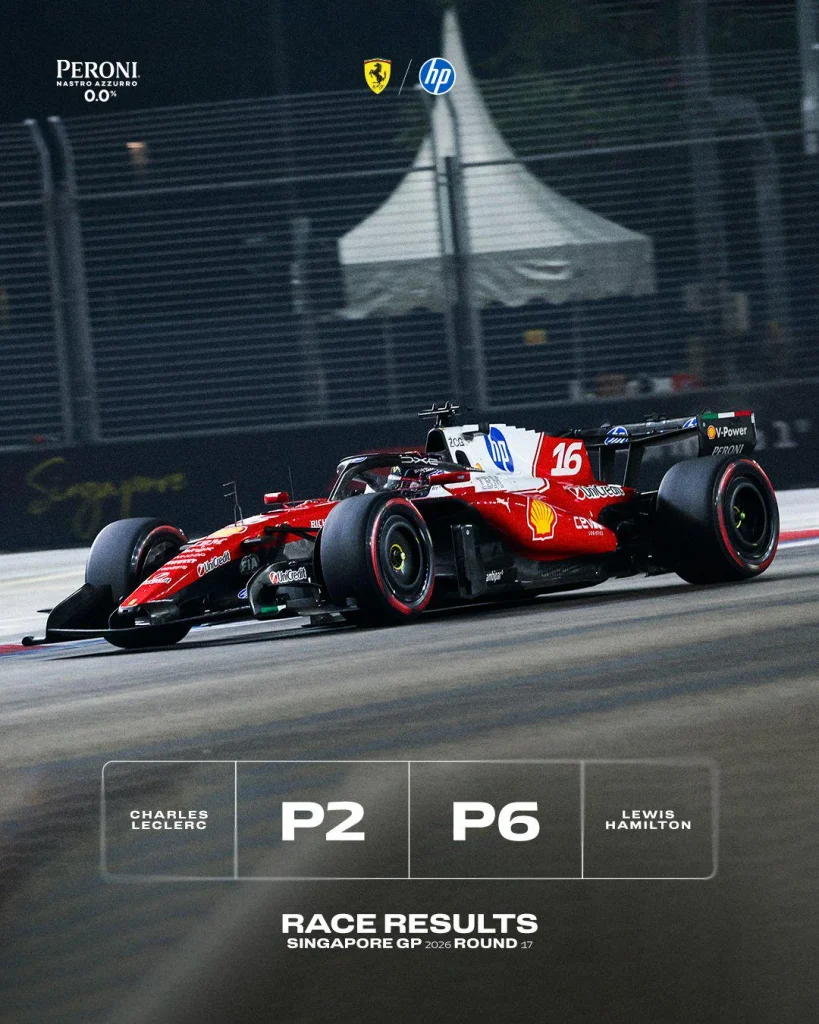
Ferrari finished second and sixth in Singapore, but the team believed it could have secured second and third.
The decisive moment came during a Virtual Safety Car period when Ferrari wanted both Leclerc and Hamilton to pit. Leclerc complied. Hamilton did not.
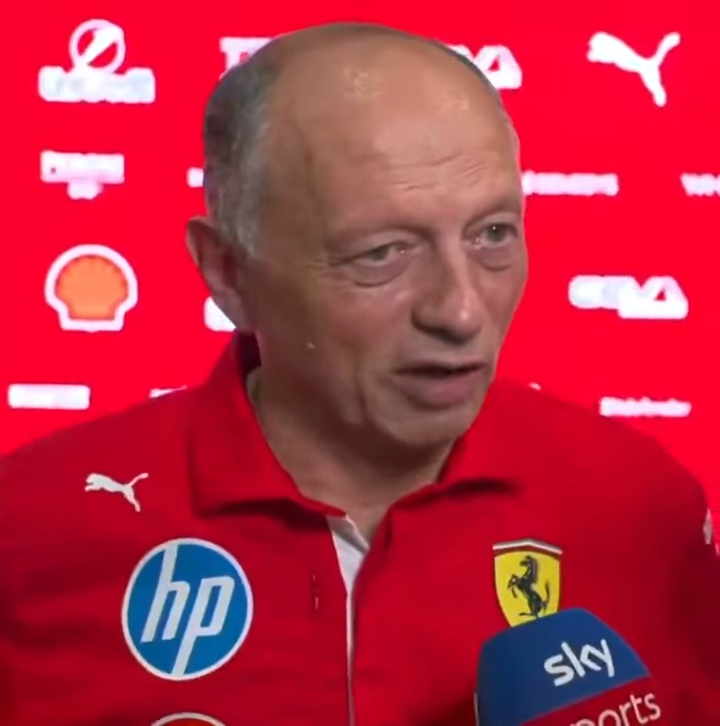
Initially, the decision appeared to be another questionable strategic call from Ferrari’s pit wall, particularly as Hamilton remained on track while his teammate took advantage of the opportunity to change tires. However, team principal Fred Vasseur subsequently clarified that Ferrari had instructed both drivers to stop.
“We called them both to pit,” Vasseur explained. “It would have been P2/P3 because we were P2/P3 on track. He missed the pit entry and honestly it’s a bit of a shame because he’s losing a podium.”
According to Vasseur, the instruction was clear. Hamilton subsequently accepted responsibility over the radio, apologizing to the team for his strategic decision and the points lost. That makes the central issue considerably clearer than it initially appeared.
Ferrari wanted Hamilton to stop. Hamilton remained on track. And the resulting strategy ultimately cost him track position.
The seven-time world champion had been running in contention for a podium but eventually finished sixth, behind both McLarens. It was a particularly frustrating outcome because Ferrari had enough pace for Leclerc to finish second, suggesting that a double podium was a realistic possibility rather than an overly optimistic projection. Hamilton’s decision appears to have been motivated by the possibility of gaining track position and potentially improving on third place.
But by staying out, he exposed himself to a significant tire disadvantage against competitors who had stopped for fresher rubber. The gamble did not pay off.
Instead of securing third, Hamilton fell behind Antonelli, Norris, and Piastri.
Why Ferrari’s Strategy Reputation Made the Confusion Worse
The immediate reaction to Hamilton’s race was revealing.
Before Vasseur’s explanation became widely circulated, much of the criticism was directed at Ferrari. That reaction was hardly surprising given the team’s history of controversial strategic decisions. Ferrari has repeatedly faced criticism for indecisive calls, confusing radio communications, and situations in which drivers appear to be making strategic decisions without clear guidance from the pit wall.
The familiar jokes about multiple alternative strategies returned almost immediately. But Singapore demonstrated the danger of allowing a team’s reputation to substitute for an understanding of what actually happened. Hamilton’s post-race apology and Vasseur’s account both point toward the driver bearing responsibility for the missed stop.
That does not mean every Ferrari decision throughout the afternoon was beyond criticism. Hamilton struggled for pace during his opening stint on medium tires and was brought in relatively early. That compromised his flexibility later in the race and placed him on a different strategic trajectory from Leclerc. There were also questions about whether Ferrari should have exchanged the positions of its drivers when Hamilton was attempting to make use of his tire advantage.
However, that argument overlooks an important consideration: Leclerc was generally managing his tires more effectively and demonstrating stronger race pace. Allowing Hamilton through would not necessarily have improved Ferrari’s overall result, particularly if the drivers subsequently needed to exchange positions again. There was also uncertainty during the race over whether Leclerc was firmly committed to a one-stop strategy or whether Ferrari was still considering a second stop.
The medium tire appeared particularly difficult for Ferrari to manage, making the team’s strategy more complicated than the television coverage initially suggested. Ultimately, though, the VSC presented an opportunity to simplify matters. Ferrari could have secured both drivers on fresh tires while retaining second and third positions.
Hamilton’s decision not to stop removed that opportunity. The broader issue for Ferrari may therefore be one of confidence rather than a single bad strategic call. When a team repeatedly makes questionable decisions, its drivers can become more inclined to challenge or second-guess instructions.
That can be beneficial when a driver possesses information the pit wall does not. But it can also lead to mistakes when the team has a clearer view of the overall strategic picture.
Singapore demonstrated how costly that uncertainty can become.
The Missing Radio Message Creates Another Controversy
Vasseur’s explanation also raised a separate question.
If Ferrari clearly instructed Hamilton to pit, why did viewers not hear the message? Several fans reviewing the available onboard footage reported that they could not identify a clear instruction telling Hamilton to stop during the VSC. Others pointed out that Ferrari appeared prepared for a double pit stop, with tires available for both cars.
The apparent discrepancy fueled speculation about whether certain radio communications had been omitted from the broadcast or onboard feeds. However, the absence of a message from a publicly available feed does not necessarily prove that the communication never occurred. Formula 1 broadcasts select which radio exchanges to feature, and viewers do not receive every conversation between drivers and their teams.
Questions remain about the completeness of particular onboard recordings, but there is insufficient evidence from the supplied accounts to establish exactly why Hamilton’s instruction was not heard. The important distinction is between what viewers were shown and what the participants subsequently said happened. Both Vasseur’s explanation and Hamilton’s acknowledgment of responsibility support the conclusion that the missed stop was a driver error.
The incident also highlights how quickly incomplete information can shape a race narrative. During the race, Ferrari was widely criticized for a decision it says it did not make. Afterward, that interpretation proved difficult to dislodge, even when the team’s explanation became available.
For a team already operating under intense scrutiny, the episode was another reminder that reputation can sometimes matter almost as much as performance in shaping public reaction.
Leclerc Extracts the Maximum as Ferrari Misses an Opportunity
While Hamilton endured a frustrating afternoon, Leclerc delivered one of Ferrari’s strongest performances of the weekend.
Second place was an excellent result on a circuit where overtaking is notoriously difficult and track position is particularly valuable. Leclerc managed his tires effectively and took advantage of the VSC to secure fresh rubber for the closing stages. He also claimed the fastest lap of the race with a 1:35.202.
Although Verstappen remained beyond reach, Leclerc ensured Ferrari left Singapore with a substantial points haul. His performance also reinforced the contrast between the two Ferrari drivers’ afternoons. Hamilton struggled to maintain competitive pace on the mediums, while Leclerc appeared better able to preserve his tires and execute the strategy required to remain near the front.
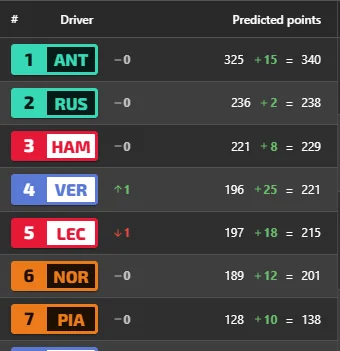
There is an argument that second place represented the maximum realistic result for Ferrari given Verstappen’s pace. But the team will still be disappointed that it could not convert its competitive performance into a double podium. The result leaves Hamilton third in the Drivers’ Championship on 229 points, with Leclerc fifth on 215.
And with Verstappen closing rapidly on both, Ferrari’s missed opportunities are becoming increasingly expensive.
Antonelli Moves Within Reach of the World Championship
While Verstappen celebrated victory and Ferrari debated its strategy, Antonelli quietly strengthened his grip on the 2026 World Drivers’ Championship.
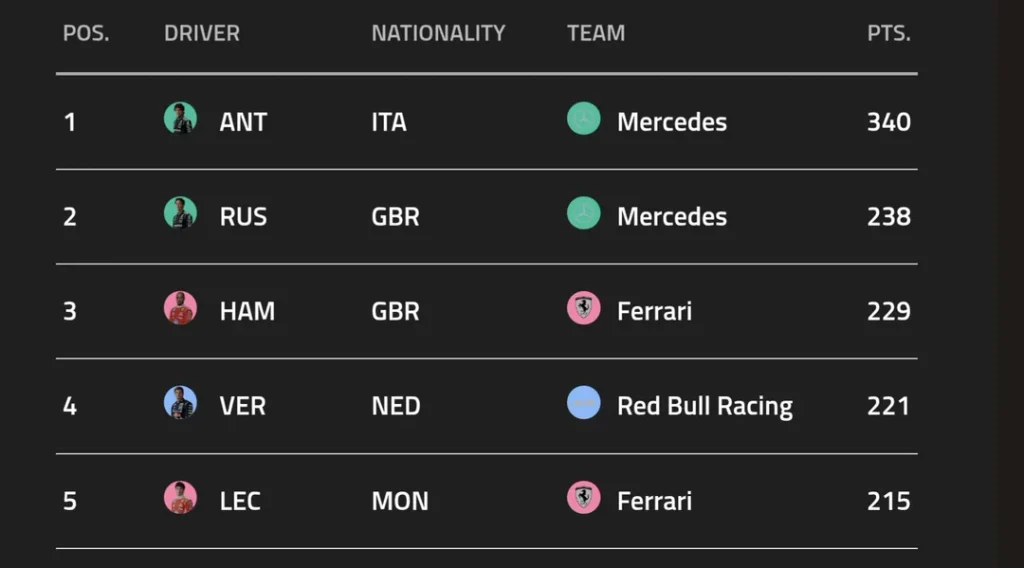
The Mercedes driver finished third in Singapore, bringing his total to 340 points. His closest challenger, teammate Russell, finished ninth and now has 238 points. That gives Antonelli a commanding 102-point advantage.
With six races provisionally remaining and 150 Grand Prix points available, the championship is approaching its mathematical conclusion. Antonelli could secure the title at the United States Grand Prix in Austin. Assuming the remaining calendar proceeds as planned and there are no additional points available beyond the six Grands Prix, Antonelli needs to extend his advantage over Russell by at least 23 points to reach a 125-point lead with five races remaining.
A victory for Antonelli combined with Russell finishing ninth or lower would accomplish that. A win for Antonelli would therefore give him an opportunity to become world champion before the season’s final stretch. The situation has been complicated by speculation surrounding the Qatar and Abu Dhabi Grands Prix.
Concerns about whether the two Middle Eastern races will proceed have prompted discussion about the possibility of cancellations or replacement events. No cancellation should be treated as confirmed on the basis of that speculation. However, the championship implications are substantial.
If both races were canceled without replacements, only four Grands Prix would remain, offering a maximum of 100 points. Antonelli’s current 102-point advantage would therefore be mathematically unassailable. If one race were canceled without replacement, the calculation would change, potentially allowing Antonelli to clinch the championship under less demanding circumstances. But until the calendar situation is officially resolved, Austin remains the next realistic opportunity for Antonelli to secure the title on track.
It would be a remarkable achievement for a driver who has emerged as Mercedes’ leading championship contender in 2026.
Russell’s Difficult Race Opens the Door for Verstappen
While Antonelli’s championship advantage continues to grow, Russell’s season has become increasingly difficult.
The Mercedes driver finished ninth in Singapore, collecting just two points. It was a particularly disappointing result considering the competitiveness Mercedes has demonstrated throughout the year. Russell also struggled to make progress through the field, including an extended battle with Hülkenberg’s Audi.
The result has left him vulnerable in the championship standings. Verstappen is now only 17 points behind Russell. Hamilton is nine points behind Russell, while Leclerc trails by 23.
The battle for second has become one of the most intriguing storylines of the final portion of the season. Russell still holds the advantage, but Verstappen has the momentum. And with several races remaining, the Red Bull driver’s recent form makes second place a realistic target.
Potential engine-related grid penalties could further complicate Russell’s position, although the precise timing and extent of those penalties remain uncertain. Mercedes is also expected to benefit from further power unit development, while Ferrari has been linked with significant upgrades for Austin. Whether those developments alter the competitive order remains to be seen. The recent history of the season has demonstrated that upgrades do not automatically translate into improved results.
But even without further technical gains, Verstappen’s current pace has made the fight for second considerably more competitive than it appeared only a few weeks ago.
Verstappen Could Still Finish Second After Red Bull’s Difficult Start
The possibility of Verstappen finishing second in the championship would have seemed improbable earlier in the season.
Red Bull’s opening races were marked by inconsistent performance, reliability concerns, and difficulties extracting competitive pace from its package. At one stage, the team appeared closer to the midfield than to Mercedes. Now Verstappen has closed to within striking distance of Russell.
The turnaround has generated considerable debate over how much of the improvement comes from Red Bull’s development program and how much can be attributed to Verstappen’s driving. The most reasonable interpretation is that both have contributed. Verstappen has repeatedly demonstrated an ability to maximize difficult machinery, but even an exceptional driver cannot consistently win races without a car capable of competing near the front.
Red Bull’s recent results indicate that the underlying package has improved substantially. The team’s technical organization also deserves credit for delivering those gains despite the departure of several senior personnel. There has been considerable discussion about Red Bull Powertrains and the origins of its engineering expertise, particularly the recruitment of personnel from rival manufacturers.
But attributing the current power unit’s performance to any single group of former Honda, Mercedes, Ferrari, or Renault engineers would oversimplify a complex development effort. What matters competitively is that Red Bull has produced a package capable of winning again. There is still a legitimate question about whether it will perform equally well at Austin, Mexico City, São Paulo, and Las Vegas.
Different circuit characteristics could favor different teams, and Mercedes and Ferrari may still have opportunities to fight back. Nevertheless, Verstappen has placed himself in a position where second in the championship is no longer an unrealistic ambition.
It may now be the most compelling individual battle remaining in 2026.
Racing Bulls Reaches 100 Points as Lawson Continues to Impress
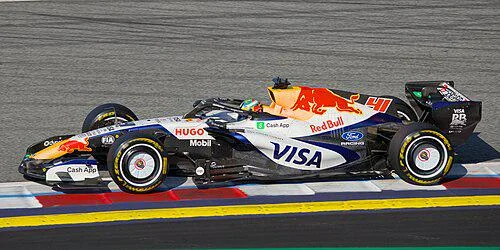
Beyond the front-running teams, Singapore also delivered an important milestone for Racing Bulls.
The Faenza-based team reached 100 points in the Constructors’ Championship, continuing a strong season that has raised hopes of a fifth-place finish. That possibility carries historical significance. Former team principal Franz Tost long maintained the ambition of establishing Toro Rosso, and later AlphaTauri, as a consistent contender for fifth in the Constructors’ standings.
With Racing Bulls now pushing toward that target, the team could finally achieve an objective associated with its former leader. Lawson’s seventh-place finish in Singapore was another major contribution. The New Zealander has developed into one of the season’s most impressive midfield performers, regularly challenging to finish immediately behind the leading teams.
His performances have been especially notable given the criticism he faced earlier in his Formula 1 career. Lawson’s confidence and aggressive approach initially divided opinion, but his recent results have strengthened his reputation considerably. He has demonstrated strong racecraft, particularly in wheel-to-wheel situations, and has become increasingly effective at converting opportunities into points.
His development has even prompted comparisons with Pierre Gasly, who has long been regarded as one of Formula 1’s strongest midfield competitors. Gasly remains an accomplished qualifier, but Lawson’s recent performances have highlighted his ability to defend positions and maintain competitive race pace. Racing Bulls’ progress is also a reminder of the strength of the Faenza operation.
The team has periodically delivered impressive results despite operating outside Formula 1’s traditional front-running organizations. Its current season is another example of its ability to develop competitive machinery and nurture emerging talent. Hadjar also contributed to the team’s Singapore result by finishing tenth, despite a difficult weekend. With both drivers scoring points, Racing Bulls continued strengthening its position in the Constructors’ Championship.
The contrast with Williams, which finished fifth last season but is reportedly down in ninth, further illustrates how dramatically the midfield order has shifted under the 2026 regulations.
Singapore Raises More Questions About Pirelli’s Tire Compounds
Another subject of debate was the durability of Pirelli’s soft tires.
Singapore is traditionally associated with high physical demands and significant strategic considerations, yet the ability of soft tires to survive unusually long stints raised questions about whether the compound was sufficiently aggressive. Some drivers were able to extend their tire life far beyond what might normally be expected from the softest available compound. That reduced the strategic pressure on teams and potentially limited opportunities for varied pit-stop strategies.
The contrast with Ferrari was particularly interesting. While some competitors managed lengthy stints, Hamilton struggled badly on mediums during the opening phase. Leclerc also had to manage his medium tires carefully before switching to softs.
The different performance characteristics across teams suggest that tire management remained a major competitive variable, even if overall degradation was lower than some fans expected. For a circuit where overtaking is already difficult, durable tires can make track position even more decisive. That places additional emphasis on qualifying performance and pit-stop timing, potentially reducing opportunities for drivers to recover through alternative strategies. It is an ongoing challenge for Formula 1 and Pirelli: producing tires that create meaningful strategic choices without introducing excessive or unpredictable degradation.
Singapore offered another example of how difficult that balance can be.
The Championship Standings After Singapore
The Singapore Grand Prix leaves Antonelli comfortably ahead, but the fight behind him is tightening dramatically.
| Position | Driver | Points |
|---|---|---|
| 1 | Kimi Antonelli | 340 |
| 2 | George Russell | 238 |
| 3 | Lewis Hamilton | 229 |
| 4 | Max Verstappen | 221 |
| 5 | Charles Leclerc | 215 |
| 6 | Lando Norris | 201 |
| 7 | Oscar Piastri | 138 |
| 8 | Isack Hadjar | 97 |
| 9 | Liam Lawson | 75 |
| 10 | Pierre Gasly | 41 |
Just 37 points separate Russell in second from Norris in sixth.
That creates the possibility of substantial changes in the standings over the remaining races. Verstappen is only eight points behind Hamilton and six ahead of Leclerc, making the battle between Red Bull and Ferrari particularly close. The championship would look remarkably different without Mercedes’ overwhelming advantage. Hamilton, Verstappen, and Leclerc are separated by only 14 points, illustrating just how competitive the fight among the other leading teams has become.
Mercedes may have largely settled the championship battle at the front, but the fight behind its leading driver is anything but settled.
A Landmark Win, a Missed Podium, and a Championship Nearing Its Conclusion
The Singapore Grand Prix may ultimately be remembered for several very different reasons.
For Verstappen, it was the weekend he finally added Marina Bay to his list of Formula 1 victories, doing so in his 250th Grand Prix and overcoming a communication failure that could easily have disrupted his race. For Red Bull, it was another confirmation that its development program has brought the team back into contention at the front. For Ferrari, Leclerc’s second place demonstrated the car’s potential, but Hamilton’s missed VSC stop turned a possible double podium into a frustrating sixth-place finish for the seven-time world champion.
The episode also exposed how quickly assumptions about Ferrari’s strategy can take hold, particularly when the available broadcast information does not tell the complete story. For Racing Bulls, reaching 100 points represented another significant step toward a historic Constructors’ Championship result, with Lawson continuing to establish himself as one of the season’s standout performers. And for Antonelli, Singapore moved the championship closer to its inevitable mathematical conclusion.
The Italian now carries a 102-point advantage into Austin, where he could potentially secure his first World Drivers’ Championship. But while the title battle may be approaching its end, the contest for second is gathering momentum. Verstappen has transformed his season from one defined by Red Bull’s struggles into one that could still finish with him as championship runner-up.
With Hamilton, Leclerc, Russell, and Norris all involved in that fight, the closing races could produce some of the most competitive action of the year. Singapore belonged to Verstappen.
The question now is just how much further Red Bull’s remarkable recovery can carry him before the 2026 season concludes.