

Lewis Hamilton has 267 points. George Russell and Lando Norris have 264 apiece. With two races left, three British drivers in three different cars are fighting for third in the drivers’ championship. Mercedes has a stake in two of them. Russell drives its works car. Norris drives a Mercedes-powered McLaren, and every point he takes off Russell benefits a team that has already beaten Mercedes to two consecutive constructors’ titles.
That makes the proposed limit on how many teams one engine manufacturer can supply more than an abstract debate. If Mercedes had room for only one customer, would it keep supplying the rival that has made the best use of its engine?
Three routes to third
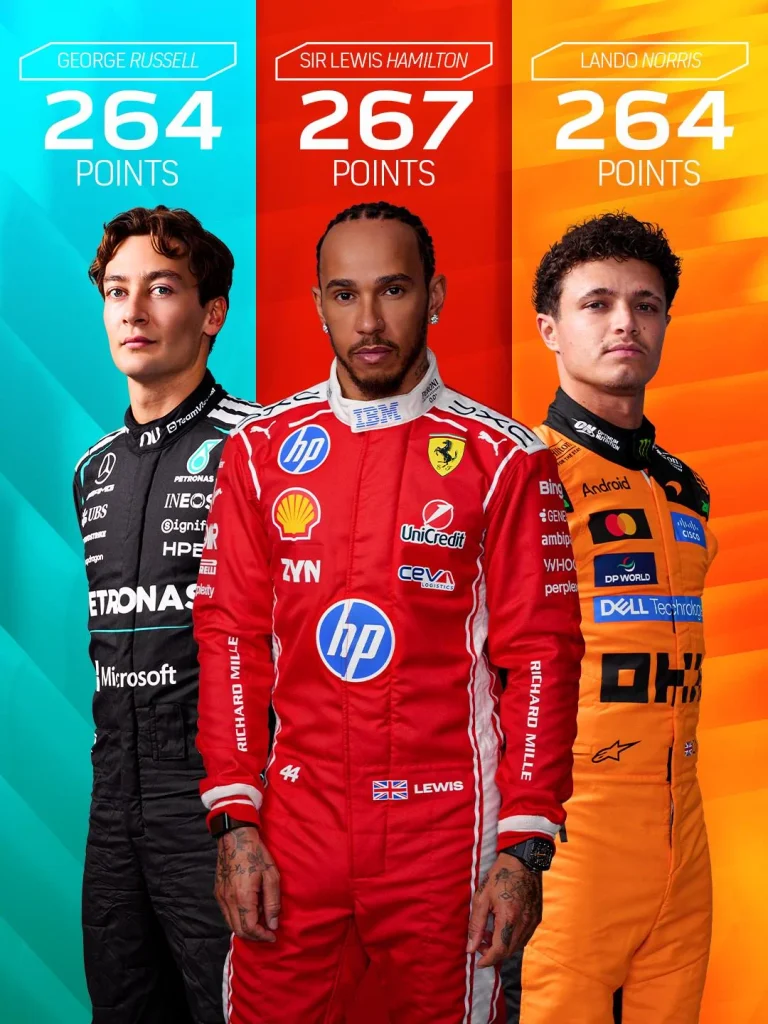
Hamilton has the lead and the freshest reminder of how quickly three points can disappear. In Las Vegas, Ferrari wanted him attacking Oscar Piastri. Contact with teammate Charles Leclerc sent Hamilton spinning. Leclerc still has his own interest in the standings, so asking him to support Hamilton comes at a cost. Ferrari could help both drivers simply by giving whichever one is attacking a rival the space to finish the move.
Russell has already seen what help from a teammate can look like. Kimi Antonelli yielded a place in Brazil once the win was out of reach. The circumstances matter. Antonelli has secured the championship and still wants to win races. Asking him to exchange positions once a victory is gone is a different request from asking him to give up a chance to win. Either way, Russell has to be close enough to receive the place.
For Norris, the decision with the biggest bearing on third could happen in the garage. Piastri took a new engine and a grid penalty in Vegas, then recovered from 17th to third. Norris finished second with an older unit. Their straight-line speeds drew conflicting readings, so it is hard to put a number on what the mileage cost Norris. McLaren’s choice is clearer. It can accept a known grid penalty for a fresh unit or keep the grid position and ask the older engine to finish the job. Piastri’s recovery made the first option look manageable in Vegas. It tells McLaren less about how readily Norris could recover those places in Qatar.
The customer Mercedes might least want to lose
Mercedes currently powers its own team, McLaren, Williams and Alpine. A limit of two teams in total would leave it with one customer. A limit of two customers in addition to the works team would let it keep two. The distinction changes how many teams would need new engines, and the proposal has yet to settle anyone’s future supply.
McLaren’s success cuts both ways. For the Mercedes engine operation, a McLaren championship demonstrates what its power unit can do. For the Mercedes race team, losing to a car with the same engine directs attention back to its chassis and how well it uses the package. Ending the relationship would hardly eliminate McLaren as a competitor. It could give another manufacturer a championship-winning customer.
McLaren also has something more specific to protect than a badge on its engine cover. Discussing the extension of its Mercedes deal through 2030, McLaren CEO Zak Brown said the team wanted “more influence and more awareness earlier on, because historically as a customer team you kind of get the power unit at the end and then you’ve got to design your car around it.” Knowing the engine’s layout early gives the chassis engineers time to plan around it. Another supplier could offer a competitive engine and still leave McLaren with a harder job fitting it into the car.
Williams offers Mercedes an established relationship. Alpine also needs a supplier after giving up its own engine program. With customer prices capped, there is a limit to what McLaren could accomplish simply by offering more money. The Race has reported that Mercedes and Ferrari themselves supported reducing their supply commitments because of the cost. Serving more teams also means producing more examples of each upgrade. What looks from the outside like political influence comes with a manufacturing bill.
A cap could spread that influence more evenly. Four Mercedes-powered entries have a common interest when a proposed change affects their engine. How any one of them votes is a separate question. The strongest objection to a strict limit is simpler. Five manufacturers supplying two teams each can cover ten entries on an eleven-team grid. A sixth supplier, such as GM if its program is ready, would provide room for all eleven. One delay or withdrawal would reopen the problem. Before anyone assigns McLaren to Audi or Williams to Honda, the final rule needs to answer a practical question. Who supplies the eleventh team if there are only ten slots?
How long does an overtake have to last?
Las Vegas made a strong case for the current 50/50 hybrid formula and exposed the hardest part of watching it. A driver could use the tow down the Strip, spend electrical energy to pull alongside and complete the pass under braking. The next straight might give the other driver a chance to take it all back. Whether that first pass was worthwhile depended on what each had left.
The tow itself never crosses a particular distance threshold and becomes dirty air. Both terms describe the wake behind the leading car. On a straight, the following car benefits from reduced drag. Carry the same gap into a fast corner and the disturbed airflow can cost the follower downforce just when it needs grip. If the driver slides to maintain the pace, the tires pay for it. Following can also make cooling harder. A useful gap at Monza, with long stretches to collect the straight-line gain, can be a poor bargain at a circuit where much of the lap is spent turning. Battery deployment adds a choice the driver can carry from one corner to the next. Australia, Monza and Vegas supplied examples of the sustained fighting that was often missing when a string of cars sat in a DRS train. The frustration comes when the faster car on one straight is almost certain to be the slower one on the next. An overtake count credits both exchanges equally. A spectator trying to work out who has actually improved their position has to watch another corner.
A return to naturally aspirated V8s has an obvious attraction in the sound alone. The hybrid has a sporting case beyond efficiency, too. Deciding where to spend limited energy can reward a driver who thinks several corners ahead. The most persuasive argument for keeping that element is a pass whose timing matters. Saving enough to keep the place against a counterattack makes the initial move worth remembering.
Why Bearman cares about the third year
Mark Hughes reports that Haas wants Oliver Bearman on a three-year deal covering 2027 through 2029. Bearman would prefer a shorter commitment while Ferrari’s longer-term lineup remains uncertain. Signing would give him security and take his stint at Haas to five seasons. The cost might only become apparent in year three, if a competitive seat opened and another team had to negotiate with Haas before it could hire him.
Haas has a good reason to ask for all three years. It would keep a driver it rates or have a say in the terms of an early release. Bearman has an equally good reason to care about the wording. Even a hypothetical clause allowing him to join Ferrari would do little for him if the best offer came from somewhere else. Russell’s third season at Williams illustrates how long a highly rated junior can wait. Mercedes buying Valtteri Bottas out of his Williams commitment illustrates the other possibility. Somebody has to want the driver enough to pay.
From Bearman’s end, a Ferrari vacancy is worth keeping open as a possibility. From Hamilton’s cockpit, there is little reason to treat one as inevitable. He leads the fight for third. Fernando Alonso, answering calls for both veterans to make way, put his own retirement test plainly. “I’ll retire when I feel slow, not when my passport says I’m a certain age.”
Alonso has seven points in this Aston Martin. Three years ago he finished fourth in the championship for the same team. The revealing part of that season came after Aston’s early advantage faded. Alonso could still fight Sergio Pérez to the line for a podium in Brazil. A veteran can have a reasonable claim to another season at the same time a younger driver has a reasonable claim to a better car. Bearman’s contract matters because F1 can take years to find room for both.
Max Verstappen has a seat in mind for Antonelli that would allow both drivers to keep their F1 jobs. He named the Mercedes driver as his pick for the Nürburgring 24 Hours. Antonelli has tested GT3 machinery, and his father runs a GT3 team. Verstappen Racing already uses Mercedes-AMG GT3s, with Winward Racing running its Nürburgring program and 2 Seas Motorsport operating its GT World Challenge Europe effort. That gives the pairing an appeal beyond putting two F1 champions in the same car. For now, Verstappen has named the driver he would choose. Finding the time in an F1 season and securing permission to race together would come next.
The £627,000 Williams thought was outside the cap
Williams reached an Accepted Breach Agreement with the FIA over its 2025 cost-cap submission. The team said it exceeded the cap by £627,000 after treating administrative costs associated with a change in its corporate structure as exempt. It accepted the FIA’s interpretation that the costs belonged inside the cap. The agreement covers a minor overspend and a procedural breach. Williams faces a financial penalty and a 1.5% reduction in wind tunnel and CFD testing for 12 months.
According to Williams, the FIA acknowledged that the team acted in good faith and gained no sporting or financial advantage. That matters when evaluating James Vowles. Williams set expectations for its 2026 car that its results have struggled to meet. That is a fair basis on which to judge the rebuild. The breach concerns how Williams accounted for a restructuring expense the previous year. Treating the £627,000 as extra money spent making this year’s car faster would misstate the finding.
The consequence does reach forward. A team trying to modernize its infrastructure and improve its car now has less aerodynamic testing available. The reduction is small, but a wind tunnel run forgone is something the engineers will feel more directly than an argument over which column an administrative bill belonged in.
The other Vegas leaderboard

Above the garages and starting line, six people from Island Creek Oysters had a competition of their own. A caterer had asked the Duxbury, Massachusetts, farm to bring 20,000 oysters to the Paddock Club. Over three days, the crew shucked 19,000 of them, working from 11 a.m. to 1 a.m. The oysters were included for guests. One crew member started keeping score, two guests traded the lead, and the winner finished on 56.
The six people doing the shucking ate about ten oysters between them, by the crew member’s estimate. The next day, on the way to the airport, they kept dropping things because their hands could barely grip. The part worth coming back for happened after the guests left. With the track empty below them, the service crews traded oysters for drinks and pizza. Island Creek hopes to work Austin and Vegas next year. If they return, somebody already has a number to beat.