

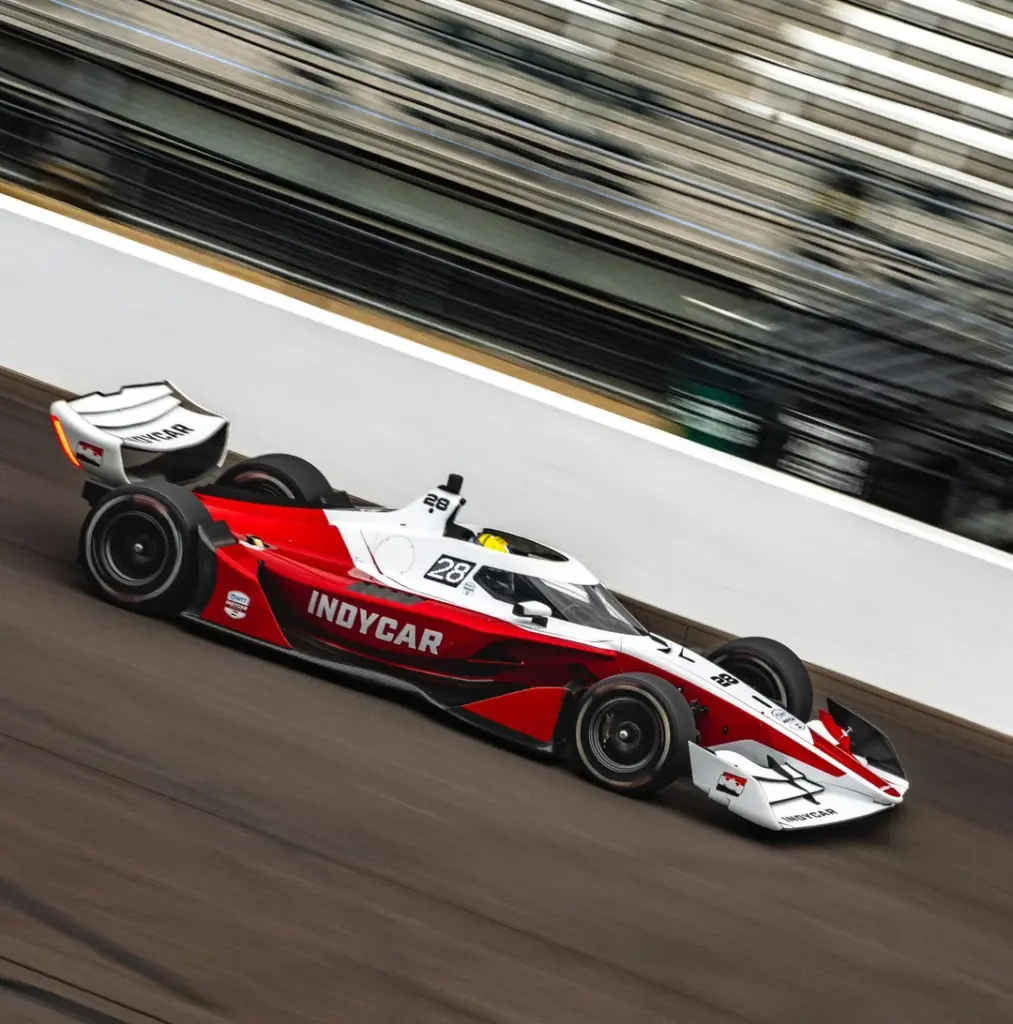
The IR-28’s first on-track appearance at Indianapolis Motor Speedway was always going to be judged by its looks. After months of renders and static display photos, fans finally got to see the next-generation IndyCar in its natural habitat.
What many expected to be a discussion about styling quickly became something much bigger.
The car’s appearance may have exceeded expectations, but the biggest takeaway wasn’t visual at all. It was audible.
The Sound of Summer
One of the first reactions from fans living near Indianapolis Motor Speedway had almost nothing to do with lap times or aerodynamics.
Instead, it was simple: they could actually hear the car. One longtime resident who lives roughly two and a half miles from the Speedway noted that IndyCars during the DW12 era had become surprisingly difficult to hear from home. Road course sessions were barely noticeable, while oval running was only slightly more audible. During the IR-28 shakedown, however, the car was clearly distinguishable despite running a temporary test engine. That observation immediately unlocked something many fans hadn’t realized they missed.
For generations around Speedway, Indiana, the sound of race cars wasn’t just background noise—it was part of daily life. Fans recalled playing high school baseball games during the Month of May while hearing IndyCars circulating in the distance throughout the afternoon. Others remembered classrooms with open windows where the soundtrack of practice sessions signaled the approaching end of the school year. Even routine afternoons grilling in the backyard or talking on the phone could suddenly be interrupted by the unmistakable roar of cars around the Speedway. Some memories were even more vivid.
Several longtime locals described how major crashes could be identified by sound alone. One remembered hearing Sébastien Bourdais’ qualifying crash in 2017 from miles away, describing it as a distant explosion. Another recalled friends pausing phone conversations because they heard an impact before television broadcasts showed the incident. Others remembered the older eras when a significant crash sounded like a bomb had gone off. Whether those memories were happy or sobering, they all pointed to the same conclusion: the Speedway wasn’t just something you visited. It was something you lived alongside. That connection had faded somewhat during the DW12 era.
For many fans, hearing the IR-28 carry farther across the surrounding neighborhoods felt like a small but meaningful step toward bringing back one of Indianapolis’ defining traditions.
Finding the Right Balance
Interestingly, not everyone wants IndyCar to simply chase maximum volume.
Many fans acknowledged that modern cars being slightly quieter has practical benefits. Ear protection isn’t nearly as necessary at the track, making races more comfortable for families and casual spectators. Instead, what people seem to want is balance. The consensus emerging from the discussion wasn’t that IndyCar needs to recreate the deafening noise of decades past. Rather, fans hope the series can recover enough sound and higher-frequency character to restore the atmosphere without sacrificing the improvements that have come with modern race cars.
Some discussion also centered on the engine itself. Several fans pointed out that the car currently testing isn’t using the incoming production power unit. Instead, it’s running a temporary test mule engine, meaning nobody should draw firm conclusions about exactly how the final package will sound. Even so, if the testing configuration is already producing a more noticeable presence around the Speedway, there’s optimism that the finished product could continue in that direction. The conversation naturally expanded to modern motorsport as a whole.
As racing becomes increasingly electrified, many fans worry that sound is one of the sport’s most irreplaceable sensory experiences. Speed can be measured. Lap times can be analyzed. But the feeling of hearing a race car long before you ever see it is much harder to replicate.
The Renders Didn’t Do It Justice
The other surprise from the test was just how different the IR-28 looked once it was actually moving.
Initial renders had left many fans uncertain about the styling. Static studio images failed to generate overwhelming excitement, with some questioning whether the design represented enough of a visual evolution. Trackside photographs quickly changed that perception. The side profile, in particular, received widespread praise. Fans highlighted how aggressive the proportions looked in motion and appreciated details like the visibility of the rear wing lighting from the side of the car.
Several admitted they had been skeptical after seeing the original promotional material but completely changed their minds after seeing real-world images from Indianapolis. More than one fan summed up the collective feeling by saying the car simply looked like it belonged at IMS.
Sometimes a race car needs asphalt instead of a showroom floor to make sense.
More Than Just a Pretty Car
Interestingly, the excitement surrounding the IR-28 also prompted broader conversations about IndyCar itself.
Some fans argued that, despite Alex Palou’s dominance this season, IndyCar continues to deliver compelling racing because outcomes rarely feel predetermined. While the championship leader is expected to perform well, there remains genuine uncertainty about how victories unfold and who will challenge for them. Others contrasted that unpredictability with Formula 1, suggesting IndyCar still feels like a competition driven primarily by drivers and machines rather than outside narratives. Whether or not every fan would agree with that comparison, it reflects growing confidence in the product IndyCar is putting on track.
The IR-28 is arriving at a moment when many supporters already believe the racing speaks for itself.