

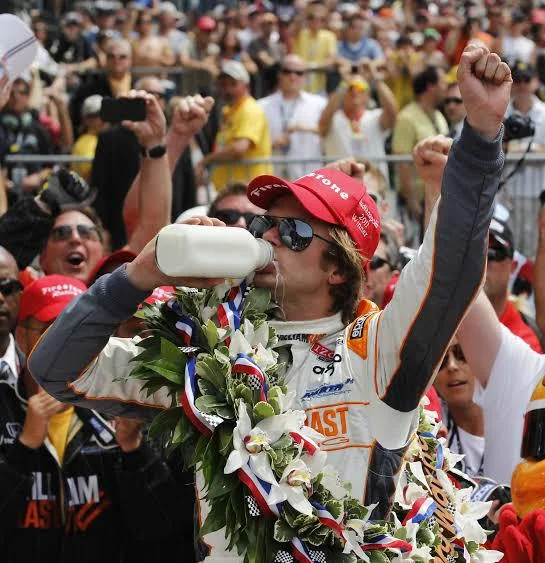
Fifteen years after Dan Wheldon’s death at Las Vegas, the loss remains difficult to separate from the images, sounds, and uncertainty of that afternoon. The tightly packed field. Cars launching into the air. Fire and debris. Then the wait for news that turned a race day into something the sport would never forget.
Anniversaries bring those memories back, but remembering Wheldon should mean more than revisiting the accident. It also means considering what racing asks of its drivers, which risks it can reduce, and why safety must remain central to every decision about the show.
Elsewhere, Alex Palou’s appearance in an Indy NXT test offered a very different subject: an established champion helping a development program while giving the next generation a demanding benchmark.
Wheldon’s Loss Still Carries a Responsibility
One of the most unsettling elements of the Las Vegas race was how little separation there appeared to be between close competition and a situation drivers could no longer escape.
With 34 cars on a high-banked oval, the field’s density left little room for a developing incident to remain contained. Once the crash began, its consequences extended far beyond the initial contact. Will Power and Pippa Mann were also caught in frightening airborne accidents. Their survival belongs in any assessment of that day because the danger was never confined to one cockpit. Wheldon’s death was the tragedy that defined the event, but the scale of the accident showed how many drivers had been exposed to potentially devastating consequences. That distinction matters when considering the lessons of Las Vegas. The question cannot stop at what happened to one car. It must include the conditions that allowed so many cars to become involved.
There is also a human cost beyond the drivers themselves. For people watching from the grandstands or at home, the afternoon became a lasting memory of fear and helplessness. For children watching with their parents, it could become an abrupt introduction to the reality that a driver might not come home. Those experiences deserve sensitivity. There is no need to repeatedly show the most distressing footage or revisit graphic accounts to explain the magnitude of the loss. Marty Reid’s farewell captured that finality:
“Goodbye, Dan Wheldon.”
Fifteen years later, those words still carry the weight of an afternoon when the race itself ceased to matter.
Close Oval Racing Must Leave Drivers Room to Race
Remembering Las Vegas does not require rejecting high-speed oval racing. It does require distinguishing between competitive racing and a tightly compressed pack with too few ways out.
Drafting, passing, tire management, and side-by-side competition can produce compelling oval races. The Texas races raised in the supplied material offer a useful reference for that argument: excitement can come from drivers working with changing grip and choosing their moments, rather than remaining locked together. A car that can stay planted on the bottom with little incentive to move does not automatically create more racing options. Close proximity is only one part of competition. Drivers also need opportunities to change lines, manage their equipment, and respond when something goes wrong ahead. Las Vegas should therefore remain part of the discussion about the entire racing package: the car, the circuit, the field size, and the behavior those elements produce together.
The same care applies to retrospective claims about safety equipment. It is understandable to ask whether a modern aeroscreen could have changed Wheldon’s accident. The material supplied does not establish that answer, and competing assertions about impact angles and structural strength cannot settle it. We can support continued cockpit protection without claiming certainty about an accident that occurred under different circumstances. Safety improvements deserve evaluation on their evidence, not on promises that any one device can eliminate every possible outcome. The Indianapolis victory earlier that year adds another painful dimension to Wheldon’s final season. JR Hildebrand’s late crash created the opportunity for Wheldon to win, giving the year a moment of extraordinary triumph before its devastating conclusion.
That sequence is heartbreaking enough without treating one race as having made the other inevitable or assigning retrospective blame to drivers involved at Indianapolis. Wheldon’s victory should remain a sporting achievement in its own right.
Palou Gives Indy NXT a Demanding Benchmark
At the other end of this roundup, Palou finished the test for the 2027 Indy NXT season at the top of the timing charts.
According to the results shared by Austin Lawton, Tymek Kucharczyk finished second, followed by Max Taylor, Max Garcia, and Jack Beeton. Alessandro de Tullio was sixth. The supplied timing comparisons put Palou approximately three tenths ahead of Kucharczyk and almost half a second ahead of de Tullio. There is an easy joke about a promising rookie showing enough potential to earn an IndyCar opportunity. The useful story, however, is what Chip Ganassi Racing can learn from putting its established champion in the car.
The supplied explanation for Palou’s participation was that Ganassi’s Indy NXT operation had been behind its competition and brought him in to assist. In that context, topping the test is only one part of his contribution. A fast lap establishes what was achievable in his hands. Feedback can help the team understand how to get closer to it. That does not mean Palou has produced one setup that every Ganassi development driver should copy. Different drivers can need different responses from a car, and a configuration that supports one driver’s confidence may not suit another. The greater opportunity is to use his observations and data to improve the team’s understanding. A clearer baseline can give engineers a stronger starting point while leaving room to adapt the car to each driver.
For prospective recruits, access to that information also gives Ganassi something tangible to offer: an opportunity to study how a five-time champion approaches the same machinery.
Kucharczyk Leads the Chasing Group
Palou’s presence should not obscure the performances behind him.
Kucharczyk finished closest to the benchmark, with Taylor, Garcia, and Beeton completing the top five. Those positions are meaningful results from the session, even if they cannot establish the competitive order for an entire season. The gap to Palou also needs context that the supplied results do not fully provide. A finishing order and approximate time differences do not reveal every driver’s run plan, experience in the car, or setup work. It would be premature to turn the session into either a verdict against the younger drivers or a prediction of who will dominate next year. For Ganassi, the practical value is that the test produced both a target and information to examine. Palou showed the pace available to him; the development program’s task is to turn that reference into progress for its own drivers.
The next generation needs opportunities to learn, equipment it can understand, and teams capable of helping it improve. Wheldon’s anniversary is a reminder that it also deserves a sport willing to keep examining the conditions in which it competes.