

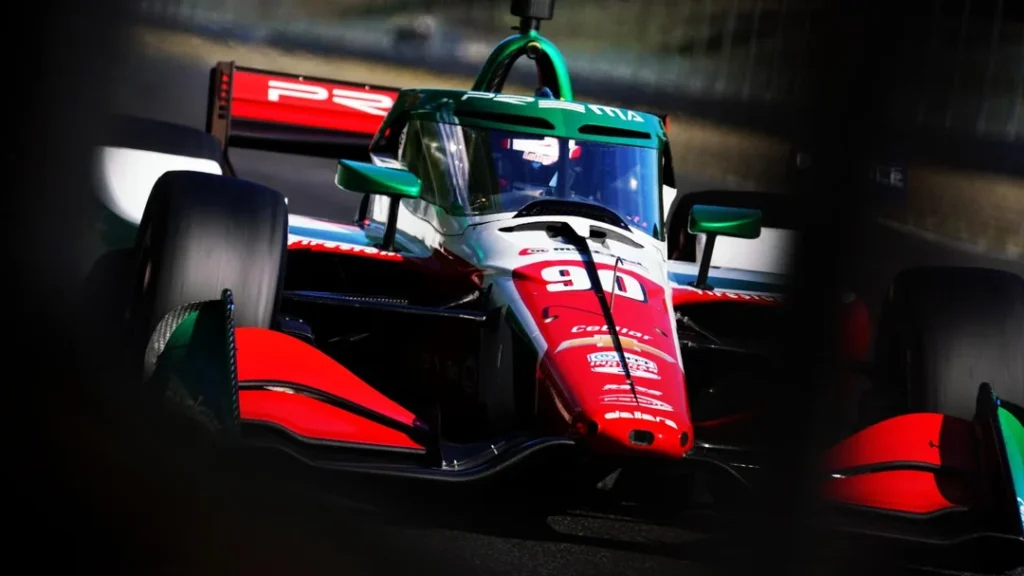
PREMA has been confirmed to miss the opening round of the IndyCar season, a development that feels less like a temporary setback and more like the closing chapter of one of the shortest-lived experiments in recent IndyCar history.
What makes this situation especially jarring is how dramatically the trajectory shifted. Not long ago, PREMA delivered one of the coolest moments in recent memory by taking pole for the Indianapolis 500. To go from that high-water mark to effectively absent within a year is, by any standard, an extraordinary collapse.
There were early comparisons floating around to Brawn GP, but that analogy doesn’t really hold up under scrutiny. Brawn was not a true “new team,” but rather the continuation of Honda’s F1 operation, sold for $1 to Ross Brawn and effectively rebadged before eventually becoming Mercedes. That lineage traces continuously through Tyrrell, BAR, Honda, Brawn, and Mercedes, the so-called “Team Brackley.” PREMA’s situation is fundamentally different. They were not inheriting a fully intact top-level operation. They were an existing European motorsport organization stepping into American open-wheel racing, and they never truly established themselves as race winners in IndyCar.
If anything, the more accurate comparison is that they became another Carlin: present, professional, but not competitive enough to justify long-term survival.
The more troubling signals, however, go beyond on-track performance.
On Alexander Rossi’s podcast, it was hinted, without explicit detail, that PREMA had informed employees they were free to seek opportunities elsewhere shortly after the season ended. That is rarely a sign of temporary turbulence. Reports suggest much of the staff had already returned to Europe by year’s end, leaving the team without the personnel base required to even meaningfully test. No staff, minimal funding, and no testing schedule make it difficult to see how a race weekend appearance would have been feasible.
The driver implications are significant.
Callum Ilott appears to have at least secured a fallback option in IMSA should IndyCar commitments collapse entirely. Robert Shwartzman’s situation is more complex. He left what was described as an almost guaranteed long-term future within Ferrari’s Hypercar program for a single season with a struggling IndyCar operation. The irony is especially sharp given that the very car he once drove in WEC went on to win the 24 Hours last season.
There is optimism that his Indy 500 pole performance alone should reopen doors in Hypercar, even if not with Ferrari. He was reportedly the fastest in a DS Penske Formula E test as well. However, as of now, he is not a reserve or development driver with any F1 program. Mercedes has Vesti as reserve for 2026, and Pourchaire has recently signed as a development driver, Shwartzman is currently unaffiliated at the Formula 1 level.
Behind the IndyCar collapse lies a broader financial narrative.
PREMA is owned by the same parent company as Iron Lynx. Iron Lynx heavily invested in Lamborghini’s Hypercar program, only to have that effort abruptly pulled, creating major financial strain. PREMA also provided engineering and technical support for that program and is reportedly suing Lamborghini over proprietary technology disputes, though that litigation is separate from IndyCar operations.
Compounding matters, PREMA’s traditional revenue stream, wealthy drivers paying for seats in junior categories, has reportedly declined sharply. Their primary backer, Deborah Mayer, is also said to be facing financial difficulties. When combined, the picture is less about IndyCar underperformance and more about systemic financial stress across the broader organization.
And then there is the charter system.
IndyCar’s grid is capped at 27 cars. By 2028, factory charters and three-car expansions among existing teams could effectively lock in the field. Mid-Ohio is already described as either at capacity or extremely tight with 27 entries, and while NASCAR once fit 38-40 cars there, the pit box dimensions and operational requirements are fundamentally different. IndyCars require precise alignment for fueling; stock cars have tighter pit boxes and greater turning radius flexibility. Apples to oranges.
The cap itself appears less about physical space and more about protecting charter value. If open entries could simply show up at any event, charters would lose leverage. Leader’s Circle access remains the primary financial benefit, and one-off teams wouldn’t meaningfully contend for it anyway.
With Toronto confirmed under a multi-year deal in Markham, not a one-off, the schedule isn’t creating unexpected new grid openings either.
Speculation about a third OEM continues, but even there the outlook is murky. Honda and Chevrolet are each receiving one additional charter allocation. A new manufacturer would likely receive one, not two. More realistically, any new OEM would attempt to badge an existing engine rather than develop an entirely new 2.4L twin-turbo V6 from scratch, especially given Honda and Chevy’s development head start. A true third manufacturer may not arrive until the next engine cycle, if at all.
Without a charter, PREMA’s assets lose much of their strategic value. There is little incentive for a buyer to acquire full infrastructure, buildings and office operations hold less appeal than selective equipment acquisition. The more likely outcome is that other teams gradually absorb pieces rather than purchase the entity outright.
At this point, it is difficult to avoid the conclusion that PREMA’s IndyCar chapter is effectively over.
The pole at Indianapolis will remain an undeniably cool moment. But the broader trajectory, staff departures, financial strain, charter limitations, and minimal competitive upside, suggests this is not a pause. It is an exit.
And in a charter-capped, manufacturer-constrained grid, there may not be a way back in.