


Formula 1 has never lacked for debate, but the latest conversations circulating around the sport highlight a deeper tension running through the modern era: what exactly Formula 1 is supposed to be. Across comments from rival series figures, discussions around energy regulations, aerodynamic experimentation, and driver feedback culture, the sport once again finds itself confronting the question of whether it is evolving in the right direction.
At the center of that conversation this week was Formula E co-founder Alberto Longo, who openly argued that Formula 1 risks losing its identity by borrowing too heavily from electric racing concepts.
“Yes, we can use eight minutes or six minutes of Attack Mode and the car doesn’t slow down,” Longo said. “I think they need to be back to where they are. They are noise, they are full power, they are breaking the latest technologies, this is what Formula 1 is about.”
Longo emphasized that Formula E was designed from the outset as a fundamentally different type of championship rather than a replacement for Formula 1.
“We are a completely different proposition. We have been presented like that since day one. It’s not one or the other; it’s both of them. But the problem is that they try to become more Formula E.”
“In my opinion, as a fan, I think they are making a mistake. I definitely believe that they should stick to what they are, to their principles.”
The irony of invoking “principles” in Formula 1 was not lost on observers. The sport’s long history of commercial maneuvering and regulatory compromises has often led to the suggestion that its guiding principle is less about philosophy and more about financial incentives. The modern era, critics argue, is filled with examples of competing interests shaping the rules, from technical compromises to political negotiations between teams and the governing body.
At the same time, discussions about Formula E’s own future highlight how the two series are slowly drifting toward each other technologically. Longo pointed to the coming Gen4 Formula E cars, which are expected to run on wider circuits and potentially use longer layouts such as Mexico’s full circuit configuration. Monaco’s Grand Prix layout has already proven that Formula E can deliver surprisingly aggressive racing on tracks traditionally associated with Formula 1.
Those developments come alongside expectations that Formula E will continue increasing performance. Some projections suggest Gen4 machinery could reach Formula 2 levels of speed, with further gains possible in later regulation cycles as battery technology improves. Electric powertrains, after all, continue to evolve quickly compared with the slower gains possible in traditional internal combustion engines.
Yet many observers remain skeptical about whether Formula E’s ambitions can realistically translate to full-length circuits. The series’ heavy reliance on energy regeneration and braking zones still limits track choices, since the cars need frequent opportunities to recover energy to complete race distances. Longer, faster tracks could push those systems beyond their current capabilities.
In the meantime, Formula 1’s own technical debates continue to intensify.
One example is the FIA’s recently published energy and power limits for the 2026 Chinese Grand Prix, which introduced revised harvesting allowances and deployment parameters for the hybrid power units. The regulations increased the maximum amount of energy harvesting per lap compared to the season opener in Australia, while also allowing significantly more energy recovery during qualifying sessions.
The new limits also raised the allowable harvesting rate due to Shanghai’s track characteristics. Because the circuit’s power-limited distance falls below the FIA’s threshold, teams are permitted to harvest energy at twice the rate previously allowed earlier in the season.
The immediate reaction from many observers, however, was confusion. Even experienced followers of the sport struggled to interpret whether the changes would ultimately make the cars faster or slower. Some explanations suggested that the additional energy harvesting would allow teams to recharge batteries more aggressively and deploy more power later in the lap, potentially improving qualifying performance.
Others pointed out that the complexity itself is becoming part of the problem. Modern Formula 1 power units require careful energy budgeting, deployment mapping, and harvesting strategies that even seasoned viewers find difficult to follow. The increasing reliance on electrical deployment limits, speed-dependent power caps, and energy recovery zones has led to criticism that the sport risks alienating casual audiences who once followed the action through simpler measures such as horsepower and lap times.
For some fans, the sport’s technical sophistication remains part of its appeal. For others, the sheer complexity of the regulations, combined with multiple power modes, battery constraints, and software-controlled energy strategies, makes the spectacle harder to understand.

If the power-unit debates highlight the complexity of modern Formula 1, the return of a curious aerodynamic concept has reminded many observers of the sport’s long tradition of experimentation.
Ferrari’s latest rear-wing configuration, quickly nicknamed the “Macarena wing,” has reignited conversations about aerodynamic philosophy in Formula 1. The design stands in stark contrast to one of the most famous quotes associated with the team’s founder, Enzo Ferrari, who once argued that aerodynamics were simply for engineers who could not build engines.
The irony of Ferrari leaning heavily into unusual aerodynamic solutions has not gone unnoticed. In a sport where every tenth of a second matters, teams have long since accepted that engines alone are no longer the decisive factor. Modern Formula 1 performance is the product of aerodynamics, power units, energy management, tire strategy, and software integration all working together.
That shift in priorities has led some to joke that the rest of the grid would gladly accept both sides of the equation powerful engines and advanced aerodynamics, rather than treating them as competing philosophies.
The Macarena wing itself has drawn technical scrutiny from observers attempting to determine whether the design is genuinely unconventional or simply appears unusual due to camera angles and packaging around the engine cover. Some early interpretations suggested the absence of a central actuator or the use of a single mounting pylon, although further inspection indicated that the wing still complies with the standard two-pylon structure required under the current regulations.
Whether the design proves effective remains to be seen. But Ferrari’s willingness to experiment has sparked the familiar emotional cycle among supporters: excitement at the possibility of a breakthrough combined with lingering fear that expectations may once again outrun results.
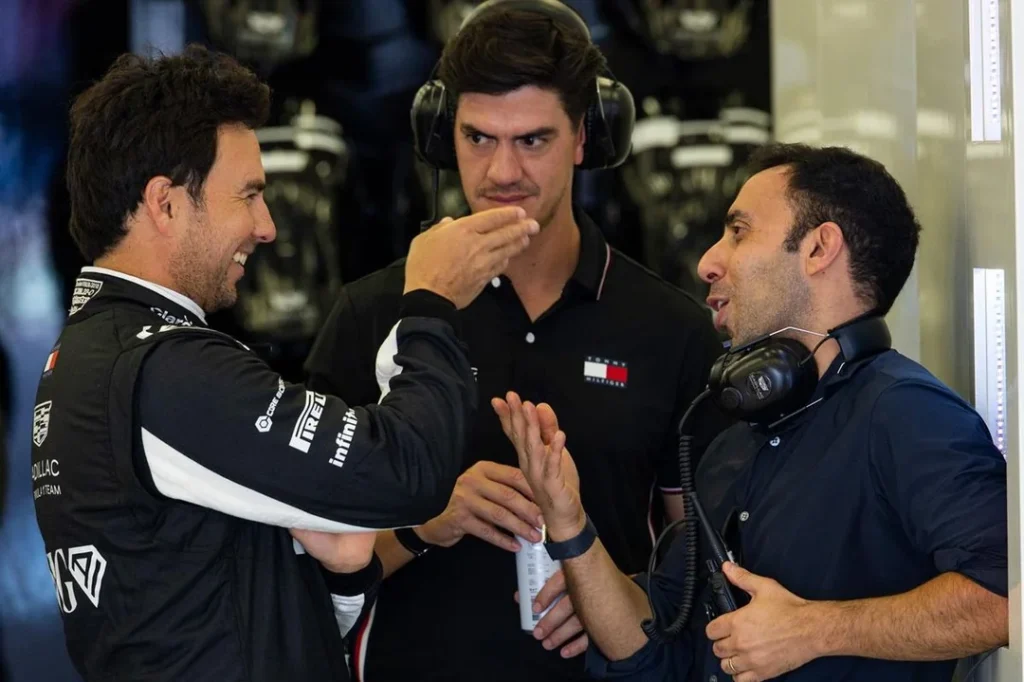
While aerodynamic innovation captures the imagination, the dynamics between drivers and teams continue to shape Formula 1’s internal culture just as much as technical regulations.
That tension surfaced again when Sergio Perez discussed his new environment at Cadillac, explaining that the team values his feedback far more than he experienced during his time at Red Bull.
The remark reignited a broader discussion about how Red Bull handled driver feedback during its dominant years. Perez and teammate Max Verstappen had reportedly raised concerns about the car’s behavior well before the team acknowledged any underlying problems. Because the car continued winning races and championships, however, the engineering group had little incentive to fundamentally alter a design that was delivering results.
In hindsight, some observers believe those warnings should have been taken more seriously. The theory is that Red Bull’s overwhelming competitive advantage masked deeper issues within the car’s development direction, allowing problems to compound over time. As long as Verstappen could extract victories from the package, the complaints were easy to dismiss.
This dynamic is not unique to Formula 1. Dominant organizations across sports and engineering often face what historians describe as the “incumbent’s dilemma,” the tendency for success to slow innovation by reducing the urgency to improve.
The situation at Cadillac presents the opposite scenario. As a new team building its program from the ground up, the organization is heavily reliant on experienced drivers who can guide development. Perez and Valtteri Bottas bring decades of combined experience from championship-winning operations, making them natural choices for a team focused on learning rather than immediate results.
Their responsibilities extend far beyond driving quickly. For a new team, veteran drivers must help translate on-track behavior into engineering feedback, attract sponsors and fan interest, and deliver consistent finishes while the car itself evolves.
That dynamic also shapes expectations for Cadillac’s early seasons. Points finishes may be rare initially, but the long-term goal is building a foundation capable of sustained development. In that context, a driver’s ability to describe exactly what the car is doing, and what it needs, can be more valuable than raw pace alone.
Across all these discussions, one theme consistently emerges: Formula 1 remains a sport defined by constant tension between tradition and innovation.
Longo’s criticism that Formula 1 risks drifting toward Formula E reflects one side of that debate. The increasingly complex hybrid power units, energy limits, and deployment strategies represent the modern technological frontier. Meanwhile, Ferrari’s experimental aerodynamics and the ongoing arguments over driver feedback highlight how the sport continues to evolve through trial, error, and controversy.
For all the confusion, frustration, and occasional absurdity that accompany those changes, they also reveal why Formula 1 remains uniquely compelling. It is a championship where engineering philosophy, regulatory politics, driver psychology, and technological ambition all collide on the same stage.
Whether the sport ultimately leans toward simplicity or complexity, toward combustion engines or electrification, or toward aerodynamic experimentation or power-unit supremacy, one thing remains certain: the debate about what Formula 1 should be is far from settled.