

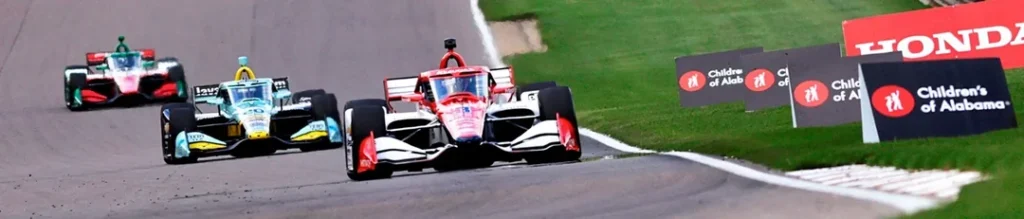
Qualifying for the 2026 Children’s of Alabama Indy Grand Prix delivered everything Barber Motorsports Park promises—and then some.
A track drivers openly love for its rhythm and challenge once again proved why it’s one of the most demanding circuits on the calendar. But beneath that appreciation was a session defined by crashes, controversy, breakout performances, and a familiar name returning to the top.
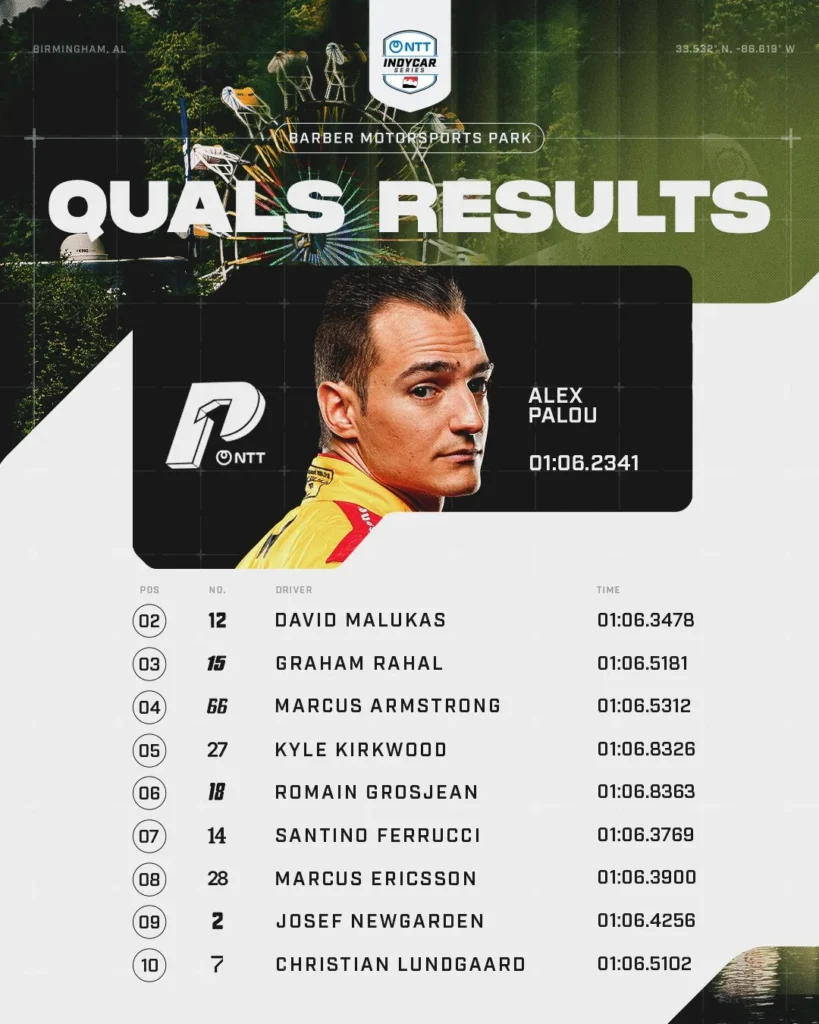
At the center of it all: Álex Palou, who secured pole with a 1:06.2341—yet somehow, even that felt like just one piece of a much bigger story.
Barber Does What Barber Does
There’s a reason drivers consistently rave about this track. Barber rewards commitment—but punishes even the smallest miscalculation.
That duality played out in full during qualifying.
The most dramatic moment came when Will Power slammed into the barrier, continuing what has become an almost inexplicable run of misfortune. Whether framed as bad luck, driver error, or something in between, the result was the same: another session derailed.
The reaction captured the broader tension. Some pointed to a pattern—multiple self-inflicted incidents this season—while others leaned into the randomness of it all. But what unified the response was just how unsettling the crash felt. Conversations quickly turned toward worst-case scenarios—brake failures, stuck throttles—the kind of fears that only surface when something goes seriously wrong.
Barber doesn’t just expose mistakes. It amplifies them.
The “Cursed 26” Narrative Reaches a Breaking Point
Power’s crash didn’t exist in isolation—it fed directly into one of the weekend’s strangest but most persistent storylines: the idea that the No. 26 car is simply cursed.
Across both Power and Colton Herta, the car has become synonymous with chaos. Incidents, bad luck, inexplicable setbacks—it’s reached a point where analysis is giving way to superstition.
Some pushed back, noting that several of the incidents have been driver-induced rather than team-related. Others weren’t convinced. When both drivers tied to the same entry continue to encounter issues, coincidence becomes harder to argue.
At Barber, that narrative only intensified.
Qualifying Chaos: Obstruction, Errors, and Margins That Matter
If the crash set the tone, the rest of qualifying ensured it never settled.
A major flashpoint came from Sting Ray Robb, whose on-track actions were widely viewed as one of the worst obstructions seen in qualifying. The reaction was immediate and unforgiving—an incident that didn’t just compromise individual laps but disrupted the competitive flow of the session.
Elsewhere, the margins were razor-thin. Mick Schumacher missing advancement by just a tenth was framed less as disappointment and more as a sign of life—evidence that even those on the fringes are within striking distance.
But while some struggled, others quietly built momentum.
Standout Performers: Pace, Consistency, and Redemption
Romain Grosjean delivered one of the standout performances of the session. Even with a late mistake, the takeaway was clear: at his best, he remains one of the quickest drivers in the field. There’s growing sentiment that his pace deserves more than the machinery he currently has.
Marcus Armstrong continued his run of quietly strong performances—consistent, controlled, and increasingly difficult to ignore. The kind of form that doesn’t dominate headlines but steadily reshapes expectations.
And then there’s David Malukas.
Starting second, Malukas reinforced what’s becoming one of the defining narratives of the season. Once questioned, now validated—his pace, particularly in qualifying, is no longer surprising. The bigger conversation has shifted to race execution, but the foundation is clearly there.
“Li’l Dave is having a season” isn’t just optimism anymore—it’s observation.
Rahal’s Return and a Grid Full of Questions
Starting third, Graham Rahal delivered what many see as a familiar pattern: flashes of brilliance that arrive just often enough to remind everyone what’s possible.
There’s a sense of inevitability to it—one or two standout qualifying performances a year—but that doesn’t diminish the impact when it happens. At Barber, it puts him firmly in the conversation.
Behind him, the grid tells a broader story:
- Marcus Armstrong continues to rise.
- Kyle Kirkwood remains consistently near the front.
- Grosjean backs up his pace with a strong position.
- Santino Ferrucci and Marcus Ericsson reinsert themselves into relevance.
- Josef Newgarden and Christian Lundgaard round out a deeply competitive top 10.
And yet, even within that competitiveness, disparities remain. Some drivers are extracting maximum performance. Others are struggling to show up at all—particularly notable on a permanent road course like Barber.
McLaren Stalls as the Field Moves Forward
One of the most telling narratives wasn’t about who excelled—but who didn’t.
Arrow McLaren’s lack of presence at the sharp end continues to raise questions. The perception is increasingly clear: while teams like Penske, Ganassi, and Andretti have progressed, McLaren has stagnated.
The issue appears especially pronounced in qualifying. Over race distance, there’s still belief in their competitiveness—but one-lap pace is leaving them exposed.
And in a field this tight, that’s a problem.
Dixon Debate: Decline or Context?
Further down the order, another conversation continues to simmer around Scott Dixon.
The qualifying struggles are undeniable—no top-12 starts across multiple races—and it’s prompting difficult questions about whether this is a natural decline or simply a run of bad circumstances.
The counterargument remains strong: his race pace is still there. Strategy, luck, and execution have played a role. But in modern IndyCar, starting position matters more than ever.
And Barber only reinforced that reality.
Palou on Pole—And the Weight of Expectation
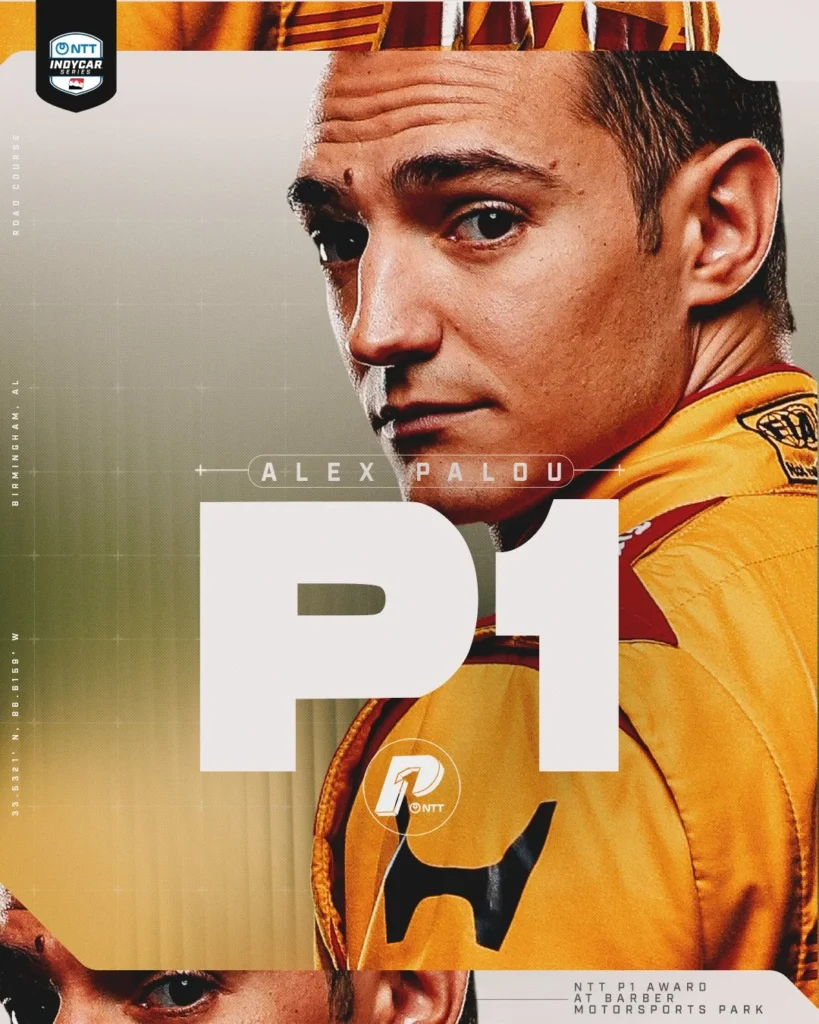
Then there’s Palou.
Pole position here doesn’t feel like an outlier—it feels like confirmation. On road courses, and especially at tracks like Barber, he has become the benchmark.
The reaction to that dominance is increasingly nuanced. There’s respect, even awe, at the level he’s operating at. But there’s also fatigue. Dominance, while historically significant, can feel predictable in the moment.
“Death, taxes, and Palou” isn’t just a joke—it’s becoming a framework for how the series is understood.
And yet, there’s still intrigue beneath it. Because while Palou may be the favorite, the battle behind him is anything but settled.
Strategy in Motion Before the Race Even Begins
Even within qualifying, teams were already thinking ahead.
Some opted to save fresh tires, sacrificing potential grid position for race-day flexibility. It’s a calculated gamble—especially when the driver on pole has a reputation for controlling races from the front.
Because that’s the looming question heading into Sunday:
If Palou executes, is anyone actually racing him—or just racing each other?
The Barber Equation, Revisited
Barber Motorsports Park doesn’t just produce fast laps. It exposes truths.
- It highlighted how quickly things can unravel.
- It blurred the line between bad luck and deeper issues.
- It elevated drivers quietly building momentum.
- And it reinforced a reality that’s becoming harder to ignore:
Beating Palou isn’t just about pace.
It’s about perfection—and surviving everything Barber throws at you along the way.