

IndyCar’s future is beginning to come into focus — but perhaps the most interesting parts are the ones we still can’t quite see.
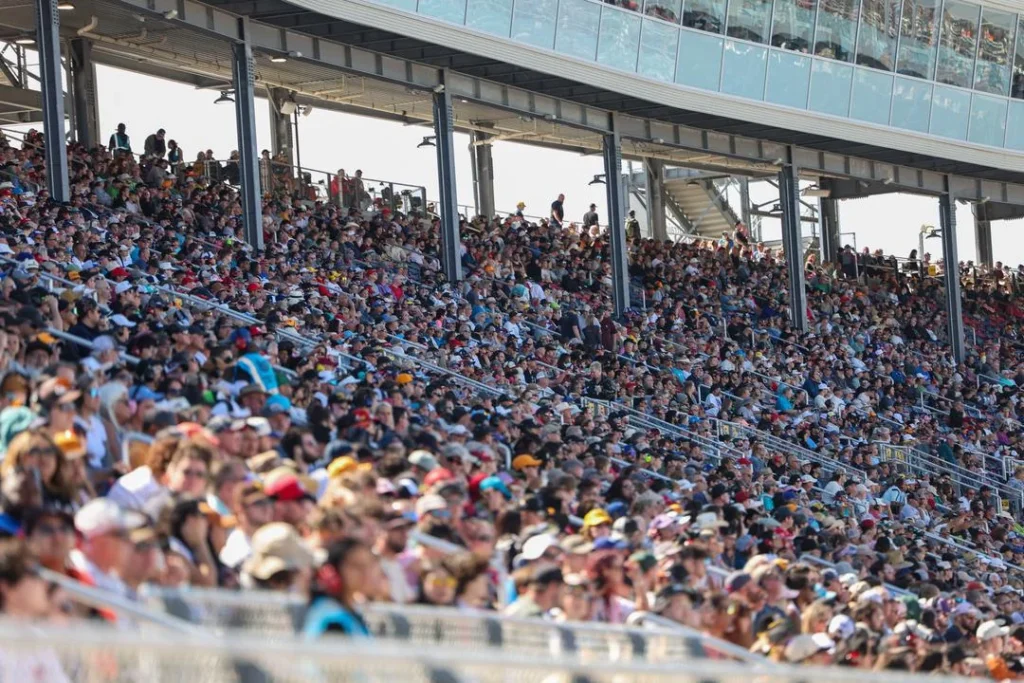
Phoenix Raceway has confirmed that its IndyCar-NASCAR weekend will return in 2027, giving fans something concrete to celebrate. Meanwhile, Doug Boles has once again cracked open the door to the possibility of a third engine manufacturer, and Alexander Rossi has sparked an entirely different round of speculation about what IndyCar may eventually have planned for its new car.
Taken together, it feels like IndyCar is simultaneously working on three different parts of its future: where it races, who powers the cars, and just how far the next generation of machinery could eventually be pushed.
Phoenix Is Coming Back in 2027
Phoenix Raceway has announced that the IndyCar-NASCAR weekend will return March 12-14, 2027.
And judging by the immediate fan reaction, this was not an announcement that needed much selling.
The enthusiasm ranged from a straightforward “HELL YEAH” to fans calling the continuation of the event a win for American motorsports. More importantly, several people who actually attended this year described the race as a blast and were thrilled that it would be sticking around.
One fan said this year’s Phoenix event was their first motorsport race of any kind. They live near the circuit, went to IndyCar, caught the bug, and even emailed the track asking them to bring it back. Now they’re getting their wish. Another fan has already purchased tickets from Wisconsin despite never having seen racing at Phoenix before, while another plans to fly all the way from Europe to combine IndyCar with seeing their favorite NASCAR driver.
Those reactions are probably the strongest argument for keeping this kind of weekend around. IndyCar-NASCAR doubleheaders don’t necessarily need to be viewed as one series borrowing an audience from the other. They can be an opportunity to turn somebody who came for one form of racing into a fan of another. There was also some appreciation for the role FOX’s partial ownership of IndyCar could potentially play in making collaborative events like this easier to organize and promote. Whatever happens behind the scenes, fans clearly like the concept: put two major American racing series together and give people a bigger reason to make a weekend out of it.
And then there are the inevitable jokes. The announcement prompted the suggestion that Phoenix has effectively secured another second-place finish for the Malukas brothers — a reference to the brothers’ Phoenix results — while the prospect of more IndyCar/NASCAR doubleheaders was celebrated almost as enthusiastically as Phoenix itself. But Phoenix might actually be the least mysterious piece of IndyCar’s future.
Because Doug Boles just gave fans something else to obsess over.
Wait… Did Doug Boles Just Tease a Third Manufacturer?
The mythical third IndyCar engine manufacturer is back.
Death, taxes and rumors of another IndyCar manufacturer. During an appearance on Conor Daly’s podcast, Boles was discussing the rollout and testing schedule for the new car when he said:
“Right now, we’ve got the one car now. We’ll start rolling them out to the manufacturers, both Honda and Chevy, and hopefully if we land another manufacturer here we’ll be able to get those manufacturers in the car and start testing a little bit this fall still and certainly when we get into the spring next year.”
The important word there is hopefully. Nothing in that statement confirms IndyCar has secured a third manufacturer. It doesn’t even necessarily confirm that negotiations with one are advanced. In fact, the most conservative interpretation is probably the correct one: IndyCar wants another manufacturer, it is presumably continuing to make that opportunity available, and the new-car transition creates a natural window for somebody to enter.
Still, you can’t drop “if we land another manufacturer here” into an IndyCar conversation and expect fans to behave normally.
Immediately, the guessing began. Toyota was one of the most frequently suggested possibilities, with some fans pointing toward previous rumors surrounding the company and IndyCar. Hyundai was floated because of its desire to grow in the U.S. market and its motorsport involvement. Lexus appeared. Mercedes appeared. Ford inevitably appeared. Someone suggested Daewoo. Someone else went with Briggs & Stratton.
And naturally, one fan simply announced: “It’s me. I am the third engine.”
At this point, that might have as much supporting evidence as some of the other theories. The skepticism is understandable. IndyCar fans have heard third-manufacturer speculation so many times that it has practically become part of the championship’s folklore, alongside international race rumors and other endlessly recurring paddock possibilities. One fan described the third manufacturer as a bigger myth than a cheap hot dog at IMS.
But there is at least an interesting argument for why now would be the moment for it to happen.
If a Manufacturer Wants In, Is This the Window?
With IndyCar transitioning toward its new machinery and engines, the competitive landscape is being disturbed anyway.
That doesn’t mean a newcomer would arrive on completely equal footing. As fans pointed out, Chevrolet and Honda already have considerable knowledge and development behind them. The discussion noted that engines begun in 2022 before being shelved are relevant to the new program, with the base architecture of those 2.4-liter engines expected to carry into the 2028 engines. A 2.4-liter Ilmor engine from that program is already installed in the test car. So this isn’t exactly everybody opening a blank sheet of paper simultaneously.
But the argument is that the disadvantage for a newcomer could still be smaller now than it would become after Honda and Chevrolet have accumulated another year or two of running their new packages. One interesting hypothetical raised by fans was whether a new manufacturer could initially purchase engines from Ilmor while getting its own development program established. Again, that’s speculation rather than something Boles announced.
And that’s ultimately where this entire story needs to stay for now. Boles didn’t announce Toyota. He didn’t announce Hyundai.
He didn’t announce Ford, Mercedes or Lexus. What he did reveal is that IndyCar is at least leaving a place at the table.
And if another manufacturer really is considering sitting down, the clock may already be ticking.
Alexander Rossi Just Created an Even Bigger Mystery
Then there’s the car itself.
Alexander Rossi’s comments on Off Track generated perhaps the most fascinating speculation of all, because Rossi appeared to hint that IndyCar is future-proofing its new car for something that could dramatically increase steering effort. Discussing steering assist, Rossi said:
“I don’t know if I’m at liberty to say what they’re future proofing for, so I’m not going to say it. But again, this car is going to be around for a while. So there’s elements of it that could be in the pipeline that would make steering very heavy to the point where would it be impossible to drive?”
Well, that’s one way to make sure IndyCar fans spend the rest of the day theorizing. The important distinction in Rossi’s comments is that steering assistance itself doesn’t appear to be the secret. The mystery is what IndyCar might eventually do to the car that would make steering assistance necessary.
That’s a much more interesting question. The simplest theory is downforce. More downforce means greater loads, and as the car becomes faster through corners, steering effort can become increasingly demanding. More horsepower, better tires and increasingly optimized setups could all contribute to the same basic problem: eventually IndyCar has to decide whether preserving unassisted steering is worth placing a ceiling on performance. Fans also noted that teams already make compromises between qualifying and race setups because steering effort that might be manageable over a short qualifying run may not be sustainable over an entire race.
That makes Rossi’s comments particularly intriguing.
How Fast Does IndyCar Actually Want the IR-28 to Become?
Another quote shared from the podcast gives considerably more context to Rossi’s thinking.
Rossi said there is a solution to the weight problem of an IndyCar. While the new car is lighter than the current generation, he questioned whether it would ultimately be light enough to achieve the performance level IndyCar wants.
His framing was essentially a trade-off: if IndyCar wants the car to “haul ass,” power steering might eventually be part of the price.
Rossi also apparently made clear that he personally enjoys the physicality of IndyCar. He likes being able to work hard in the gym during the offseason and have that work potentially affect his competitiveness. That’s one of IndyCar’s distinctive characteristics. But Rossi also doesn’t believe the series should accept going slower in a DW12 than drivers were going in 2017.
And 2017 immediately caught fans’ attention. That was the final season of the manufacturer aero kits. Could IndyCar eventually be considering significantly more downforce? Could it open up more development? Is there something else being contemplated entirely?
We don’t know. And Rossi apparently isn’t telling us. James Hinchcliffe offered the counterargument that eventually faster cars can produce worse racing. There is also something uniquely IndyCar about preserving an element that makes the cars physically difficult to drive compared with other major series.
That leaves IndyCar facing a fascinating philosophical decision. How much should difficulty itself be protected? If unassisted steering eventually limits suspension geometry, performance or the development potential of the car, is keeping it really worth slowing the cars down?
Or is the physical steering effort part of what makes an IndyCar an IndyCar?
And Then the Theories Got Weird
Once Rossi said he wasn’t at liberty to reveal what IndyCar might be future-proofing for, predictable speculation gave way to much more entertaining speculation.
One possibility raised was electrification of the front wheels. The idea would effectively create a four-wheel-drive IndyCar using independent electric motors at the front, potentially introducing benefits such as acceleration and torque vectoring. That immediately produced an entire engineering debate.
Could motors realistically be packaged around an open-wheel car’s nose? Would the additional weight compromise the car? Could Formula E-style solutions demonstrate that the hardware doesn’t necessarily require an enormous front end? Would additional battery capacity be necessary? Would four-wheel drive improve the racing or merely create complexity without enough benefit? There were arguments on both sides, including the reminder that four-wheel-drive Indycars have existed before — just not with electric motors. To be clear, none of this was identified by Rossi as the mysterious future technology.
It’s fans trying to solve a puzzle without being given all the pieces. Other theories were considerably less serious. Tyrrell-style six-wheelers.
Thirty-inch wheels with hydraulics allowing drivers to hop over cars blocking the track. A La Cucaracha horn. And, perhaps the most straightforward guess of all: 1,000 horsepower.
Until Rossi decides he’s at liberty to elaborate, your theory is probably as good as ours.
Power Steering Could Also Change Who Can Drive an IndyCar
There’s another side to the steering discussion that goes beyond outright performance.
Fans raised the accessibility implications of an IndyCar requiring extremely high steering effort. Jamie Chadwick’s experience was brought into the conversation, with fans referencing the physical challenge she encountered when testing an IndyCar and questioning whether reducing steering effort could make the championship more accessible to drivers who otherwise struggle with the sheer forces required. That doesn’t mean IndyCar should remove every physical challenge from driving the car.
But it does raise an interesting question about whether steering strength should remain such an important competitive differentiator if it begins limiting either car development or the pool of drivers capable of extracting its performance. There’s also the possibility of assisted steering opening up suspension geometry options that aren’t currently practical because of the resulting steering effort.
So the conversation shouldn’t necessarily be reduced to “power steering makes the cars easier.”
If steering assistance allows engineers to make the car itself faster or more capable, then the trade becomes much more complicated.
The IR-28 Seems Designed Around Questions IndyCar Hasn’t Answered Yet
Perhaps the biggest takeaway from Rossi’s comments isn’t any particular theory.
It’s the concept of future-proofing. IndyCar knows this car is going to be around for a while. Instead of building something that can only accommodate what the championship wants in 2028, there appears to be consideration being given to what IndyCar might want several years later. Fans pointed toward other clues as well. The new wheel design has been discussed as being capable of handling greater loads. Space has reportedly been left for brake-by-wire. Electric column-assist steering is another possibility the chassis can accommodate.
Even Rossi’s comments about spec dampers carried another intriguing caveat. While discussing that decision, he reportedly said he needed to be careful about what he could reveal and characterized the current arrangement as “the solution for now.”
Again, that doesn’t tell us what’s coming.
But “for now” and “future proofing” are exactly the kinds of phrases that generate questions when you’re talking about a car intended to establish IndyCar’s technical direction for years.
And maybe that’s the most exciting part.
IndyCar Is Building More Than Just a New Car
Phoenix is returning.
The new car is coming. Honda and Chevrolet are preparing for the next engine era. IndyCar still hopes another manufacturer might join them.
And somewhere inside the IR-28 could be the ability to accommodate ideas that the series isn’t ready — or willing — to publicly discuss yet. Some of those ideas might never happen. The mysterious change Rossi referenced could ultimately be something relatively conventional. A third manufacturer might remain exactly what it has been for years: something perpetually appearing just over the horizon. That’s why it’s important not to turn hints into announcements.
But IndyCar fans have spent a long time asking where the series goes after the DW12. For once, we’re starting to get answers.
And those answers are creating even more questions.