

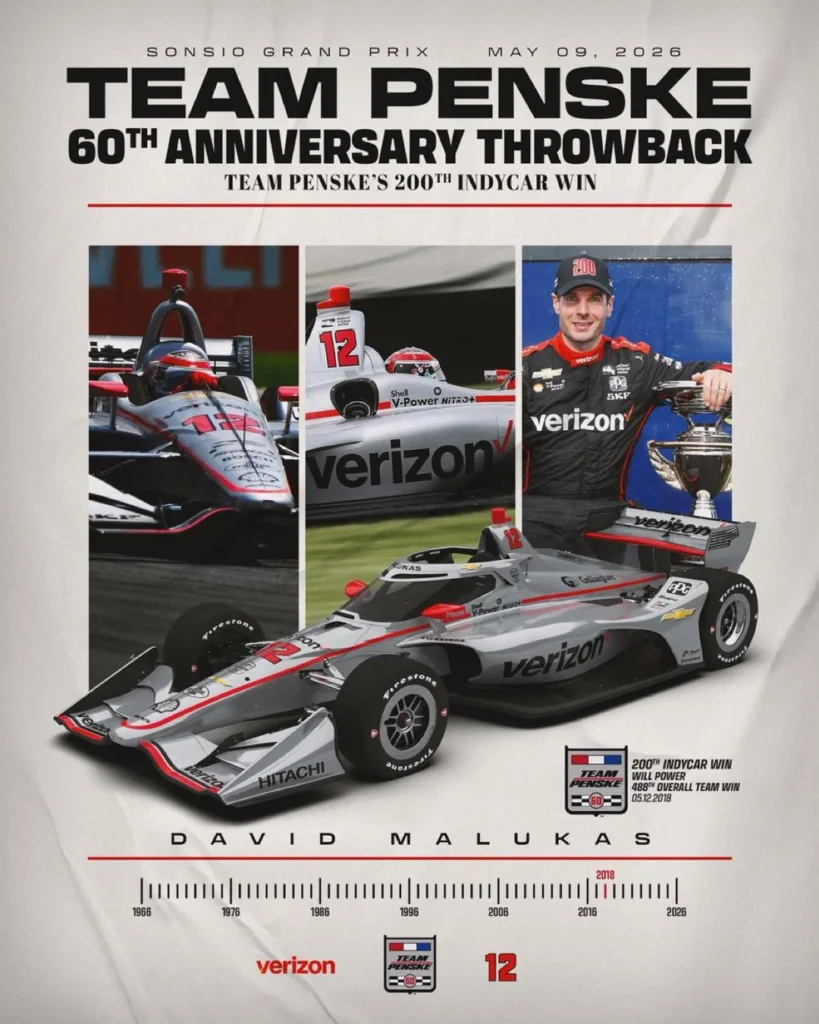
Team Penske’s latest special livery reveal has done exactly what these designs are supposed to do—get people talking. But instead of a unified wave of nostalgia, the reaction has been more analytical, with fans dissecting whether this is truly a “throwback” or something closer to a modern tribute dressed up in retro language.
At the center of the discussion is the car’s inspiration: a design tied to Penske’s milestone 200th win, which came at the 2018 Indy Grand Prix. That framing immediately raised eyebrows. While milestone liveries are nothing new in IndyCar, calling this a throwback to such a recent era has created a noticeable disconnect in how fans interpret the intent.
A “Throwback” in Name Only?
The most immediate reaction from fans was confusion over the timeline. For many, the design doesn’t reach far enough into the past to qualify as a true throwback. Instead, it lands in an awkward middle ground—recognizable, recent, and still fresh in memory.
There’s a consistent sentiment that this is less about revisiting history and more about rebranding a recent achievement. A more precise label, as some observers noted, would have been a “livery celebrating the 200th win,” rather than positioning it as a historical callback. That distinction matters, especially in a series where throwback liveries often tap into decades-old iconography.
The timeline issue becomes even more pronounced when considering how recent 2018 feels in the context of IndyCar’s long history. Fans pointed out that labeling something from just a few years ago as a throwback stretches the definition—particularly when many of the drivers associated with that era are still active on the grid. The idea of a “throwback to someone still racing in the series” struck many as inherently contradictory, described more as a “light toss back than a throwback.”
The 2020 Factor and Pandemic-Era Context
Complicating matters further is the association with the 2020 car. For some, that season carries a unique—and somewhat surreal—identity due to the COVID-19 pandemic. The mix of real-world races and empty grandstands has led to a perception that those cars almost existed in a liminal space between reality and simulation.
That blurred memory even led to tongue-in-cheek remarks suggesting the car “only existed on iRacing,” a nod to how the pandemic reshaped the viewing experience. While factually incorrect—the car did run a full season (minus the Indy 500)—the sentiment underscores how disconnected that era feels compared to traditional seasons.
In that sense, the livery doesn’t just reference a recent car—it references a recent moment in IndyCar history that already feels oddly distant.
Milestones vs. Nostalgia
Another layer to the reaction is how fans interpret milestone celebrations more broadly. Penske’s history offers no shortage of landmark wins—100th, 200th, 300th—and each carries its own visual and historical identity. Some fans quickly contextualized the 200th win within that lineage, noting its place alongside other major achievements like the 300th victory at Milwaukee and the 100th at the 1981 Indy 500.
That historical framing highlights the core tension: this livery isn’t lacking significance, but its execution blurs the line between commemoration and nostalgia. Milestones are inherently retrospective, but not all retrospectives feel “retro.”
Style Over Semantics?
Despite the semantic debate, one point of consensus did emerge: the car looks good. Even among critics of the “throwback” label, there’s appreciation for the aesthetic. The chrome and red combination, in particular, drew praise, with some going as far as suggesting it should be run full-time.
That visual appeal may ultimately be the deciding factor in how the livery is remembered. In motorsport, design often transcends context, and a striking car can win over fans regardless of how it’s categorized.
Still, the discussion reveals something deeper about fan expectations. Throwback liveries aren’t just about paint—they’re about storytelling. They’re meant to evoke a specific era, trigger nostalgia, and create a clear emotional link to the past. When that link feels too recent or too ambiguous, the reaction shifts from emotional to analytical.
A Modern Trend?
This situation also reflects a broader trend in motorsport marketing, where the definition of “heritage” is becoming more flexible. As teams look to celebrate milestones and recent success, the line between history and present-day branding continues to blur.
In Penske’s case, the intent is clear: honor a significant achievement. But the execution has sparked a conversation about how recent history should be framed—and whether every milestone needs the “throwback” label to carry weight.
Final Take
Whether you see it as a throwback, a tribute, or simply a well-designed livery, the reaction proves one thing: fans are paying attention to the details. And in a series built on both legacy and innovation, those details matter.
Penske may not have delivered a traditional throwback, but they’ve succeeded in starting a conversation—one that highlights just how nuanced nostalgia can be in modern IndyCar.