

The 2026 Children’s of Alabama Indy Grand Prix didn’t unfold as a wheel-to-wheel thriller for the win — but it didn’t need to. What played out instead was something far more telling about the current state of IndyCar: a race defined not by outright dominance, but by execution gaps, strategic pivots, and a field that continues to beat itself.
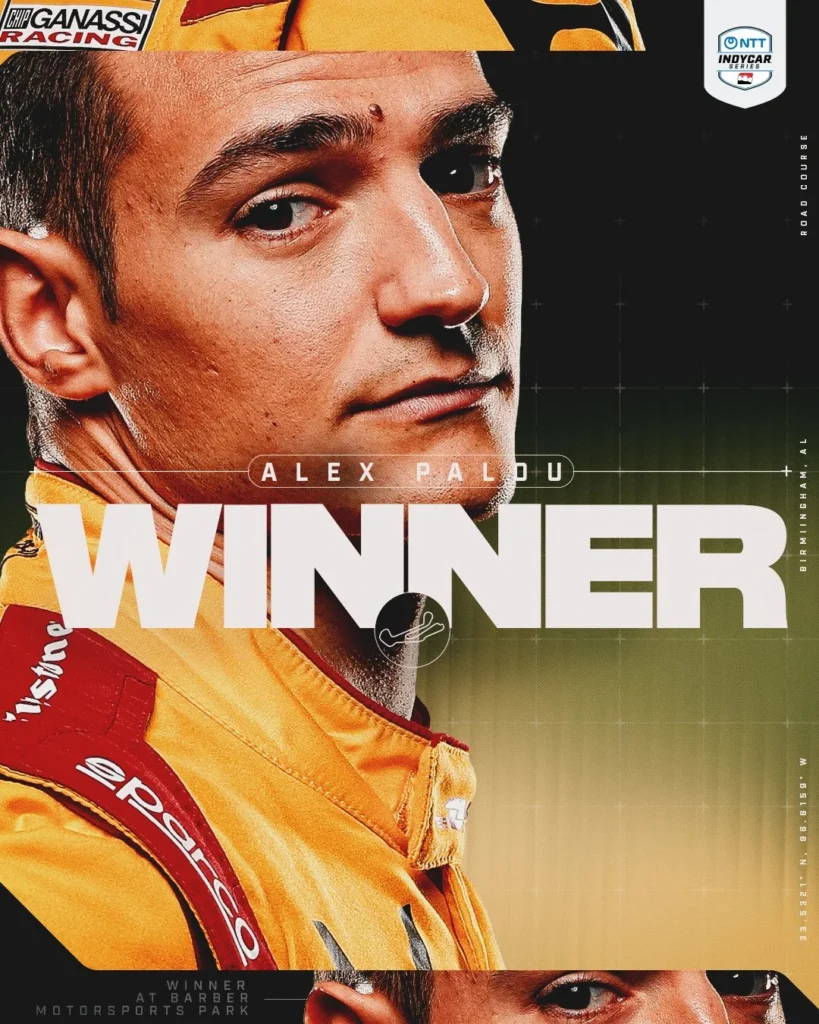
At the front, it was once again Álex Palou who capitalized — not through overwhelming superiority, but through something far more repeatable: doing everything right while others didn’t.
Result: Familiar Outcome, Unfamiliar Path
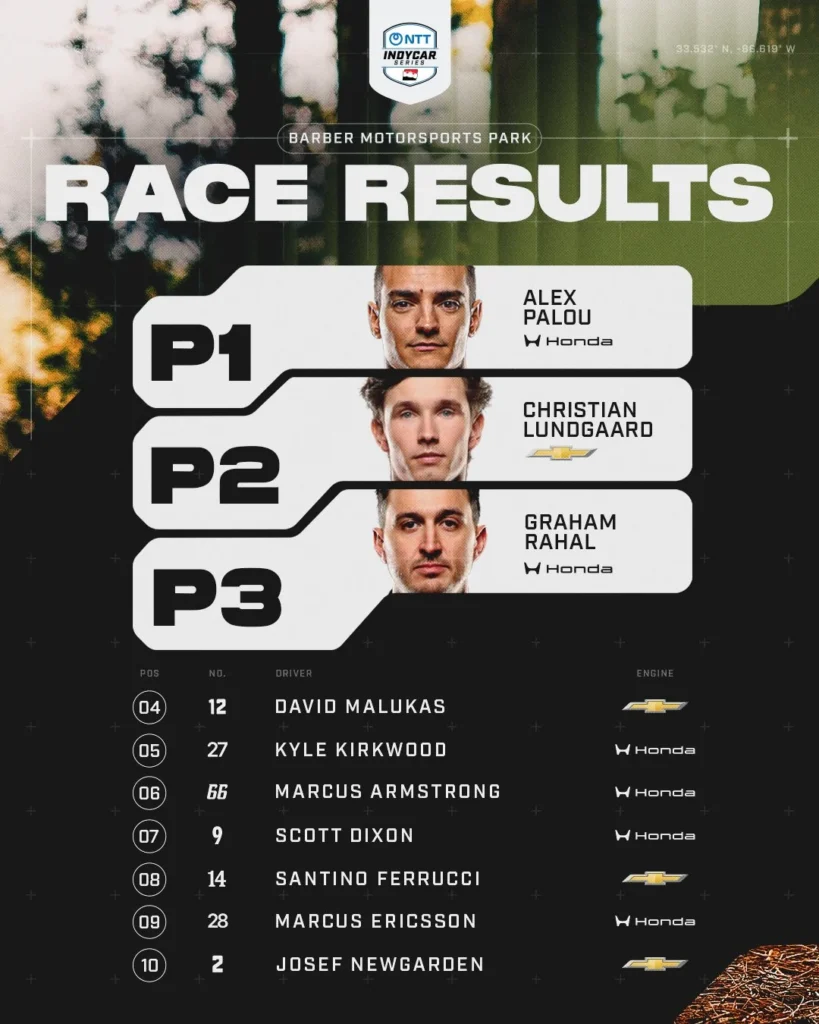
Race Results — Barber Motorsports Park
- P1: Alex Palou
- P2: Christian Lundgaard
- P3: Graham Rahal
- P4: David Malukas
- P5: Kyle Kirkwood
- P6: Marcus Armstrong
- P7: Scott Dixon
- P8: Santino Ferrucci
- P9: Marcus Ericsson
- P10: Josef Newgarden
On paper, another Palou win. In reality, a race that repeatedly hinted it could — and perhaps should — have gone another way.
The Defining Theme: Execution Over Pace
If there was a single takeaway from Barber, it’s this:
The fastest car didn’t win. The cleanest race did.
Christian Lundgaard was widely viewed as having the pace to take victory. But in a race where passing proved difficult and track position became everything, one mistake — a costly pit stop — was enough to swing the outcome decisively.
That dynamic defined the entire race:
- Passing was limited → track position became king
- Strategy mattered → but only if executed cleanly
- Pit stops weren’t marginal → they were decisive
As one prevailing sentiment captured it: this wasn’t a race Palou stole — it was one others gave away.
Ganassi vs The Field: A Structural Gap
What continues to separate Palou isn’t just talent — it’s infrastructure.
Chip Ganassi Racing has emerged as the only team consistently delivering a complete package:
- clean pit execution
- stable strategy
- mistake-free race management
Meanwhile, their rivals continue to fragment:
- Team Penske: dominant on ovals, inconsistent elsewhere, prone to errors
- Andretti Autosport: fast but unreliable, particularly on pit lane
- Arrow McLaren: well-funded but structurally inconsistent
The result is a championship environment where no one can consistently apply pressure — even when they have the speed to do so.
Or put more bluntly: Palou isn’t untouchable — he’s just the only one not making mistakes.
Strategy Curveball: When Tires Flipped the Race
Barber introduced another critical variable: tires didn’t behave as expected.
The sudden shift toward hard tires becoming the preferred race compound forced teams to adapt mid-race — and not all did so effectively.
Some teams had already committed to weekend-long strategies:
- Kirkwood and Rahal sacrificed qualifying performance to preserve red tires
- Others leaned into soft-heavy strategies expecting a different race profile
That divergence created winners and losers — but also reinforced a broader point:
The best teams anticipated. The rest reacted.
RLL’s Confusion: Strategy or Misread?
No team embodied that confusion more than Rahal Letterman Lanigan Racing (RLL).
A key storyline emerged post-race:
- Graham Rahal admitted he believed the race required two alternate (soft) tire stints
- That rule only applies to street circuits, not Barber
- RLL was the only team where all drivers used softs at least twice
Whether it was:
- a full-team misunderstanding
- a driver-level miscommunication
- or a desperate strategy gamble
…the outcome was the same: compromised race execution.
Even broader context added to the confusion:
- TV commentary reportedly reinforced the incorrect rule pre-race
- Multiple teams and viewers appeared unclear on the requirement
Regardless of cause, it underscored the same theme running through the race:
Small informational or strategic errors had outsized consequences.
Arrow McLaren: The Biggest Understory
While Palou won the race, Arrow McLaren may have defined it.
The team’s weekend became a case study in underperformance:
- Pato O’Ward finished 17th on a track he’s previously won at
- Strategy shifts mid-race lacked clarity
- Pit stop issues compounded problems
- Performance varied wildly across cars
More importantly, the reaction wasn’t just about this race — it reflected a growing sentiment:
McLaren isn’t failing occasionally — they’re structurally inconsistent.
Recurring criticisms included:
- lack of clear technical leadership
- inability to execute across all three cars
- weak qualifying undermining race weekends
- no identifiable competitive edge vs top teams
Despite resources and investment, the team continues to be described as:
not the best at anything — and therefore not a true contender
Malukas, Rahal, and the Quiet Performers
Behind the chaos at the front, several secondary narratives stood out:
David Malukas — Quietly Delivering
- P4 finish
- Now highest Penske driver in points
- Strong average start and finish metrics
His performance has been understated — but increasingly significant.
Graham Rahal — Rare Execution Window
- Capitalized on strategy and race dynamics
- Secured a podium in what many see as an infrequent peak performance
Marcus Armstrong — The “Top-10 Constant”
- Another P6 finish
- Reinforcing a pattern: consistent, but lacking breakthrough results
The Palou Formula
At this point, the pattern is unmistakable:
- Don’t make mistakes
- Let others make them
- Win
It’s been compared to the Scott Dixon method — but with more outright pace. And until another team can match that level of operational consistency, it’s hard to see the formula breaking.
Conclusion: A Race About Everyone Else
Barber didn’t showcase a runaway performance. It exposed a competitive gap — not in speed, but in execution.
The field is close. The margins are thin. The opportunities are there.
But right now, only one team — and one driver — is consistently converting them.
And until that changes, the outcome may keep looking exactly like this.