

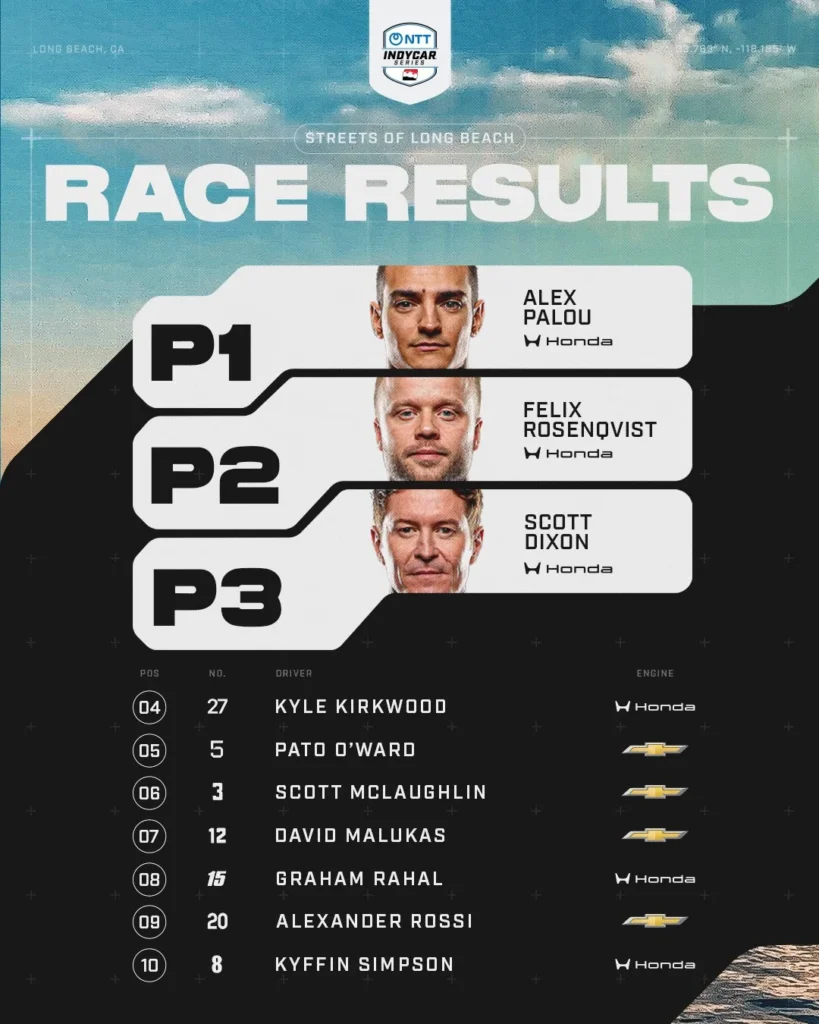
The 2026 Acura Grand Prix of Long Beach was supposed to be a marquee street race—the final stop before the Month of May, a reset point in the season. Instead, it became something far more familiar: another clinical victory for Alex Palou and Chip Ganassi Racing, wrapped in frustration over race control decisions, processional racing, and a growing sense that the rest of the field simply cannot keep up.
A Start That Defined Everything
Before strategy, before pace, before tire management—this race was defined in its opening moments.
The start itself drew immediate backlash. It wasn’t just messy—it was widely viewed as unacceptable. The field wasn’t properly aligned, yet the green flag was waved anyway, prompting confusion and anger. There’s a growing sentiment that standards have slipped, especially compared to previous seasons where cleaner starts were waved off without hesitation. The decision not to abort effectively locked the race into a trajectory it never escaped.
From that point on, everything felt predetermined. What could have been a race of evolving strategy and sustained battles instead became static, with many believing that a proper restart might have reshaped the entire event.
Strategy, Pit Cycles—and the Moment It Flipped
For a time, it looked like Felix Rosenqvist might finally break through.
He controlled the race cleanly, led confidently, and crucially, didn’t put a foot wrong. Everything about his execution suggested this could be his day. But Long Beach, once again, proved how fragile control can be.
The turning point came in the pit cycle.
Despite a strong weekend from Meyer Shank Racing—arguably one of their most complete in recent memory—the margins at the front were defined by perfection versus near-perfection. Rosenqvist did everything right. Ganassi did everything better.
Palou emerged where it mattered most.
There’s a recurring pattern to how he wins. Sometimes it’s domination from the front. Other times, like this, it’s surgical positioning—never visibly the fastest car in clean air, yet always appearing in the lead when it counts. Whether through pit sequencing, timing, or capitalizing on caution dynamics, the outcome feels less like chance and more like inevitability.
Palou’s Pace: Effortless, Unfair, Inevitable
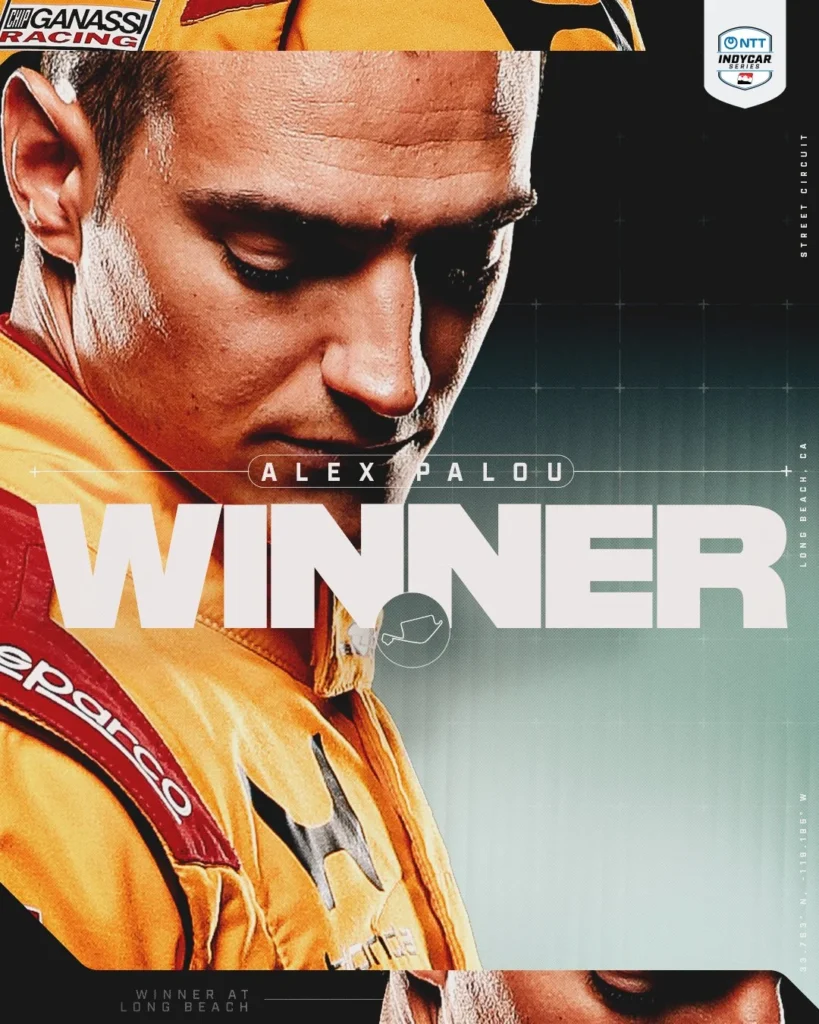
Once in front, the race was effectively over.
Palou’s final stint only reinforced what’s becoming increasingly difficult to ignore: his ability to extract performance under any condition is operating at a different level. Managing tires in a way that defies expectation, delivering pace that doesn’t match the compound, and doing it all while leaving performance in reserve—it creates the impression of total control.
Winning by seconds while still holding unused push-to-pass isn’t just dominance—it’s detachment from the field.
At this point, it’s no longer just about wins. It’s about consistency at a level that warps expectations. With 61 top fives in 103 starts, his baseline isn’t competing—it’s finishing at the front. And that consistency is now outpacing even strong campaigns from rivals like Kyle Kirkwood, whose results would typically define a championship favorite in any normal season.
This is not a normal season.
The Field Behind: Execution Gaps Everywhere
What made the result more stark wasn’t just Palou—it was everyone else.
Chip Ganassi Racing executed flawlessly. Others didn’t.
Andretti, at what is widely considered one of their strongest tracks, failed to maximize. Penske’s struggles were even more visible—drivers moving forward only to finish where they started, strategy failing to convert pace into results, and a general lack of cohesion compared to their usual standards. McLaren, meanwhile, continued to drift without a clear foothold as a consistent front-running threat.
Even strong individual performances were undone by execution. David Malukas ran competitively but lost track position in the pits. Rosenqvist did everything right—and still lost. The gap isn’t just performance. It’s precision.
A Race Without Racing
Beyond the result, the larger issue was the race itself.
There was little passing. Strategy failed to create variation. Tire degradation didn’t introduce meaningful differences. Even a mid-race push-to-pass anomaly—where the system was incorrectly available to drivers on a restart—had virtually no impact on overtaking.
That’s perhaps the most telling detail: even when given an unintended boost, drivers still couldn’t race.
The top six remained largely unchanged deep into the event. Cautions were minimal. And the sense throughout was that nothing was happening—not because of circumstance, but because the cars and conditions no longer allow for it.
There’s growing criticism that the current chassis, combined with added weight from hybrid systems and safety components, has fundamentally dulled the racing product. The result is a car that’s harder to race closely, especially on tight street circuits like Long Beach.
Off-Track Controversies Add to the Noise
The race wasn’t without incident—but even those moments added more frustration than excitement.
A pit lane penalty for Will Power, following contact with a crew member during a stop, became a focal point. While there was initial debate about whether contact occurred, it was ultimately accepted that safety had to take priority, especially in such a confined pit lane environment.
Meanwhile, the push-to-pass system failure on Lap 62 introduced another layer of controversy. Twelve drivers used the system when it should have been disabled, yet no penalties were issued. While the reasoning centered on the lack of competitive advantage gained, it raised questions about system reliability, enforcement consistency, and transparency—especially given similar issues in the past.
In a race already struggling to engage, these moments didn’t elevate the spectacle—they undermined confidence in the process.
The Bigger Picture: Admiration vs. Apathy
There’s a tension building around IndyCar right now.
On one hand, what Palou and Ganassi are doing deserves recognition. This is elite-level execution, consistency, and racecraft. A generational run.
On the other hand, dominance without challenge—especially in races lacking action—creates fatigue.
It’s not just that Palou is winning. It’s how easily it’s happening, and how little the rest of the field seems capable of disrupting it. Even fans who respect his talent are finding themselves wanting something—anything—different.
Long Beach didn’t just reinforce that imbalance. It amplified it.
Final Results
- Alex Palou
- Felix Rosenqvist
- Scott Dixon
- Kyle Kirkwood
- Pato O’Ward
- Scott McLaughlin
- David Malukas
- Graham Rahal
- Alexander Rossi
- Kyffin Simpson
The Acura Grand Prix of Long Beach should have been a showcase.
Instead, it became a case study—of dominance, of missed opportunities, and of a racing product that, at least on this day, struggled to deliver.
And as the series heads into the Month of May, one question looms larger than ever:
Who, if anyone, can stop Alex Palou?