

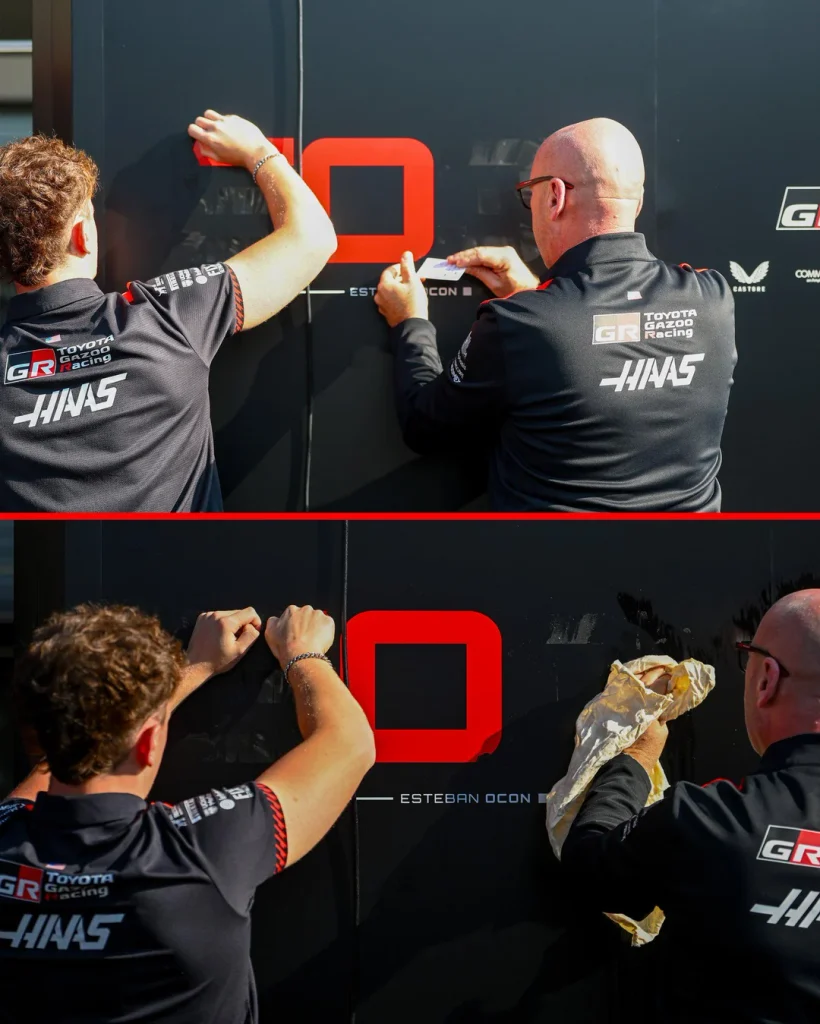
Esteban Ocon has acknowledged a disagreement within Haas but categorically denied allegations of physical violence after the team replaced him with reserve driver Ryo Hirakawa for the remainder of the Mexico City Grand Prix weekend.
Haas confirmed the driver change without explaining its cause, stating that no further statements would be made at that time. Ocon subsequently issued his own response after reports suggested a confrontation had taken place following Friday’s second practice session. The immediate outcome is clear: Hirakawa will make his Formula 1 race debut alongside Ollie Bearman. What remains unresolved is whether Ocon will return before the end of the season—and precisely what led Haas to remove him from the car.
Elsewhere, Max Verstappen’s reference to Liam Lawson’s uncertain seat has added a personal dimension to their on-track disagreement, while Isack Hadjar has called for better security following his incident with a fan. Together, these stories raise different questions about authority, professional relationships, and the boundaries drivers should be expected to navigate.
Haas Makes the Change, Ocon Rejects Allegations of Violence
Haas’s announcement established the scope of its immediate decision:
“TGR Haas F1 Team reserve driver Ryo Hirakawa will replace Esteban Ocon for the remainder of the weekend’s Mexico City Grand Prix.”
The team noted that Hirakawa had already driven the VF-26 in Friday’s opening practice session, finishing 15th in his third free practice appearance of the season. He would continue through final practice, qualifying, and Sunday’s 71-lap race.
Haas ended its statement with: “No further statements will be made at this time.”
That left a substantial gap between the announcement and an explanation. It did not identify illness, a disciplinary issue, or any other reason for the substitution. The absence of an explanation, however, cannot itself establish which of those possibilities applies. Ocon’s subsequent statement confirmed that a disagreement had occurred.
“Last night, a difference in viewpoints led to a discussion with the parties involved,” he said.
“Whilst I acknowledge that this took place, I categorically reject any reports or allegations suggesting that any form of physical violence was used to resolve any differences of any nature.”
He added that he strongly condemned violence, called for disagreements to be handled with “professionalism, respect, and mutual understanding,” and asked that speculation be avoided while the matter was addressed.
His acknowledgment is significant, but so is the limit of what he acknowledged. Ocon confirmed a discussion arising from differing viewpoints. He did not confirm the more serious allegations circulating around it.
Before his response, Tomás Slafer had reported a “fight” involving Ocon in Haas’s post-FP2 briefing and suggested that the driver may already have left Mexico. That wording did not explain whether “fight” meant a verbal confrontation or something physical, nor did it identify another participant.
L’Équipe’s reported account went further, describing a “brutal, maybe physical exchange” between Ocon and team principal Ayao Komatsu. Ocon’s categorical denial directly contests the physical element of that allegation. The newspaper’s reported cancellation of a planned interview with him adds to the picture of an interrupted weekend, but does not establish what happened in the briefing.
The distinction matters. An acknowledged disagreement, a reported confrontation, and an allegation of physical violence are different claims. They should not become interchangeable simply because the driver was subsequently replaced.
A Garage Change Is Visible. Ocon’s Longer-Term Status Is Not.
Autosport reported that Haas had removed Ocon’s name and driver number from his garage in Mexico. Kym Illman also documented the change and reported that Hirakawa was likely to remain in the seat for the rest of the season, with Jack Doohan taking over reserve duties from Brazil.
That would make this a much larger development than a single-weekend substitution. But the distinction between Haas’s announcement and Illman’s report remains essential: the team confirmed Mexico, while the longer arrangement was reported separately. Removing Ocon’s garage identification is consistent with preparing the space for Hirakawa. It is not, by itself, confirmation that Ocon’s contract has ended or that his Formula 1 career is over. There is nevertheless an obvious human cost to the uncertainty. If this becomes a permanent departure, a race winner could leave without knowing that his last appearance in the car was his final one. There would be no planned farewell, no opportunity to approach the closing races with that knowledge, and no orderly conclusion to the relationship.
That possibility deserves recognition without being written as an outcome that has already occurred. Comparisons with Ocon’s early departure from Alpine in 2024 are also understandable. But two relationships ending before a season’s final race would not establish that they ended for the same reason. A previous breakdown cannot substitute for evidence about the current one.
Nor can a driver’s reputation settle what happened behind closed doors. The question is what occurred at Haas, not whether the latest reports fit a familiar narrative about Ocon.
The FP2 Radio Raises Questions About Trust
The reported radio exchange during FP2 provides a possible backdrop to the disagreement, although no confirmed account establishes it as the cause of Ocon’s replacement.
Accounts of the exchange describe Haas wanting to move him from soft tires to mediums, with Ocon responding, “Don’t do that to me,” and, “It’s my turn this weekend.”
Those words suggest frustration with more than the immediate choice of tire. They can reasonably be read as a driver questioning how his running was being prioritized. They do not, on their own, explain the underlying agreement, the team’s reasoning, or what happened afterward. There is a legitimate tension here. A team needs drivers to complete programs that serve its overall understanding of the car. A driver also needs confidence that his own preparation is receiving appropriate attention. When that confidence weakens, an ordinary instruction can take on a much larger meaning. A change of compound becomes a question about fairness; a request for data becomes a question about whose weekend matters.
That is a possible interpretation of the language, not proof that Haas was sacrificing Ocon’s preparation for Bearman or that Ocon refused to cooperate. It is equally premature to decide whether benching him was proportionate. A disagreement about a run plan would be one thing. A more serious breakdown in the working relationship would be another. Neither Haas’s brief announcement nor Ocon’s denial supplies enough detail to determine where this situation falls.
The formal language of Ocon’s response should not be mistaken for an admission, either. With allegations of violence circulating, precision is understandable. The wording does not reveal who drafted it or establish what occurred beyond what Ocon explicitly says.
Hirakawa Gets His Opportunity Amid the Uncertainty
For Hirakawa, the immediate sporting consequence is a Formula 1 debut under unusual circumstances.
His FP1 appearance means he has already driven the car at the circuit this weekend. That gives the substitution some practical continuity, even though stepping from a practice program into qualifying and a full Grand Prix is a substantially different assignment. Using the designated reserve is a straightforward immediate response. It does not require a broader theory about commercial influence or competing interests to explain why Haas selected him for Mexico. The longer-term question is more complicated. Discussion of Rafael Câmara as an alternative has centered on the potential value of giving him experience, alongside reported contractual and scheduling considerations. Those suggestions do not establish either his availability or Haas’s intentions. Similarly, speculation about financial incentives behind Hirakawa’s promotion should not be presented as an explanation without supporting evidence.
For now, the clearest story is the opportunity in front of him: a reserve driver who began the weekend with an FP1 assignment will now make his race debut. The circumstances surrounding Ocon should not erase Hirakawa’s own sporting task.
Verstappen’s Lawson Remark Goes Beyond the Incident
Verstappen’s criticism of Lawson carries a different kind of pressure.
“Maybe not very smart behavior, what he was trying to do there,” Verstappen said of their incident.
“But if I was him, I’d act a little bit smarter, especially when you’re fighting for your seat. It’s not very smart behavior.”
The reference to Lawson’s seat is what turns a familiar driver disagreement into something more pointed. Criticizing a decision on track addresses the incident. Bringing employment security into it introduces the driver’s position within the wider organization. That does not prove Verstappen controls Lawson’s future. No such authority has been established here. But the comment does not need to constitute a literal threat to carry weight: a leading driver publicly invoking another driver’s vulnerability changes the tone of the criticism. It is particularly sharp in the context of a practice incident. Frustration is understandable, but the consequences of a driver’s words extend beyond the moment that prompted them.
There is also a broader question about how Lawson’s value should be assessed. Being useful to Racing Bulls and being viewed as a future Red Bull driver are different tests. A development program may prioritize the next promotion candidate, while the team currently racing still benefits from capable, consistent drivers. If Lawson is no longer viewed as a future main-team option, that could create uncertainty even if he remains valuable in his current seat. But that is an analysis of the competing priorities, not confirmation that Red Bull has reached that conclusion or chosen a replacement. Suggestions involving Nikola Tsolov remain speculation. So do predictions that Lawson has no route back or that his time with Racing Bulls is necessarily ending.
One practice confrontation cannot establish his career trajectory. His place should be evaluated through the wider sporting picture, rather than treated as something settled by displeasing the organization’s most prominent driver.
Hadjar Wants Security to Handle Security
Hadjar’s response to his incident with a fan was blunt:
“Next time I need someone who does the security job a bit better, and then, I’ll be out of trouble. I don’t want to do security for myself.”
His central point deserves consideration. Drivers moving through the paddock should not have to manage access, negotiate unwanted proximity, and determine when someone needs to be moved away while also trying to get to work. Access to the paddock is not permission to touch a driver or demand an immediate photograph. A driver declining an interaction should not need to escalate the refusal before it is respected. At the same time, the accounts of this particular encounter differ over whether the fan touched Hadjar and exactly how the interaction unfolded. That uncertainty matters when assessing his response. It would be wrong to turn conflicting descriptions into a definitive sequence.
The useful distinction is between recognizing a driver’s personal boundaries and declaring every physical response appropriate. The former does not require the latter. Better-managed walkways could reduce the need for those decisions in the first place. Protected routes between working areas, alongside designated opportunities for willing drivers to meet guests, would give both groups clearer expectations.
That would preserve meaningful interaction while recognizing that a paddock is also a workplace. A photograph is a request, not an entitlement.
Accountability Does Not Require Public Scapegoating
Hadjar’s criticism also raises a question about how responsibility should be addressed.
A driver facing public criticism should be able to explain why he felt unsupported. Publicly identifying a security concern is not automatically unreasonable, particularly when the driver is being asked to answer for the outcome. But his statement does not establish whether responsibility rested with team personnel, venue security, the organization of the walkway, or some combination of those factors. A problem in how access is managed should not automatically become a verdict on one employee. Drivers also have responsibilities beyond the cockpit. Their public comments affect the people working around them, and frustration does not remove the value of measured communication.
The strongest response would therefore address both sides: appropriate conduct from the driver and a clear assessment of whether the arrangements protected his space. Focusing exclusively on Hadjar’s reaction risks leaving the underlying access problem untouched; focusing exclusively on security risks avoiding scrutiny of his own conduct. Across the Mexico stories, the need for precision is especially clear. Haas has replaced Ocon for the weekend, but has not publicly explained why. Ocon has acknowledged a disagreement and denied violence. Verstappen has criticized Lawson’s judgment while invoking his seat security, without establishing what happens next. Hadjar has demanded better protection, while the details and responsibility surrounding his encounter remain contested.
The decisions and statements are consequential enough on their own. They do not need the gaps filled with assumptions.