

The 2026 Singapore Grand Prix weekend may be over, but the fallout is continuing well beyond the checkered flag. From McLaren’s increasingly public internal tensions to Lewis Hamilton’s costly strategic gamble, George Russell’s extraordinary grid penalties and Max Verstappen’s late-season resurgence, the race has raised questions about far more than the final classification.
While Kimi Antonelli appears to have one hand firmly on the World Drivers’ Championship, the battle behind him is becoming increasingly unpredictable. Meanwhile, Formula 1’s television coverage is facing renewed criticism from fans who believe the sport is spending more time showcasing its production capabilities than the racing itself.
And as the paddock reflects on another difficult weekend, Singapore has already begun the process of transforming its street circuit back into public roads.
McLaren’s Norris-Piastri Clash Exposes Growing Tensions Over Team Priorities
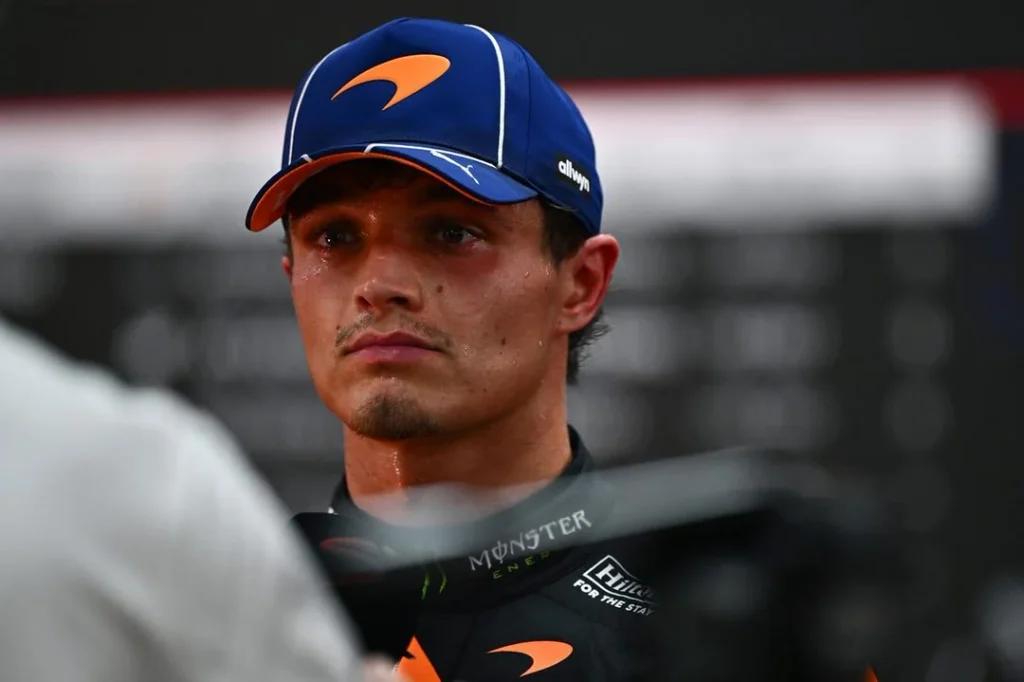
The biggest controversy emerging from the Singapore Grand Prix weekend centers on Lando Norris and Oscar Piastri, whose collision during the Sprint has developed into a much larger debate about McLaren’s management philosophy.
Norris has now publicly accepted responsibility for the incident, acknowledging that his actions were not in the team’s best interests.
“I simply got to think more of the team that I represent rather than myself. It was a mistake on my part and I let down the team,” Norris admitted.
The apology represents a significant change in tone from his immediate reaction to the collision, which drew criticism for appearing defensive and failing to fully acknowledge his responsibility. For McLaren, the incident was particularly frustrating because the team is engaged in an increasingly tight Constructors’ Championship battle with Red Bull. The collision reportedly cost McLaren eight valuable points, with the gap between the two teams now down to just seven. The potential reward from Norris’s attempted overtake was relatively small compared with the consequences of a collision. With Norris fighting for fifth in the Drivers’ Championship rather than defending a realistic title challenge, the risk-reward calculation was especially difficult to justify.
However, the intensity of the criticism has also prompted questions about whether the incident has been blown out of proportion. Formula 1 drivers are supposed to race, including against their teammates. An unsuccessful overtaking attempt should not automatically become a referendum on a driver’s character or commitment to the team. The distinction is that Norris was not simply criticized for attempting the move. Much of the backlash developed from how he handled the aftermath. Had Norris immediately acknowledged that he had misjudged the situation, the controversy might have ended much sooner. Instead, his initial comments created a second issue for McLaren to manage.
There is also a difference between holding a driver accountable for a costly mistake and turning that mistake into an excuse for personal attacks. Criticism of the driving and subsequent interviews is legitimate. Speculation about Norris’s personal life, mental health advocacy or supposed insecurities contributes little to understanding what actually happened.
Andrea Stella Makes McLaren’s Expectations Clear
McLaren team principal Andrea Stella has been unusually direct about the incident, describing the Sprint collision as unacceptable and emphasizing that the team’s interests must take precedence over those of individual drivers.
“As for what happened yesterday in the Sprint race, I said that it was an unacceptable incident, and I was very pleased that our drivers also took this view,” Stella explained.
He continued by outlining what he expects from the team’s drivers moving forward.
“We must be aware that, whether we’re at the factory, in the pit lane or in the cockpit of a car, the team’s interests take precedence over any individual’s interests.”
Stella also welcomed Norris’s willingness to assist Piastri during the closing stages of the Grand Prix.
“I was pleased with what Lando said during the final laps of the race, and I expect to see more examples of this in the future, whether expressed over the radio during the race, behind closed doors in our meetings, or when we discuss strategies.”
The comments suggest that McLaren sees the incident as an opportunity to reinforce its broader team culture rather than simply settle a disagreement between two drivers. Yet that approach introduces another complication. If Norris is running comfortably ahead of Piastri, should he be expected to sacrifice his own result to help his teammate? And would Piastri, himself a competitive racing driver, actually welcome that assistance?
During the Singapore race, Norris reportedly asked how he could help Piastri despite running approximately five seconds ahead. For some, that demonstrated a welcome commitment to the team. For others, it highlighted how far McLaren’s internal expectations may have shifted. There is an important distinction between avoiding unnecessary collisions and expecting one driver to compromise his race for the other. McLaren can reasonably demand that its drivers race responsibly without requiring them to stop competing altogether. The comparison with Daniel Ricciardo’s time alongside Norris is also interesting. McLaren did not routinely require Norris to sacrifice his position to assist Ricciardo, and Ricciardo himself reportedly made clear that he would not have wanted such assistance.
That raises questions about whether McLaren’s current expectations reflect a consistent team philosophy or the particular circumstances of its championship battle.
Is McLaren Making Its Own Problems Worse?
Another issue is the public nature of McLaren’s internal discussions.
Most Formula 1 teams attempt to handle disagreements between drivers behind closed doors, offering relatively restrained explanations to the media. McLaren, by contrast, has repeatedly explained its internal expectations in considerable detail. That transparency can be admirable, but it also creates additional scrutiny.
Every time the team establishes a public principle about equal treatment, cooperation or racing conduct, it invites questions about whether that principle is being applied consistently. And when reality becomes more complicated than the stated philosophy, McLaren can find itself defending rules it voluntarily made public. There is also a broader performance issue that risks getting lost in the controversy.
McLaren’s championship position cannot be explained by Norris’s Sprint mistake alone. The team has faced criticism throughout the season over strategy decisions, slow pit stops, reliability concerns, car drivability and upgrades that have apparently failed to deliver the expected improvements. Supporters have pointed to problems ranging from tire choices and underfueling to brake duct issues and battery-related difficulties. The concern is that McLaren is spending considerable public attention discussing driver behavior while its competitive position continues to deteriorate.
If Red Bull ultimately overtakes McLaren in the Constructors’ Championship, the Sprint collision may prove costly. But it would be an oversimplification to make Norris solely responsible for a championship campaign shaped by numerous operational and technical decisions. For Norris, the immediate challenge is to demonstrate that his apology translates into better judgment without losing the aggression that helped make him a World Champion.
For Stella, the challenge is arguably greater: maintaining accountability and cooperation without creating the impression that McLaren’s drivers are no longer free to race.
Hamilton Accepts Responsibility as Ferrari’s Singapore Strategy Unravels
While Norris faced criticism for his on-track decision-making, Lewis Hamilton experienced a different kind of disappointment in Singapore.
The Ferrari driver finished sixth after an alternative strategy failed to deliver the expected result, losing three positions during the closing stages as his tires deteriorated. Hamilton subsequently issued a detailed statement accepting responsibility for the decisions that shaped his race.
“Today wasn’t the result we were looking for and it was on me,” Hamilton explained.
“At a track that’s difficult to overtake, you need to try something different and I chose to start on a new Medium tyre, to go long and try to make a one-stop work. Unfortunately the Medium didn’t perform as well as the Soft.”
The decision to begin on mediums was intended to create a strategic advantage by extending the opening stint. However, the compound did not perform as Hamilton had hoped. Although his pace improved during the second stint, the decisive moment came during a Virtual Safety Car period.
“Under the VSC, the team called me in but I missed the entry. After that, I decided to stay out and try to hold track position to the end but in the closing laps, I was struggling massively with tyre degradation and lost three places, finishing P6,” Hamilton said.
He concluded by apologizing to Ferrari for the lost points.
“Not every call will work out, and I can accept getting it wrong but I’m sorry to the team for the points we lost today.”
Was Hamilton Trying to Beat Leclerc?
The most interesting question surrounding Hamilton’s strategy is what he hoped to achieve by remaining on track.
One interpretation is that Hamilton wanted to avoid finishing behind Charles Leclerc. Had Ferrari double-stacked its drivers during the VSC, Hamilton may have been forced to wait behind his teammate and surrender track position. Staying out offered the possibility of benefiting from a subsequent full Safety Car or somehow preserving enough tire life to maintain his position.
But it was a low-probability gamble. The alternative explanation is more straightforward: Hamilton missed the initial pit entry, and by the time another opportunity arose, the VSC advantage had disappeared. At that point, remaining on track was an attempt to minimize the damage rather than necessarily part of the original strategy.
Hamilton’s own explanation supports the latter sequence, although it does not establish exactly why he missed the entry. There has been speculation about radio communication, hesitation and the demands of monitoring his VSC delta, but the available information does not conclusively explain the moment. What is clear is that Hamilton accepted responsibility rather than attempting to shift blame onto Ferrari.
That distinction has become particularly notable when compared with the Norris controversy. Both drivers made decisions that ultimately cost their teams points. Both subsequently apologized. However, Hamilton’s decision primarily compromised his own result, whereas Norris’s mistake directly affected his teammate.
And Hamilton’s public explanation left considerably less room for disagreement about where responsibility belonged.
The Lap Times Challenge Claims That Hamilton Was Faster
One of the more contentious arguments following the race was that Ferrari should have moved Leclerc aside to release Hamilton.
The available lap-time comparisons tell a different story. Before Leclerc’s pit stop, Hamilton’s clean-air laps on soft tires were:
- 1:37.2
- 1:37.1
- 1:37.0
- 1:37.2
After his out lap on mediums, Leclerc recorded:
- 1:37.3
- 1:36.8
- 1:36.9
- 1:36.9
These figures suggest that Leclerc was not meaningfully holding Hamilton back. In fact, Leclerc quickly demonstrated stronger pace on what was nominally the slower compound. There was also a potential cost to swapping the cars. One analysis estimated that a position exchange following the VSC cost approximately 1.4 seconds. Requiring two exchanges could therefore have sacrificed roughly 2.8 seconds, although that remains an estimate rather than a confirmed simulation.
Such a loss would have been difficult to justify if Hamilton could not sustain a significant pace advantage. The numbers reinforce the argument that Leclerc was simply the quicker Ferrari driver on the day.
That does not diminish Hamilton’s abilities or suggest he was wrong to attempt an alternative strategy. It means the strategy failed to produce the circumstances necessary for success.
Ferrari’s Tire Degradation Remains a Bigger Concern
Beyond Hamilton’s individual decisions, Singapore exposed another potential weakness in Ferrari’s race performance.
The team’s tire degradation appeared particularly severe compared with its leading rivals. Leclerc initially looked capable of challenging Verstappen, but his pace faded after only a handful of laps. Hamilton’s late-race difficulties were even more dramatic, ultimately costing him three positions.
One theory is that Ferrari prioritized qualifying performance and track position at the expense of race pace, a potentially understandable decision at a circuit where overtaking is difficult. However, that approach becomes problematic when tire degradation prevents the drivers from defending the positions they gained. There is also an apparent distinction between Ferrari’s performance in different conditions. The team has looked more comfortable in damp conditions and at circuits where front-tire limitations are more significant, while rear-tire degradation appears to be a recurring weakness.
The contrast with Red Bull is especially concerning. Verstappen’s car has recently demonstrated impressive performance on soft tires, while Ferrari has struggled to maintain competitive lap times even when its drivers initially appeared well positioned.
For Ferrari, improving tire management may ultimately be more important than debating whether Hamilton should have pitted one lap earlier.
Broadcast Confusion Fuels Unnecessary Ferrari Criticism
The Hamilton incident also highlighted how incomplete television coverage can influence the interpretation of a race.
Some viewers initially believed Ferrari had simply failed to call Hamilton into the pits during the VSC. That assumption reinforced an existing narrative about Ferrari’s questionable strategy decisions. However, Hamilton’s subsequent explanation established that the team had instructed him to pit and that he had missed the entry.
The confusion was compounded by the fact that not all relevant radio communications were heard on the television broadcast. Some viewers examining onboard footage reported seeing radio activity indicators despite the corresponding conversations not being audible. The absence of that information left commentators and viewers trying to reconstruct the decision from incomplete evidence.
Once Hamilton’s explanation became available, the criticism directed at Ferrari’s pit wall looked considerably less justified. The incident illustrates why it is important to distinguish a team’s decision from a driver’s decision, particularly when television coverage provides only a partial account of the conversation.
It also raises a broader question about how Formula 1 selects which radio messages to broadcast and when.
Verstappen Emerges as Favorite in the Fight for Second
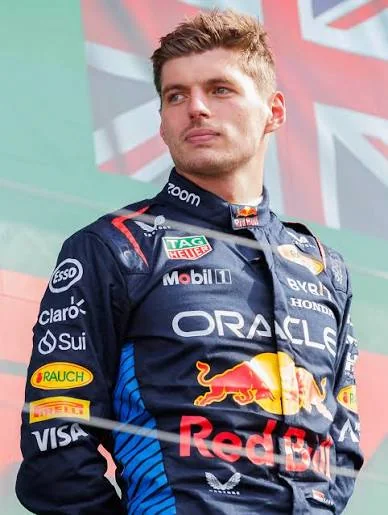
While Antonelli continues to dominate the Drivers’ Championship, the battle for second place is developing into one of the most interesting storylines of the final six races.
The standings provided following Singapore show a remarkably tight contest among five drivers.
| Driver | Points |
|---|---|
| George Russell | 238 |
| Lewis Hamilton | 229 |
| Max Verstappen | 221 |
| Charles Leclerc | 215 |
| Lando Norris | 201 |
Just 37 points separate Russell in second from Norris in sixth. More importantly, only 17 points separate Russell and Verstappen. That gap looks increasingly vulnerable given Red Bull’s recent improvement.
Verstappen has emerged as a serious contender for second place after a run of performances suggesting that Red Bull has finally delivered a car capable of consistently challenging at the front. The improvement appears particularly noticeable in acceleration and race pace, with Red Bull arguably enjoying a slight performance advantage over its closest rivals during the last two races.
That represents a significant change from earlier in the season, when Verstappen frequently had to compensate for limitations in the car.
Can Verstappen Still Challenge Antonelli?
Mathematically, the championship is not entirely settled under the six-race scenario discussed.
However, the gap between Antonelli and Verstappen stands at 119 points. With a maximum of 150 points available from six Grands Prix, Verstappen would need an extraordinary combination of victories and poor results for Antonelli. One calculation suggests Antonelli needs only 31 additional points to eliminate Verstappen’s mathematical challenge, assuming Verstappen wins every remaining race.
Even a series of seventh-place finishes would be sufficient. There is also uncertainty surrounding the final two rounds, and any reduction in the number of remaining races would further strengthen Antonelli’s position. The realistic battle is therefore for second, rather than the championship itself.
Verstappen’s recent form makes him a compelling candidate, but it would be premature to assume that Russell will simply surrender the position. Russell remains ahead on points, and Mercedes has demonstrated that it can deliver exceptional performances when circumstances favor the car. Nevertheless, the direction of development is becoming increasingly important.
Red Bull appears to have found meaningful performance, while Mercedes has faced questions about the effectiveness of its recent upgrades. Verstappen’s championship points trajectory has also changed noticeably since Zandvoort, with his recent scoring rate approaching Antonelli’s.
That is not proof that Red Bull will maintain its advantage at every remaining circuit, but it provides a stronger basis for predicting Verstappen’s rise than simply reacting to one successful weekend.
Ferrari and McLaren Could Decide the Outcome
The battle for second will not be determined by Verstappen and Russell alone.
Hamilton remains just nine points behind Russell, while Leclerc is only six points behind Verstappen. Ferrari has demonstrated strong qualifying performance, but its race pace and strategy execution remain concerns. McLaren faces a different problem.
Norris is 37 points behind Russell, and the team’s apparent loss of competitiveness makes a recovery increasingly difficult. The upcoming races could favor different cars, potentially allowing the order to change repeatedly. Verstappen may have the strongest recent momentum, but his starts and remaining power unit allocation could become factors. There is also the possibility of another grid penalty, which would be particularly damaging at a circuit where overtaking is difficult.
The championship runner-up battle therefore remains open, even if the World Championship itself appears firmly under Antonelli’s control.
Russell’s Extraordinary 60-Place Grid Penalty Revives Debate Over F1’s Rules
George Russell’s weekend was complicated by one of the most unusual penalty totals seen in recent Formula 1 history.
The Mercedes driver received an additional 20-place grid penalty, bringing his accumulated total to 60 positions. According to the FIA document provided, Russell’s latest penalties resulted from using a fourth Energy Store and a fourth Control Electronics unit. Each additional component carried a 10-place penalty, producing the extra 20-place drop.
The FIA cited Articles B8.2.2 and B8.2.3 of the Formula 1 Regulations, with the penalties imposed under Article B8.2.8. Despite accumulating 60 places in penalties, Russell could only be moved to the back of the actual grid.
That creates an obvious question: what is the practical difference between a 20-place penalty and a 60-place penalty when the driver is already starting last?
Is 60 Places a Record?
Russell’s total is extraordinary, but it does not appear to surpass the historical benchmark discussed by fans.
Jenson Button was reportedly handed a 70-place grid penalty at the 2015 Mexican Grand Prix during McLaren-Honda’s difficult period. That era also produced other enormous accumulated penalties, including weekends in which Button and Fernando Alonso received a combined total exceeding 100 grid positions. Russell’s penalty therefore joins an unusual historical category rather than establishing an undisputed new record.
The underlying issue remains the same: Formula 1’s grid penalty system can produce numbers that exceed the number of positions available to lose.
Should Unserved Grid Penalties Carry Over?
One proposed solution is to require drivers to serve the entire penalty, even if it takes multiple races.
Under that approach, a driver who receives a 60-place penalty but can only drop 19 positions would carry the remaining 41 places into subsequent Grands Prix. That would make every penalty position meaningful. However, the consequences could be excessive.
A driver already struggling with unreliable equipment could be forced to start near the back for several consecutive races, potentially destroying a championship challenge through circumstances largely outside their control. For teams regularly qualifying toward the rear, the problem could become even worse. A driver might theoretically accumulate penalties faster than they could serve them.
Alternative proposals include converting excess grid penalties into race-time penalties or creating a fixed sanction once the accumulated total exceeds the length of the grid. But those approaches also introduce complications. A time penalty could have a very different impact depending on the circuit, race conditions and competitive position of the driver.
There is also a fundamental distinction between penalties for dangerous driving and penalties for replacing mechanical components. The latter often punish drivers for reliability problems they did not create. That makes the idea of carrying enormous penalties across multiple weekends particularly difficult to justify. Ultimately, Russell’s 60-place penalty illustrates a system that can appear absurd without necessarily requiring an even harsher replacement.
The purpose should be to discourage excessive component usage, not to make a driver’s season uncompetitive because of accumulated mechanical failures.
F1 Fans Want to See Racing, Not Just the Leaders Circulating
Beyond the sporting controversies, the Singapore Grand Prix reignited frustration with Formula 1’s television direction.
The central complaint is simple: too much attention is being given to the leading cars when more interesting racing is happening elsewhere. Russell and Isack Hadjar were among the drivers making recovery drives, yet viewers complained that many of their overtakes were relegated to small picture-in-picture windows or shown only in replays. At the front, cameras frequently remained focused on cars circulating with little immediate prospect of an overtake.
That is particularly frustrating at a circuit where passing opportunities are already limited. If there are only a handful of meaningful battles during a race, surely those battles should receive priority. One viewer noted that Russell had already overtaken 10 cars while much of the television coverage remained focused elsewhere.
Another example involved a battle between the Haas teammates, which commentators reportedly discussed despite the action appearing only in a small window rather than the main broadcast. The problem is not necessarily that Formula 1 has no racing to show.
It is that the racing taking place is not always what the audience gets to watch.
Even Commentators Appear Frustrated
Viewers have increasingly noticed commentators drawing attention to battles that are not being shown prominently.
Martin Brundle and David Croft have reportedly made remarks about wanting to see particular incidents or questioning why the broadcast is focused on relatively uneventful footage. On F1 TV, commentators were similarly observed describing battles taking place in smaller windows. The significance is that these criticisms are no longer limited to viewers discussing the race afterward.
When commentators repeatedly direct attention toward action outside the main picture, it reinforces the perception that the broadcast is failing to prioritize the most interesting racing. Of course, commentary teams do not necessarily control the pictures they receive. They are often reacting to the same production choices as the audience.
That can create an awkward situation in which the commentators are effectively telling viewers that something more interesting is happening somewhere else.
Bathurst Provides an Uncomfortable Comparison
Some fans compared Singapore’s television coverage with the Bathurst race held the same day.
The contrast was described as striking. At Bathurst, cameras were frequently focused on close battles throughout the field, even when those battles involved cars running well outside the leading positions. The implication is that motorsport television does not need to concentrate exclusively on the leaders to create an engaging broadcast.
A fight for 24th can be compelling if the drivers are racing closely. Conversely, watching the leading cars circulate several seconds apart can become tedious regardless of their championship positions. The comparison also challenges the idea that F1’s enormous production resources automatically translate into superior coverage. Formula 1 has access to extensive camera systems, onboard feeds, timing information and advanced visual effects.
Yet viewers are still complaining that relatively straightforward midfield overtakes are being missed.
Is the Problem the Broadcast, the Cars or the Circuits?
Not everyone agrees that television direction is the primary issue.
Some argue that the regulations have produced cars that struggle to race closely, making overtaking increasingly difficult. Others point toward circuit design, particularly layouts that provide limited passing opportunities. There is also an ongoing debate about whether Formula 1 can simultaneously demand more overtaking while rejecting artificial assistance and other mechanisms designed to create passing opportunities.
The reality is that these issues are interconnected. Regulations influence how closely cars can follow. Circuit layouts influence where overtaking is possible.
Tire performance and strategy create differences in pace. Television direction determines how much of that action the audience actually sees. A poor circuit cannot be transformed into a classic simply through better camera selection. But poor television direction can certainly make an already difficult race less entertaining.
And when overtaking opportunities are limited, capturing the ones that do happen becomes even more important.
Spectacular Pit Stop Camera Effects Highlight F1’s Broadcast Contradiction
The debate over television direction became particularly relevant after a visually impressive replay of Verstappen’s Singapore pit stop attracted attention.
The sequence appeared to transition smoothly from an external pit stop camera into the onboard perspective as Verstappen departed his pit box. The effect impressed viewers and prompted considerable discussion about how it was created. Some suggested that the transition involved Gaussian splatting, a technique used to reconstruct three-dimensional scenes from visual information.
Others argued that generative artificial intelligence was more likely, particularly given the limited time available to prepare a replay during a live sporting event. There was also speculation that the production could combine existing three-dimensional models, camera footage and AI-assisted processing. However, no official technical explanation from Formula One Management or the broadcast production team was included in the material available.
It would therefore be premature to identify any particular technique as the definitive method. What is clear is that the transition demonstrates how sophisticated F1’s television presentation has become. That makes the criticism of missed overtakes even more pointed.
The broadcast can deliver elaborate camera transitions, yet viewers are still asking why a battle between two midfield cars cannot receive the main picture.
The Return of the Spinning Camera
Another pit stop camera effect generated a less enthusiastic response.
During a separate sequence, the broadcast used a rotating camera movement that appeared to spin around during the pit stop. Several viewers reported that their feeds froze or glitched during the rotation. The issue was reported across multiple platforms, suggesting it was not simply an isolated problem with one viewer’s internet connection.
The effect itself divided opinion. Some found it entertaining and appreciated the physical camera movement. Others compared it to an outdated PowerPoint transition and questioned whether it added anything meaningful to the coverage.
The freezing made the sequence particularly awkward, with some viewers initially believing the camera had been dropped. There were also questions about the use of AI-assisted imagery in sponsor-heavy environments. If a visual effect reconstructs portions of a car or surrounding scene, distorted lettering or logos could create complications for commercial partners.
For now, that remains a broader consideration rather than evidence of a particular production method. The bigger question is whether Formula 1’s priorities are aligned with what its audience actually wants. Visual innovation can enhance a broadcast, but it should complement the racing rather than distract from it.
The recurring request from viewers is not especially complicated: show the overtakes, keep the battles visible and provide better access to timing and driver-tracking information. Some have suggested persistent multi-camera feeds, a permanently visible track map or additional simultaneous views. Those ideas would give audiences greater control over how they follow the race.
And if F1 can develop increasingly elaborate replay effects, it should also be capable of improving the presentation of basic wheel-to-wheel action.
Crofty’s Cooldown Room Apologies Spark Another Broadcast Debate
Formula 1’s television presentation also became the subject of a lighter controversy following the Singapore Grand Prix.
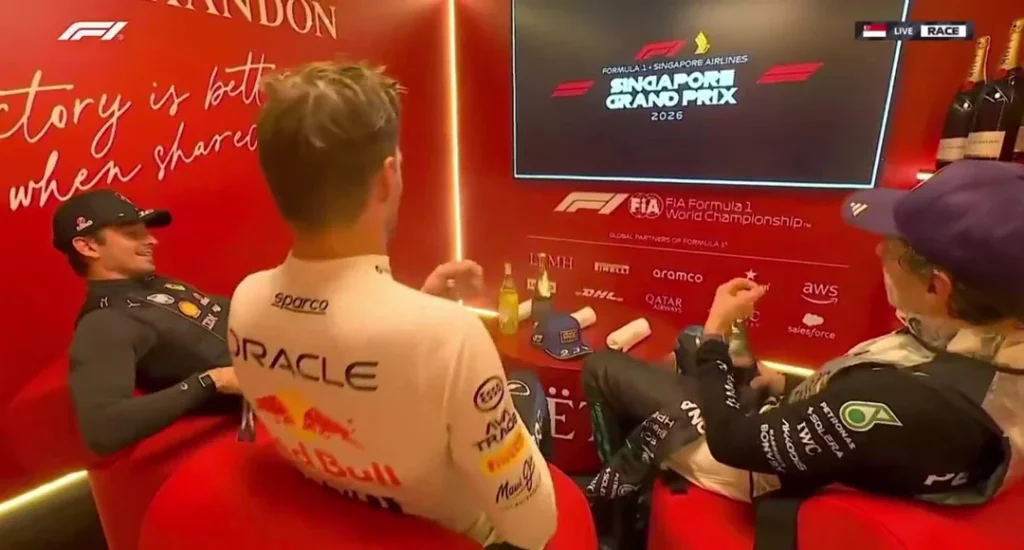
During the cooldown room coverage, David Croft apologized for language used by Verstappen.
“I apologize for Max Verstappen’s language in the cooldown room,” Croft said.
Moments later, Leclerc exclaimed, “Freaking hell.”
Croft promptly added, “And for Charles Leclerc.”
The exchange prompted debate over whether broadcasters should apologize for spontaneous language from drivers immediately after an exhausting race. One argument is that Formula 1 should embrace genuine reactions rather than attempt to sanitize them. Drivers spend hours operating under enormous physical and mental pressure. Their immediate responses after a race are not always going to resemble carefully prepared corporate statements.
Indeed, many fans have complained that modern Formula 1 drivers are too guarded in interviews. When drivers finally show unfiltered emotion, criticizing their language can seem contradictory. However, Croft’s apologies also need to be understood within the context of British broadcasting standards.
The United Kingdom operates a television watershed, generally beginning at 9 p.m., after which more adult content can be broadcast. Broadcasters covering live sporting events during the day must therefore consider the possibility of inappropriate language reaching audiences that include children. The fact that Formula 1 is broadcast internationally adds another complication.
Attitudes toward profanity vary considerably between countries. In the Netherlands, for example, viewers described a much more relaxed approach to swearing on television and radio. What seems unremarkable in one market can create regulatory concerns in another.
There is also a practical difficulty with introducing a broadcast delay. Some viewers would welcome a short delay to allow inappropriate language to be removed. Others would complain that censoring the drivers undermines the authenticity of live coverage. Croft’s response may therefore be less about personally objecting to the language and more about meeting the expectations placed on the broadcaster.
Still, the incident demonstrates another tension in modern Formula 1: fans want drivers to be authentic, but broadcasters must package that authenticity for audiences with different expectations and regulations.
Singapore Begins Rapid Circuit Teardown as City Returns to Normal
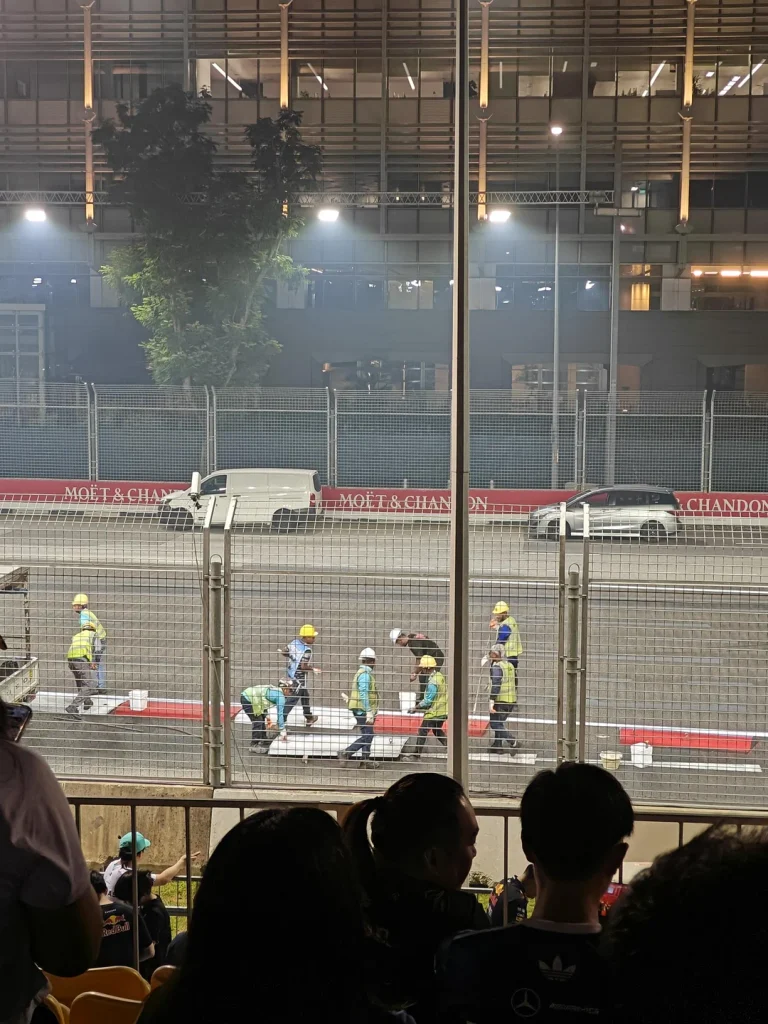
While much of the Formula 1 community continues debating the race, Singapore has already begun dismantling its temporary circuit infrastructure.
Images of curbs being removed shortly after the Grand Prix attracted attention for the speed of the operation. According to an individual who identified themselves as working at the Singapore Grand Prix, selected vehicles were expected to regain road access by midnight following the race, with the full public reopening scheduled for Tuesday. The turnaround is particularly impressive considering the scale of the event and the location of the circuit.
Singapore’s track sits near the central business district, with several important roads providing access to major financial and commercial areas. The circuit also affects access around significant government buildings, making the rapid restoration of normal traffic a priority. Unlike a permanent racing facility, a street circuit must coexist with the everyday needs of the surrounding city. Every additional day of road closures creates inconvenience for residents, commuters and businesses.
That makes dismantling the infrastructure almost as important as building it in the first place.
Experience Makes the Difference
Singapore has now accumulated extensive experience organizing its Grand Prix.
With the event having been staged repeatedly over nearly two decades, the organizers have had numerous opportunities to refine their installation and removal procedures. The relatively consistent circuit layout also provides an advantage. Teams responsible for dismantling barriers, curbs, fencing and other temporary structures can work from established procedures rather than reinventing the operation each year.
That experience likely contributes to the impressive turnaround. The speed also highlights an often-overlooked aspect of street circuit racing. Fans see the finished track, grandstands and hospitality facilities during the event, but the logistical work required before and after the Grand Prix is enormous.
The discussion also raised questions about the working conditions behind such rapid operations. Efficiency is worth celebrating, but it should not automatically be treated as evidence that every aspect of the operation is ideal. Labor practices, staffing and worker welfare remain relevant considerations when evaluating major-event logistics. Comparisons with events such as the London Marathon illustrate that many cities are capable of reopening roads quickly after large sporting events, although the infrastructure involved can be quite different. Singapore’s rapid teardown is therefore impressive without necessarily being unique.
For the city, the priority is straightforward: restore normal operations as quickly as possible after the spectacle has ended.
A Championship Nearly Decided, but Plenty of Questions Remain
The Singapore Grand Prix has left Formula 1 in an unusual position.
At the front of the Drivers’ Championship, Antonelli’s advantage appears almost insurmountable. Yet the fight behind him is becoming increasingly compelling. Verstappen has emerged as a genuine threat to Russell’s second place, while Hamilton, Leclerc and Norris remain close enough to influence the final standings.
The Constructors’ Championship is also creating significant pressure, particularly at McLaren. Norris’s Sprint collision has intensified scrutiny of the team’s driver management, but McLaren’s technical and operational difficulties remain equally important to its championship prospects. Ferrari faces its own questions after Hamilton’s strategy gamble and another race in which tire degradation limited its competitiveness.
Russell’s extraordinary grid penalties have revived a longstanding debate about whether Formula 1’s sporting regulations produce meaningful or occasionally absurd consequences. And away from the teams, the frustration surrounding television direction suggests that the sport’s presentation is becoming a major talking point in its own right. There is a certain irony in a weekend when fans praised a sophisticated pit stop camera transition while simultaneously complaining that they could not watch the overtakes happening elsewhere on the circuit.
Formula 1 does not lack technology, production resources or compelling storylines. But those resources only matter if they improve the experience of following the racing. As the championship heads toward its final six scheduled rounds, the biggest question may no longer be who wins the title. Instead, attention is shifting toward who finishes behind Antonelli, whether Red Bull can complete its recovery, whether McLaren can resolve its internal and competitive problems, and whether Ferrari can convert qualifying speed into stronger race results.
The championship leader may be comfortably ahead, but the rest of Formula 1 is anything but settled.