

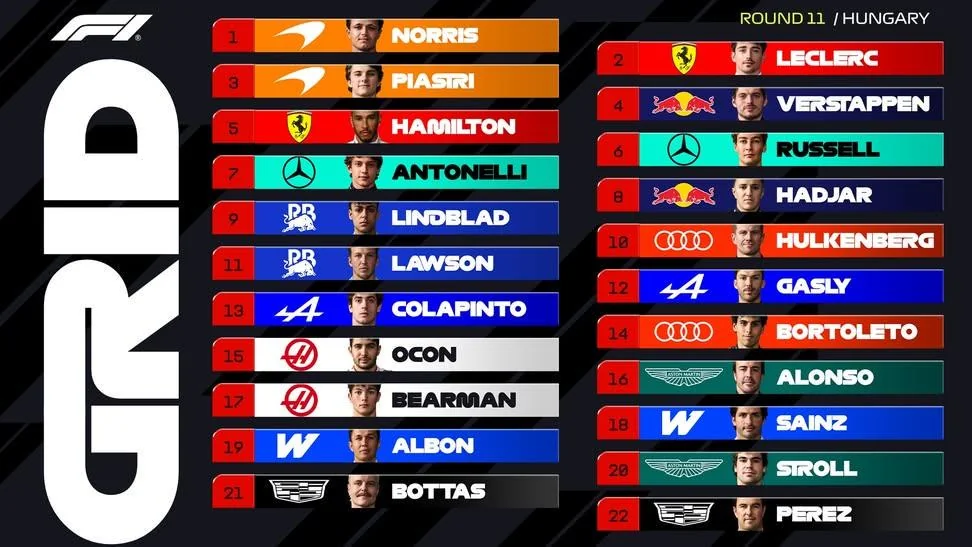
Lando Norris claimed pole position for the Hungarian Grand Prix, but the final qualifying order only told part of the story.
Lewis Hamilton initially completed a McLaren-Ferrari front three by qualifying second ahead of Charles Leclerc, while Max Verstappen endured another alarming session in an increasingly unpredictable Red Bull. By the end of the evening, however, penalties for Hamilton and Kimi Antonelli had transformed the starting grid and promoted Oscar Piastri from fifth to third without him needing to complete another lap. The final top 10 was Norris, Leclerc, Piastri, Verstappen, Hamilton, George Russell, Antonelli, Isack Hadjar, Arvid Lindblad and Nico Hülkenberg. That leaves Norris on pole with Leclerc alongside him, Piastri directly behind his teammate and Verstappen sharing the second row with a McLaren. Hamilton and Russell will start together on the third row, while Antonelli drops behind both after his own stewards’ decision.
It is a grid that promises an unusually tense run to Turn 1.
Norris Delivers as McLaren Returns to the Front

Norris produced the fastest lap when it mattered and extended his run of consecutive Q3 appearances to 42.
McLaren had looked competitive throughout qualifying, although the final session became more complicated for Piastri. He was forced to abandon a push lap after encountering Hamilton moving slowly on the racing line approaching Turn 1. Piastri could see Hamilton from the start line and expected the Ferrari to move. Instead, he closed rapidly, was forced to run wide and responded with a visibly sarcastic thumbs-up. His frustration was understandable. The incident eliminated one of his final opportunities to challenge the front of the grid and added to a sequence of weekends in which circumstances have repeatedly worked against him.
This time, however, the stewards’ room gave him back some of what he had lost. Hamilton’s penalty promoted Piastri one position, while Antonelli’s separate grid drop moved him up again to third. The race had not even started, yet Piastri had already gained two places.
That promotion gives McLaren a powerful strategic position. Norris controls the start from pole, while Piastri begins directly behind Leclerc and can immediately pressure the Ferrari separating the two McLarens.
Ferrari’s Strongest Qualifying Undermined by Another Avoidable Error

Ferrari’s pace was one of the clearest positive stories of the session.
Hamilton initially qualified second, with Leclerc third, putting both cars in immediate contention at a circuit where track position may be especially valuable. Hamilton even stopped beside the first-place board after qualifying, seemingly unaware that Norris had beaten his time. The confusion continued after the session. Hamilton was investigated for impeding Piastri and later received a three-place grid penalty. The FIA determined that Hamilton had been travelling at a significantly reduced speed on the racing line while Piastri approached on a push lap.
Piastri was forced to take avoiding action, run wide and abort his lap. Hamilton explained that he had just completed a fast lap and did not receive Ferrari’s warning until Piastri was already close. He also said Piastri was not visible in his mirrors because of his position on the track. Ferrari team principal Frederic Vasseur accepted responsibility.
“We told him about Piastri, but it was far too late,” Vasseur said. “If there’s a mistake, it’s our mistake.”
The penalty itself was difficult to dispute. Hamilton was moving slowly on the racing line, Piastri had to avoid him and the lap was ruined. The more damaging question for Ferrari is why the situation was allowed to develop at all. On a weekend when both cars had the pace to start inside the top three, a late warning turned Hamilton’s front-row position into fifth. Ferrari had an opportunity to capitalize while Mercedes suffered reliability problems and Red Bull struggled for balance, but another operational error immediately reduced that advantage. Hamilton still starts within reach of the leaders, but passing his way back toward the front will be more difficult than simply defending from the front row.
Ferrari produced the speed required to challenge McLaren. It did not produce the execution required to protect the result.
Verstappen Calls Red Bull “Completely Broken”
Verstappen qualified fourth after a session that became progressively more chaotic.
He spun during Q3 and immediately described the car as “completely broken aerodynamically.”
“It’s just getting worse and worse,” Verstappen said. “What a joke. What a shit weekend.”
The frustration was supported by more than driver emotion. Verstappen said Red Bull could see a loss of downforce in its data, connected to the rear wing, and that the handling deteriorated as the session continued.
“We don’t have tyre degradation, we have car degradation,” he said.
The exact technical cause remains unclear, but the observable problem was consistent: the car became more difficult to control as qualifying progressed. Both Verstappen and Hadjar complained about the balance, and both appeared exhausted by the experience afterward. Verstappen’s anger was accompanied by resignation, while Hadjar’s post-qualifying reaction suggested he had little confidence that the car could deliver what the drivers needed. The most important concern for Red Bull is not simply that the car lacked pace. Verstappen repeatedly described a machine that was losing aerodynamic performance and becoming less predictable.
That instability appeared to contribute to the spins and moments that defined the session. Verstappen’s eventual promotion to fourth improves his starting position, but it does not solve the problem underneath him. He now begins directly behind the leaders and alongside Hamilton, yet Red Bull must determine whether its car can maintain performance throughout a full race.
A strong launch could place Verstappen in the fight immediately. A worsening balance could send him backward just as quickly.
Antonelli Penalized for Insufficient Yellow-Flag Lift
Verstappen’s spin also triggered one of the other major post-qualifying decisions.
The incident was covered by a single waved yellow rather than double yellows because Verstappen’s car was away from the racing line and no marshals were exposed. A single yellow requires drivers to reduce speed, remain in complete control and be prepared to alter their line. Double yellows are generally used when the danger is on or close to the racing surface, the track is obstructed or personnel are exposed. Antonelli did lift after seeing the yellow flag and light panel, but the FIA concluded that the reduction was too brief and too small.
Telemetry showed that Antonelli lifted 16 meters earlier and entered the yellow-flag sector 14 km/h slower than on his previous push lap. However, because he applied less braking into the corner, he was travelling 3 km/h faster when he passed Verstappen’s car. His mini-sector time was only 0.03 seconds slower than his best, representing a speed reduction of less than one percent. The stewards therefore determined that Antonelli had not slowed sufficiently.
The normal recommended penalty was a five-place grid drop, but it was reduced to three because Antonelli had made an attempt to slow and had limited time and distance to react. The incident highlighted the difference between merely acknowledging a yellow flag and meaningfully reducing speed. Antonelli lifted, but the telemetry showed that he was effectively still driving at close to qualifying pace when he reached the danger.
He drops from fourth to seventh as a result.
Russell’s Qualifying Ends with Coolant on the Rear Tires

Mercedes’ problems were not limited to Antonelli’s penalty.
Russell was instructed to stop after the team discovered a coolant issue. The leak reportedly deposited fluid around the rear of the car and onto the tires, costing him grip and preventing him from showing his full pace. The problem also exposed how little of the situation was communicated to viewers during the session. Russell’s slowing car and the cause of his difficulties received limited attention while several other incidents dominated the broadcast. He eventually qualified sixth after the penalties were applied, directly behind Hamilton and one place ahead of Antonelli.
Mercedes therefore retains both cars in the top seven, but the reliability concern again hangs over its race prospects. Ferrari’s operational errors may have cost it positions, but Mercedes must first ensure its cars can complete the distance without further technical trouble.
Aston Martin Improves While Williams Collapses

Further down the order, Aston Martin reached Q2 for the first time this season.
The result was only 16th on the grid, but the performance represented a noticeable step forward for a team that had previously struggled to escape the first stage of qualifying. Its progress looked even more striking when compared with Williams. Alex Albon delivered a damning assessment over the radio, complaining that he was being forced to drive qualifying laps as though they were race laps. The car did not provide the grip or confidence required to push at the limit.
Williams had been significantly faster than Aston Martin just one week earlier. In Hungary, the order was reversed. The circuit’s aerodynamic demands exposed Williams’ weaknesses, leaving both Albon and Carlos Sainz frustrated with a car that could not be attacked in qualifying trim. The wider concern is the scale of the team’s regression. Williams dedicated substantial attention to the current regulations, yet its drivers are now openly describing a car that cannot be driven with normal qualifying aggression. The frustration does not necessarily mean either driver has a realistic alternative elsewhere. The leading teams have established line-ups, and most potential moves would be sideways rather than forward.
For now, Albon and Sainz must find answers inside Williams.
A Front Row Built for Tension
After the penalties, Norris will lead Leclerc, Piastri and Verstappen toward Turn 1.
Behind them, Hamilton and Russell share the third row, Antonelli starts beside Hadjar and Lindblad lines up ahead of Hülkenberg. Each row carries its own story. Norris must protect pole from Leclerc.
Piastri can attack the Ferrari while also supporting McLaren’s strategic advantage. Verstappen starts high enough to challenge despite having little trust in his car. Hamilton must recover the places Ferrari lost through its own communication failure.
Russell must manage a car that suffered a coolant problem. Antonelli must regroup after a penalty that turned a second-row start into seventh. Qualifying delivered Norris the pole, but it also exposed weaknesses across nearly every team around him.
McLaren has the strongest grid position. Ferrari has the pace but must clean up its execution. Red Bull has Verstappen near the front but cannot explain why its car keeps getting worse. Mercedes has both drivers in contention but continues to fight reliability and penalty trouble.
The Hungarian Grand Prix now begins with Norris in control—and uncertainty everywhere behind him.