

The Azerbaijan Grand Prix may be over, but Formula 1 is still unpacking plenty from Baku while already moving on to Malaysia.
Lando Norris has apologized to Franco Colapinto for comments made immediately after their collision, George Russell has officially joined one of F1’s more exclusive statistical clubs, Pirelli is already looking toward more tire degradation in 2027, and Max Verstappen’s race radio offered another reminder of just how much strategic work happens behind the scenes. Away from the track, McLaren Racing is reportedly on course for $1 billion in revenue, Williams has somehow found yet another unexpected collaboration, and the debate around what F1 Academy is actually supposed to accomplish continues.
And because apparently Baku wasn’t enough chaos for one week, a group of drivers is already treating the trip to Malaysia like the beginning of The Hangover.
Norris apologizes to Colapinto after Baku comments
Lando Norris has apologized to Franco Colapinto following comments he made in the immediate aftermath of their Azerbaijan Grand Prix incident.
Norris wrote on Instagram:
“Tough weekend overall in Baku and of course a disappointing and early end to the race. After the race, I sent Franco a message apologising for the comments I made that I simply should not have said. I know better and emotions were running high but that is not an excuse, it was wrong of me. I’ve made mistakes of my own over the years and I know this is very much a part of racing and fighting on the limit. Me and Franco came to a good understanding, are still good friends and are both excited to get back racing this weekend.”
It was pretty obvious at the time that Norris was furious. This wasn’t somebody calmly sitting down hours later and deciding to launch an attack on another driver. The race was still going on. Norris had just been eliminated, his weekend had already been difficult, and the crash had potential consequences extending beyond that afternoon. That doesn’t make everything he said appropriate, and Norris clearly knows that. The most important part of the story is that he contacted Colapinto directly, apologized, and says the two reached an understanding.
That should probably be the end of it. The strange part of modern Formula 1 is that fans constantly demand more personality and less PR-polished language from drivers, only to erupt the moment somebody actually sounds like a human being. Drivers are interviewed while the adrenaline is still flowing, often almost immediately after climbing from the car. Sometimes they’re going to say something too harsh. Sometimes they’re going to regret it.
Norris did. Then he apologized. That is arguably more authentic than pretending the initial reaction never happened.
The bigger concern is how quickly these moments now become fuel for online tribalism. The problem isn’t confined to one nationality or one fanbase. As F1 grows, the loudest corners of social media can take a relatively simple racing dispute and turn it into something far uglier within minutes. We have already seen drivers including Pierre Gasly, Yuki Tsunoda, Jack Doohan and Esteban Ocon dragged into similar waves of abuse. There is also an uncomfortable contradiction in how F1 content works now.
Fans want immediate access. Broadcasters want immediate reactions. Media outlets want the quote while emotions are still raw. Then everybody acts surprised when the quote sounds emotional. The sport can’t have both complete access and permanently sanitized responses. In this case, Norris said something he shouldn’t have, recognized it, and dealt with it directly with Colapinto.
Malaysia gives everyone something else to talk about.
George Russell joins the Grand Slam club
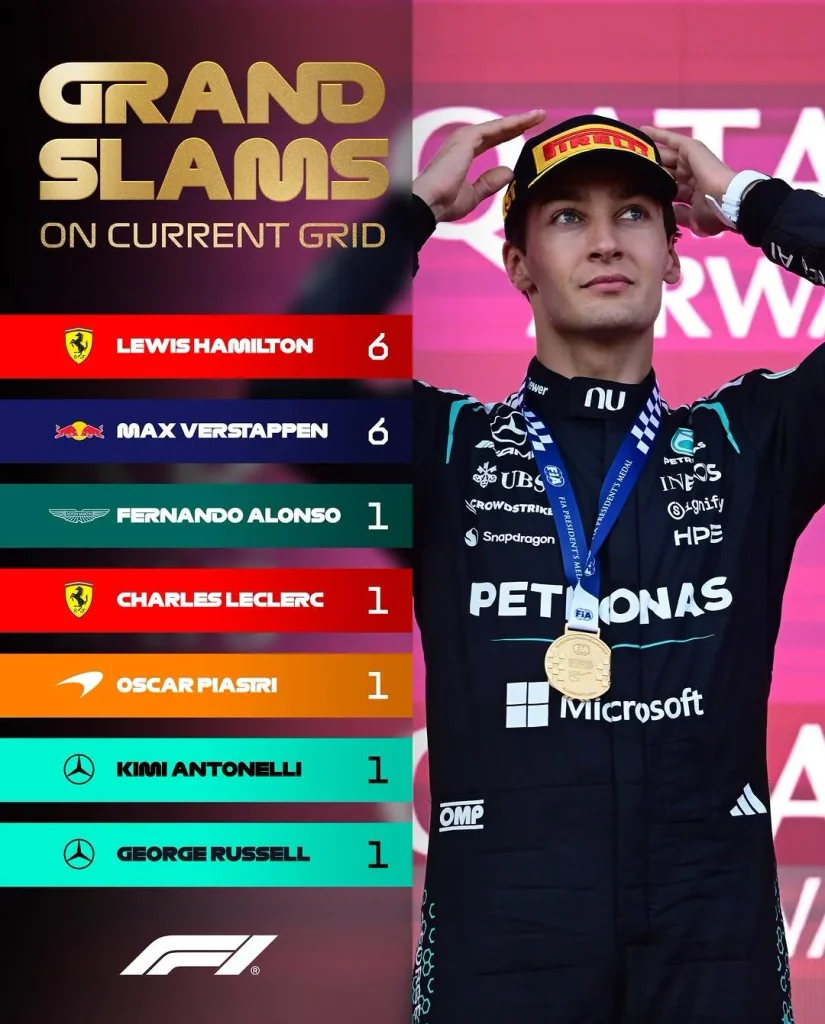
George Russell’s Azerbaijan Grand Prix weekend has also added him to a very exclusive statistical list.
Russell became the latest driver to record an F1 Grand Slam: pole position, race victory, fastest lap and every lap led. Among the current grid, the totals supplied by F1 are:
- Lewis Hamilton: 6
- Max Verstappen: 6
- Fernando Alonso: 1
- Charles Leclerc: 1
- Oscar Piastri: 1
- Kimi Antonelli: 1
- George Russell: 1
Only 29 drivers in Formula 1 history have recorded a Grand Slam, and only 14 have managed more than one. Every driver with multiple Grand Slams has also won a world championship: Jim Clark, Hamilton, Verstappen, Alberto Ascari, Michael Schumacher, Jackie Stewart, Ayrton Senna, Nigel Mansell, Sebastian Vettel, Nelson Piquet, Juan Manuel Fangio, Jack Brabham, Mika Häkkinen and Nico Rosberg. Russell came remarkably close to going even further in Baku.
The informal “Ultimate Grand Slam” adds topping every practice session and every qualifying segment to the usual Grand Slam requirements. Russell was fastest everywhere except FP3, where Verstappen beat him by just 0.099 seconds.
That was the only session standing between Russell and an almost complete weekend sweep. Charles Leclerc’s lone Grand Slam, meanwhile, came in Australia in 2022, one of the most dominant weekends of his Ferrari career. The early part of that season now feels like another universe. Leclerc also looked dominant in Spain that year before his engine failure, while Bahrain 2019 remains another obvious example of a race in which his performance deserved more than the result ultimately showed.
There is a tendency to reduce Leclerc’s career into either “Ferrari always ruins it for him” or “Charles throws away his own chances.”
Neither extreme is particularly useful. France 2022 remains the most obvious example of Leclerc costing himself a potential victory. But there have also been multiple weekends where machinery or strategy took a result away. The more interesting point is just how rare the Grand Slam itself remains.
Pole and victory are hard enough. Adding fastest lap and leading every lap means nothing can really go wrong anywhere in the race.
Russell managed exactly that in Baku.
Norris keeps missing his Grand Slam by one fastest lap
There is also a slightly cruel statistical footnote here for Norris.
He has already produced weekends that were effectively Grand Slam-caliber without officially receiving the designation. Singapore 2024 and Abu Dhabi 2024 both slipped away because another driver claimed fastest lap late in the race. Daniel Ricciardo took the Singapore fastest lap in his final race, while Norris was again denied in Abu Dhabi. George Russell took fastest lap in Mexico 2025, while Alex Albon did the same in Brazil 2025.
The 2019 rookie class apparently enjoys ruining each other’s statistics.
Verstappen’s Baku radio showed why patience mattered
A transcription of Max Verstappen and Isack Hadjar’s Baku radios also offered a fascinating look at the amount of work happening during a race that viewers barely notice.
The most memorable moment came when Verstappen observed:
“These softs can easily last half of the race.”
Gianpiero Lambiase responded:
“It’s track position and risk, just be patient.”
That exchange ended up mattering. There was an obvious temptation to react to Oscar Piastri and attempt an undercut, but Red Bull stayed patient. Given how durable the soft tire ultimately proved to be, rushing into a stop would have sacrificed track position without necessarily creating enough strategic upside.
Sometimes strategy is less about making something happen and more about refusing to panic because somebody behind you has made the first move. The radios also demonstrated just how absurdly busy modern F1 drivers are inside the cockpit. Engineers are constantly requesting changes while drivers themselves are adjusting settings such as brake bias from corner to corner.
All of this happens while they’re driving faster than virtually anybody else on Earth could manage. There is also apparently a separate skill possessed only by GP: understanding Max Verstappen. To everybody else, Verstappen’s radio can occasionally sound like somebody dropped a microphone into a washing machine. To GP?
“Understood, Max.”
Maybe years of context allow him to fill in the missing pieces. Maybe his audio feed is better. Or maybe GP occasionally has absolutely no idea what Max just said and knows that if it actually matters, Verstappen will repeat it.
Either way, it’s a relationship built on an impressive amount of shorthand.
Baku may have made Pirelli’s 2027 problem impossible to ignore
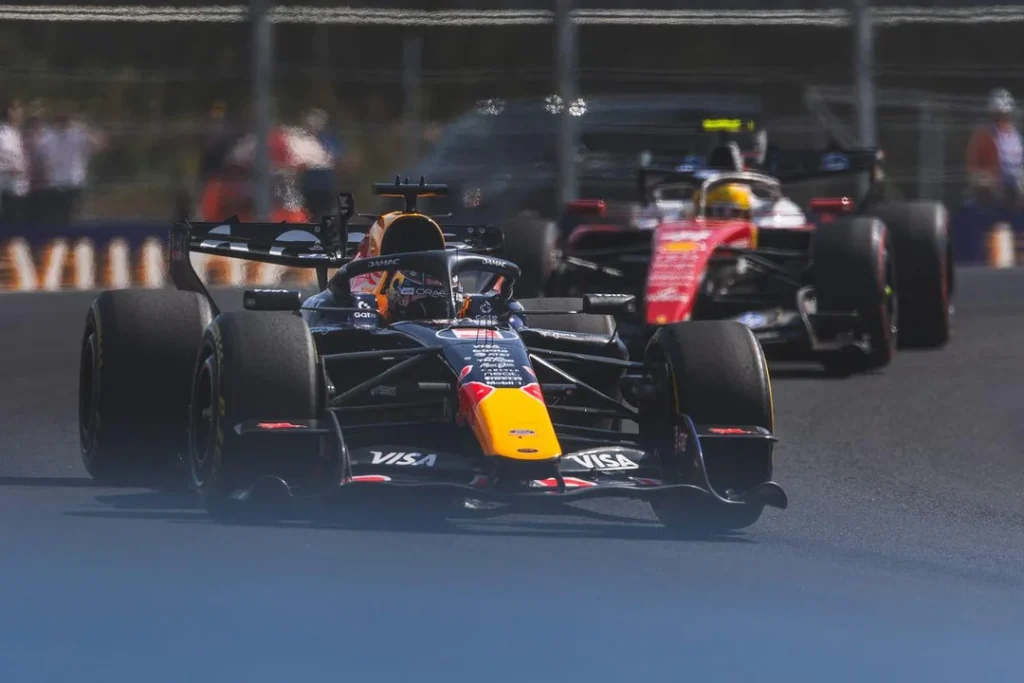
That Verstappen could casually observe that the soft tire would last half the race leads directly into another story.
Formula 1 is reportedly planning higher-degradation tires for 2027. After Baku, that conversation practically writes itself. We just watched a race in which the softest available tire was capable of going an enormous distance.
At some point, calling something a “soft” tire starts becoming a branding exercise.
But blaming Pirelli alone misses some important context. The 2026 regulations changed how the cars behave, and Pirelli did not have the luxury of conducting all of its development work using actual 2026 machinery before the season began. Testing was done using modified 2025 cars with reduced downforce, but those still weren’t truly representative of what eventually appeared on track. It also makes sense that Pirelli would err toward durability.
An overly conservative tire might produce a boring one-stop race. An overly fragile tire can produce failures. Only one of those becomes a serious safety and reputational disaster.
The regulations themselves may also be contributing to the lack of degradation. Drivers have discussed not being able to attack corners at the limit throughout races in the way they once could. If the car isn’t being driven at its absolute limit, the tires aren’t necessarily being tortured at their limit either. And Baku’s tire allocation couldn’t simply have gone softer.
Pirelli brought the C3, C4 and C5. Those were the three softest available compounds. So this wasn’t a case of somebody accidentally bringing rocks to a low-degradation street circuit.
There simply wasn’t another softer option available.
The C3 may be trying to do too many jobs
There is also a broader structural problem with the current compound range.
A tire such as the C3 has to perform vastly different jobs depending on the circuit. At one race it can effectively be the soft. At another it becomes the hard.
That means Pirelli has to design a compound capable of delivering enough performance to work near one end of the range while remaining durable enough to survive at the other. The result can be a tire that is simply too versatile. The C3 also appears so frequently that teams accumulate enormous amounts of data on it. The more familiar the compound becomes, the easier it is to model.
That feeds into another modern F1 problem: teams are extremely good at strategy. There is usually a mathematically correct answer. And they usually find it.
James Vowles has previously talked about eras when strategy calculations could be done in minutes on relatively simple tools. Now teams are feeding huge quantities of information into increasingly sophisticated simulations. Unless weather, a Safety Car or something genuinely unusual intervenes, everybody often arrives at nearly the same answer.
That is why simply creating a tire that lasts 10 laps isn’t straightforward. If the tire lasts 10 laps when pushed flat-out, drivers will conserve it until it lasts 20. If it only lasts 10 laps while being conserved, then it might fall apart halfway through a qualifying-style push lap.
Pirelli is being asked to engineer a tire that degrades enough to force strategy but not enough to create dangerous failures, while working at 24 different circuits across different temperatures, surfaces, corner profiles and car behaviors. It’s an almost comically specific design brief. And yes, the natural Reddit solution is apparently sprinklers. Or Tusken Raiders.
At some point Bernie Ecclestone’s sprinkler idea stops sounding quite so ridiculous.
Williams has entered its collaboration era
Williams, meanwhile, appears determined to collaborate with everything that exists.
The team announced that K-pop superstar TZUYU will provide the voice for the Atlassian Williams F1 Team × DAN DA DAN special collaboration theme song. That sentence contains a British Formula 1 team, a Japanese anime and a Taiwanese K-pop star coming together around Singapore. Somehow, it works.
Williams has gone from Marvel to DAN DA DAN to TZUYU, and at this point the only logical question is what comes next. True crime podcast? Prime-time game show?
GTA VI getaway mission in FW48s? MrBeast? The collaborations have become so frequent that Williams appears to be collecting them like championship points.
If only those were interchangeable. Still, there is something genuinely smart about Williams aggressively expanding its identity beyond the racetrack. A strong season opens commercial doors, and Williams has clearly been walking through as many as possible.
Perhaps all the supernatural assistance from DAN DA DAN will even unlock the Turbo Granny upgrade.
McLaren may be heading toward $1 billion in revenue
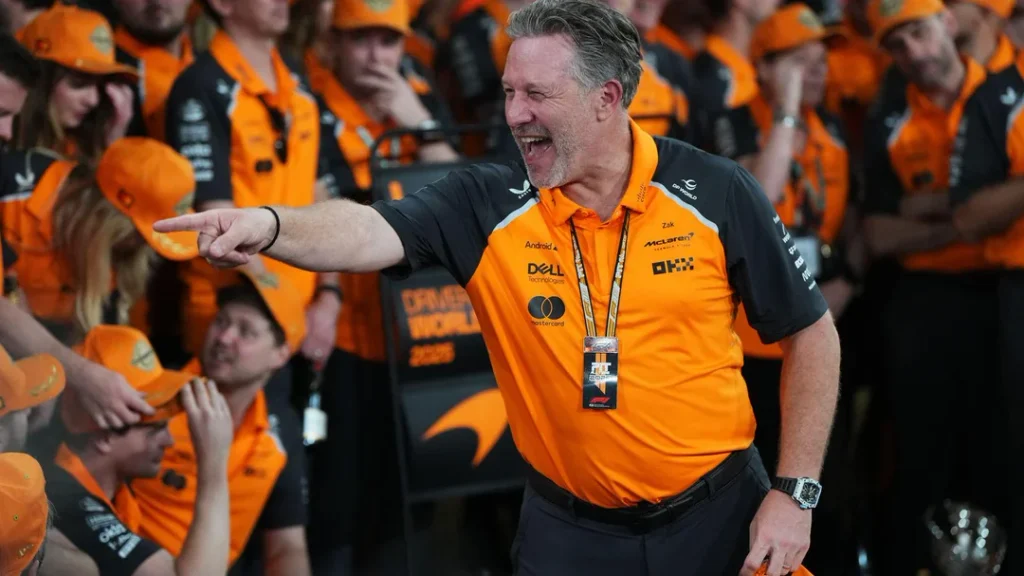
If Williams is demonstrating what increased relevance can do commercially, McLaren is operating at another level entirely.
McLaren Racing is reportedly on track to reach $1 billion in revenue. For years, Toto Wolff and Mercedes represented the obvious benchmark for turning an F1 team into a financial powerhouse. Zak Brown may now have pushed McLaren beyond even that image.
McLaren reportedly has more than 40 sponsors this year, more than twice the number associated with Mercedes in the material we’re looking at. Whatever anybody thinks of Brown personally or stylistically, his commercial impact on McLaren is difficult to argue with. The team wasn’t merely struggling competitively before his era.
Its financial position was deeply concerning. Sponsor logos were sparse during the mid-2010s, and McLaren eventually reached a point where its wider financial situation became genuinely precarious. Brown helped rebuild the commercial side before the results fully returned.
That matters. It’s much easier to sell sponsorship when you’re already winning championships. The difficult part is convincing companies to invest when the car isn’t giving them much reason to.
Now McLaren has turned itself into one of the most recognizable motorsport brands across multiple series.
McLaren’s IndyCar presence shows why branding matters
The effect is particularly noticeable in IndyCar.
McLaren merchandise has become incredibly visible at races, helped significantly by Pato O’Ward’s popularity. But it isn’t just the driver. You can identify a McLaren IndyCar immediately.
That sounds obvious, but in IndyCar it isn’t. Team liveries can differ dramatically between cars and can change between races depending on sponsorship. Penske, Ganassi and Andretti entries aren’t always instantly recognizable as belonging to the same organization. McLaren has leaned much harder into visual consistency.
Papaya means McLaren. That creates brand equity across championships. It also helps explain why fans who primarily discovered McLaren through F1 might still recognize and support the team when they attend an IndyCar event.
Add Pato’s personality and social-media presence, and McLaren has built something much bigger than simply placing another race car on another grid. And next year, that IndyCar operation is set to add Scott Dixon. The business still overwhelmingly revolves around Formula 1, though.
More than 90% of McLaren Racing’s revenue reportedly comes from F1. That sounds astonishing until the financial scale is compared. The figures supplied here put McLaren’s total 2024 IndyCar revenue at £45 million and Formula E at £37 million.
Its World Constructors’ Championship payout alone was £144 million. Before sponsorship. Before everything else. F1 isn’t merely McLaren Racing’s biggest series.
Financially, it’s in a different universe.
F1 Academy’s biggest challenge may come after F1 Academy
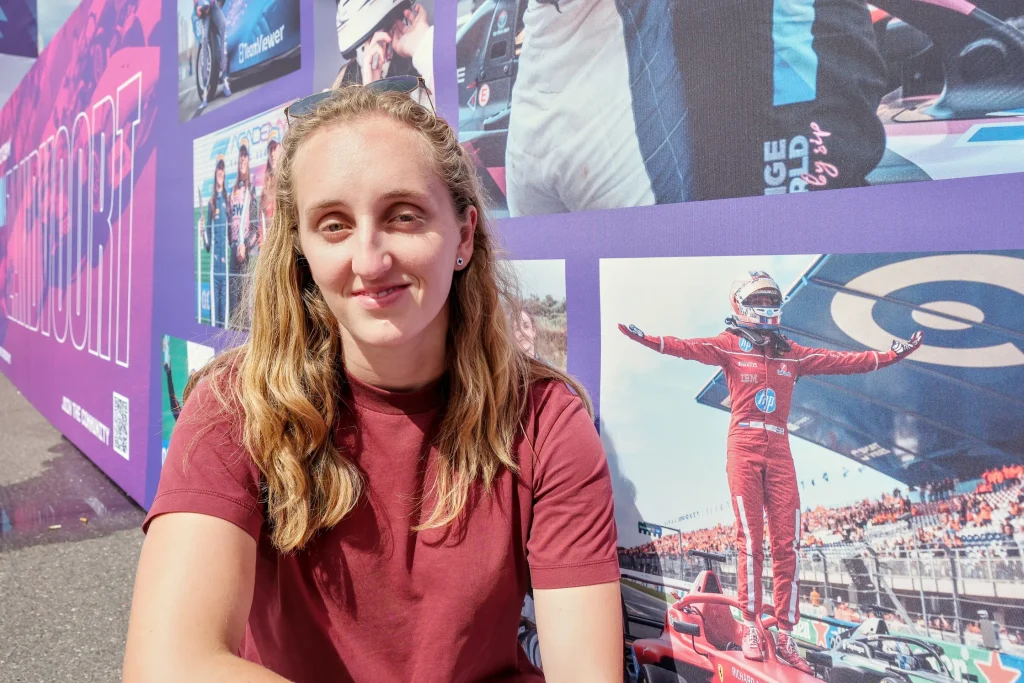
Another discussion this week highlighted one of the most complicated questions surrounding F1 Academy.
What happens after drivers leave? Female racers continue to face serious difficulties finding sponsorship and securing enough track time once they’re outside the series. Jamie Chadwick’s path through Indy NXT provides one useful example of how difficult the next step can be.
She improved in her second Indy NXT season and produced a standout victory from pole, leading all 20 laps and surviving multiple restarts and a late red flag. But her IndyCar test demonstrated another level of difficulty. IndyCar has no power steering, and Barber is hardly an easy place to learn a high-downforce car.
That doesn’t mean women are inherently incapable of handling the physical demands. Danica Patrick won an IndyCar race and repeatedly finished inside the top four at the Indianapolis 500 in cars without power steering. Physical preparation is part of driver development. The larger issue is that IndyCar represents an enormous competitive step regardless of gender. And F1 Academy itself is effectively operating around an F4 level.
That distinction matters because the name “F1 Academy” can create expectations that the drivers are somehow one or two steps from Formula 1.
They aren’t.
F1 Academy isn’t supposed to produce an F1 driver immediately
Judging F1 Academy by whether its current drivers reach Formula 1 almost completely misunderstands what the project is trying to accomplish.
The immediate next step isn’t F1. It isn’t necessarily even F3. Success could simply mean moving drivers into stronger mixed championships and eventually building a pipeline where women regularly reach F3, F2, Indy NXT, sports cars or other professional categories.
The bigger goal is representation. If young girls watch Formula 1 and only ever see men driving the cars, becoming a racing driver can feel like something that belongs to somebody else. F1 Academy puts women directly inside the F1 weekend environment.
That visibility matters. It also gives drivers connections to F1 teams that would be incredibly difficult to obtain otherwise. Doriane Pin’s Mercedes relationship is an obvious example. She received an F1 test and remains connected with Mercedes as a development driver.
Those opportunities aren’t meaningless simply because they don’t immediately produce an F1 race seat.
The real test may happen at karting level
The strongest argument for F1 Academy may not involve its current grid at all.
It may involve 10- and 13-year-old girls who see it and decide to start karting. One 13-year-old girl recently won the British COTFA championship in a mixed junior category and earned an F4 test with a legitimate team after receiving support from the F1 Academy Discover Your Drive program. That is potentially far more important to the long-term objective than trying to manufacture an F1 prospect from the current pool.
The talent pipeline has to start younger. If female participation was extraordinarily low in karting 20 years ago, the probability of producing an elite female F1-level prospect was automatically tiny before development even began. You don’t fix that in three or four seasons.
The long-term solution is getting significantly more girls into karting, giving them comparable opportunities at comparable ages, and then allowing competition to determine who progresses. That could take a generation. F1 Academy does not need to create the first female world champion itself.
It needs to help create the conditions where that driver actually enters motorsport in the first place.
But the exit pathway still needs work
None of that means the system is perfect.
The criticism that drivers can leave F1 Academy and immediately struggle for funding is completely legitimate. Motorsport is brutally expensive for everybody, and outside Formula 1 almost every young driver is effectively competing for sponsorship. But if F1 Academy provides enormous visibility for two seasons and then leaves its best drivers unable to afford a meaningful next step, some of that development work is inevitably wasted.
A fully funded F3 seat might actually be too large a jump. Going directly from F1 Academy machinery into F3 could skip developmental steps and put the driver in a position where being buried at the back does more damage than good. A funded season in a category such as GB3, FREC or another appropriate intermediate championship may make more sense.
The pathway needs to develop drivers, not simply promote them. Abbi Pulling is a useful example. Dominating F1 Academy doesn’t mean she should immediately be judged against Formula 1 standards. Her next challenge is proving herself in stronger mixed competition.
That is how a ladder is supposed to work.
Crashgate looked suspicious — believing it was real was the hard part
A retrospective discussion around the 2008 Singapore Grand Prix also raised an interesting question:
How obvious was Crashgate at the time? The answer appears to be: more obvious than people remember, but still almost impossible to believe. Martin Brundle noted during the broadcast how strangely Fernando Alonso’s aggressive strategy had worked out when teammate Nelson Piquet Jr. crashed and triggered the Safety Car.
Marc Surer reportedly made a similarly skeptical observation on the German broadcast. Felipe Massa has also said that while he initially assumed Piquet had simply crashed, Jean Todt immediately believed something was wrong. There were clues.
Alonso’s strategy looked extremely strange unless a Safety Car appeared. Piquet had already experienced a moment on the formation lap. The eventual crash came at an unusual location.
And when the Safety Car arrived, everything suddenly aligned perfectly for Renault. The problem wasn’t necessarily that nobody could connect the dots. It was that the conclusion felt absurd.
Surely a Formula 1 team wouldn’t deliberately instruct one of its drivers to crash and build an entire race-winning strategy around it. That was the mental barrier.
The pieces could look suspicious without anybody being willing to make the leap to “they actually rigged the race.”
And broadcasters had another problem: accusing a team of deliberately fixing a Grand Prix without proof is an enormous allegation. So Brundle could point out the irony. He could explain how perfectly the circumstances aligned.
He could basically lay out the entire sequence. But saying the final sentence was another matter. Ferrari’s disastrous pit stop with Massa dragging the fuel hose away also immediately became one of the dominant images of the race, which helped pull attention elsewhere. In hindsight, everything looks obvious because we already know the answer.
At the time, the hardest evidence to overcome was simply disbelief that somebody would go that far.
And somehow Flavio Briatore is back in the paddock
Crashgate also creates an unavoidable modern footnote.
People remain amazed that Flavio Briatore is again part of the F1 paddock. The FIA imposed a lifetime ban, but Briatore successfully challenged it in the French courts.
Whatever the legal path that followed, seeing him back in Formula 1 inevitably makes the 2008 story feel much less distant than it otherwise might.
Finally: the Malaysia boys’ trip has begun
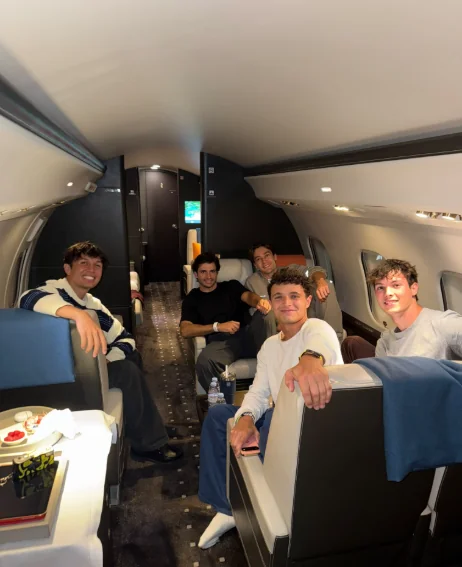
And after all of that, George Russell posted the group heading to Malaysia.
Which means the paddock has apparently entered boys-trip mode.
The immediate reaction was less “Formula 1 drivers traveling to their next race” and more “please verify their whereabouts in 48 hours.”
George’s hypothetical stag party ending with him dehydrated on a Kuala Lumpur rooftop is apparently already part of the lore. Kimi Antonelli has been cast as Mr. Chow. Alex Albon has been assigned the inevitable phone call to Toto Wolff:
“We can’t find George.”
Carlos Sainz, meanwhile, continues his long-running role as honorary British driver. At this point he has spent enough time around Norris, Russell and Albon that nationality appears negotiable. Carlos is either Lando and Alex’s permanent plus-one or has simply been running an extremely committed long-term undercover operation.
Oliver Bearman making the trip has also been celebrated as confirmation that he’s officially one of the lads. And somewhere, Arvid Lindblad is apparently still waiting at the airport. The sport moves quickly.
One day we’re debating collisions, tire degradation and billion-dollar racing businesses. The next we’re trying to work out which driver is most likely to wake up missing a shoe in Malaysia.
Fortunately, there’s another Grand Prix this weekend.