

The NTT IndyCar Series returned to Phoenix Raceway for the 2026 Good Ranchers 250, and after eight years away the series delivered one of the most action-packed short oval races in recent memory. Over 250 laps and 255.5 miles (411.187 km), the race produced relentless passing, multiple lead changes, and a dramatic closing stretch that ultimately saw Josef Newgarden claim victory.
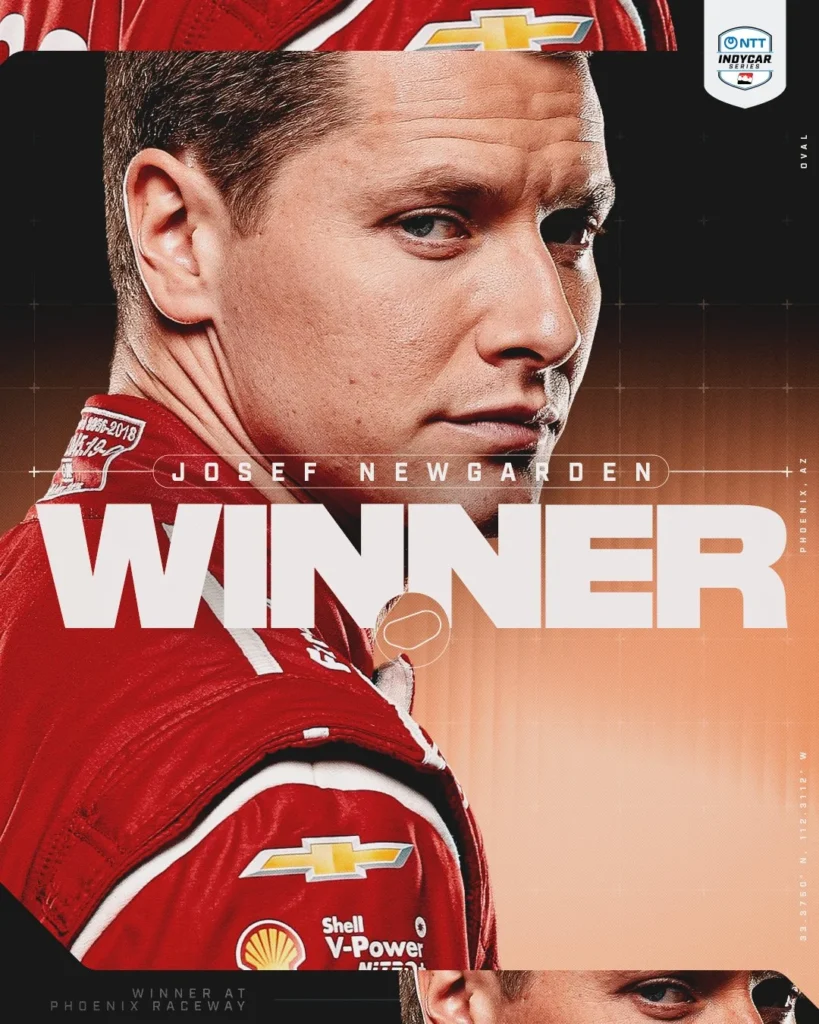
When the checkered flag fell, the finishing order read: Newgarden first, Kyle Kirkwood second, David Malukas third, Pato O’Ward fourth, Marcus Armstrong fifth, Alexander Rossi sixth, Scott Dixon seventh, Scott McLaughlin eighth, Graham Rahal ninth, and Kyffin Simpson tenth.
The result not only added another oval victory to Newgarden’s growing résumé, but also shook up the championship picture in a way few expected.
A Phoenix Return That Delivered
There had been uncertainty heading into the weekend about how the racing would look at Phoenix after such a long absence. Those concerns vanished quickly once the green flag dropped.
The race produced staggering passing totals, with 565 on-track passes, including 323 passes for position, 145 inside the top 10, and 60 among the top five, all records for IndyCar at Phoenix Raceway. Cars were able to run side-by-side through the corners, creating sustained multi-line battles across the field.
The effectiveness of the current short-oval package was immediately apparent. Drivers were sliding around, attacking different grooves, and making moves deep into corners in ways Phoenix had rarely seen during its previous IndyCar era.
Many observers described the race as one of the best non–Indy 500 oval events in recent seasons. The combination of heavy passing, tire management, and constant traffic meant the race rarely settled into long stretches without action.
For a venue that had previously produced mixed results in earlier IndyCar visits, the comeback could hardly have gone better.
Newgarden Does What Newgarden Does on Ovals
When IndyCar races on ovals, Josef Newgarden has repeatedly proven himself to be one of the most formidable drivers in the series, and Phoenix added another chapter to that story.
Newgarden managed the race patiently before striking late, executing a decisive move to seize the lead in the closing stages. His late-race pace proved decisive, particularly compared to drivers ahead who struggled to make moves through traffic.
One sequence in particular captured the difference. While others were stuck behind slower cars, Newgarden found a way through, demonstrating the kind of racecraft that has defined his oval success.
His dominance in this discipline has become difficult to ignore. Remarkably, 12 of his last 25 oval starts have ended in victory, underscoring just how consistently he performs whenever IndyCar turns left.
In a race filled with standout drives, the final stint once again showcased Newgarden’s ability to execute under pressure and close out a win.
Kirkwood and Malukas Shine
Behind Newgarden, Kyle Kirkwood delivered another quietly impressive performance, finishing second after running consistently near the front.
Kirkwood has increasingly built a reputation as one of the most underrated drivers in the series. While he rarely dominates headlines, results like this continue to reinforce the idea that he may be one of the strongest performers in the field.
Just behind him, David Malukas completed the podium after starting from pole position. Malukas led early portions of the race and held strong in the closing laps despite heavy pressure from behind.
Late in the race, there were moments where it looked like he might fall backward through the pack as tire wear and traffic intensified, but he managed to hold on to secure a hard-earned podium finish.
Rasmussen’s Charge Ends in Controversy
One of the most electrifying performances of the race came from Christian Rasmussen, who carved his way through the field with relentless aggression.
Rasmussen recorded 61 overtakes, accounting for roughly 11% of all passes during the race. His speed and willingness to attack made him one of the most entertaining drivers on track and a legitimate contender for victory.
However, his charge ultimately ended in heartbreak following contact with Will Power.
The incident occurred during a crucial phase of the race when Rasmussen attempted to challenge around the outside. The two cars collided, sending Rasmussen into the wall and ending what had been shaping up as a potential race-winning drive.
After the race, Power approached Ed Carpenter, Rasmussen’s team owner, and apologized for the incident. Power later acknowledged responsibility, explaining that he simply did not realize Rasmussen was alongside him at the moment of contact.
The crash sparked immediate debate about whether the move was an unavoidable racing incident or a defensive mistake. Some believed Rasmussen’s attempt was an aggressive but necessary move for the lead, while others argued patience might have allowed him to avoid the risk entirely.
Regardless of interpretation, the contact ended one of the race’s most compelling storylines.
Palou’s Rare Misstep
Another major turning point came when Álex Palou crashed out of the race following contact with Rinus VeeKay.
Palou’s exit was particularly notable given his dominance in recent seasons. The crash immediately reshaped the championship outlook and reminded the paddock that even the series’ most consistent performer is not immune to mistakes or misfortune.
The incident triggered a lengthy debate about responsibility. Some felt VeeKay attempted a move that carried too much risk, while others suggested Palou’s spotter may not have properly warned him about the approaching car.
What made the moment especially striking was how unusual it felt to see Palou’s race end abruptly. His ability to consistently avoid incidents has been a defining characteristic of his championship runs.
For once, however, circumstances went against him.
Dennis Hauger’s Moment of Magic
While the race produced plenty of drama, it also delivered one of the most remarkable saves of the weekend.
Dennis Hauger produced an extraordinary moment of car control, spinning backwards at more than 120 mph before somehow keeping the car out of the wall.
The maneuver looked more like a Hollywood stunt sequence than a racing save, yet Hauger managed to gather the car and continue without significant damage. The moment quickly became one of the most talked-about highlights of the race and a potential contender for save of the season.
Encouraging Debut for Mick Schumacher
Another driver drawing attention throughout the weekend was Mick Schumacher, making his first proper oval appearance.
Schumacher had qualified impressively on the second row, an eye-catching result for a driver still adapting to IndyCar’s unique demands. During the race he ran competitively early on before a problematic pit stop dropped him down the order.
He ultimately finished 18th, but completing the race distance and gaining experience on his first oval outing was widely seen as a solid foundation for the future.
A Race Worthy of a Permanent Return
Beyond the on-track action, the success of the event also sparked immediate discussion about Phoenix’s future on the IndyCar calendar.
The race filled an important gap in the early-season schedule and showcased just how well the current short-oval package performs at this venue. Reports indicated that before the race even began, IndyCar had already been asked to return to Phoenix in 2027, a request that now feels even more justified.
The event also benefited from a double-feature weekend with NASCAR, which helped lay rubber on the track and added a sense of crossover between the two series.
The synergy between the two paddocks created a unique atmosphere that many felt should be repeated in future seasons.
A Great Race, Despite Broadcast Frustrations
If there was one consistent criticism throughout the event, it centered on the television broadcast.
Despite the incredible on-track product, viewers repeatedly noted issues with the production, including timing tower failures, missing graphics, and camera direction that sometimes missed key battles unfolding elsewhere on track.
Several pivotal moments, including important passes and pit cycles, were reportedly not shown live due to the broadcast focusing on cars running alone.
Even so, the sheer intensity of the racing still managed to shine through.
IndyCar at Its Best
In the end, the 2026 Good Ranchers 250 delivered exactly the kind of race IndyCar hopes for when it schedules short oval events.
The race had everything: relentless passing, late-race drama, breakout performances, and a championship shakeup.
Most importantly, it reminded everyone just how spectacular IndyCar racing can be when the package and venue align perfectly.
If Phoenix returns to the calendar, as many now expect, the 2026 edition will be remembered as the race that proved the track deserved another chance.