

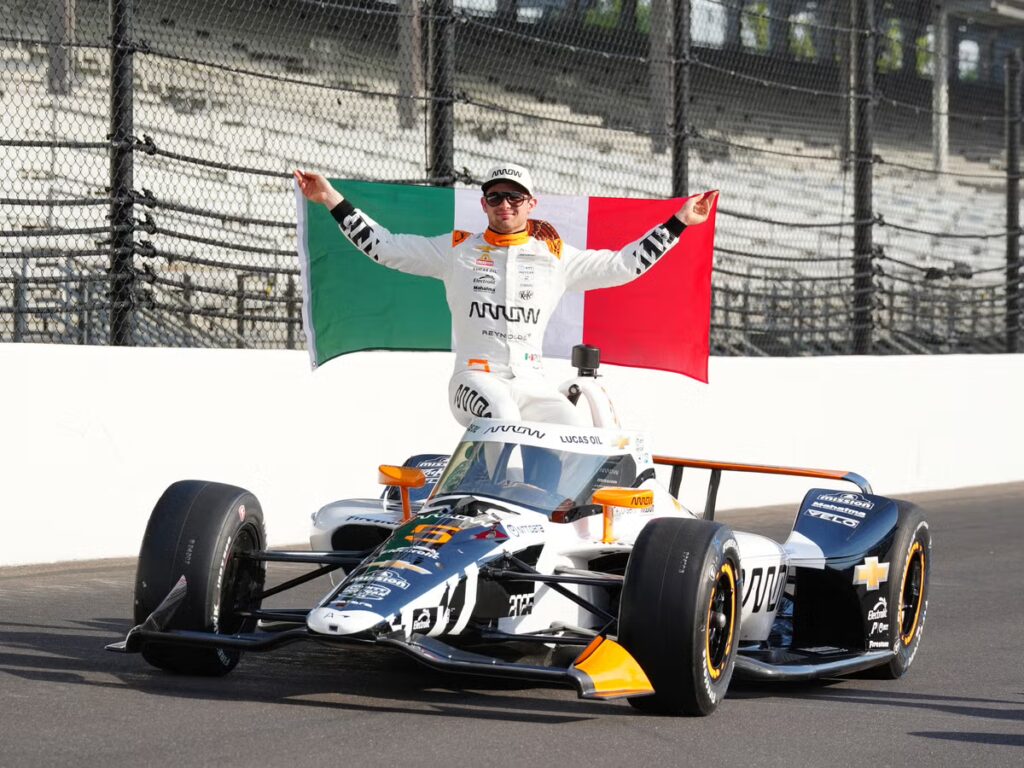
IndyCar’s international ambitions have taken another hit, with Mexico now “off the table for now,” but the reaction across the paddock and fanbase suggests this is about far more than just one race falling through. What’s unfolding instead is a broader tension between financial reality, competitive integrity, and the long-term identity of the series.
Mexico Dreams vs. Domestic Reality
On paper, a Mexico City race feels like a no-brainer — a massive market, deep motorsport heritage, and proximity to the U.S. But the collapse of the latest effort reinforces a recurring theme: interest alone doesn’t make an event viable.
The underlying issue appears to come down to cost and risk. Escalating logistical expenses — from track rentals to operational overhead — reportedly pushed the event beyond what the series was willing to absorb. And crucially, IndyCar isn’t operating from a position where it can take speculative financial swings.
That reality has shaped a clear internal logic: prioritize stability over expansion. Domestic races — particularly in markets like Denver or additional U.S. venues — are seen as lower-risk, more controllable, and directly tied to TV audiences that ultimately fund the series.
From that perspective, Mexico isn’t being rejected as an idea — it’s being postponed as a business decision.
At the same time, frustration lingers around how the situation was handled. Building up expectations around Mexico only for it to collapse has left a perception gap. The issue isn’t just that it didn’t happen — it’s that it felt like it was going to.
And that distinction matters.
The Illusion of Global Expansion
The Mexico situation has also reignited a broader debate: should IndyCar even be prioritizing international races right now?
There’s a growing sentiment that the series isn’t yet in a position to sustain global expansion. The argument is straightforward — before chasing markets like Mexico, Brazil, Japan, or Australia, IndyCar needs to be “bursting at the seams” domestically.
That includes:
- Stronger U.S. attendance across the calendar
- More consistent broadcast growth
- A deeper, more stable sponsorship ecosystem
Until those fundamentals are locked in, international races are viewed less as opportunities and more as liabilities.
Even among international options, there’s skepticism. Australia is seen as logistically difficult with limited existing partnerships. Japan presents challenges despite ties to major backers. And while Brazil and Mexico generate excitement, both come with financial and organizational complexity.
In contrast, U.S.-based expansion offers immediate returns with fewer unknowns.
That doesn’t mean fans aren’t dreaming. There’s clear appetite for:
- A return to historic venues
- Additional superspeedway races
- New regional markets within the U.S.
- Even revived international classics
But right now, those ideas are colliding with a series that is still fundamentally operating within tight economic guardrails.
The Nolan Siegel Situation — A Case Study in IndyCar Economics
If the Mexico situation highlights the macro challenges, the situation surrounding Nolan Siegel at Arrow McLaren exposes the micro-level reality of how teams operate.
At its core, the arrangement is simple: funding drives opportunity.
Siegel’s seat is widely understood as a fully funded entry — effectively a paid ride where his family finances the No. 6 car. Structurally, this resembles a lease: the team provides the equipment and infrastructure, and the driver brings the budget required to run it.
And critically, there are no performance clauses tied to that arrangement.
That detail reframes everything. Results — whether finishing first or twentieth — don’t dictate the contract. Funding does.
From a pure business standpoint, the logic is difficult to dispute. Running a third car at a competitive level is expensive, and securing stable, guaranteed funding eliminates risk. In a series where budgets are tight and margins are thin, that kind of financial certainty is valuable.
But it comes at a cost — perception.
There’s growing frustration around how situations like this are presented publicly. The issue isn’t that pay drivers exist — they’ve always been part of motorsport. The issue is the disconnect between messaging and reality.
Other teams have leaned into transparency. When a driver is there to fund a seat, it’s acknowledged. Expectations are set accordingly: bring the car home, contribute to the team, and anything more is a bonus.
In contrast, positioning a funded driver as a competitive equal to title contenders creates friction — especially when results don’t align.
And that’s where criticism of Arrow McLaren has intensified.
Strategy, Not Sentiment
Yet beneath the criticism, there’s a more pragmatic view emerging: this isn’t incompetence — it’s strategy.
Top teams aren’t building their seasons around their third cars. Their championship ambitions sit with their primary entries. Everything else is optimization.
So the decision becomes binary:
- Option A: Spend heavily to field a third car capable of fighting near the front
- Option B: Accept funding to run a third car further down the order
For many teams, Option B is the rational choice.
That model isn’t unique to McLaren. It mirrors approaches seen across the grid over recent years — where funded drivers help sustain operations while lead entries chase wins.
The difference is execution and expectation management.
There’s also nuance in how different funding models operate. Drivers backed by sponsors still have external expectations to meet — performance, visibility, results. But a driver directly funding a car introduces a different dynamic: fewer external pressures, but greater financial security for the team.
That distinction helps explain the level of patience being shown.
A Series Defined by Tradeoffs
Taken together, the Mexico decision and the Siegel situation point to the same underlying truth: IndyCar is a series defined by tradeoffs.
Growth vs. sustainability
Performance vs. funding
Ambition vs. practicality
Every major decision — from calendar expansion to driver selection — sits somewhere on that spectrum.
And while that can be frustrating from the outside, it reflects the reality of a championship that doesn’t have the financial cushion of its global counterparts.
The desire for bigger, bolder moves is clearly there — from international races to fully merit-based grids. But until the underlying economics shift, those ambitions will continue to be filtered through a lens of risk management.
For now, Mexico is on hold.
And IndyCar, once again, is choosing stability over spectacle.