

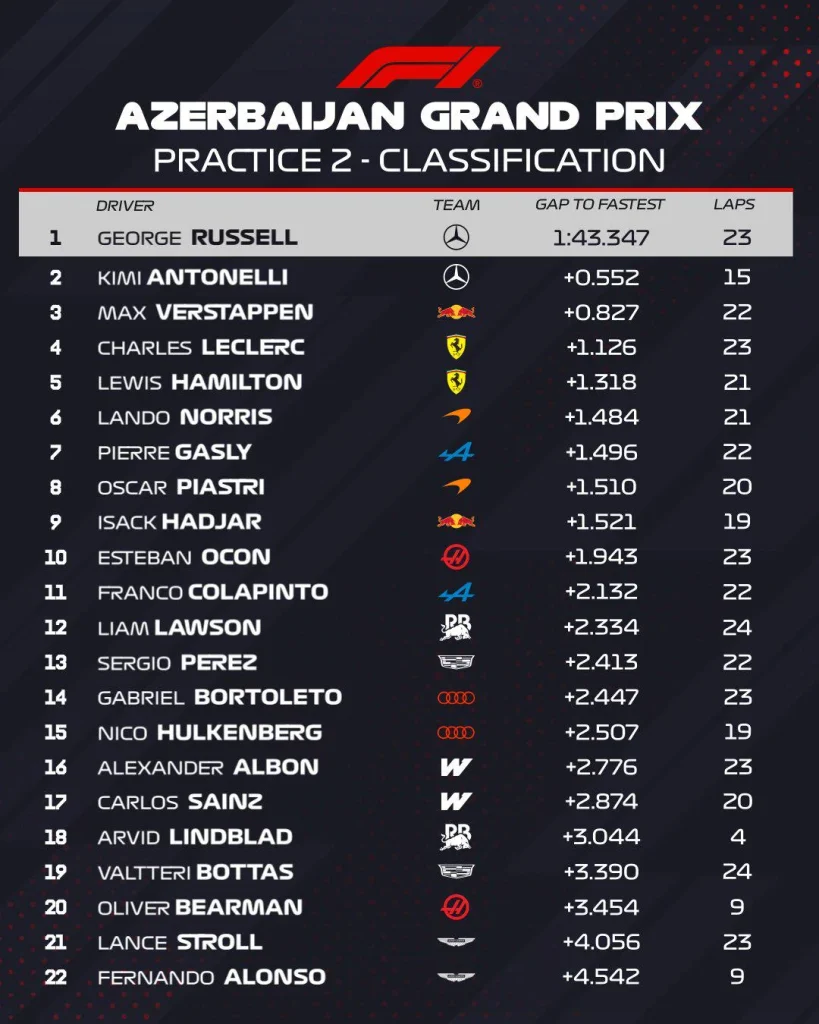
George Russell ended the second practice session of the Azerbaijan Grand Prix at the top of the timesheets, but simply looking at his P1 doesn’t really capture just how strong Mercedes looked around Baku.
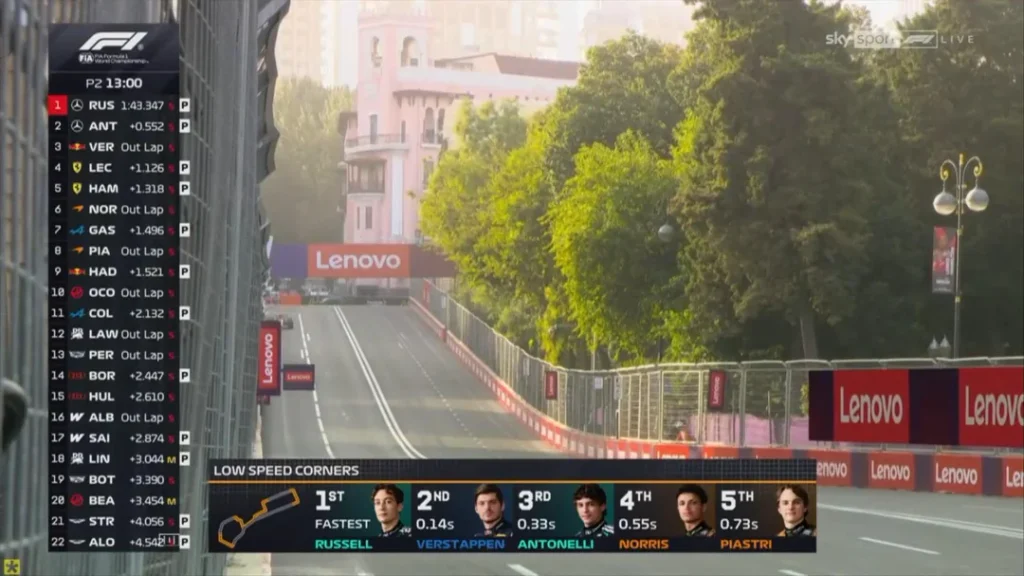
Russell led teammate Kimi Antonelli for a Mercedes 1-2, with Max Verstappen third ahead of Charles Leclerc, Lewis Hamilton, Lando Norris, Pierre Gasly, Oscar Piastri, Isack Hadjar and Esteban Ocon. Russell’s 1:43.347 was already impressive enough, but dig into the sector times, corner performance and longer runs and Mercedes suddenly starts looking like the team everyone else may have to catch.
And perhaps the strangest part is where Mercedes was doing the damage.
Russell Leads a Mercedes 1-2
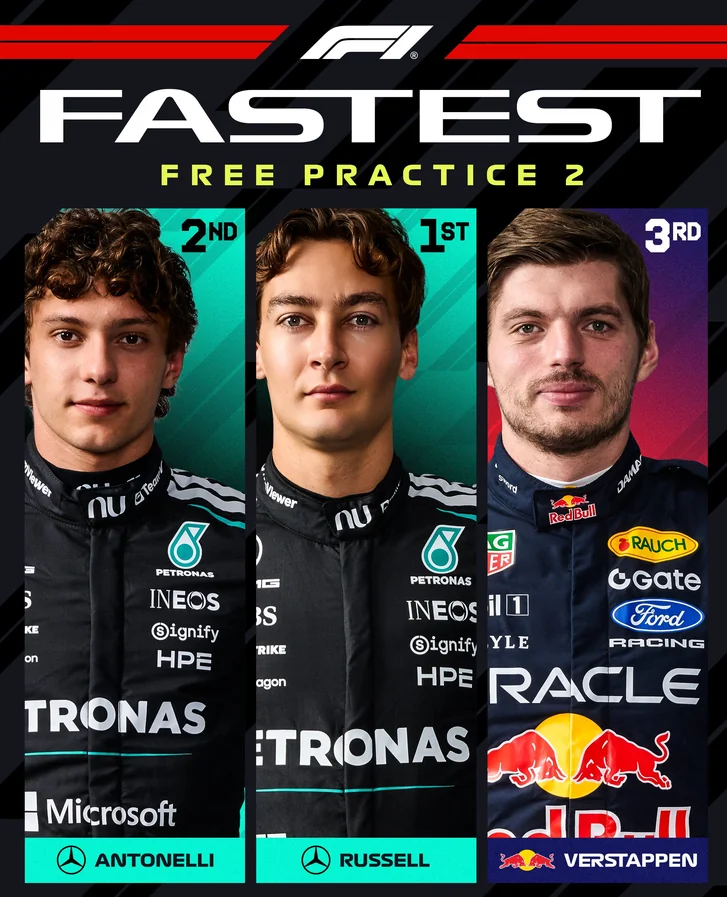
The top 10 in FP2 was:
- George Russell — 1:43.347
- Kimi Antonelli
- Max Verstappen
- Charles Leclerc
- Lewis Hamilton
- Lando Norris
- Pierre Gasly
- Oscar Piastri
- Isack Hadjar
- Esteban Ocon
Russell has earned something of a “Mr. Thursday” reputation this season, but Baku’s unusual schedule at least opens the door for the obvious joke: with the race taking place on Saturday, does Mr. Saturday get his turn?
Jokes aside, Mercedes looked genuinely quick. Russell was fastest in Sector 2 with a 42.235 and Sector 3 with a 24.496, while Norris took the fastest Sector 1 at 36.510. Russell was also the fastest driver through Baku’s low-speed corners. Verstappen was 0.14 seconds slower, Antonelli 0.33 behind, Norris 0.55 behind and Piastri 0.73 behind.
Considering “low-speed corners” describes an enormous percentage of Baku’s actual corners, that’s a pretty useful advantage to have.
Even more striking was the telemetry. Russell spent less time at full throttle and more time at partial throttle than some of his rivals, yet still produced the fastest lap by a considerable margin. Mercedes wasn’t simply blasting past everyone on the straights. The car looked strong through the corners, had excellent traction out of them and then had the straight-line performance to finish the job.
That combination could make Mercedes extremely difficult to beat this weekend.
McLaren Has a Massive Sector 3 Problem
McLaren’s biggest concern wasn’t necessarily Norris finishing sixth or Piastri eighth.
It was what happened once the cars reached Sector 3. Norris was fastest of everyone in Sector 1, yet Russell was roughly seven tenths faster than him in Sector 3 alone. Seven tenths.
A visualization of their laps showed just how dramatic the difference became on Baku’s enormous run toward the finish line. Norris topped out around 320 km/h while Russell reached approximately 338 km/h, with Mercedes carrying an average speed advantage of roughly 15 km/h down the straight without a tow in the comparison. At the beginning of Sector 3, the cars weren’t dramatically separated. Once Russell got beyond roughly 290 km/h, however, the Mercedes just disappeared. That doesn’t necessarily mean McLaren is actually seven tenths slower in that sector when everything is turned up for qualifying.
There were different energy-deployment strategies at play during practice, and Norris abandoned a later quick lap that appeared considerably more competitive. McLaren also doesn’t necessarily gain much from repeatedly completing the enormous flat-out portion of the lap during practice if it already has the information it needs. Piastri’s own fastest lap offers another clue. He recovered nearly three tenths relative to Norris in the final sector while reaching a top speed around 4 km/h higher. Tows matter enormously at Baku as well. A particularly good one can be worth a massive amount of lap time.
Russell himself benefited from traffic ahead during his lap, catching the Audis and picking up slipstream along the way. So no, we probably shouldn’t expect Norris to automatically lose seven tenths to Russell in Sector 3 during qualifying. But there is still clearly something there.
McLaren’s straight-line performance has been one of the car’s weaknesses, and Baku is an unforgiving place to have that weakness exposed. Different deployment, gearing and McLaren’s own gearbox all complicate any attempt to simply blame the Mercedes power unit. That’s important because both cars are Mercedes-powered. If Mercedes is destroying McLaren down the straight while simultaneously beating it through the low-speed corners, this isn’t as simple as saying Mercedes built the better engine.
The entire package appears to be working.
Mercedes Looks Strong Over a Race Distance Too
The long runs didn’t exactly make Mercedes look any less threatening.
One set of stint data initially put Russell’s average medium-tire pace at 1:47.960, with Antonelli at 1:48.520. Another race-simulation dataset listed Antonelli at 1:48.519 and Russell at 1:48.964, although the creator subsequently acknowledged an error in the data processing and specifically noted that Russell’s average should have been 1:47.9 rather than 1:48.9. That makes interpreting the exact order difficult, especially with drivers using different compounds and fuel loads. But Mercedes certainly didn’t look slow.
Verstappen averaged 1:48.517 on the softs in the latter dataset, while Leclerc was at 1:48.773, Norris 1:48.827, Hamilton 1:48.968 and Piastri 1:49.080. Nico Hulkenberg also produced an eye-catching 1:48.842 average on mediums, although his much quicker out-lap raised the possibility that Audi was running him with less fuel. There simply aren’t enough comparable laps on identical programs to declare a definitive race hierarchy from FP2. Antonelli also missed significant running across the two practice sessions, which leaves the possibility of more time to come as he gets further up to speed.
Still, if Mercedes’ one-lap advantage is backed up by legitimate long-run pace, Russell and Antonelli could be in an extremely strong position.
Verstappen Is Right There
Max Verstappen quietly finished third, and Red Bull appears to have enough pace to make this interesting.
He was only 0.14 seconds behind Russell in the low-speed corner comparison and his 1:48.517 soft-tire race-simulation average was among the quickest numbers recorded. He also provided one of the prettier moments of the session when he spun the Red Bull through 180 degrees and smoothly rejoined the circuit. Maximum Max. The spin ultimately didn’t prevent him from finishing third, and unlike some of the other incidents throughout the day, it didn’t result in contact with Baku’s walls.
With Mercedes looking strong and McLaren’s ultimate pace still somewhat obscured by its practice program, Verstappen could once again find himself right in the middle of the fight.
Ferrari Is Fast Enough to Be Close, but the Numbers Aren’t Encouraging

Ferrari finished fourth and fifth with Leclerc and Hamilton.
That doesn’t sound disastrous. The deeper numbers are less flattering. Neither Ferrari appeared among the five quickest cars in the low-speed corner comparison, which is particularly concerning at a circuit consisting largely of exactly that type of corner.
The long-run averages weren’t especially convincing either, although Leclerc’s final lap was more than a second faster than his earlier laps, meaning the average doesn’t necessarily reflect his ultimate potential. There is also the question of Ferrari’s power-unit programs. The information circulating around the session suggested Leclerc was running ADUO2 while Hamilton was likely using ADUO1, potentially explaining some of Hamilton’s losses on the straights. Hamilton is expected to have ADUO2 available later in the weekend rather than unnecessarily adding practice mileage.
That makes Ferrari another team whose Thursday results may not tell us everything. But the larger trend isn’t particularly comforting. Ferrari began the weekend with expectations of potentially challenging near the front, yet Mercedes currently looks stronger through the corners and down the straights.
At least Fred Vasseur isn’t losing sleep over it. Asked whether Mercedes’ pace surprised him at the end of Friday running, Vasseur replied:
“I’m getting too old to pay too much attention to Friday.”
There was just one problem. It was Thursday. After being reminded, Vasseur somehow made the joke even better:
“Friday is useless, imagine the Thursday!”
Fair enough.
Aston Martin Just Got Outdragged by the Entire F2 Field
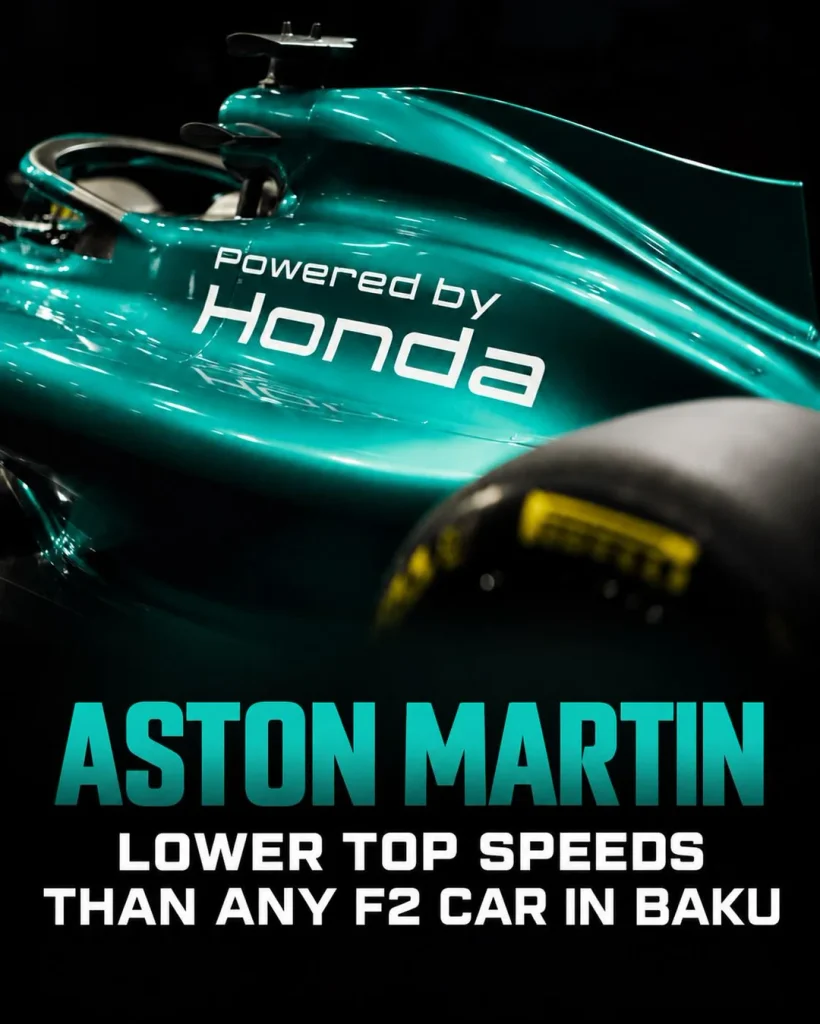
If Ferrari thinks it has power-unit problems, Aston Martin would probably happily trade.
Aston Martin failed to exceed 315 km/h at any point during FP2. Every single Formula 2 car went faster during qualifying. All 22 of them.
Joshua Dürksen reached 328.4 km/h, with every F2 driver recording at least 318.3 km/h. Even the slowest F2 top speed was therefore more than 3 km/h higher than Aston Martin managed in FP2. The comparison is obviously imperfect because the cars, sessions and running conditions are different. It is still an absolutely brutal statistic.
Fernando Alonso’s famous “GP2 engine” radio message has been given an unfortunate modern sequel, except this time even the actual F2 cars are appearing on the wrong side of the comparison.
Honda has taken plenty of criticism for Aston Martin’s performance, but the situation appears more complicated than simply blaming the power unit. The gearbox, chassis and severe vibrations have all been raised as potential pieces of a much larger problem. Whatever percentage belongs to Honda and whatever belongs to Aston Martin, the complete package isn’t working. Lance Stroll’s race-simulation average of 1:53.799 on softs certainly didn’t improve the picture. Baku has a very long straight.
Not being able to go fast in a straight line here is kind of a problem.
Sergio Perez Remembers That This Is Baku
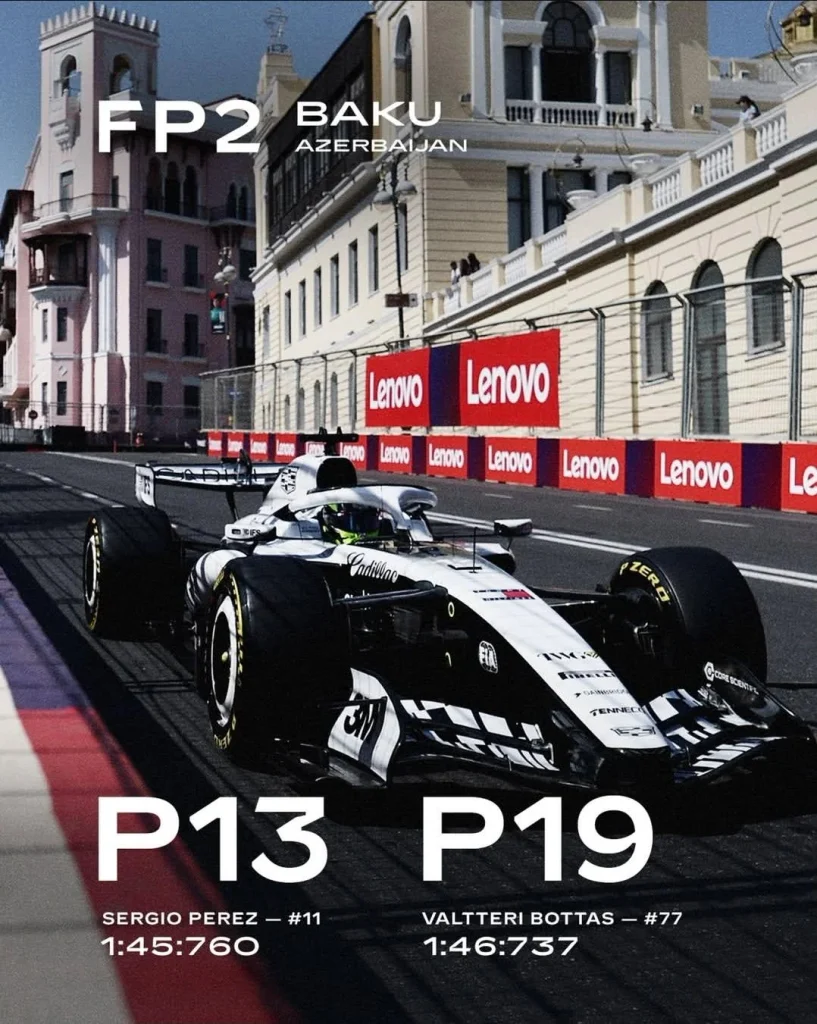
Sergio Perez finished 13th.
Normally, that wouldn’t generate much excitement. This is Baku. Perez has developed such a reputation around this circuit that P13 in a Cadillac suddenly feels like enough to start the hopium machine.
Valtteri Bottas finished down in P19, making Perez’s performance look even more encouraging by comparison. Does Cadillac suddenly have top-10 pace? Probably not based purely on FP2.
But Baku has already been eating cars throughout practice, and reliability issues have been appearing all over the grid. If the race becomes chaotic, Perez may not need a car capable of finishing inside the top 10 entirely on pace. He just needs to stay close enough to take advantage. Of course, that assumes the Cadillac itself survives. After the team’s previous brake problems, simply making it deep enough into the race to capitalize on everyone else’s trouble may be challenge number one.
Still, if Cadillac is going to steal its first points through a combination of chaos and Perez doing Perez things around a street circuit, Baku feels like a pretty logical place for it to happen.
Baku Keeps Biting
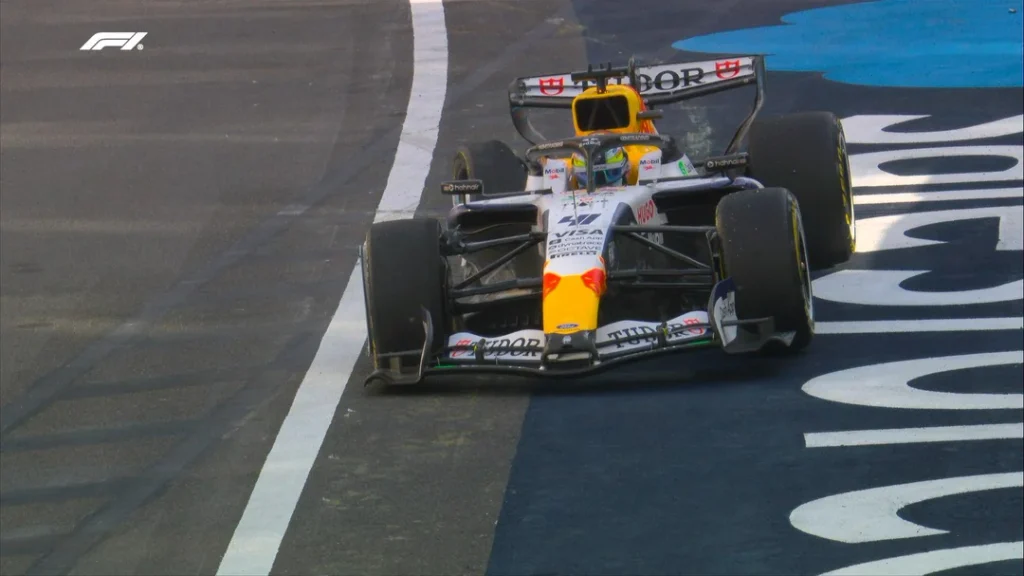
The circuit wasn’t particularly interested in letting everyone complete a clean Thursday.
Arvid Lindblad clattered the wall through Turns 8 and 9, bringing out the red flag. It initially didn’t look quite as violent onboard as it did from the external camera, but Baku has a habit of making relatively small mistakes extremely expensive. Lindblad has had a strong season, and a few difficult sessions don’t suddenly erase that. Young drivers are going to make mistakes, and Baku isn’t exactly the circuit where anyone should expect perfection. Oliver Bearman then suffered his own problem shortly after getting back on track.
“My engine broke,” Bearman reported.
The session added to a growing list of cars encountering trouble around Baku, with Hulkenberg, Antonelli and Bearman all stopping at different points and Aston Martin continuing to battle its own problems. Baku doesn’t need much help producing chaos.
The cars appear determined to provide some anyway.
Hamilton Reprimanded for Severe Impeding of Lawson
Hamilton’s afternoon also included another impeding incident, and this one ultimately resulted in action from the stewards.
Hamilton received a driving reprimand for unnecessarily impeding Liam Lawson between Turns 16 and 19. It is Hamilton’s second reprimand of the season. According to the stewards, Hamilton was on an out lap while Lawson approached on a flying lap. Ferrari had informed Hamilton twice that Lawson was approaching. The Race Director’s Competition Notes required cars on out laps or slow laps to remain on the extreme left from the exit of Turn 16 to the entry of Turn 18. Drivers and teams were also required to manage their gaps so they could travel from the apex of Turn 18 to the apex of Turn 19 without impeding a car on a competitive lap.
Hamilton didn’t remain on the extreme left. As Lawson closed approaching Turn 19, Hamilton remained on the racing line, forcing Lawson to lift and slightly brake. The stewards found that Hamilton had failed to follow the traffic-management instructions and unnecessarily impeded Lawson.
Normally, impeding during free practice results in a warning unless it is considered dangerous or intentional. The stewards found no intent but described this incident as “severe” because of the circuit layout, the high-speed corners and the specific instructions issued by the Race Director.
They also acknowledged an interesting complication created by the current cars: energy deployment. Both Hamilton and Lawson told the stewards that once a driver runs out of energy to deploy, the speed differential between cars through that section can become significant. Taking all of that into account, Hamilton received the driving reprimand.
And this is where the situation becomes a little uncomfortable. This isn’t the first time Hamilton has been involved in a practice impeding incident this season. When the stewards themselves describe an incident as severe, note that the driver had been warned twice about the approaching car and confirm that the other driver had to lift and brake at high speed, another reprimand feels remarkably light. At the same time, precedent matters.
Free-practice impeding generally doesn’t carry the same consequences as ruining someone’s qualifying lap, and escalating every practice incident into a grid penalty would represent a significant change in how these situations have traditionally been treated. But there is a legitimate question about where the line actually sits. If repeated practice impeding simply produces warnings and reprimands until somebody makes contact, the deterrent isn’t particularly strong. Yet punishing Hamilton more severely solely because Lawson could have hit him would effectively make the outcome of the incident part of the punishment. The stewards are trying to split that difference.
This time, the official answer was a reprimand.
Baku Might Be a Mercedes Track
Practice results are practice results.
Vasseur may have accidentally called Thursday Friday, but his larger point isn’t wrong. Different fuel loads, tire compounds, energy deployment, tows and run plans make Baku particularly difficult to decipher. McLaren almost certainly has more pace than its P6 and P8 positions suggest. Ferrari’s power-unit configuration may change. Verstappen is already close. And qualifying around Baku can be transformed by something as simple as catching the right car down the enormous straight. But Mercedes gave us more than one reason to pay attention.
Russell was fastest overall. He was fastest in Sector 2. He was fastest in Sector 3.
He was fastest through the low-speed corners. Mercedes appeared competitive over the longer runs. And Antonelli still put the second Mercedes in P2 despite losing valuable practice running.
Meanwhile, McLaren’s biggest weakness is being exposed on one of the longest full-throttle sections on the calendar, Ferrari doesn’t appear to have the cornering advantage it might have wanted, and Aston Martin just managed to lose a top-speed comparison to every Formula 2 car. Thursday doesn’t decide the Azerbaijan Grand Prix.
But if Mercedes carries this performance into qualifying, everyone else may have a problem.