

The 2026 Formula 1 reset is already doing what regulation changes always do best: expose hope, anxiety, overconfidence, and memory. And nowhere is that more visible than around Mercedes.
The W17: Smaller, Sharper, and Immediately Polarizing
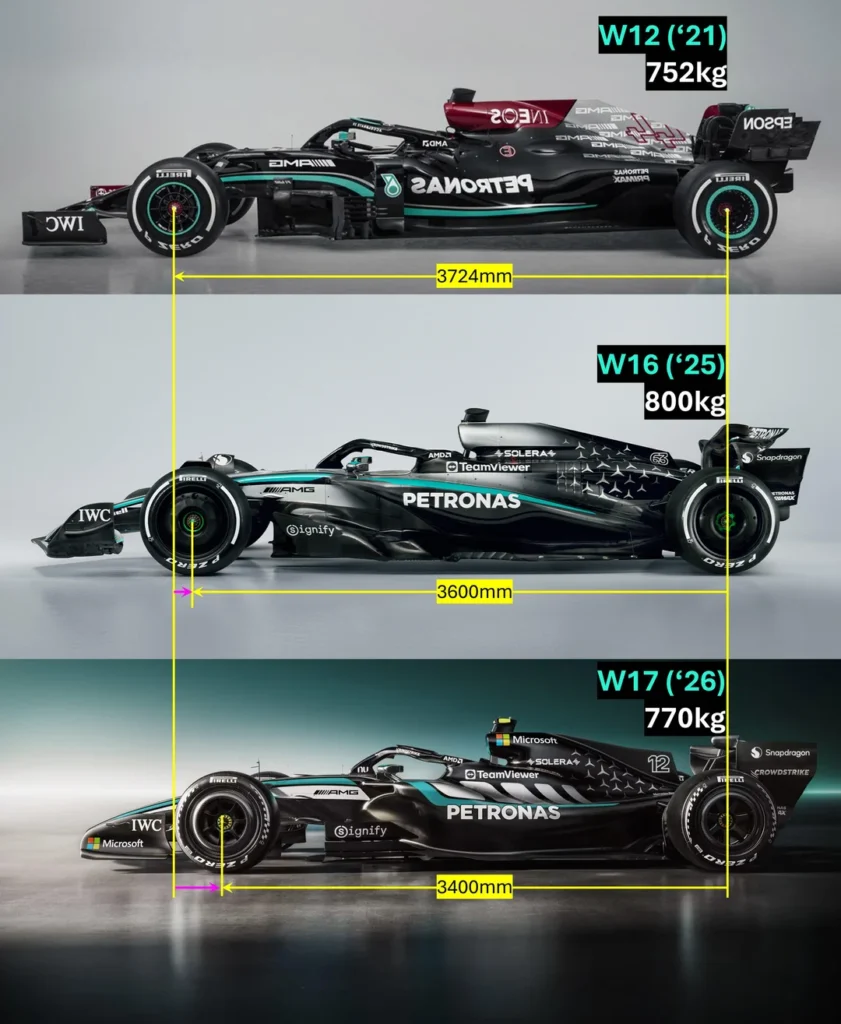
The first thing people noticed about the Mercedes‑AMG Petronas Formula One Team W17 wasn’t a lap time, it was proportion. Shorter wheelbase, tighter packaging, and a front wing that finally hugs the wheels rather than hovering awkwardly ahead of them.
The comparison numbers tell the story:
- W12: 752 kg, 3724 mm wheelbase
- W16: 800 kg, 3600 mm wheelbase
- W17: 770 kg, 3400 mm wheelbase
Visually, the shift is obvious. The car looks more compact, more purposeful, and, according to many, simply better. The front wing in particular is doing heavy lifting for the aesthetics, no longer extending comically beyond the tires. Several fans pointed out that returning to a wing narrower than the inner tire width instantly makes the car feel more “correct,” even before it moves.
There’s also nostalgia at play. Shorter cars evoke older eras, 2009, 2016, even earlier, when drivers were more visibly working the car. Not everyone agrees those eras produced better racing, but aesthetically, the consensus is clear: downsizing helps.
Racing, Downforce, and the Endless Argument
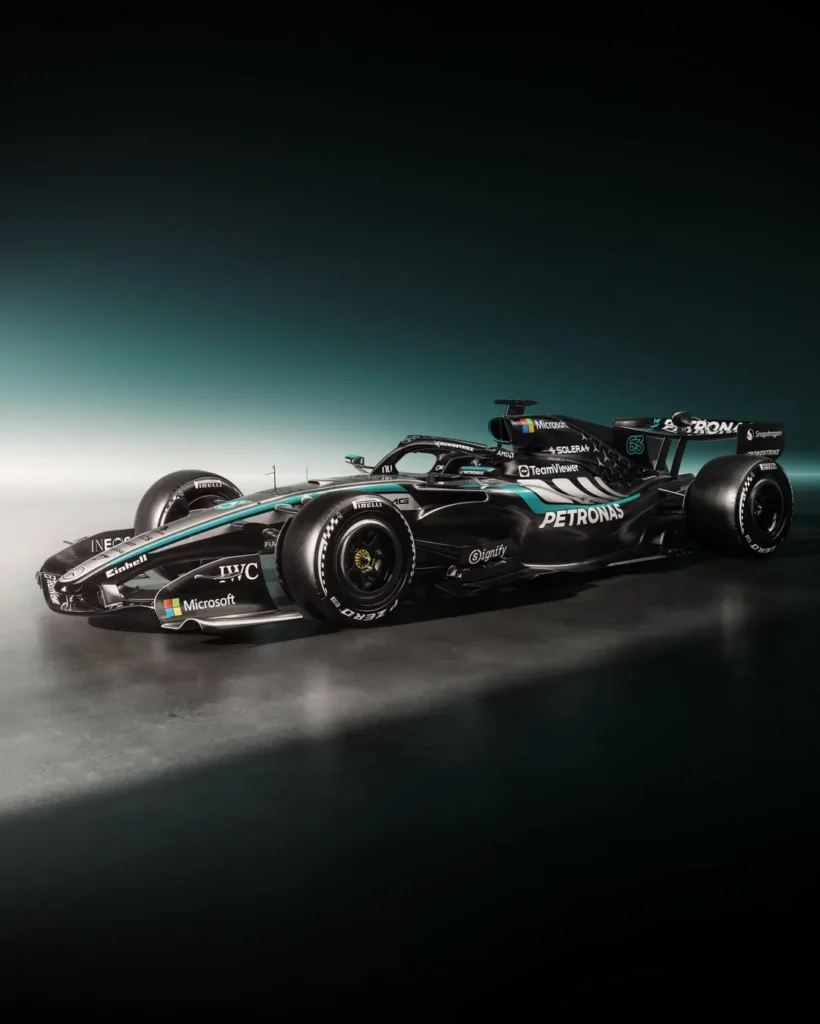
That aesthetic approval quickly turns into philosophy. Smaller cars reopen the sport’s oldest debate: downforce versus power, engineering versus driver skill.
Many argued that racing improves when grip is reduced and power remains high, when drivers are forced onto the limit rather than cruising within thermal windows. Others pushed back, reminding everyone that Formula 1 has always been an engineering championship first, with drivers acting as separators when cars converge.
Tires sit at the center of the argument. Unkillable tires, tactical stops, and energy harvesting were blamed for processional racing and the lack of mistakes. The wet was repeatedly cited as proof that less grip equals more spectacle. Monaco, inevitably, re-entered the discussion, special cars, spec chassis, even go-karts were floated as ways to preserve the race without pretending modern F1 cars still fit the track.
What was broadly agreed: the W17’s reduced size looks like a step in the right direction, even if nobody agrees on where “right” actually is.
The Diffuser Déjà Vu Problem
Then came the technical intrigue.
A visibly different diffuser interpretation, large side openings working in concert with aggressive sidepod undercuts, sparked immediate speculation. Rumors followed. Some claimed Mercedes had found something fundamental. Others immediately reached for history.
Because everyone remembers the zero-sidepod era.
The W13 launch hysteria, the talk of “locked-in advantages,” the Sebastian Vettel dough-blob comparison, the belief that Mercedes had broken the regulations before reality intervened. The lesson stuck. Different does not mean fast. Simulation can lie. Correlation matters. And being bold early does not guarantee success.
Adrian Newey’s old comments resurfaced, acknowledging that the zero-pod concept could work, but that Red Bull chose a different path with a higher ceiling. Cost caps, scaling issues, and ground-effect sensitivity were all cited as reasons Mercedes couldn’t brute-force their way to a solution last time.
That context now hangs over the W17. Fans are excited, but far more cautious. Pre-season visuals have fooled them before.
George Russell and the Weight of Expectation
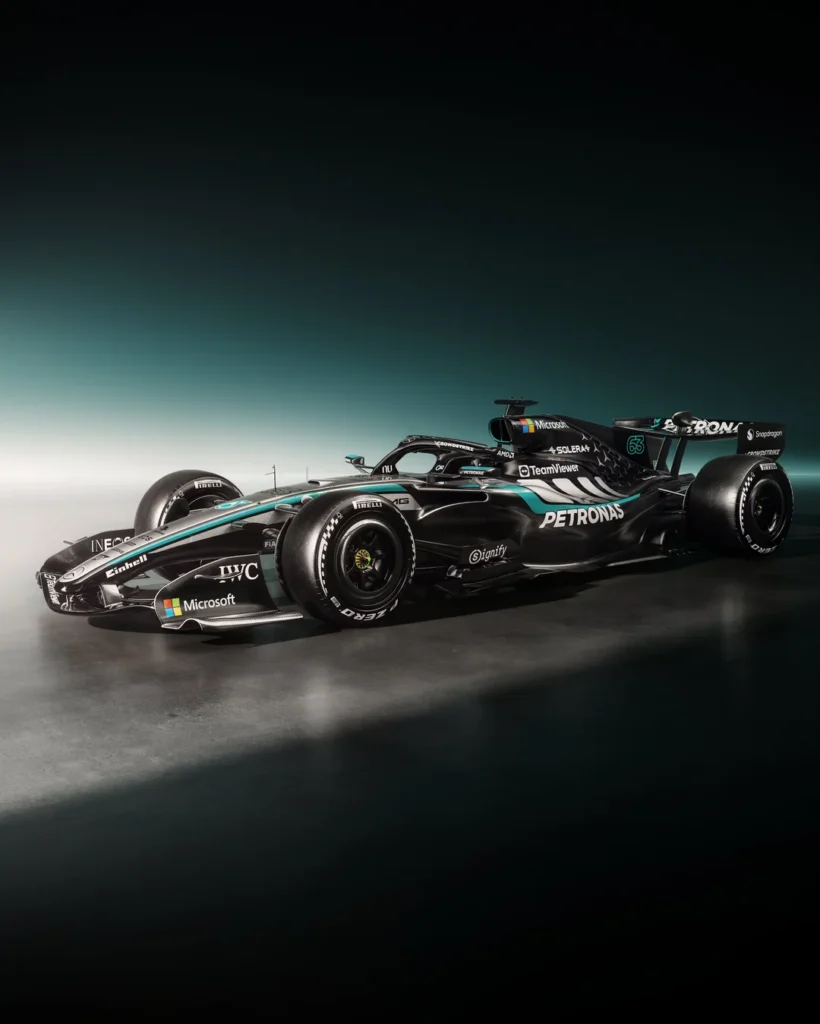
If there’s one constant through all of this, it’s the belief that George Russell deserves a car that can fight at the front.
“Looks fast while standing still” became a running joke, but beneath it sits a serious sentiment: Russell has delivered consistently, and many see 2026 as a moment where his talent should finally translate into a title-contending package. Whether the W17 becomes his car remains unknown, but optimism around him is louder than it’s been in years.
Bottas, Australia, and Accidental Linguistics
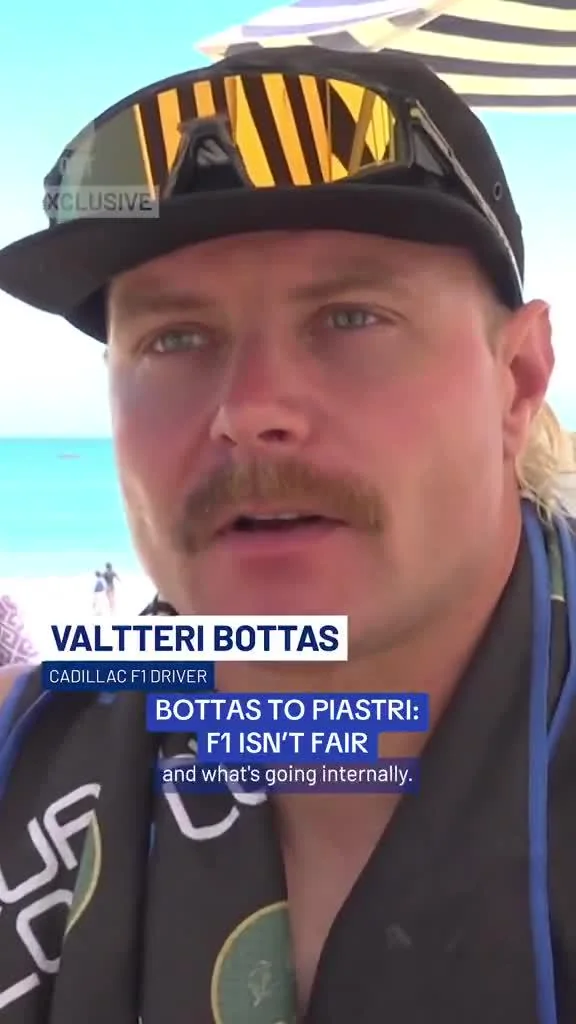
Away from car design, Valtteri Bottas offered a reminder that F1 discourse doesn’t always stay technical.
Speaking about Oscar Piastri, Bottas praised his season, acknowledged that the first half was stronger than the second, and backed his “fellow Aussie” to succeed. That phrase alone sparked an entire detour into Australian slang, cultural adoption, and Bottas’ increasingly public embrace of life in Adelaide.
The takeaway was simpler than the jokes: Bottas sees Piastri as a long-term force, and his tone suggested admiration rather than rivalry.
Charles Leclerc, YouTuber (Apparently)

Meanwhile, Charles Leclerc quietly picked up his one-million-subscriber YouTube plaque, prompting surprise that he even had a channel.
With relatively few uploads spread across several years, the reaction wasn’t about volume but presence. His Monaco, Monza, and Rafale videos were singled out, as was how much official Formula 1 content has quietly leaned on his footage. Comparisons followed, to other Monaco-based drivers, to YouTubers who’ve beaten Lewis Hamilton in equal machinery, and to the strange overlap between elite motorsport and creator culture.
The plaque itself wasn’t the point. The ease with which top drivers now straddle professional racing and personal media was.
Microsoft Joins the Party
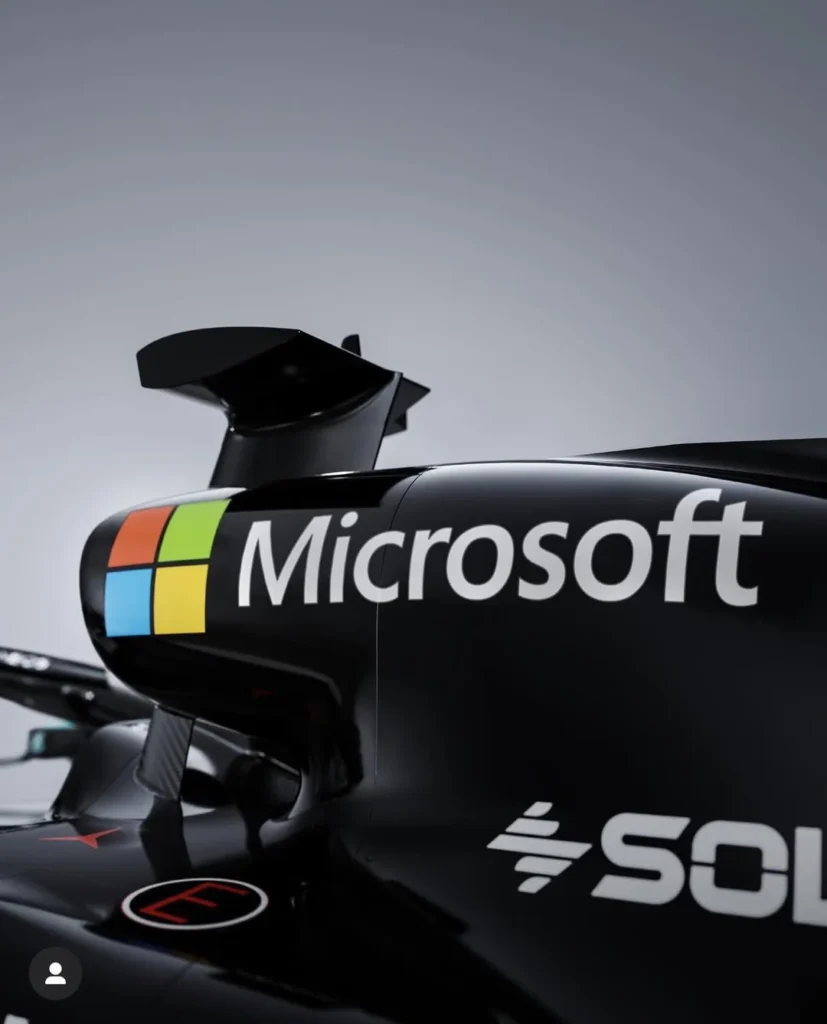
Mercedes’ announcement welcoming Microsoft to the team ahead of 2026 should have been straightforward.
Instead, it detonated.
Years of George Russell PowerPoint jokes resurfaced instantly. Copilot memes followed. Blue screens, forced updates, mid-race reboots, CrowdStrike references, none of it took long. The community’s message was clear: if Mercedes doesn’t lean into this with at least one knowingly ridiculous skit, they’ve missed an open goal.
The Sound of 2026
On track, at least audibly, change is coming.
A controlled comparison, same filmer, same location, same equipment, suggested the 2026 cars sound slightly louder, higher-pitched, and raspier. Not a revolution, but a shift. Many attributed the difference to the removal of the MGU-H, while others reiterated that the real sound culprit has always been the turbo, not the V6 layout itself.
Nobody pretended it rivals the V10 or V8 eras. But there was cautious optimism that, in person, the cars will feel more urgent and less muted.
F1 Goes to the Oscars
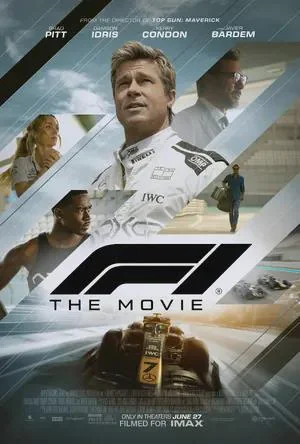
Finally, the sport crossed into cinema.
F1: The Movie secured four Academy Award nominations, including Best Picture. Reaction followed a familiar split.
Very few believe it will, or should, win Best Picture. Most see the nomination as a by-product of the expanded ten-film era and aggressive studio lobbying. But technical categories tell a different story. Best Sound, Best Editing, and Visual Effects were widely viewed as deserved recognition for blending real racing into a cinematic framework that feels immersive rather than synthetic.
Avatar is still expected to dominate VFX. But even critics of the script acknowledged that the editing and sound design elevate the experience, particularly in IMAX, where early-90s engine notes and race sequences landed with real impact.
The consensus landed somewhere in the middle: not a great film, not a historical Best Picture, but a legitimate technical achievement, and a sign of how far Formula 1’s cultural reach now extends.
Waiting for the First Lap
That’s where things stand.
A smaller Mercedes that looks right. A diffuser that looks different. A grid debating whether engineering or drivers should matter more. Veterans embracing new homes. Champions running YouTube channels. Microsoft jokes writing themselves. Louder cars. Oscar nominations.
And not a single meaningful lap time yet.
History says most of this noise will age badly. But until cars hit the track, speculation fills the vacuum, and 2026 has already proven it won’t be a quiet reset.