

The first on-track session for the 2026 Java House Grand Prix of Arlington delivered exactly what many expected from IndyCar’s newest street circuit: raw speed, punishing bumps, and a layout that immediately divided opinion between those watching from home and those strapped into the cockpit.
At the end of Practice 1, it was Scott McLaughlin who set the pace, finishing fastest ahead of Álex Palou and Will Power. Pato O’Ward and Felix Rosenqvist rounded out the top five, with Marcus Ericsson, Alexander Rossi, Christian Lundgaard, Scott Dixon, and rookie Dennis Hauger completing the top ten.
Even in the earliest session of the weekend, the Arlington circuit already appears poised to produce one of the most unpredictable races of the season.
McLaughlin Sets the Benchmark
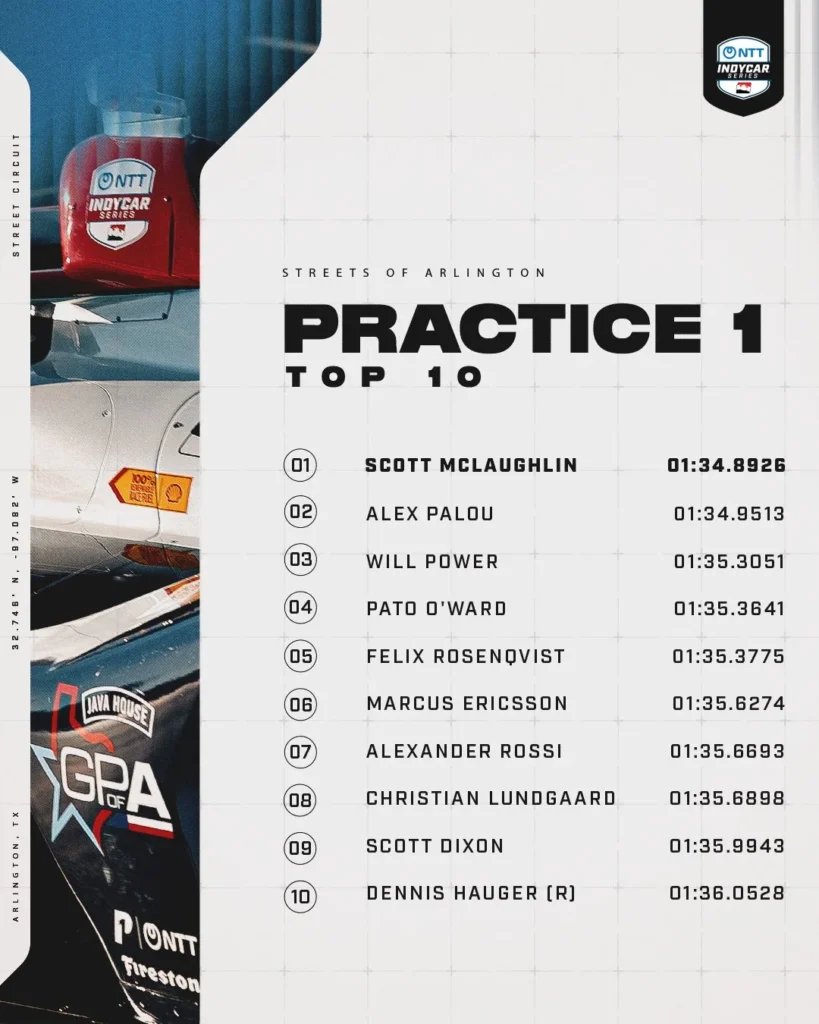
McLaughlin wasted little time stamping his authority on the new circuit, topping the opening practice and looking immediately comfortable on a track many drivers were still learning.
The Team Penske driver was quick to praise the venue, offering one of the strongest endorsements a new street circuit can receive.
Scott McLaughlin: “That is instantly my most favorite street circuit ever.”
The comment carries additional weight considering McLaughlin’s background in Australian Supercars, where drivers regularly face tight, technical street layouts. For a driver accustomed to notoriously bumpy tracks like Surfers Paradise, Arlington’s aggressive surface may feel familiar.
Observers quickly noted that McLaughlin appeared especially dialed in compared to the rest of the field. While teammates and rivals worked through their programs, his early pace suggested he had already found a comfortable rhythm on the circuit.
Yet even with McLaughlin leading the way, the competitive order behind him hinted at a weekend where no single team holds a clear advantage.
A Wide-Open Top Ten
The timing sheets from Practice 1 painted a picture of unusual parity across the field.
Five different teams appeared inside the top five positions, and the top ten featured drivers from seven separate organizations. For a series built on tight competition, Arlington may be delivering that balance immediately.
Palou’s presence near the top of the order was hardly surprising. The reigning IndyCar powerhouse is rarely far from the front on street circuits, and even in early practice he looked poised to challenge McLaughlin throughout the weekend.
Further back, the inclusion of Dennis Hauger in tenth place was particularly notable. The rookie managed to insert himself into the top ten in his first weekend running the new circuit, an early sign that he may adapt quickly to the demands of IndyCar’s street courses.
Across the paddock, teams now face the familiar overnight task: digging into data to extract more speed.
With a brand-new layout, engineers and drivers alike will spend the evening evaluating telemetry and refining setups, particularly as the race distance approaches.
One likely adjustment is suspension setup. The violent bumps seen throughout the lap suggest that teams may soften their cars significantly before race day to ensure durability and driver comfort over a full stint.
Arlington’s Signature Straight
If there is one feature of the Arlington circuit that dominated discussion throughout the session, it was the track’s enormous straight.
Onboard footage revealed a section that pushes the cars to extreme speeds before funneling them into a technical braking zone, a combination that looks thrilling for viewers but physically punishing for drivers.
The violent vibrations over the surface were impossible to ignore. From the driver’s-eye cameras, the cars appear to bounce relentlessly as they approach top speed, with the suspension absorbing constant impacts from the uneven pavement.
For viewers, the sensation bordered on disorienting. The onboard view along the straight was so intense that simply watching the footage felt physically uncomfortable, underscoring just how brutal the experience must be in the cockpit.
The cars are effectively redlining along the final portion of the straight, reaching speeds that resemble those seen on short oval tracks before diving back into a narrow sequence of corners.
With such high speeds followed by heavy braking, the circuit could also place enormous strain on braking systems. Over a full race distance, teams will need to carefully manage temperatures and wear.
Bumps, Concrete, and Texas Streets
Part of the circuit’s brutality appears to come from the nature of Texas roads themselves.
The Arlington layout runs across heavily used urban streets where the underlying clay soil expands and contracts rapidly with weather changes. That ground movement leads to constant shifting beneath the surface, creating bumps that are far more severe than what drivers experience on purpose-built circuits.
The result is a track that quite literally shakes the cars apart down the straight, a physical test that will likely leave drivers sore long after Sunday’s race.
While challenging to drive, the layout has also drawn praise as a true driver’s circuit. The combination of speed, bumps, and narrow sections demands precision while offering multiple technical challenges within a single lap.
Painted Runoffs and Creative Racing Lines
Another unusual aspect of the Arlington circuit emerged during the session: drivers repeatedly cutting across painted sections and curbing in certain corners.
This wasn’t a case of drivers pushing track limits, it was simply the intended layout.
According to the broadcast, teams had originally run the circuit in the simulator without the painted runoff areas or decorative curbing that appeared when they arrived at the track. Because those markings were added later, drivers have effectively been allowed to drive over them freely.
The result is a racing line that occasionally resembles something closer to a NASCAR-style corner entry than a traditional street course apex.
Those painted sections also appear to use abrasive sand-based paint similar to that found on many FIA Grade 1 circuits. While the surface may offer additional grip in dry conditions, it could become a serious hazard if rain arrives during the weekend.
The Broadcast Booth Steals the Show
Beyond the action on track, the opening practice session also drew praise for the broadcast itself.
The commentary booth delivered a lively start to the weekend, highlighted by a moment where the nickname “Rasmanian Devil” made it onto the broadcast after circulating among fans earlier in the week.
The moment quickly became a highlight of the session, reinforcing the sense that the broadcast team has found a strong chemistry early in the season.
Throughout the session, the booth’s dynamic helped maintain an entertaining rhythm, balancing technical discussion with humor as the field worked through their first laps around Arlington.
The only interruption came from occasional feed glitches reported by viewers, though the issue appeared to resolve quickly.
Early Incidents and Familiar Storylines
Not every driver enjoyed a clean session.
Sting Ray Robb again drew attention during Practice 1, continuing a pattern that has followed him across several race weekends. Incidents and inconsistent pace remain ongoing concerns, and teams will be watching closely to see whether he can stabilize his performance as the weekend progresses.
Elsewhere, the data from the session also produced some surprising comparisons. At one point, Robb’s lap time was noted as being only about 0.05 seconds faster than the quickest Indy NXT time, a statistic that quickly caught attention among observers.
For teams like Juncos Hollinger Racing, the session highlighted the need for significant overnight improvements if they hope to compete further up the order.
A Physically Demanding Weekend Ahead
If Practice 1 revealed anything about the Arlington street circuit, it’s that the race will likely be as demanding physically as it is strategically.
The combination of relentless bumps, long periods at full throttle, and heavy braking zones places enormous strain on both drivers and equipment.
Even in a short practice session, the circuit already looked exhausting to drive. Over a full race distance, the punishment could be far greater.
Yet despite the brutality of the layout, drivers appear to be embracing the challenge.
McLaughlin’s enthusiastic reaction suggests the paddock may have found something special in Arlington: a street circuit that feels raw, fast, and unpredictable.
And if Practice 1 is any indication, Sunday’s race could deliver exactly the kind of chaos IndyCar thrives on.
The early takeaway from the opening session was simple.
This race weekend has all the ingredients to be fun.