

The Singapore Grand Prix weekend delivered another chapter in McLaren’s increasingly complicated relationship between Lando Norris and Oscar Piastri. A collision between the teammates, an FIA decision to take no further action, and Andrea Stella’s promise of internal consequences have reignited questions about whether McLaren’s approach to managing its drivers is helping or hurting the team. Meanwhile, Max Verstappen has questioned the value of sprint races at circuits where overtaking is difficult, reports of arrests in the Singapore paddock have been clarified, and fans are debating where Formula 1 should race if Germany returns to the calendar.
Norris and Piastri Collide as McLaren’s Internal Tensions Return

McLaren’s Singapore sprint became another example of how quickly an attempt to maintain equality between two competitive drivers can turn into a problem for the entire team.
Norris attempted to overtake Piastri on the inside at Turn 5, but the two made contact at the apex. The incident prompted an investigation by the FIA stewards, who ultimately determined that neither driver was wholly or predominantly responsible. According to the official decision, Piastri had not expected Norris to attempt an overtake at that corner. After turning in, he noticed his teammate on the inside and attempted to leave space. orris offered a different perspective. He believed his front axle had moved ahead of Piastri’s mirror before the apex, meaning he was entitled to racing room. However, as the corner approached, the available space was less than anticipated. Norris used the inside curb, applied the brakes, and contact followed.
After reviewing the evidence and hearing from both drivers and a McLaren representative, the stewards concluded that both had contributed to the collision. No further action was taken.
That ruling might have settled the question of whether a sporting penalty was warranted, but it did little to resolve the bigger issue: Why was Norris attempting such a risky move against his own teammate in the first place?
A Risky Move for One Sprint Point
The overhead perspective of the collision has only intensified scrutiny of Norris’s decision-making.
There are legitimate arguments on both sides of the incident itself. Norris had established enough overlap to believe he deserved space, while Piastri appeared to leave at least some room on the inside. The stewards’ conclusion that neither driver was predominantly responsible reflects the difficulty of assigning blame based solely on the positioning of the two cars. However, the question of whether an overtake is technically permissible is separate from whether attempting it makes competitive sense. Norris was fighting to gain one position in a sprint race, potentially worth just one additional championship point. He was not attempting a pass for the victory or a podium position.
More importantly, the driver he was attacking was his teammate. McLaren entered the weekend facing significant pressure in the Constructors’ Championship, with Red Bull reportedly just 11 points behind. Under those circumstances, putting both cars at risk for such a limited individual reward is difficult to justify. The wet conditions and worn intermediate tires only made the calculation more questionable.
An aggressive overtake against a rival might have been celebrated as an example of determined racing. Attempting the same maneuver against a teammate, when both drivers are needed to protect the team’s championship position, carries an entirely different set of consequences. The move also raises an uncomfortable question about the Norris-Piastri relationship. When the championship benefit of gaining a single position is so small, it becomes tempting to wonder whether finishing ahead of Piastri has become an objective in itself.
That does not establish Norris’s motivation. Drivers are naturally competitive, and the instinct to overtake the car ahead is fundamental to Formula 1. Nevertheless, the perception that McLaren’s drivers are competing against each other as much as their external rivals is precisely what the team needs to avoid.
Norris’s Explanation Creates Another Controversy
If the collision itself was controversial, Norris’s subsequent comments did little to calm the situation.
Speaking about the incident, Norris acknowledged his role as the attacking driver while defending his decision to attempt the pass.
“But I did apologise because it was still me that was the one attacking, as I have the right to do, but if I just sat there and was boring, like I should be, then nothing would have happened. So it’s still my fault, but I deserve to go for the space, and I still believe […] I had the right for it.”
His argument is understandable from a racing perspective. Norris believed he had established sufficient overlap, and he did not want to abandon an opportunity simply because the other car belonged to McLaren. However, his explanation also illustrates why the incident has attracted so much criticism. Norris effectively acknowledged that he initiated the situation while continuing to defend the decision that created it.
The distinction matters. A driver can accept responsibility for attempting an overtake without necessarily accepting sole responsibility for the resulting collision. That is consistent with the stewards’ finding that both drivers contributed. But Norris’s suggestion that avoiding the move would have amounted to being boring shifts the discussion away from racecraft and toward entertainment.
The choice was not simply between attempting a risky overtake and refusing to race. It was between taking a significant risk against a teammate for a minimal potential reward and recognizing the broader competitive situation.
Formula 1 drivers should not be expected to abandon every ambitious move. But the ability to recognize when an opportunity is not worth pursuing is itself an important part of racing intelligence.
Is Norris Being Judged More Harshly Than Other Drivers?
The reaction to Norris has extended beyond the collision, with criticism increasingly focused on his public demeanor.
Some see his recent comments as evidence that winning the World Drivers’ Championship has made him more outspoken without necessarily making him more measured. Comparisons with Verstappen have been particularly prominent. Verstappen faced intense criticism for aggressive racing during his early Formula 1 career. His willingness to defend controversial moves became a defining characteristic of his public image, but he was also considerably younger when many of those debates began.
Norris, by contrast, is now a reigning world champion. That status brings greater expectations regarding judgment and accountability. Yet there is another side to this discussion. Fans frequently complain that modern Formula 1 drivers are too carefully managed by public relations departments. Drivers are criticized for offering predictable answers, avoiding controversy, and refusing to express genuine opinions.
When Norris speaks candidly, however, the response can be equally hostile. There is a contradiction in demanding more personality from drivers while criticizing them whenever their unfiltered opinions are unpopular. The distinction should be between honesty and sound judgment. Norris is entitled to explain why he believed the overtake was justified, just as observers are entitled to question whether the attempt was sensible. The FIA’s decision also deserves consideration. The stewards reviewed the incident and concluded that it did not warrant a penalty. Criticism of Norris should not erase that finding simply because his subsequent explanation was unpopular.
At the same time, a no-further-action decision does not automatically make every aspect of the move strategically defensible.
Andrea Stella Draws the Line: No Individual Is Bigger Than McLaren
McLaren team principal Andrea Stella was considerably less interested in debating which driver deserved racing room.
His message was focused on the team’s interests.
“Two McLarens making contact is simply not acceptable. We’ll discuss this with our drivers. We’ll reiterate that the team interest is far bigger than any of us, there’s no ego, there no person that is bigger than the interest of McLaren.”
Stella’s position establishes a distinction between the FIA’s responsibilities and McLaren’s own expectations. The stewards were asked to determine whether the collision breached the sporting regulations and whether either driver deserved a penalty. McLaren must answer a different question: Should its drivers have allowed themselves to reach that situation at all?
From a team-management perspective, the answer appears straightforward. McLaren cannot afford unnecessary contact between its own cars, especially while facing pressure in the Constructors’ Championship.
But the team’s handling of the aftermath is now becoming a controversy of its own.
Papaya Rules Become a Public Relations Problem
McLaren reportedly indicated that discussions about consequences for the collision would take place after the Singapore weekend, with the matter addressed before the next race in Austin. Rather than resolving the issue immediately, that approach has prolonged public speculation about what disciplinary measures the team might impose. The terminology has not helped.
“Papaya Rules” was intended to establish expectations for how Norris and Piastri race each other. Increasingly, however, the phrase has become a target of ridicule whenever McLaren’s drivers make contact or the team becomes involved in another dispute over race management.
At its most basic, the principle is simple: teammates should not collide. Turning that expectation into a publicly discussed disciplinary process risks making a professional racing team appear unnecessarily bureaucratic. There is also a danger in publicly promising consequences before deciding what those consequences should be.
If McLaren imposes a significant punishment, it risks frustrating a driver whose performance remains essential to the team’s championship ambitions. If it ultimately imposes little or no meaningful punishment, questions will follow about why the issue was escalated publicly in the first place. Neither outcome is particularly helpful.
McLaren’s emphasis on equality has created another complication. Treating two drivers fairly does not necessarily mean that every situation should be handled identically. Differences in race pace, tire condition, track position, and championship priorities sometimes require decisions that temporarily favor one driver over the other. That is not automatically favoritism. It can simply be race management.
During the Singapore sprint, questions emerged about whether McLaren could have managed the running order more effectively rather than allowing the drivers to fight. One argument is that Norris appeared faster than Piastri and could potentially have challenged Charles Leclerc had McLaren arranged an earlier position swap. The counterargument is that Singapore’s limited overtaking opportunities, the proximity of Kimi Antonelli, and the relatively small gaps between the cars made such a swap more complicated than it might initially appear.
There is no guarantee that Norris would have passed Leclerc even with clear track ahead. Nevertheless, the discussion points to a larger issue: McLaren’s reluctance to intervene decisively can leave its drivers attempting to resolve situations themselves on the circuit. That approach works when both drivers race cleanly.
It becomes far more problematic when they make contact.
Is Norris’s Frustration About More Than One Sprint Race?
Another possible explanation for Norris’s increasingly frustrated public comments is that the Singapore incident reflects dissatisfaction accumulated over a longer period.
McLaren has faced criticism over strategy decisions, pit stops, reliability concerns, and upgrades throughout the season. There is a perception that Norris has repeatedly been expected to accept setbacks and move forward, while the team’s own mistakes have not always attracted the same public accountability now being demanded of its drivers. That interpretation remains speculative. There is no confirmation that those frustrations motivated the Turn 5 attempt.
Still, it highlights why Stella must be careful about how he handles the situation. A driver who feels that his team has not consistently maximized his opportunities may respond poorly to being publicly criticized for an error of judgment, even when that criticism is justified. Piastri’s perspective matters equally.
If McLaren’s disciplinary process appears inconsistent, it risks reinforcing concerns about whether both drivers are truly being treated fairly. The challenge for Stella is not merely to establish that contact is unacceptable. It is to maintain the confidence of both drivers while ensuring that McLaren’s championship priorities remain clear. The team has demonstrated that it can produce championship-winning machinery and results.
Managing two ambitious drivers without allowing their rivalry to undermine those achievements is proving to be a different challenge.
Should the FIA Treat Teammate Collisions Differently?
The Norris-Piastri incident has also revived questions about stewarding consistency.
Some believe that collisions between teammates are routinely treated more leniently than incidents involving drivers from opposing teams. Others consider the Singapore decision entirely standard, arguing that contact between teammates is often left to the teams themselves when neither driver is clearly responsible. The distinction is important because the FIA’s decision explicitly identified contributions from both Norris and Piastri.
It was not simply a case of the stewards deciding to overlook an incident because both cars belonged to McLaren. However, the broader perception of inconsistency remains. Comparisons have been drawn with previous incidents involving Norris, including his pit-entry infringement at the 2021 Russian Grand Prix, and with penalties imposed on other drivers in unrelated circumstances.
George Russell’s Monaco chicane penalty has also been cited in discussions about whether relatively minor infringements sometimes attract harsher punishment than incidents involving contact. These comparisons are not necessarily equivalent. Different incidents involve different regulations, circumstances, and evidence. But the frustration reflects a recurring problem for Formula 1. When the reasoning behind decisions is not widely understood or appears inconsistent across incidents, even a defensible ruling can become another source of controversy.
The Singapore collision demonstrates that a clear written explanation does not guarantee acceptance, particularly when championship rivalries and perceptions of team favoritism are involved.
Verstappen Questions the Point of Sprint Races Where Overtaking Is Difficult
Away from McLaren’s internal problems, Verstappen has raised another question about Formula 1’s direction.
The Red Bull driver believes sprint races should not be held at circuits where overtaking is difficult. It is a relatively narrow criticism, but it opens a much broader debate about whether the sprint format delivers the entertainment it was designed to create. The fundamental problem is that sprint races often begin with cars arranged in approximately their natural performance order.
The fastest cars qualify toward the front, while slower cars start farther back. With limited laps and relatively little opportunity for alternative strategies, there are fewer mechanisms to create the pace differences that generate overtaking. The result can be a procession in which the leading cars gradually separate, while drivers farther back struggle to make progress.
At circuits where overtaking is already difficult, those limitations become even more pronounced.
Are Sprint Races Actually Encouraging More Racing?
Sprint races are supposed to provide an additional competitive session and more opportunities for on-track action.
Yet the championship structure can encourage precisely the opposite behavior. With fewer points available than in a Grand Prix, drivers must balance the benefit of gaining positions against the risk of damaging their cars before the main event. A driver might be willing to attempt an aggressive maneuver for a Grand Prix victory but decide that the same risk is not justified for a minor sprint position.
This creates an inherent tension. The format encourages drivers to race flat out, but the limited reward can encourage caution. The Norris-Piastri collision provides an unusually relevant example. Norris attempted the kind of aggressive move that sprint racing is theoretically supposed to encourage, yet the resulting controversy has centered on why he took such a risk for one additional point.
In other words, Formula 1 wants sprint races to produce action, but the championship incentives do not always support aggressive racing.
Should F1 Change the Format Instead?
Not everyone believes sprint races should disappear.
There is an argument that the concept remains worthwhile but has not been optimized for either entertainment or championship relevance. One solution would be to select circuits primarily based on overtaking opportunities, which aligns with Verstappen’s criticism. Another would be to experiment with formats that create greater variation in the running order.
Reverse grids, sprint-specific tires, and different qualifying arrangements have all been suggested as possible ways to generate more competitive racing. More unconventional proposals include separate races for reserve or development drivers, splitting the grid into smaller groups, and even team-based relay formats. An endurance-style event in which teammates collectively complete a longer distance would place greater emphasis on constructors rather than individual drivers, although it would introduce significant practical challenges involving car allocation, fueling, and driver fatigue.
There is also a simpler alternative: abandon sprint races and use the additional track time for feeder-series competition. That would preserve the traditional Formula 1 weekend while still providing spectators with more racing. The debate ultimately comes down to what Formula 1 wants sprint weekends to achieve.
If the goal is simply to create another session with championship points, the current format accomplishes that. If the goal is to consistently produce exciting racing, the results remain far more debatable.
And if a format requires reverse grids or increasingly elaborate regulations to create action, it is reasonable to question whether the original concept is working as intended.
Singapore Paddock Arrest Rumors Clarified: Confiscations, Not Arrests
The Singapore Grand Prix weekend also produced an unusual off-track story involving the country’s strict regulations.
Journalist Thomas Maher reported that stories had been circulating about Formula 1 personnel being arrested for possessing illegal cigarettes and vaping products while entering the paddock. However, Maher clarified that those accounts had been exaggerated. There had been no arrests, although confiscations had taken place.
Teams had reportedly received circulars before the event reminding personnel about Singapore’s strict controls on tobacco and vaping products. The reminders also addressed chewing gum and an unexpectedly specific warning about being naked in hotel rooms with the curtains open.
That final detail attracted almost as much attention as the original arrest rumors.
Chewing Gum, Hotel Curtains, and Singapore’s Unusual Restrictions
Singapore’s approach to chewing gum is frequently misunderstood.
The country’s restrictions primarily concern the importation and sale of chewing gum, with certain exceptions, rather than a blanket prohibition on the act of chewing it. The rules are associated with concerns about littering and the difficulty of removing discarded gum from public spaces. The hotel-room warning prompted a different discussion.
Singapore’s public-nudity restrictions can extend to situations where someone is visible from outside a private residence or hotel room. For visitors accustomed to different expectations of privacy, being reminded to close hotel curtains before getting undressed may seem unusually intrusive. But it is precisely the kind of local regulation that international sporting organizations must communicate to personnel traveling from around the world.
The situation also reignited a broader debate about Singapore’s approach to governance. Supporters of strict public-order rules point to the country’s cleanliness, safety, and economic success as reasons why such regulations may be worthwhile. Critics argue that some restrictions place unnecessary limits on individual freedom and personal behavior.
Those are larger political and cultural questions that extend well beyond Formula 1. For the paddock, however, the immediate lesson is considerably simpler: personnel need to understand the rules of the countries they visit, even when those rules seem unusual. The warnings about hotel-room nudity also inspired inevitable jokes about Valtteri Bottas, whose famously relaxed public persona made him an obvious target for the speculation. There is no suggestion that the warning was actually directed at Bottas.
Still, the idea of Formula 1 teams receiving formal reminders about chewing gum and closing hotel curtains provided one of the weekend’s more unexpected moments.
Verstappen Brings a Relaxed Dress Code to Singapore
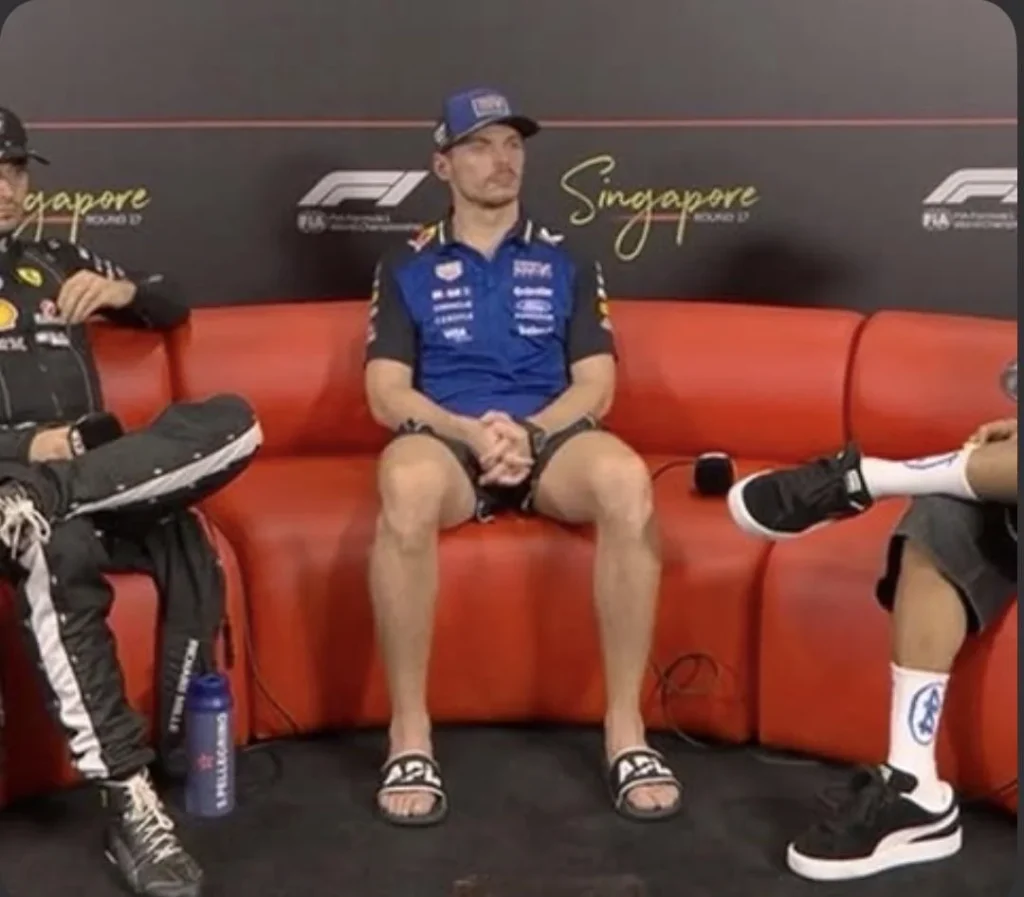
While Singapore’s regulations were generating discussion, Verstappen attracted attention for a considerably less controversial reason.
The four-time world champion attended the qualifying press conference wearing shorts and casual sandals. The outfit prompted amusement among fans, including speculation about whether Red Bull’s sponsors would approve of the footwear. Others pointed out that the sandals appeared to be connected to a sponsor.
The relaxed appearance also inspired comparisons with Australia, New Zealand, and California, where shorts and open footwear are common everyday clothing. Given Singapore’s humidity, Verstappen’s choice was hardly unreasonable. There was also surprise over claims that his sandals cost approximately $350, although the exact model and price were not independently established in the material available.
The reaction says something about Verstappen’s public image. At a time when Formula 1 drivers are scrutinized for almost every comment, outfit, and interaction, Verstappen can generate a surprisingly large discussion simply by arriving at a press conference dressed comfortably.
For a driver who has rarely appeared particularly interested in conforming to unnecessary expectations, the choice seemed entirely consistent with his personality.
Germany’s Missing Grand Prix: Hockenheim, Nürburgring, or Something Completely Different?
Another discussion gaining attention concerns Formula 1’s continued absence from Germany.
If the championship returns, should it race at Hockenheim or the Nürburgring Grand Prix circuit? Both venues have considerable history, but they offer different arguments for inclusion. Hockenheim has supporters who believe its layout provides better overtaking opportunities and would therefore be more suitable for modern Formula 1.
The Nürburgring offers its own historic appeal, although concerns remain about how easily current cars could overtake on the Grand Prix circuit. Some would prefer the return of Hockenheim’s original forest layout, with its long straights and distinctive character. However, restoring that configuration would require substantial changes, making the idea far more nostalgic than realistic.
The larger frustration is that Germany, a country with such an important place in Formula 1 history, currently has no Grand Prix.
Please, Not Another Street Circuit
The debate inevitably produced an alternative proposal: a Berlin street circuit nicknamed the “Bering.”
The suggestion was largely humorous, but it reflected a genuine concern that Formula 1’s next expansion might favor another urban venue rather than an established permanent circuit. Potential Berlin locations discussed included Tempelhof, the former airport whose grounds have hosted Formula E competition, and routes incorporating recognizable landmarks such as the Brandenburg Gate. Tempelhof offers substantial open space, but using it for a full Formula 1 circuit would present challenges, particularly because the area functions as a public park.
There were also references to the historic AVUS circuit, whose unusual configuration inspired jokes about how the current generation of power units would handle its long, high-speed sections. With energy management and superclipping already prominent topics under the current regulations, a circuit dominated by extended full-throttle running would create its own technical challenges. An even more unconventional proposal involved a point-to-point race along Germany’s Autobahn network, with fixed pit stops along the route.
It is an entertaining concept, but hardly a practical replacement for a conventional Grand Prix. Beneath the jokes is a serious question about Formula 1’s calendar priorities. Should the championship prioritize established circuits with strong motorsport histories, or continue pursuing venues that offer different commercial and promotional opportunities?
That question connects directly with Verstappen’s criticism of sprint racing. If overtaking opportunities are important enough to determine which circuits should host sprint events, they should arguably be an important consideration when deciding which venues deserve a place on the calendar at all. A German Grand Prix at Hockenheim or the Nürburgring would not automatically guarantee exciting racing.
But the desire to see Formula 1 return to an established venue, rather than introduce another street circuit, reflects growing concern about whether the calendar is being shaped primarily around the quality of the racing.
Formula 1’s Bigger Problem: Balancing Entertainment, Competition, and Control
Several seemingly unrelated stories from Singapore point toward the same underlying tension.
Norris believes he should be allowed to race aggressively when an opportunity presents itself. McLaren believes that freedom must be limited when it threatens the team’s interests. Verstappen questions whether sprint races are worthwhile when the circuits make overtaking difficult. Formula 1 continues to pursue a format designed to create additional competitive entertainment. Fans want drivers to express themselves, but those same drivers can face intense criticism when their explanations are unpopular.
And the debate about Germany’s potential return highlights the continuing conflict between traditional racing venues and the appeal of new locations. Each situation raises a variation of the same question: How much should Formula 1 prioritize competition, and how much should it attempt to manage the circumstances around it? For McLaren, the answer has immediate championship implications.
The team cannot afford to let the Norris-Piastri rivalry become more important than its collective performance. But it also cannot expect two world-class competitors to stop behaving like racing drivers whenever they find themselves fighting for position. Stella’s insistence that nobody is bigger than McLaren is a reasonable starting point. The difficult part is turning that principle into decisions that both drivers understand, respect, and consistently follow.
The FIA has already closed its investigation into the Turn 5 collision. McLaren’s internal examination of what happened, and how to prevent it from happening again, may prove far more consequential. With Austin approaching and the Constructors’ Championship still demanding attention, the team needs a solution that protects its points without creating an even larger internal conflict. Because the biggest danger for McLaren is not necessarily another aggressive overtake.
It is allowing the debate over who should have yielded to become more important than the championship both drivers are supposed to be fighting for.