

Red Bull’s confirmation that Gianpiero Lambiase will leave the team in 2028 turned a morning of rumor and interpretation into something much firmer: one of the central figures in the Verstappen-Red Bull era is now officially on a path out. And while the departure is still framed as long-term, with Lambiase remaining under contract through 2027 and continuing in his current role until his planned exit, the reaction around the news made one thing clear: this is not being treated as a routine staff change.
That is partly because Lambiase is not just any senior figure. Red Bull stated that he will remain both Head of Racing and Max Verstappen’s race engineer until his departure, underscoring how central he still is to the current operation. But the scale of the reaction around the paddock discourse reflects how closely his future has become tied to wider questions about Verstappen, Red Bull’s internal stability, and McLaren’s longer-term planning.
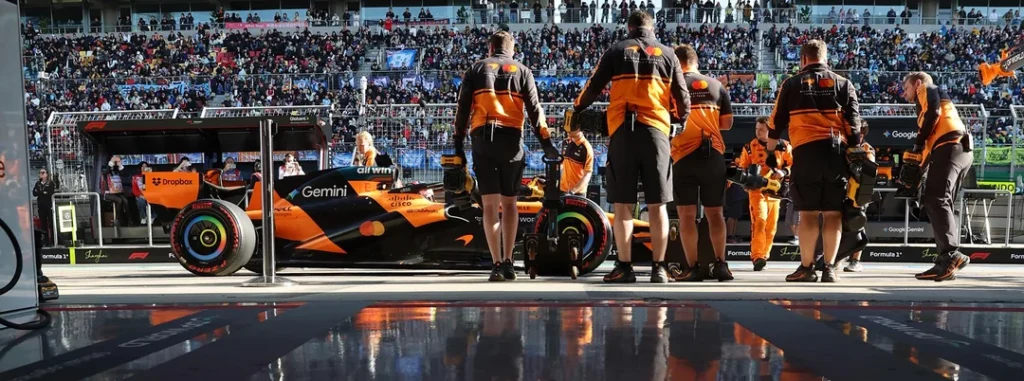
McLaren’s announcement helped clarify why the move immediately attracted so much attention. Lambiase is not arriving as team principal, despite some early interpretations pushing the conversation in that direction. McLaren instead said he will join as Chief Racing Officer, reporting to Andrea Stella. That title already exists in the team’s structure, with Stella currently carrying those responsibilities himself alongside his role as team principal. In other words, this is not a sudden team-principal handover. It is a restructuring move that formalizes the idea that Stella has been covering an unusually large amount of ground inside McLaren’s leadership.
That point became one of the strongest themes in the wider reaction. There was a clear sense that Stella has been doing multiple senior jobs at once, and that McLaren’s ability to recruit high-level personnel has in part been helped by the fact that some top-level responsibilities were effectively vacant because Stella was personally absorbing them. The view that emerged was that McLaren are not just hiring a famous name from Red Bull; they are continuing a wider model in which Stella has built the framework and now selectively installs proven operators into major roles beneath him.
That also helps explain why so many observers pushed back on the idea that this automatically means Stella is on the way out. Some saw the move instead as succession planning, or at minimum contingency planning. From that perspective, McLaren are not necessarily expecting Stella to leave, but they are protecting themselves against the possibility by adding another senior figure who could eventually become a natural candidate for larger leadership. The logic is straightforward: having a credible successor in-house is sensible risk management whether Stella stays for years or not.
At the same time, the reaction showed that Stella-to-Ferrari speculation has not gone away entirely, even if McLaren’s statement emphasized that both Stella and Zak Brown are on long-term contracts. For some, that language was read as a deliberate attempt to cool the Ferrari rumors. Others were far less convinced, pointing out that long-term contracts in Formula 1 are hardly ironclad. But even among those who still entertained the Ferrari possibility, there was recognition that Lambiase joining as Chief Racing Officer makes much more sense as a role beneath Stella than as an immediate replacement for him.
That broader McLaren structure was another major talking point. A lot of the discussion centered on how Brown and Stella appear to divide responsibilities in a way that shields the operational core of the team. Brown is seen as the public-facing figure, the one absorbing media scrutiny, pressure, blame, and noise, while Stella concentrates on actually running the team. That arrangement was widely framed as one of McLaren’s quiet strengths. Rather than dragging the team principal into every public fight, McLaren appear to let Brown act as a buffer, a “bullet sponge” for the distractions that come with the sport. In that reading, the team’s leadership model is not just functional; it is intentionally designed to protect the technical and racing side from unnecessary turbulence.
That contrast mattered because much of the Lambiase conversation quickly turned back toward Red Bull, and specifically to what many see as a team still reeling from accumulated departures, internal politics, and the loss of organizational cohesion. The announcement landed in an environment where a lot of people already feel Red Bull have been hollowed out over the last few years. Lambiase’s planned exit did not create that feeling, but it amplified it. The tone of much of the reaction was that this is another major name on a growing list, and another sign of a team that is no longer holding itself together the way a championship-winning operation should.
There was recurring emphasis on brain drain. Red Bull losing top personnel across a relatively short period was repeatedly framed as a far more serious problem than any single hire or departure. Some compared Red Bull’s current position unfavorably even to its earlier slump from 2014 to 2018, noting that at least in that phase the team still had a strong structure and a car capable of winning occasionally. Now, the anxiety is not just about pace. It is about whether the institutional backbone that once made Red Bull so formidable is slipping away at the same time.
That discussion also drew inevitable comparisons with Mercedes. Some reactions argued that Toto Wolff’s standing as a team leader looks even stronger in light of Red Bull’s unraveling, with Mercedes held up as the example of a team that also experienced staff losses and regulatory turbulence but remained coherent. The distinction many drew was not that Mercedes avoided churn, but that they had a leadership structure capable of absorbing it. The implication hanging over Red Bull was blunt: can they replicate that, or are they entering a deeper period of decline?
Opinions diverged on the causes, but the mood around Red Bull was unmistakably grim. Some blamed the team’s internal politics, some focused on the fallout from leadership changes, and some argued that once instability starts at the top, factions form, attention drifts, and people begin to leave or disengage. Even those pushing for more restraint generally conceded that the team is in a period of churn. The more bullish voices argued that it is simply difficult for dominant teams to keep everyone forever, that some departures are natural, and that rebuilding is possible. But the darker view was that Red Bull are no longer just facing a temporary wobble; they are watching the old foundations disappear.
That is why so much of the response to Lambiase’s future immediately became a response to Verstappen’s future.
The strongest recurring thread across all the sets was the belief that Lambiase’s departure says something significant about what Verstappen does next. Not everyone agreed on the exact outcome, but a huge amount of the conversation treated the two futures as linked. The reasoning varied. Some thought Lambiase may simply have concluded that Verstappen is unlikely to stay at Red Bull long-term, and has positioned himself accordingly. Others took it a step further and argued that Verstappen has already made up his mind, with Lambiase’s move reflecting that knowledge. A more dramatic interpretation was that the two may effectively be moving in tandem, whether formally or not: if Verstappen leaves or steps away, Lambiase follows his own exit route rather than remaining behind for a full rebuild.
That fed two main theories. The first is that Verstappen changes teams. The second is that he leaves Formula 1 altogether, at least for a period.
The “leave F1” theory had real traction in the reaction. A lot of the analysis around it leaned on the same core idea: Verstappen has been openly unhappy with the current regulations, has outside interests, and increasingly feels like someone whose connection to Formula 1 is conditional rather than permanent. That line of thought produced plenty of speculation about what comes next if he steps away, from endurance racing to rallying to hill climbs to an everything-with-wheels phase. Some jokingly imagined him entering anything available, while others pushed more seriously toward WEC and Le Mans as the natural destination. The broader point beneath all of it was consistent: many people now see Verstappen as a driver whose ambitions may no longer be contained by F1, especially if the sport continues in a direction he dislikes.
The “switch teams” theory, however, remains just as alive, and McLaren’s role in that discussion only intensified once Lambiase’s destination was formalized.
Even before Red Bull’s official confirmation, the idea that both Mercedes and McLaren were monitoring Verstappen’s situation was largely treated as obvious rather than surprising. The reaction to that story was often dismissive in one sense, with people calling it a non-story because every team would want Verstappen if he remained available. But once Lambiase’s McLaren move became clearer, the idea of a Verstappen-McLaren link started to feel a little less abstract in the eyes of many observers.
That does not mean McLaren is universally viewed as the likelier destination. Plenty still leaned toward Mercedes, often arguing that the Mercedes environment feels more compatible with Verstappen’s style than McLaren’s current culture. McLaren’s “papaya rules,” its collaborative driver framework, and Brown’s public personality were all cited as potential points of friction. Some doubted Verstappen would fit comfortably inside a team that asks drivers to buy into a collective system rather than orbiting around a single lead figure. Mercedes, by contrast, was viewed by some as having the temperament and structure to manage a driver like Verstappen more naturally.
But the McLaren case has its own logic. Lambiase’s move is part of that. So is the presence of several former Red Bull figures already in McLaren’s senior setup. For those who believe Verstappen’s loyalties run strongly through personal relationships and familiar staff, McLaren looks more plausible than it might have before. The idea that Verstappen could be drawn toward a place where several trusted faces have regrouped carried real weight in the reaction, even with the caveat that Lambiase will not be joining as a race engineer there.
The other major question, of course, is what either McLaren or Mercedes would do with their current drivers if Verstappen truly became attainable.
That conversation produced its own hierarchy of assumptions. At McLaren, the dominant reading was that if a seat had to be sacrificed, Oscar Piastri would be the more vulnerable of the two current drivers. That was not necessarily framed as a pure performance judgment. Instead, the argument leaned heavily on attachment and value within the team structure. Lando Norris was repeatedly described as more deeply embedded in McLaren, more commercially central, and more tied to the team identity. Piastri, by contrast, was seen as more movable even if he is still highly rated. So while some resisted the idea that McLaren would even need to chase Verstappen given its current driver pairing, those who entertained it often landed on the same conclusion: Norris stays, Piastri is the one at risk.
At Mercedes the same logic got applied differently. The question there became whether George Russell or Kimi Antonelli would be expendable depending on who had established themselves more strongly. But in both cases the existence of the question showed how destabilizing a potential Verstappen market move would be. It would not just shift one team. It could trigger a wider driver reshuffle.
For Red Bull, that possibility only adds to the sense of looming reset. Several reactions argued that if Verstappen goes, the team effectively loses far more than its lead driver. It loses the entire identity it has been built around. That was especially pronounced in the responses around Lambiase staying in place through 2027 and then exiting. Many interpreted that timeline as meaningful: he remains while Verstappen remains, then departs when the current era is over. The theory may be speculative, but it appeared again and again because it aligns with how people are reading Red Bull right now — as a team nearing the end of a cycle without an obvious next pillar to build around.
That uncertainty also shaped how people discussed gardening leave, roles, and access. There was a lot of interest in whether someone like Lambiase would be put on gardening leave before he actually joins McLaren. Some of that was procedural curiosity, but some of it carried a deeper implication: once a senior figure has committed to a rival, especially someone with access to race engineering and broader operational knowledge, teams inevitably start recalibrating what they can see and influence. Yet Red Bull’s own statement also makes clear they still need him. As long as he remains Verstappen’s race engineer and Head of Racing, he is not a ceremonial figure waiting out a contract. He is still inside the competitive core of the team.
That tension perhaps says as much as anything about why this story resonates. It is not just a future move. It is a live symbol of how the sport’s top teams are being reshaped in real time.
For McLaren, the mood around the announcement was largely admiration. The team is increasingly being viewed as methodical, opportunistic, and well-governed. It is seen as a place that identifies gaps, protects its key operational leaders, and recruits proven talent without panicking into dramatic structural overhauls. The idea that Stella and Brown have built something resilient came through repeatedly, as did the view that McLaren’s leadership culture is currently one of the strongest in Formula 1.
For Red Bull, the reaction was the opposite. Even where people urged patience, the overarching frame was one of erosion. The team no longer looks like the settled powerhouse it once did. It looks like a place people are leaving, a place whose future is tied too tightly to one driver, and a place whose next few years could define whether this is merely a difficult transition or the start of a genuine fall.
And for Verstappen, this story has only intensified the sense that every major development around him is now being read as a clue. Lambiase’s planned departure was not officially about Verstappen. McLaren’s statement was not about Verstappen. Red Bull’s statement was not about Verstappen. Yet almost every thread of reaction circled back to him anyway.
That, more than anything, is the real state of play. Lambiase’s move is important on its own, especially given his role and McLaren’s structure. But in the current climate, it also lands like a message about succession, power, and the end of one era. McLaren look like a team strengthening itself for the future. Red Bull look like a team bracing for it. And until Verstappen finally makes his next decision clear, every piece of movement around him will continue to be treated as part of the same story.