

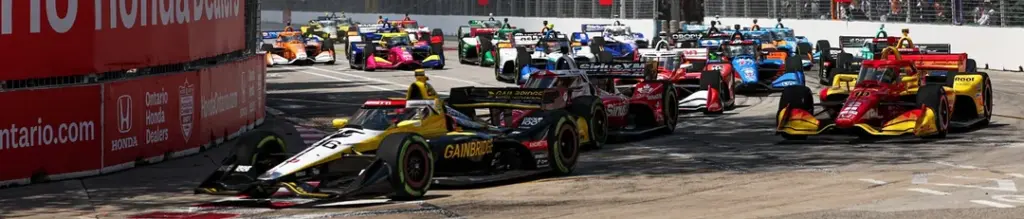
IndyCar’s first weekend in Markham produced the kind of race that can give a new circuit an identity almost immediately.
The now-infamous hairpin became a bottleneck, an overtaking opportunity, a contact zone and, depending on your perspective, either a piece of questionable circuit design or exactly the kind of corner modern motorsport needs more of. Fans loved it. But away from the on-track chaos, the inaugural event also exposed a much more serious problem. At least some disabled and mobility-limited spectators faced significant difficulties simply navigating the venue, including one longtime fan who ultimately missed Friday entirely and was unable to participate in Sunday’s pit walk.
Taken together, the two conversations offer a surprisingly clear roadmap for Markham’s second year: resist the temptation to sanitize what made the circuit entertaining, while putting considerably more thought into making sure everyone can actually experience it.
The Hairpin Accidentally Became Markham’s Signature
Before anyone starts redesigning the Markham circuit for 2027, there is a growing contingent of fans with a simple request:
Please don’t. The hairpin was involved in much of the chaos that defined Sunday’s race. Cars arrived under braking, fought for limited space, made contact, stalled, spun and occasionally created the kind of traffic jam that looked less like professional open-wheel racing and more like everyone trying to leave a Costco parking lot at the same time. And somehow, it worked.
What might have initially looked like one of the circuit’s biggest weaknesses became one of its most memorable features. Fans sitting near Turn 5 described an almost nonstop stream of entertainment: overtakes, drivers braking too late, punctures, contact, bottlenecks, spins and stalls. For spectators who bought seats there hoping for something resembling the action traditionally found at the end of Lakeshore Boulevard at the old Toronto circuit, the gamble paid off. It didn’t take long for the comparisons to get ambitious.
Markham now apparently has its own Monaco hairpin. Actually, depending on whom you ask, the hierarchy might now be Macau, Markham and then Monaco. That is quite a sentence for a circuit that has existed for one race weekend.
There were inevitable reminders that Long Beach and Montreal also belong in the conversation about famous North American street-circuit hairpins, but Markham already feels different. The combination of narrow confines, consequences for mistakes and the sheer amount of activity generated by the corner gave it an unusually strong identity for a brand-new venue. And unlike Monaco, Markham’s version actually produced racing. For some fans, that settles the question.
The corner is weird. It’s chaotic. It’s difficult. That’s exactly why they want it left alone.
Don’t Engineer the Personality Out of the Track
There is an understandable temptation whenever a new circuit produces incidents to immediately start looking for ways to “fix” it.
Markham presents a more complicated question. If the corner is dangerous in a way that needs addressing, that is one thing. But if the problem is simply that it creates unpredictable racing, then changing it could remove precisely what made the inaugural race memorable. Some fans would like a compromise.
Rather than replacing the hairpin with something resembling the original sweeping, extended-horseshoe concept, the entry could potentially be opened slightly to make it easier for cars to establish two usable lanes from entry through exit. Another suggestion was to extend the barrier and begin opening the entry several barriers earlier, potentially improving maneuverability without fundamentally changing the corner. There was also support for rounding off some of the sharper wall edges around the circuit while preserving the hairpin itself. Those are very different propositions from redesigning the corner because the racing looked messy.
Messy was the appeal. The extreme version of the fan response was essentially: make it tighter. Or add another one.
Apparently one Markham hairpin isn’t enough chaos. More seriously, there is also a good reason to wait before making substantial changes: the IR28. Several fans want to see what IndyCar’s new car can do around the circuit before making judgments based entirely on the current chassis. If the existing car could produce such an entertaining race around Markham, there is optimism that the next-generation machine could be at least as compelling.
That makes patience a legitimate option. Give the hairpin another year. Let a different car attack it. Then decide whether it actually needs fixing. Because uniqueness is increasingly valuable in racing. Fans frequently complain about circuits becoming too similar, too forgiving or too optimized. Markham accidentally created something immediately recognizable.
Changing it simply because it is unconventional could turn an emerging signature into just another corner.
The Bigger Problem Was Away From the Racing Surface
There is, however, one area where “leave it alone” absolutely does not apply.
Accessibility. One spectator’s account of trying to attend the race with his elderly, mobility-limited father paints a troubling picture of how difficult the inaugural event could be for disabled fans. The two have been attending races together since 1984.
On Friday, they arrived by GO Train and reportedly waited from approximately 8:30 a.m. until 1 p.m. for an accessible way to cross the track. Eventually, the father was sent home on the train. They returned Saturday and tried another entrance. This time they managed to cross the circuit, only to discover that the route toward the paddock required navigating what was described as a rock garden beside the YMCA.
A sidewalk behind a fence could have provided an accessible alternative, but they said they were not permitted to use it despite it apparently not being used for anything else. On Sunday, they tried again. This time, the YMCA sidewalk was open.
But another problem emerged at what was supposed to be one of the highlights of their weekend: the pit walk. The father couldn’t manage the pedestrian bridge. A ground-level pit gate was nearby, but their request to use it as a disability accommodation was denied. Then came the particularly painful part.
After they had been denied entry through that gate, spectators leaving the pit walk were allowed to exit through it. For a family that had attended races together for more than four decades, watching everyone else walk through the exact gate they had asked to use turned what should have been a memorable experience into an upsetting one.
That isn’t something that should simply be dismissed as a first-year growing pain.
Fans Say Other IndyCar Events Show What’s Possible
The accessibility discussion quickly expanded beyond one family’s experience.
Other fans with mobility-limited relatives recognized the problem immediately. Motorsport audiences do not suddenly stop wanting to attend races because they get older or develop disabilities. For a sport with generations of families attending events together, accessibility determines whether some of those traditions can continue. Long Beach was repeatedly offered as evidence that a street race can handle the problem differently. Fans familiar with that event described personnel stationed at crossover points where disabled spectators can cross, with priority provided before and after sessions. Some permanent crossover bridges reportedly have elevators, with their use reserved for people who need them, while shuttles help spectators navigate the venue.
Not every grandstand may be equally accessible, but the broader philosophy is important: accessibility is incorporated into how people move around the event rather than treated as an exception that needs to be negotiated with security every time someone encounters an obstacle. That was the fundamental frustration with Markham. The spectator involved said many staff members understood that there was a problem and wanted to help. The yellow-shirted staff in particular received praise for trying to solve problems.
The issue appears to have been bigger than individual staff members. At one point, another attendee said a volunteer at the main gate on Friday told them he was supposed to work in the disability section — but that the section hadn’t been built yet. If accurate, that detail perhaps captures the entire problem better than anything else. Accessibility cannot be something a venue figures out once disabled spectators arrive.
It has to exist before the gates open.
The Fan Is Now Trying to Help Markham Fix It
Despite the experience, the original spectator isn’t approaching the situation as someone who wants the event to fail.
Quite the opposite. They acknowledged that the circuit was being built around a pre-construction site and flooded farm field and said the venue itself was impressive given those circumstances. They expect the circuit to improve as the surrounding area develops. They are also documenting what happened, reviewing photographs, writing notes and even beginning to sketch an accessibility map with potential solutions.
Rather than simply complaining, the goal is to get constructive feedback in front of the people capable of changing the event. Other fans encouraged contacting the promoter, Green Savoree Racing Promotions, as well as local officials and IndyCar leadership. There were also suggestions that accessibility concerns could be raised with Ontario authorities rather than pursued through expensive litigation. The original spectator explicitly said they aren’t interested in suing anyone.
They want the experience fixed. That’s an important distinction because much of the broader reaction wasn’t demanding some extravagant accommodation. Fans largely saw the requests described as reasonable, particularly when a ground-level gate that could have solved one problem was already physically present. There was also an uncomfortable comparison raised involving Robert Wickens, who was at the circuit during the weekend. The point wasn’t that Wickens shouldn’t receive accommodations. Of course he should. The question was why an event capable of accommodating a prominent member of the motorsport community couldn’t provide a workable experience for an ordinary ticket holder with mobility limitations.
Accessibility cannot depend on who someone is.
Markham Has Five Years to Become Something Special
The encouraging part is that Markham doesn’t need to reinvent itself after Year 1.
It needs to learn from it. Fans pointed to the event being at the beginning of a five-year agreement as reason for optimism. The inaugural weekend was never going to be perfect, particularly at a completely new venue, and there will naturally be operational lessons that only become apparent once tens of thousands of spectators begin moving through the site. There was even speculation among fans about whether the challenge of preparing a new circuit was compounded by the promoter also handling Portland on a back-to-back schedule.
But “first year” can explain problems. It shouldn’t become an excuse for repeating them.
And the fan response has actually made the priorities remarkably easy to identify. The racing product doesn’t need rescuing. Markham found something.
The bizarre hairpin became an instant character in the race. Fans who watched from Turn 5 loved it. Casual viewers loved the chaos. People who didn’t attend are already talking about making the trip next year. The corner produced exactly the unpredictability and consequence that fans routinely claim they want from street circuits. Maybe the entry gets opened slightly. Maybe some awkward wall geometry gets cleaned up. Maybe organizers wait and see how the IR28 handles it. But there is little appetite for transforming Markham into something safer-looking simply for the sake of neatness.
The spectator experience is where the serious work belongs. Accessible track crossings need to be planned. Routes to major spectator areas need to accommodate people with mobility limitations. Pit walks and other experiences need procedures for guests who can’t use pedestrian bridges. Staff need clear options so accommodations don’t depend on whether an individual security worker is willing or authorized to improvise. And ideally, spectators should be able to see those routes on an accessibility map before they ever arrive.
Markham’s first IndyCar weekend showed exactly why the series came to the venue. It also showed exactly where the event wasn’t ready. That’s not necessarily a bad legacy for Year 1 if organizers listen. Keep the hairpin weird.
Make the rest of the circuit easier for everyone to experience.