

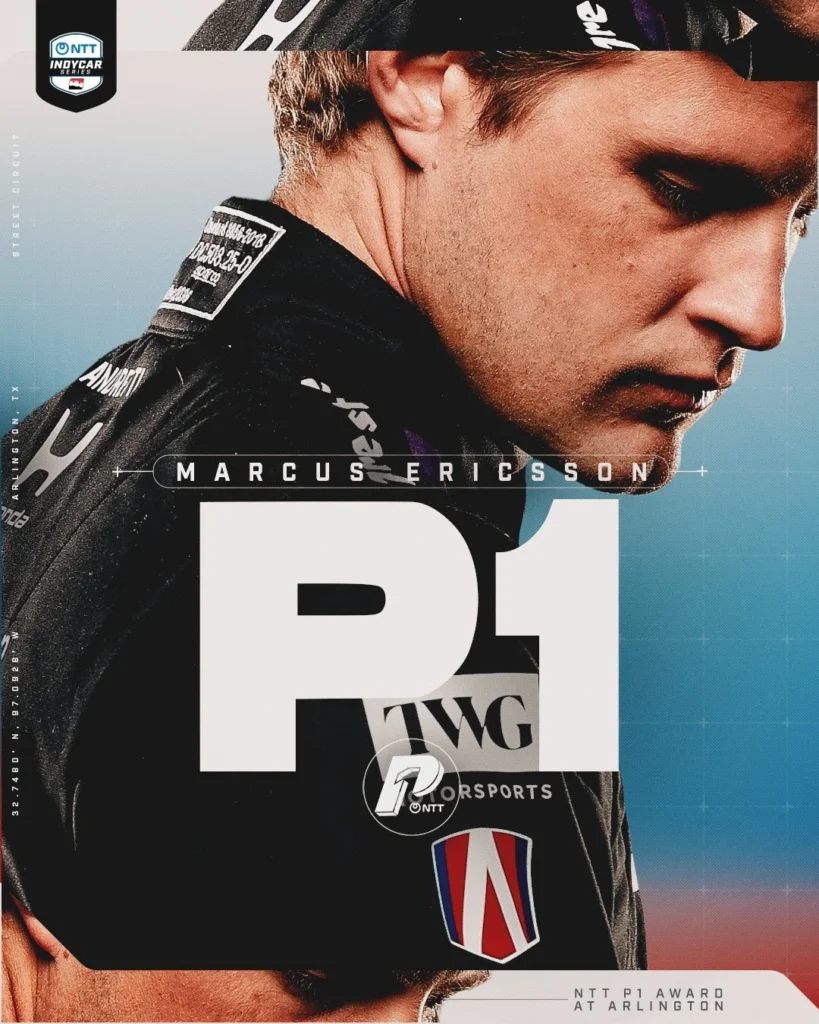
Marcus Ericsson will lead the field to green at the inaugural Java House Grand Prix of Arlington after securing the NTT P1 Award in a dramatic and chaotic qualifying session that showcased both the promise, and the unforgiving personality, of IndyCar’s newest street circuit.
Ericsson’s pole position came in a session defined by razor-thin margins, crashes, and a track that repeatedly punished even the smallest mistakes. By the end of the afternoon, the Swedish driver emerged on top ahead of Alex Palou and Pato O’Ward, with Will Power, Felix Rosenqvist, Marcus Armstrong, Kyle Kirkwood, Christian Lundgaard, David Malukas, and Alexander Rossi rounding out the top ten.
But the session’s biggest story wasn’t just the order at the front, it was the way Arlington demanded absolute precision from every driver who attempted a lap.
Arlington Shows Its Teeth
Drivers and fans alike quickly discovered that the new Arlington street circuit has a personality of its own.
Earlier in the weekend, Scott McLaughlin praised the layout as his favorite street course. Qualifying, however, proved that the circuit doesn’t care much for compliments. McLaughlin crashed during the session, a moment that perfectly encapsulated the brutal learning curve of a track that rewards commitment but punishes even minor miscalculations.
The incident reinforced what many observers were already noticing throughout the session: Arlington is not a forgiving venue. The narrow confines and unforgiving walls demanded absolute precision, and any driver pushing even slightly beyond the limit risked paying the price immediately.
It didn’t take long for the track to earn a reputation among viewers as a circuit that “has hands,” a place capable of striking back the moment a driver becomes too confident.
Ericsson Delivers When It Matters
Amid the chaos, Ericsson delivered one of the standout laps of the session to secure pole.
For the Andretti driver, the performance felt like a statement. In recent months, some observers had begun to question whether Ericsson still justified his place at the front of the grid. Arlington qualifying provided a clear response.
The lap immediately placed him ahead of the competition and held up through the remainder of the shootout format, forcing every driver who followed to chase his benchmark. With the fastest time already set, the pressure shifted to the rest of the field, and none managed to surpass it.
Some observers noted that Ericsson has historically performed well on new or unfamiliar street circuits, and Arlington appeared to continue that trend. The result also marks another strong street-course qualifying effort this season, reinforcing the idea that this type of venue plays directly to his strengths.
The moment also reflected a broader shift within the Andretti setup. With internal changes and new input shaping the car’s development, the team appears to be moving toward a direction that suits Ericsson more comfortably than previous seasons.
A Shootout Format That Needed Better Tools
While the qualifying format itself drew praise, the broadcast presentation became a major talking point throughout the session.
Single-car qualifying on a street circuit can be thrilling, but many viewers found it difficult to follow the action because of the limited data displayed on screen. Sector splits and live deltas, tools that typically allow fans to track whether a driver is gaining or losing time, were largely absent during the decisive moments.
Instead, the broadcast often relied on a simple red-or-green indicator to show whether a lap was faster or slower than the benchmark. Without a precise time comparison, the audience frequently had little sense of how competitive a lap truly was until the driver crossed the finish line.
The issue became particularly noticeable once Ericsson’s lap went on the board. Because the pole-setting time was established early, the broadcast indicator frequently remained red for the remainder of the session, draining much of the suspense from later attempts.
Some viewers noted that predictive sector timing had briefly appeared earlier in qualifying before disappearing, suggesting the system may have malfunctioned mid-session. Regardless of the cause, the result left many frustrated that a session with so much potential drama lacked the visual data needed to fully convey it.
The consensus among many observers was simple: the shootout format works, but the broadcast graphics need to keep up with it.
A Packed Front of the Grid
Behind Ericsson, the grid features several drivers with strong chances heading into the race.
Palou will start alongside the pole-sitter on the front row, followed by O’Ward and Power on row two. Rosenqvist and Armstrong round out the Fast Six.
Further back, Kirkwood narrowly missed joining the final shootout despite showing strong pace throughout the earlier segments, leaving some surprised that he did not make the final group.
Malukas and Rossi also secured spots inside the top ten as the field prepares for what could be a demanding race around the tight Arlington layout.
Weather Adds Another Variable
As if the challenge of the track itself weren’t enough, weather conditions have already forced adjustments to the race schedule.
INDYCAR announced that the broadcast start time for Sunday’s race will move to 11:30 AM ET on FOX, with the green flag expected around 12:00 PM ET (11:00 AM local time). The change comes in response to forecasts of wind gusts exceeding 50 mph, with the adjustment intended to improve safety for fans, workers, and trackside infrastructure.
While the shift only moves the green flag slightly earlier within the broadcast window, the decision underscores how unpredictable conditions could influence the race itself.
A Circuit That Demands Respect
Qualifying for the inaugural Arlington race revealed a circuit that quickly commands respect from drivers and fans alike.
It rewards bravery but punishes mistakes, and it does so immediately.
Ericsson mastered that balance better than anyone in qualifying, delivering the lap that secured pole position and placing himself in the best possible position heading into Sunday’s race.
But if the qualifying session proved anything, it’s that Arlington is not a place where a weekend’s narrative stays stable for long. One small misstep can change everything, and the walls are always waiting.