


Just one week after Ferrari looked vulnerable at the Red Bull Ring, Lewis Hamilton produced one of the standout laps of the 2026 Formula 1 season to claim Sprint Pole at his home British Grand Prix. It was a result few expected coming into Silverstone, including Hamilton himself.
On paper, Silverstone should have exposed Ferrari’s biggest weakness. The circuit is heavily dependent on power and energy deployment, exactly the areas that appeared to hurt Ferrari in Austria. Hamilton had even spoken beforehand about concerns over battery deployment through the final sector, comparing it to the modern equivalent of the famous “Bono, my tyres are gone” radio messages. Instead, Ferrari delivered its strongest Friday of the season. Hamilton’s 1:28.376 was enough to beat Mercedes rookie Andrea Kimi Antonelli by just 0.011 seconds, with Max Verstappen completing the top three. Charles Leclerc lined up fourth ahead of George Russell, while championship contenders Lando Norris and Oscar Piastri could only manage sixth and seventh.
The result immediately reignited a familiar conversation.
Silverstone Hamilton remains inevitable
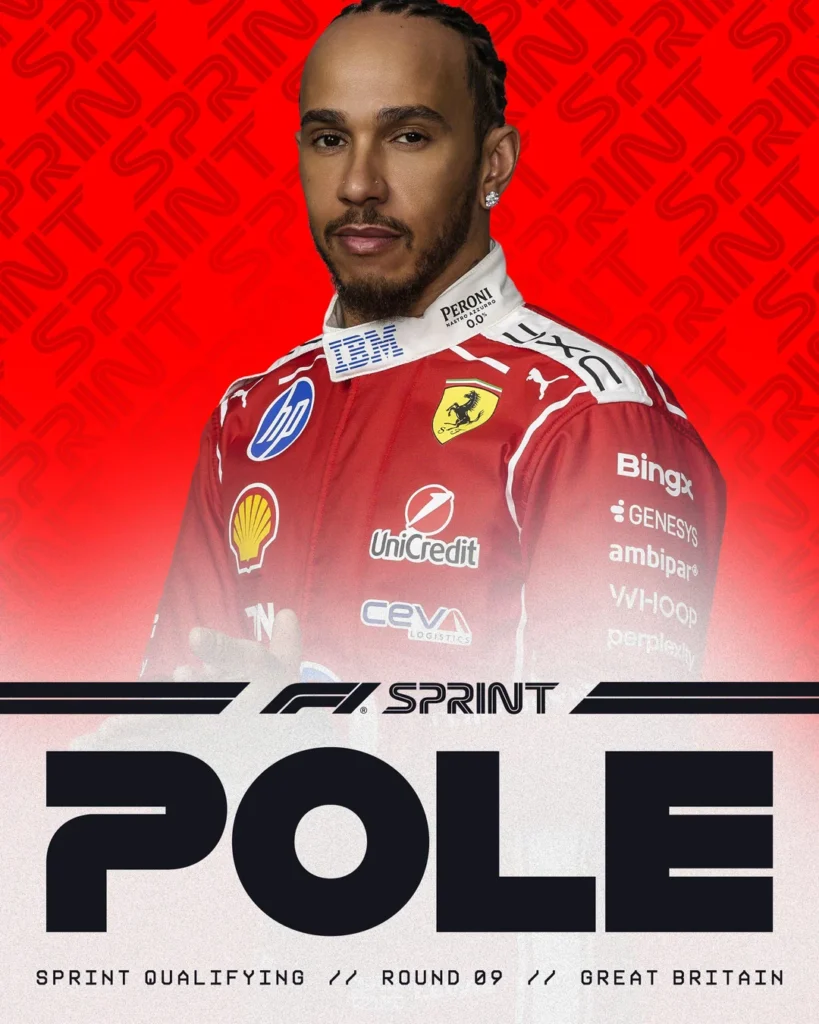
Every great driver has circuits that seem to unlock something extra, but Hamilton and Silverstone continue to exist in a category of their own.
Even after a noticeable wobble through the final corners that looked as though it had cost him pole, Hamilton still crossed the line quickest. Spectators sitting at Vale were convinced the mistake had ended his chances, only to watch the timing screens reveal he was still P1. That mistake only made the lap more remarkable. Analysis throughout the paddock quickly centered on just how much faster the lap might have been without the correction. Instead of celebrating a perfect lap, attention turned toward how much performance had potentially been left on the table. Hamilton himself looked every bit like a driver enjoying his racing again. After climbing from the car, he affectionately patted the Ferrari’s steering wheel before later being seen smiling throughout parc fermé and sharing a front-row moment with Antonelli that highlighted both the present and future of Formula 1.
The atmosphere around Silverstone reflected it as well. Even rivals appeared happy to see Hamilton produce another iconic lap at his home circuit, reinforcing the idea that some combinations simply transcend team loyalties.
Ferrari’s form has become impossible to predict

Perhaps the biggest story wasn’t Hamilton himself—it was Ferrari.
Only a week earlier, the team looked compromised in Austria. Now they suddenly appeared capable of matching Mercedes and Red Bull on one of the most demanding power circuits on the calendar. Ferrari’s performance swings over the past three races have become one of the biggest mysteries of the championship.
Rather than simply attributing the result to Hamilton’s brilliance, the technical picture suggests something more significant may have changed underneath the bodywork.
Has Ferrari finally solved its deployment problem?

The numbers from Sprint Qualifying painted a fascinating picture.
Coming into Silverstone, Ferrari had consistently lost enormous amounts of time on energy-limited circuits during the full-throttle sections of the lap. Yet during Sprint Qualifying, that deficit had almost disappeared. Hamilton lost only around 0.135 seconds to Antonelli across the major straight-line sections of the circuit. Even more surprisingly, Leclerc was actually faster than Russell across those same straight-line comparisons. That represents an enormous shift from previous weekends. The discussion quickly shifted away from outright engine power and toward deployment strategy. Instead of simply asking who had the most horsepower, the question became whether Ferrari had finally found a significantly better way to deploy its electrical energy around a lap. Some analysis pointed toward Austria’s unique combination of altitude, heat and cooling demands masking Ferrari’s true progress. Others suggested Silverstone simply allowed Ferrari to maximize a package that couldn’t shine one week earlier. Whatever the explanation, Ferrari suddenly looked far more competitive than almost anyone predicted. Even Hamilton admitted before the session that he expected Silverstone to be difficult.
Instead, Ferrari left Friday looking like the benchmark.
Mercedes suddenly have questions to answer

For much of the season Mercedes have looked like the reference team.
Silverstone was expected to reinforce that. Instead, George Russell admitted afterward that Ferrari’s pace “didn’t quite make sense,” although his full comments made clear he was expressing surprise rather than implying anything suspicious. He had simply expected Mercedes to be strongest at Silverstone after Ferrari appeared vulnerable in Austria. Ironically, Mercedes may have had more immediate questions inside their own garage. Russell qualified over three tenths behind teammate Antonelli in identical machinery, leaving many wondering whether understanding that gap should take priority over worrying about Ferrari.
Meanwhile another technical mystery continued to attract attention. Throughout Friday, telemetry appeared to show both Mercedes drivers lifting off the throttle unusually early near the finish line. Numerous theories emerged ranging from deployment strategies to data errors and fuel-saving techniques, but no definitive explanation emerged.
Combined with Mercedes’ reputation for making sizeable overnight improvements between Friday and Saturday, few are willing to assume the competitive order is settled.
Three generations share the front

The Sprint Qualifying top three also produced one of the most symbolic images of the season.
Hamilton. Antonelli. Verstappen.
Three different constructors. Three different generations of Formula 1. Hamilton represented the established legend still producing elite performances into his forties.
Verstappen remained the benchmark against whom every championship is measured. Antonelli continued proving he belongs among them. The image perfectly captured Formula 1’s current transition between eras.
Some even noted the timeline itself. Hamilton first took pole position at Silverstone in 2007. Arvid Lindblad, who qualified tenth, was born one month later.
Now both share the same Formula 1 grid.
Lawson continues knocking on the door

While Hamilton grabbed the headlines, Liam Lawson quietly continued building one of the most impressive seasons on the grid.
Ninth place on paper doesn’t tell the whole story. Lawson once again comfortably outqualified teammate Arvid Lindblad and continued establishing himself as arguably the strongest driver outside the four leading teams. Sector analysis highlighted another impressive third sector from the Racing Bulls driver, while his overall qualifying pace continues placing him within touching distance of much better-funded operations.
The gap between Lawson and the established front runners is shrinking almost every weekend.
McLaren’s difficult Friday
After dominating 2025, McLaren endured a surprisingly frustrating Sprint Qualifying.
Norris could only manage sixth after dealing with another apparent issue affecting his car, while Piastri qualified seventh. Despite the disappointing positions, one remarkable trend continued. Norris and Piastri remain almost inseparable over a single lap. Session after session, the pair continue qualifying within mere hundredths of each other, reinforcing the idea that both drivers are extracting virtually everything available from the McLaren package.
That closeness has become one of the defining characteristics of the championship.
An incredibly tight field
The final classification underlined just how competitive Formula 1 has become.
Hamilton led Antonelli by only 0.011 seconds. Verstappen sat between the two Mercedes and two Ferraris. Hadjar finished less than two tenths behind Verstappen despite qualifying eighth.
Just fractions separated multiple constructors throughout the front half of the grid. The margins were so small that minor setup decisions, deployment strategies or single driving errors could dramatically reshape the order.
Rather than one dominant team, Silverstone produced one of the closest Sprint Qualifying sessions of the year.
Hamilton changes the narrative again
One statistic perhaps summed up Friday better than anything else.
Lewis Hamilton now owns more Sprint Poles as a Ferrari driver than anyone else in Ferrari history. While partly a reflection of how recently Sprint Qualifying became part of Formula 1, it also speaks to the remarkable turnaround Hamilton has engineered since arriving at Maranello. Twelve months ago many questioned whether Hamilton’s best days were behind him.
Now the conversation has changed completely. Instead of discussing retirement, people are wondering whether the seven-time World Champion has positioned himself for one final championship charge if Ferrari can continue unlocking performance from the SF-26. Whether Friday proves to be the beginning of another Ferrari surge or simply another twist in one of the most unpredictable technical battles Formula 1 has seen in years will become clearer over the remainder of the British Grand Prix weekend.
For now, though, Silverstone once again belonged to Lewis Hamilton. And just when everyone thought they had Ferrari figured out, the Scuderia reminded the Formula 1 world that perhaps nobody truly does.