

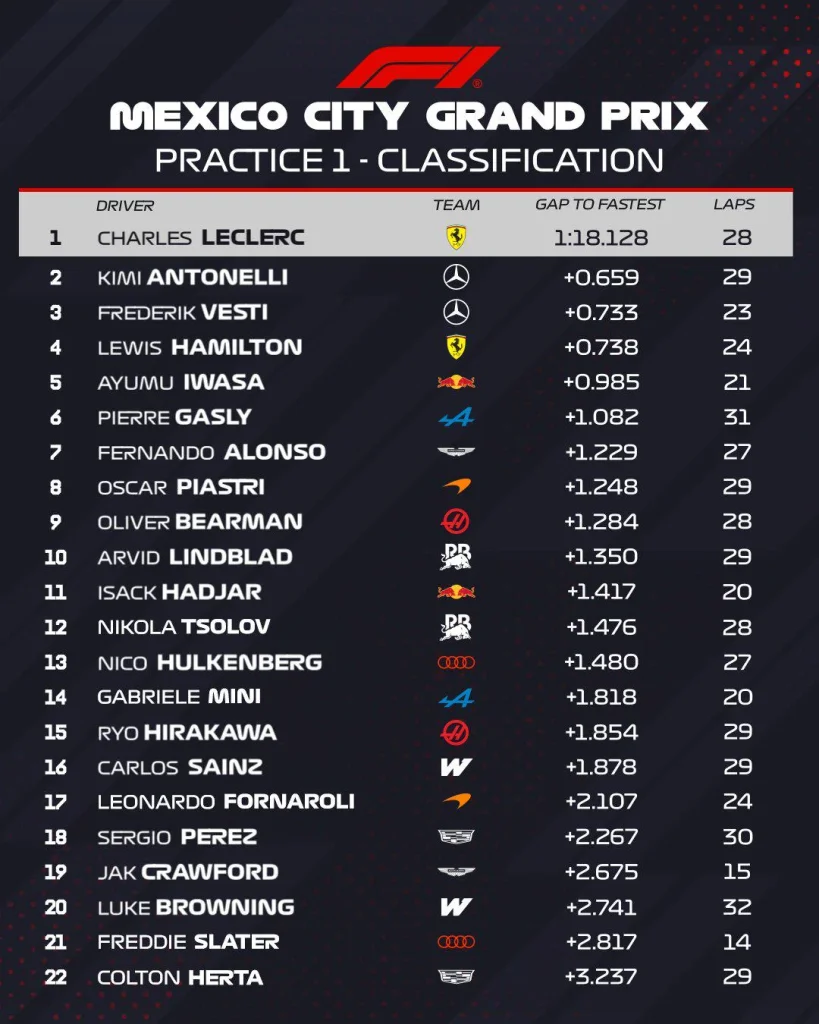
Charles Leclerc set the pace in opening practice for the 2026 Mexico City Grand Prix, topping the classification and all three sectors as Ferrari began the weekend with an encouraging display.
His 1:18.128 put him ahead of Kimi Antonelli and Frederik Vesti, with Lewis Hamilton fourth. But while Leclerc supplied the headline performance, a session featuring several unfamiliar names offered plenty beyond the battle at the front.
Vesti and Ayumu Iwasa finished inside the top five, Freddie Slater’s outing included an unusual Audi oversight, and Colton Herta completed the mileage initially reported to have secured his Formula 1 Super License—before a subsequent report cast doubt on that milestone.
Mexico City FP1: Top 10
Leclerc gives Ferrari an encouraging opening
Leclerc’s advantage was not confined to one particularly strong section of the Autódromo Hermanos Rodríguez. He recorded the fastest time in each of the circuit’s three sectors, giving Ferrari a broader reason for encouragement than the overall classification alone.
| Sector | Fastest driver | Time |
|---|---|---|
| Sector 1 | Charles Leclerc | 27.065 seconds |
| Sector 2 | Charles Leclerc | 30.895 seconds |
| Sector 3 | Charles Leclerc | 20.127 seconds |
That sweep was the clearest statement of the session. Rather than relying on a single standout sector to compensate for weaknesses elsewhere, Leclerc led across the entire lap. Hamilton’s fourth place added to Ferrari’s promising start, although the distinction between a strong Friday opening and a genuinely competitive weekend remains important. Leclerc has prompted optimism in practice before, and an FP1 result cannot settle whether Ferrari will retain its advantage when qualifying arrives.
The temptation is to treat a clean sweep of the sectors as evidence that Ferrari has arrived with the car to beat. The more useful conclusion is narrower: Leclerc produced the strongest opening session, and Ferrari now has something tangible to build on.
Vesti and Iwasa make their opportunities count
Antonelli finished second, but Vesti’s third place was one of the session’s most notable results. In a field containing academy and reserve drivers, he placed himself immediately behind Antonelli and ahead of Hamilton.
It was an effective way to draw attention to his opportunity. A single practice session is insufficient to establish how a driver would perform across a full season, but third place gave Vesti a result that stood out without requiring that larger claim. Iwasa achieved something similar in fifth, finishing ahead of Gasly, Alonso, Piastri, Bearman and Lindblad. His appearance near the front was another reminder that these sessions can offer more than a procedural handover of the car: they give drivers a chance to make a visible impression.
Neither performance needs to be stretched into a prediction about a future seat. Both were strong results on their own terms.
Tsolov offers encouragement beyond the top 10
Nikola Tsolov also attracted attention despite not appearing in the supplied top 10.
The comparisons provided from his running placed him around three-tenths ahead of Lindblad on the medium tires and approximately one-tenth behind on the softs. Those snapshots do not establish a complete performance hierarchy, but they offer a more useful starting point than judging his session solely by his absence from the leading positions. For a driver gaining experience, staying close to an established reference while learning the car is encouraging. The session accounts also described a controlled outing, with the emphasis on his execution rather than a headline-grabbing mistake. Gabriele Minì received a less favorable assessment, particularly around early braking and unusual lines during his push laps. With limited detail available on his program, however, those observations are better treated as areas to examine than a firm judgment on his potential.
That distinction matters throughout a session like this. The newcomers offer plenty to discuss, but the evidence remains a small sample.
Audi sends Slater out with a cooling fan attached
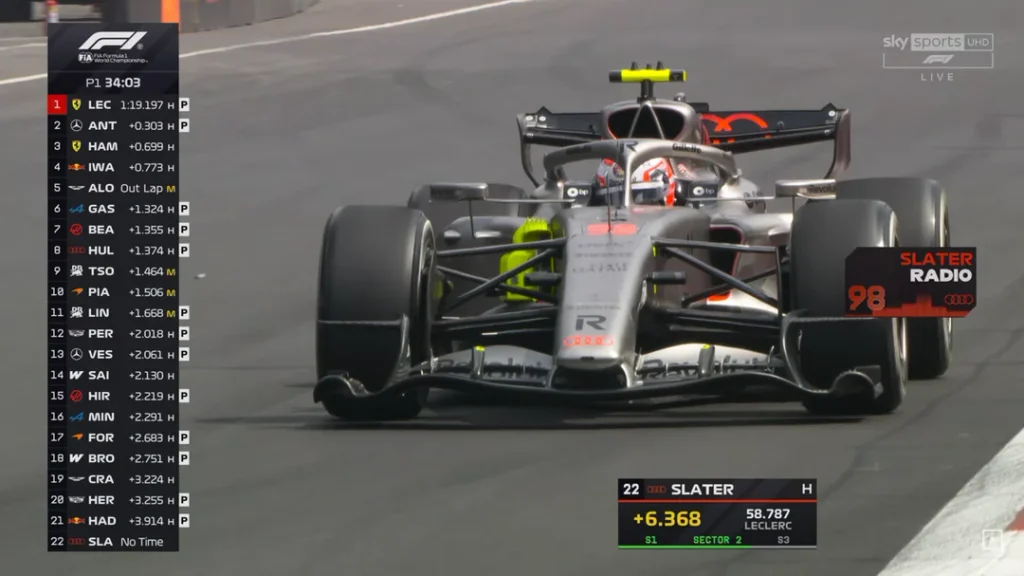
Slater’s session produced one of FP1’s strangest moments when he drove out with a cooling fan still attached to his Audi.
The conspicuous equipment made the oversight particularly striking. Its fluorescent coloring should have made it easy to identify, yet it remained on the car as Slater headed onto the circuit. The immediate concern was what the obstruction might mean for cooling and whether his session would be cut short. Early conclusions that his running was finished proved premature, however, as Audi subsequently got him back out. That return is an important part of the story. The incident interrupted an opportunity to gain experience, but it did not end his participation. The supplied material does not establish whether the car suffered damage or whether any penalty followed. Suggestions about debris entering the intake or a particular fine therefore remain speculation.
What can be said is that an avoidable garage oversight became a major talking point during a session in which Slater’s driving should have been the focus.
Herta reaches 24 laps—but the Super License picture changes
Herta’s session initially appeared to deliver a significant breakthrough in his path toward an F1 race seat.
Thomas Maher reported:
“And, with that 24th lap, Colton Herta has just achieved his F1 FIA Super Licence.”
That announcement was subsequently complicated by an update attributed to The Race, which reported that Herta remained one point short of the 40 required. According to that update, an error on IndyCar’s website had credited Herta with sixth place in the previous year’s championship rather than seventh. The correction changed the calculation behind the initial claim. The distinction is essential: Herta completed his 24th lap, but the later report in the supplied material means his full Super License eligibility cannot be presented as settled.
His running also revived the broader debate about how to evaluate his readiness for Formula 1. His IndyCar résumé—including a runner-up championship finish behind Alex Palou two years earlier—provides a substantial argument in his favor. His difficult Formula 2 campaign provides a reason for caution. Those points can coexist. Success in one category does not guarantee immediate success in another, while struggling with a particular car does not automatically erase a driver’s previous accomplishments. Equally, recognizing that Formula 2 is an imperfect predictor does not make its results irrelevant. Herta’s performance there belongs in the assessment, alongside his IndyCar record and his work in F1 machinery.
For Cadillac, the relevant question extends beyond whether an American driver would be commercially attractive. It is whether Herta can deliver the pace, consistency and feedback the team needs. FP1 mileage contributes to that evaluation; resolving his eligibility would clear a separate hurdle.
Alonso catches the eye as McLaren awaits Norris’s return
Alonso finished seventh, with his performance in the final sector drawing particular attention. Leclerc still recorded the fastest sector-three time, but Alonso’s showing offered an interesting detail beneath the overall order.
It would be premature to turn that into a conclusion about Honda’s competitiveness across the weekend. A strong section of the lap is worth noting without treating it as a complete verdict on the power unit or car. McLaren’s session was similarly difficult to reduce to one result. Piastri finished eighth, while Lando Norris did not take part and was due to return in FP2. That absence leaves an incomplete picture. Norris was both the previous Mexico City pole sitter and race winner, making his return especially relevant to assessing where McLaren stands this time around. Piastri’s eighth place was not a headline result, but it provides too little evidence to declare the team’s weekend compromised. The next session offers a more useful comparison with Norris back in the car.
For now, Leclerc owns the strongest opening statement. Fastest overall and quickest in every sector, he gave Ferrari a convincing start to its Mexico City weekend. The task ahead is to carry that performance beyond an FP1 session whose other defining feature was the opportunity it gave the next wave of drivers to be noticed.