


Charles Leclerc put Ferrari on top in opening practice for the 2026 United States Grand Prix, setting a 1:36.052 at the Circuit of The Americas. Max Verstappen finished second ahead of Lando Norris, with George Russell and Kimi Antonelli completing the top five.
The result offered Ferrari an encouraging start in Austin, but the opening hour came with plenty of qualifications. Verstappen had a faster lap deleted, three different teams shared the fastest sector times, and the usual uncertainty over practice programs made declaring a favorite premature. Further down the order, Alex Albon endured a particularly difficult session. Track-limit deletions left him with a best recorded time of 2:16.468, turning Williams’ opening practice into an exercise in frustration.
Away from the timing screens, FIA president Mohammed Ben Sulayem revived another familiar debate by declaring his commitment to bringing V8 engines back to Formula 1.
Ferrari Starts Strong, but Friday Promise Needs to Become More

Leclerc led the opening hour ahead of Verstappen and Norris, while Lewis Hamilton placed sixth in the second Ferrari.
| Position | Driver | Team |
|---|---|---|
| 1 | Charles Leclerc | Ferrari |
| 2 | Max Verstappen | Red Bull |
| 3 | Lando Norris | McLaren |
| 4 | George Russell | Mercedes |
| 5 | Kimi Antonelli | Mercedes |
| 6 | Lewis Hamilton | Ferrari |
| 7 | Oscar Piastri | McLaren |
| 8 | Gabriel Bortoleto | Audi |
| 9 | Arvid Lindblad | Racing Bulls |
| 10 | Liam Lawson | Racing Bulls |
For Ferrari, the challenge is familiar: a promising practice session only carries so much weight until the same performance appears in qualifying and the race. There is a reason the idea of Ferrari as practice champions has become such an easy joke. Leclerc’s speed can make a weekend look full of possibility before the competitive picture changes when the sessions that determine the result arrive. Austin has provided another opportunity to break that pattern, rather than proof that it has already been broken. There were reasons for encouragement beyond his position on the timing screen. Leclerc looked composed through the esses, where some cars appeared more difficult to manage, and his long runs offered grounds for cautious optimism. His pace in the final sector was another tangible positive. Hamilton’s sixth place also came with a specification question. The supplied discussion cited Autoracer.it journalist Duchessa as reporting that Hamilton was running the older specification. That makes the two Ferrari results an imperfect basis for judging the benefit of the newer package: different specifications and unknown programs prevent a clean comparison.
Ferrari can take satisfaction from leading the session. Establishing what that means for the rest of the weekend requires more evidence.
Three Teams Share the Fastest Sectors
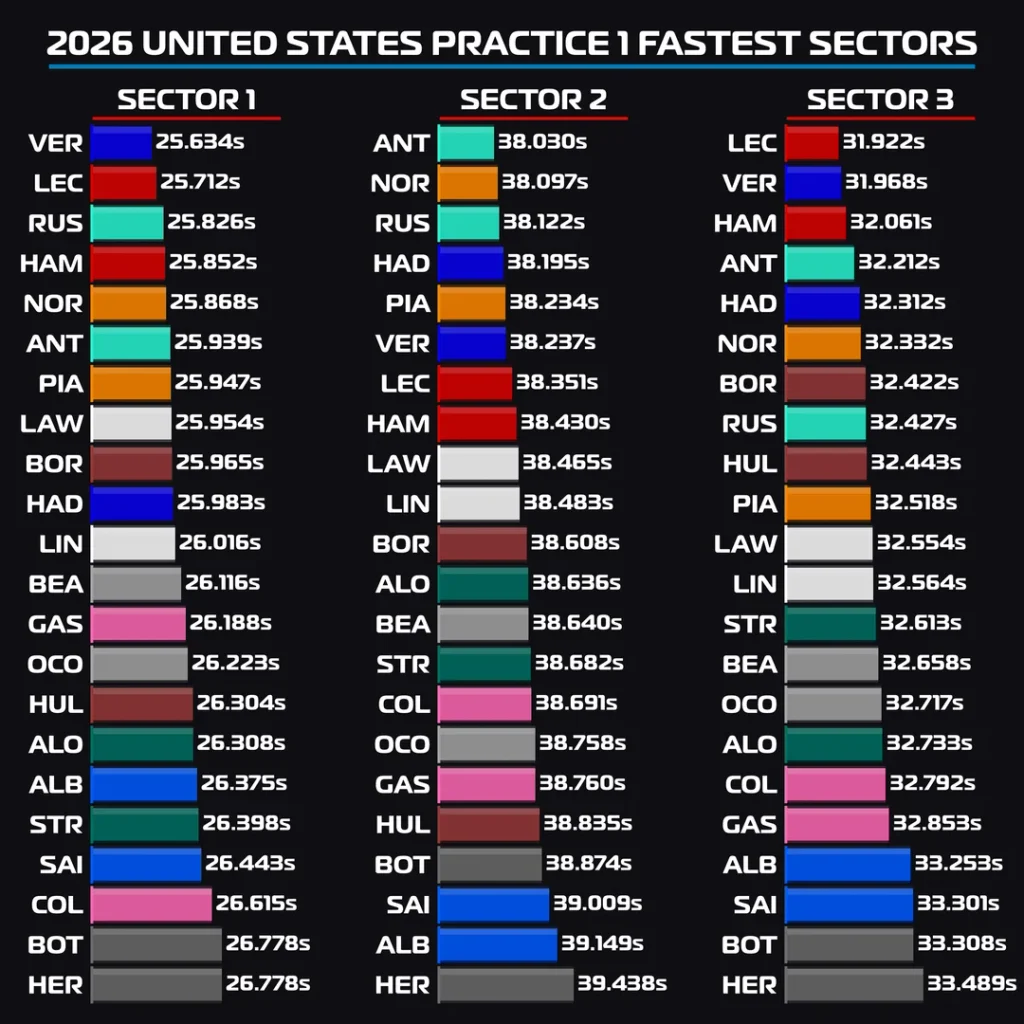
The sector times supplied by F1BigData provided a more varied picture than the headline classification.
| Sector | Fastest driver | Time |
|---|---|---|
| Sector 1 | Max Verstappen | 25.634 seconds |
| Sector 2 | Kimi Antonelli | 38.030 seconds |
| Sector 3 | Charles Leclerc | 31.922 seconds |
Verstappen’s first-sector benchmark was particularly interesting because it demonstrated speed through a part of the lap that places substantial demands on the car’s direction changes. His threat was not confined to straight-line performance. Antonelli’s fastest second sector showed that Mercedes retained a clear area of strength, while Leclerc’s final-sector time reinforced the impression that Ferrari was effective through the corners. Ferrari’s apparent contrast between cornering performance and straight-line speed remains a central question. Being quick through the turns can produce an impressive lap, but any deficit on the straights complicates both the pursuit of qualifying position and the task of racing other cars.
The split also argues against reducing the session to a simple ranking of machinery. Red Bull, Mercedes, and Ferrari each produced a sector benchmark. None of those individual times establishes which team can consistently assemble the strongest complete lap.
Verstappen’s Deleted Lap Complicates the Picture
Verstappen’s second place did not tell the whole story of his session. His deleted lap was described as approximately two tenths quicker than Leclerc’s benchmark, providing an obvious warning against treating Ferrari’s position as a decisive advantage.
A deleted lap cannot count toward the classification. It can still indicate performance, provided the circumstances are kept in view. The temptation is to take that lap, add assumptions about engine settings or fuel loads, and declare Red Bull comfortably ahead. The available material does not support that level of certainty. Equally, there is no basis for assigning Mercedes or Red Bull an arbitrary amount of hidden pace simply because this was FP1. Fuel loads, run plans, power settings, and how aggressively drivers approached their laps all complicate practice comparisons. Those uncertainties apply to everyone.
Isack Hadjar’s session required similar care. His soft-tire run was deleted, leaving a hard-tire lap as his representative time. Assessing his performance against Verstappen purely from the surviving classification would therefore miss an important part of the picture. The supplied estimates of the gap between their deleted laps varied from around half a second to a little over six tenths. That still suggests a meaningful difference, but it is a more useful comparison than treating a hard-tire time as directly equivalent to a soft-tire attempt.
The familiar scrutiny of Red Bull’s second driver will follow any substantial gap to Verstappen. In this case, tire choice and track limits need to remain part of the assessment.
Mercedes Faces Questions as McLaren Stays in Contention
Russell and Antonelli finished fourth and fifth, leaving Mercedes behind a Ferrari, a Red Bull, and a McLaren.
That order invites questions about how much of Mercedes’ earlier advantage remains. It does not, by itself, establish that the team has fallen behind all three rivals. Antonelli’s second-sector benchmark makes the picture more nuanced. Mercedes had speed in at least one substantial part of the lap, even as its final-sector performance attracted scrutiny. Whether that reflected the car’s balance, its program, or a genuine weakness remained unresolved. The broader development question is whether rivals have reduced Mercedes’ advantage through chassis improvements, better use of their power units, or some combination of the two. Those are plausible explanations to investigate. Claims that Mercedes stopped development too early, rushed unsuccessful upgrades, or is deliberately withholding performance remain theories rather than conclusions established by this session.
McLaren, meanwhile, placed Norris third and Piastri seventh. COTA’s mixture of corner types makes all-round performance valuable. A car that is competitive across several areas can be a serious contender even without recording the fastest individual sector. Norris’ position kept McLaren firmly in the opening conversation, although there was insufficient information to explain the difference between its two drivers.
Later practice sessions should help establish whether Norris can turn that starting point into a qualifying challenge and whether Piastri can move closer to the front.
Albon’s Track-Limit Troubles Leave Williams With Little to Celebrate

Albon’s 2:16.468 was the most conspicuous time in the supplied material, sitting more than 40 seconds behind Leclerc’s benchmark.
That number was a consequence of deleted laps, rather than a meaningful measure of the Williams’ outright pace. F1BigData reported that all of Albon’s laps had been deleted for track limits, leaving the unusually slow best recorded time. The distinction matters. The session did not show a Williams genuinely circulating more than 40 seconds off the leading pace. It showed a driver unable to retain a representative lap. Repeated, unexpected locking under braking offered a more concerning explanation than simple carelessness. The problem appeared at different corners, making it difficult to complete a clean lap around COTA’s 20 turns. If the car cannot provide a predictable response under braking, staying within the white lines becomes a consequence of the underlying handling problem as well as a matter of driver precision.
The result lent itself to jokes about scenic routes and whether a bicycle might have been quicker. For Williams, the practical issue was that an hour of running produced little useful evidence on the classification. It also sharpened a broader frustration with the team’s long-term messaging. Treating a difficult season as preparation for the next can be reasonable during a rebuild, but the explanation becomes harder to sustain when the next promised step repeatedly appears to move further away. Williams’ financial and structural challenges provide relevant context. Its two Grand Prix podiums last year, with another podium in a Sprint, also complicate any claim that there has been no recent progress.
Those achievements make the current difficulties more frustrating. There has been evidence of what Williams can accomplish, and a session like Albon’s raises questions about why that progress has not translated into a more dependable platform.
Ben Sulayem Revives the V8 Debate
Alongside the practice action, Ben Sulayem used a joint social media post with the FIA to reiterate his preferred direction for Formula 1’s engines.
“For the fans. For the drivers. For the sport. I am committed to bringing V8s back to Formula 1,” he stated.
The appeal is straightforward. Engine sound is part of Formula 1’s identity, and a V8 return offers a powerful emotional pitch to those who want more noise and a different character from the cars. That appeal is not universal. A louder engine can make a brief trackside experience more dramatic while also making an entire session less comfortable to attend. Enjoying the sound of an older engine and wanting to hear it continuously for two hours are different considerations. There is also a technical question behind the branding: what specific objectives would a V8 meet, and could changes to the existing engine concept achieve some of the same goals? Cylinder count alone does not answer every question about sound, performance, or the driving experience.
Manufacturer interests add another layer. Hybrid development can offer a connection to road-car efficiency, materials, and broader engineering knowledge, even when no identifiable Formula 1 component appears in a showroom car. The value of that connection is open to debate, but it cannot be dismissed solely because the transfer is difficult for a customer to see. Conversely, invoking road relevance does not automatically settle what makes the best Formula 1 engine. The championship must also consider the experience it provides to drivers and spectators.
Ben Sulayem’s statement expresses an intention. The supplied announcement does not establish an agreed technical package or a timetable for introducing it. Until those details emerge, the V8 return remains a proposal with considerable nostalgic appeal and significant unanswered questions.
An Encouraging Start for Leclerc, With the Competitive Order Still Open
Leclerc leaves opening practice with the fastest official lap and a strong final-sector benchmark. Verstappen’s deleted effort supplies an immediate reason for caution, while Antonelli’s sector pace and Norris’ third place keep Mercedes and McLaren in the discussion.
For Ferrari, the next task is to sustain the promise when the weekend becomes more representative. For Williams, it is more immediate: give Albon a car he can brake with confidently and turn his running into clean, usable laps.
Austin’s opening hour produced a Ferrari headline, but it left plenty of room for the picture to change.