


Charles Leclerc completed a Friday practice sweep at the 2026 Mexico City Grand Prix, leading Lando Norris and George Russell in FP2 and backing up his outright speed with the quickest long-run average among the supplied figures.
But Ferrari’s encouraging pace came with a substantial setback on the other side of the garage. Lewis Hamilton lost power before completing a promising lap, leaving his fastest middle sector as an indication of what might have been. Elsewhere, an unnecessary confrontation between Max Verstappen and Liam Lawson carried consequences beyond Friday. Both received one-place grid penalties and a penalty point after going wheel-to-wheel while preparing for flying laps, with the stewards explicitly escalating their response following an earlier warning to teams.
Verstappen also struggled with practice starts, while Isack Hadjar reported severe bottoming before facing a separate summons over an incident in the paddock. It made for a complicated afternoon across the Red Bull teams, even as their finishing positions suggested competitive underlying pace.
Mexico City FP2: Top 10

Leclerc’s Friday strength extends beyond one lap
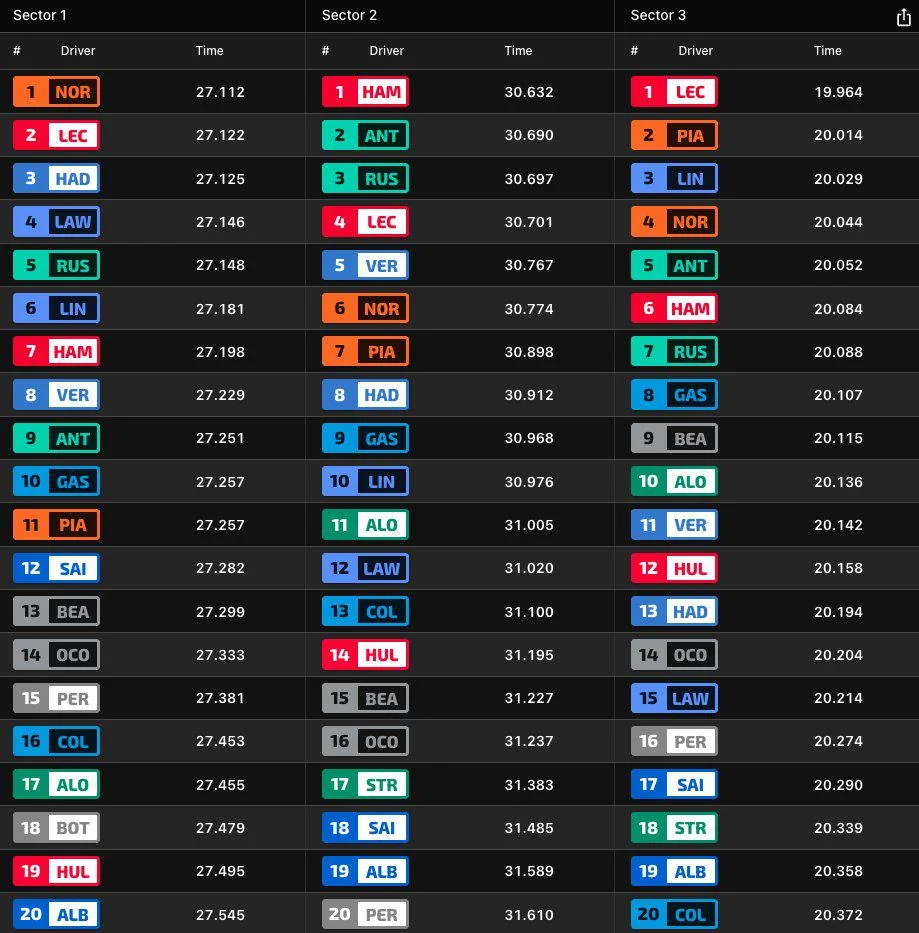
After topping FP1 and all three sectors earlier in the day, Leclerc returned to the top in second practice. This time, the fastest sectors were shared among three drivers, but Ferrari remained represented in two of them.
| Sector | Fastest driver | Time |
|---|---|---|
| Sector 1 | Lando Norris | 27.112 seconds |
| Sector 2 | Lewis Hamilton | 30.632 seconds |
| Sector 3 | Charles Leclerc | 19.964 seconds |
The division offered a more competitive picture than Leclerc’s opening-session sweep. Norris supplied the strongest first sector, Hamilton retained the quickest middle sector despite his interrupted session, and Leclerc completed Ferrari’s showing with the fastest final section. The supplied discussion put just 0.106 seconds between the leading three overall. That leaves little room for mistakes if the same competitive balance carries into qualifying. More encouraging for Leclerc was that his speed also appeared in the longer runs. His medium-tire average was the quickest of the seven listed, ahead of several rivals running softs.
| Driver | Tire compound | Average stint pace |
|---|---|---|
| Charles Leclerc | Medium | 1:21.163 |
| Lando Norris | Soft | 1:21.319 |
| Isack Hadjar | Soft | 1:21.369 |
| George Russell | Soft | 1:21.442 |
| Kimi Antonelli | Medium | 1:21.487 |
| Max Verstappen | Soft | 1:21.490 |
| Oscar Piastri | Soft | 1:21.642 |
Those figures strengthen Ferrari’s Friday case, but they do not establish a definitive race order. Without matching information on fuel loads, stint lengths, tire age and traffic, the averages remain indicators rather than a prediction. Even with that limitation, Leclerc’s combination of short-run and long-run performance is more persuasive than a practice headline alone. Ferrari has grounds for optimism across both parts of the weekend. The challenge is converting it. Repeated Friday success has made Leclerc the subject of an unofficial “Free Practice Championship,” in which he has drawn level with Russell on 667 points, ahead of Antonelli on 649. Topping five of the last eight sessions erased a 78-point deficit in that tally.
It is an amusing reflection of a more serious frustration: Leclerc has repeatedly provided reasons to believe on Friday. Mexico now offers another opportunity to turn that promise into a result.
Hamilton’s fastest sector leaves Ferrari wondering what was possible
Hamilton’s afternoon supplied an important qualification to Ferrari’s strong showing.
He lost power in the final sector of a promising lap and had to stop the car. Yet his 30.632-second middle sector remained unbeaten through the end of the session. That makes his interrupted running more consequential than a poor finishing position would suggest. Ferrari’s speed was visible in both cars, even though only Leclerc could turn it into a representative result at the front. The exact cause of Hamilton’s stoppage was not established in the supplied material. Suggestions of a hydraulic problem therefore remain unconfirmed; the clear point is that he suffered a loss of power and lost valuable running.
His absence from the listed FP2 long-run averages also leaves Ferrari with an incomplete comparison between its drivers. Leclerc’s pace offers encouragement, but Hamilton heads into Saturday with fewer answers.
Norris restores McLaren’s presence at the front
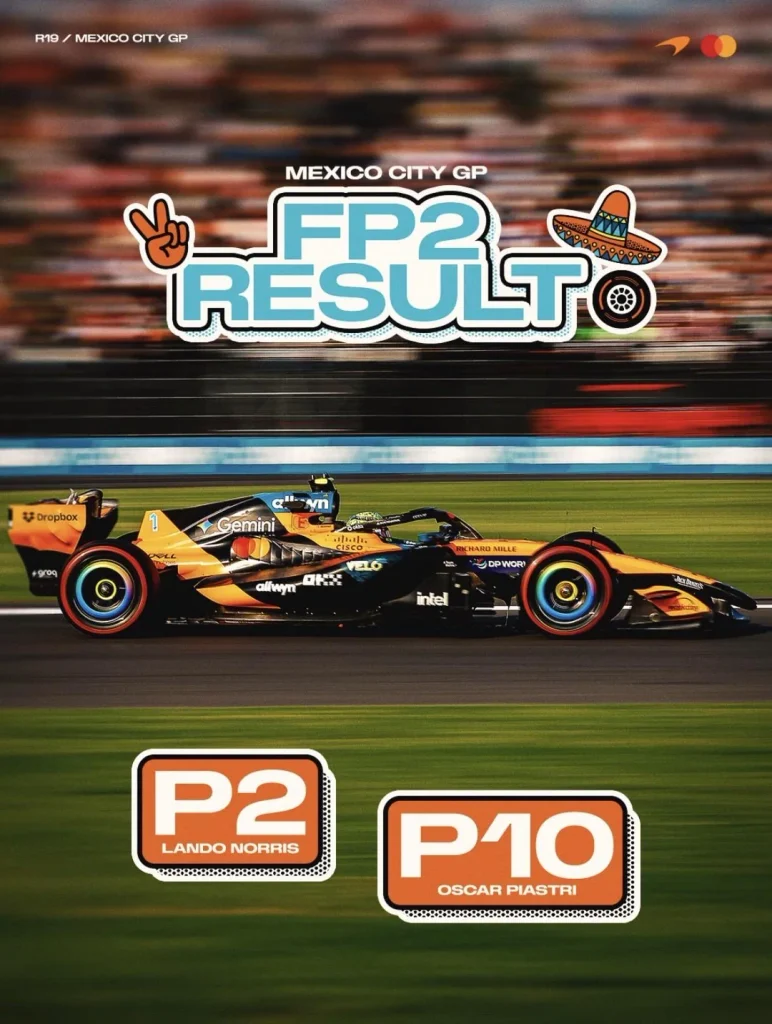
Norris returned after sitting out FP1 and immediately put McLaren into contention, finishing second and setting the quickest opening sector.
For last year’s Mexico City winner, it was a promising start to his own weekend. His soft-tire long-run average was also the second quickest among those listed, giving his performance substance beyond a single lap. The uncertainty concerns how consistently McLaren can access that speed. The session discussion described a car with a narrow operating window, capable of producing a strong lap but difficult to keep settled when pushed. That makes the middle sector an obvious area of interest. Norris already demonstrated the pace to lead through the opening portion of the circuit; bringing the rest of the lap together could put him firmly in the qualifying fight.
Piastri’s tenth place needs more context than the classification alone provides. His best attempt was compromised by a slide at the final corner, and he did not complete another push lap afterward. It would be excessive to assign a precise hypothetical time to that unfinished effort. The supplied accounts disagree over how close he could have been to Norris, and the mistake itself was part of the challenge of extracting performance.
Nevertheless, tenth does not necessarily represent the full potential of his session. His longer-run average, however, was slower than Norris’s on the same compound, leaving work to do across both qualifying preparation and race pace.
Track position could become decisive
Friday’s running also raised concerns about how much opportunity the race will provide to recover from a disappointing qualifying result.
The supplied observations described Leclerc and Norris spending multiple laps behind Lawson without completing a pass, even when exiting the final corner close behind and using full boost. If that pattern persists, qualifying could carry particular weight. A car ahead that can deploy strongly down the main straight may be difficult to attack, even when the following driver has better underlying pace. Practice traffic is not a complete simulation of race conditions, so it cannot establish that overtaking will be impossible. But it does provide a warning: the fastest long-run average may be of limited use if a driver cannot get into clear air.
For Ferrari and McLaren, that increases the importance of converting Friday speed into a strong starting position. For Red Bull, it makes both its grid penalty and its launch difficulties more costly.
Verstappen and Lawson turn preparation laps into grid penalties

The afternoon’s most contentious incident began on the approach to Turn 12 and continued through the apex of Turn 14.
The FIA established that Verstappen was on a preparation lap, while Lawson was on a cooldown lap preparing for another push. Neither was completing a flying lap that required the other to clear the way. What followed was a sequence of moves, contact and competing claims over space that was disproportionate to anything available to gain in practice. The stewards heard from both drivers and their teams and reviewed video evidence. They judged both drivers’ behavior unacceptable, particularly because a warning had already been issued at the team managers’ meeting earlier that day.
Both drivers admitted that the moves were unnecessary and “clumsy.”
| Driver | Grid penalty | Penalty points added | Total over 12 months |
|---|---|---|---|
| Max Verstappen | One place at his next race | 1 | 1 |
| Liam Lawson | One place at his next race | 1 | 4 |
Verstappen’s decision cited Appendix L, Chapter IV, Article 2 d) of the International Sporting Code; Lawson’s cited Article 2 e). The stewards also explained why this incident went beyond a formal warning. Similar practice incidents had occurred during the year, and the earlier warning had not prevented another confrontation. They therefore escalated to grid penalties, referencing previous practice incidents involving contact. That explanation matters when assessing the punishment. This was not simply a driver inadvertently sitting on the racing line or receiving a late message from the pit wall. It was a sustained exchange between two drivers who were not on competitive laps.
There remains room to question whether their individual actions deserved identical sanctions. Equal penalties do not require every move in the sequence to have been identical. But the central conclusion is difficult to escape: both had an opportunity to prevent a practice dispute from becoming a race-weekend disadvantage.
Verstappen’s seat remark adds another dimension
Verstappen’s subsequent comments brought Lawson’s future into the argument.
“If I would be him I would act a little bit smarter. Also, when you’re fighting for your seat, it’s not very smart behaviour.”
Invoking Lawson’s seat was an unnecessary escalation of an already avoidable disagreement. The driving could be criticized on its own merits without introducing the employment pressure facing a driver elsewhere in the same Red Bull system. It also exposed the awkward position Lawson occupies. Assertiveness can be presented as a desirable quality in a prospective Red Bull driver, yet exercising it against the senior team’s leading driver creates a different kind of scrutiny. That tension does not excuse either driver’s actions. Nor does it establish anything about Lawson’s future. It does, however, explain why the confrontation became a wider discussion about hierarchy rather than remaining a straightforward practice collision.
The stewards’ findings provide the clearest endpoint: both drivers were held responsible for unacceptable behavior, and both acknowledged that the exchange was unnecessary.
Red Bull’s launch problems remain a separate concern
Verstappen finished fifth, with the supplied discussion placing him around three-tenths from the front despite floor damage. His listed long-run pace remained close to Antonelli’s, although they were using different compounds.
That suggests an afternoon with more underlying performance than its incidents might imply. His practice starts were less reassuring.
“I think I could sprint faster off the line.”
He continued:
“Like, I do the start at the end of the pit lane, disaster. I do another start, another disaster.”
His proposed alternative was characteristically blunt:
“Why are we not just changing something? Or it’s better I do like a Le Mans start, you know? I run, push the car and jump in. And then take off for the race.”
The supplied discussion offered competing explanations involving the clutch, hardware configuration and calibration, alongside secondhand references to team comments about changes for 2027. It does not establish a single confirmed technical diagnosis. The immediate consequence is clearer. With a long run to Turn 1, a poor launch could undo a strong qualifying performance before Verstappen reaches the opening corner. His one-place grid penalty adds another obstacle before that launch even begins. Hadjar, meanwhile, finished sixth and recorded the third-quickest listed long-run average, but his session included an alarming report from the cockpit.
“Oh my God. I had the biggest bottoming of all time.”
He immediately asked:
“Check the car, check the floor. That was so bad.”
The radio establishes the severity of what Hadjar felt, rather than confirming the extent of any damage. Combined with Verstappen’s problems, it nevertheless added to an afternoon in which Red Bull’s competitive pace came with significant complications.
Hadjar faces a separate paddock summons
Hadjar was also summoned over an alleged breach of Article 12.2.1.l of the International Sporting Code concerning misconduct in the paddock.
The supplied accounts described an interaction with someone attempting to take a selfie, with particular disagreement over a second push after the person appeared to be moving away. Two considerations can coexist: paddock access does not entitle anyone to invade a driver’s personal space, and a response can still warrant scrutiny if it continues after the immediate intrusion has ended. At this stage, the summons is an allegation to be examined, not a finding of misconduct or a confirmed penalty.
On track, Ferrari leaves Friday with the strongest combined evidence: Leclerc led both sessions and the listed long-run averages, while Hamilton demonstrated speed before his stoppage. Norris and Mercedes remain close enough to make qualifying finely balanced. For Red Bull, the task is broader—turn competitive pace into a cleaner Saturday, then prevent penalties and poor starts from compromising Sunday before the race has properly begun.