

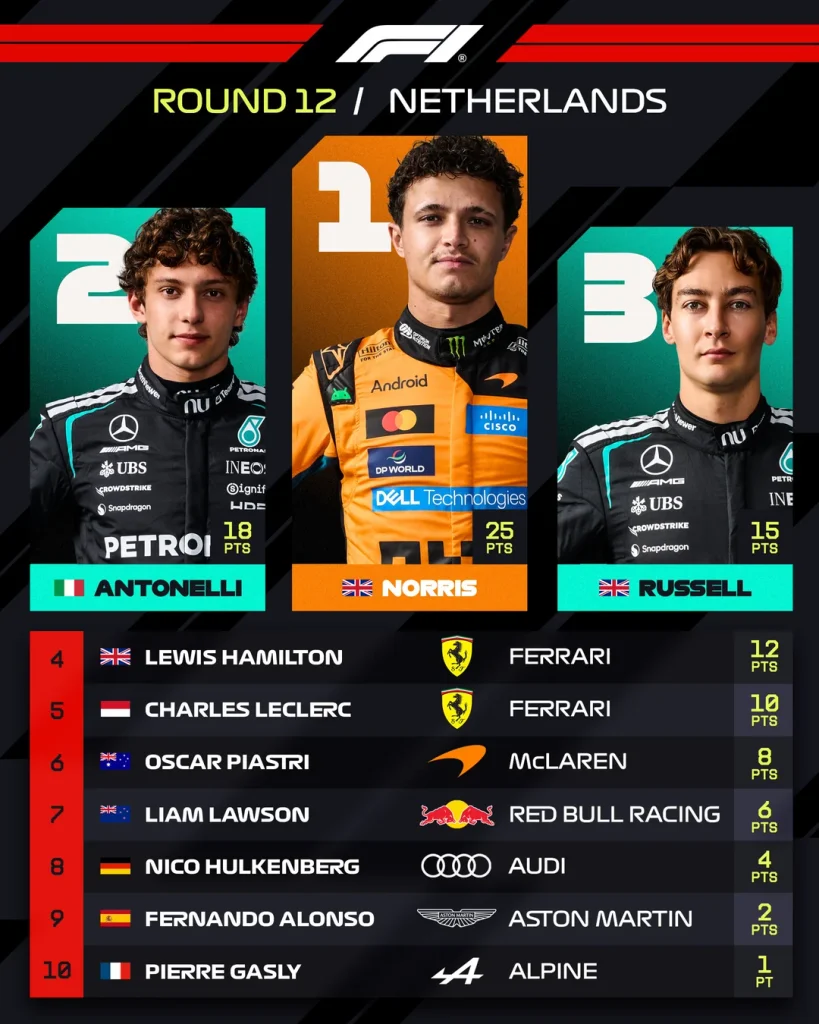
The 2026 Dutch Grand Prix somehow delivered almost everything the buildup had promised, just not in the way anyone expected.
The rain that threatened to transform the race never really arrived when it mattered. Instead, the chaos came from the drivers, pit walls and a series of strategic decisions that repeatedly reshuffled the race. Max Verstappen crashed out on the opening lap of his home Grand Prix. Kimi Antonelli took the lead from Lando Norris after the restart. Oscar Piastri briefly looked capable of fighting toward the front before his race unraveled. Ferrari found multiple ways to compromise both of its drivers. Mercedes made the controversial decision to move George Russell aside for Antonelli. Carlos Sainz collided with his own teammate. And Fernando Alonso quietly turned an alternative strategy into points. Through all of it, Norris emerged as the constant. The McLaren driver ultimately won at Zandvoort, completing back-to-back victories with a drive that became increasingly impressive as the afternoon developed.
And considering just how many teams seemed determined to make the Dutch Grand Prix more difficult than necessary, simply executing a clean race turned out to be an enormous advantage.
Verstappen’s Home Grand Prix Ends Almost Immediately

There had been hope before the race that the weather might provide the entertainment.
A dry-wet-dry race seemed like the ideal scenario after a disappointing sprint, particularly because a completely wet race could have produced its own problems with visibility and overtaking. Rain was falling on the grid, but the timing once again teased rather than delivered. It had arrived immediately after the sprint and again before the Grand Prix, only to leave conditions suitable for slicks by the start. The track was still treacherous. That became painfully clear on the opening lap.
Verstappen lost control through the final banked corner, crashed heavily and brought out a red flag. He was able to get out of the car and was okay, but his final Dutch Grand Prix had effectively ended almost as soon as it began. Replays made the mistake look particularly unusual for Verstappen. His inside tires appeared to touch the white line or painted section in wet conditions, on a part of the banking where grip was already precarious. Lawson, running behind him, had taken a noticeably wider and more conservative line. It was an unnecessary amount of risk for the first lap.
Verstappen has built much of his reputation on knowing precisely how far he can push a car in difficult conditions, which made this one particularly surprising. The circumstances may have been difficult, but touching painted surfaces or a wet curb in those conditions was always going to carry enormous risk. There is also a broader question surrounding Verstappen’s season. He appears to be asking more of the car than it can consistently give him. That can create spectacular performances when it works, but it also narrows the margin for error. There have been suggestions that some of his incidents this season reflect a driver trying to compensate for machinery that doesn’t respond the way he expects it to. Whatever the wider explanation, this particular incident looked like a straightforward driver error.
It was also a brutal way for Verstappen’s final home Grand Prix to end, particularly with Zandvoort set to disappear from the calendar next year.
Hülkenberg Produces One of the Saves of the Race

Verstappen’s accident could easily have become much worse.
Gabriel Bortoleto spun separately in the same area amid the smoke and debris, creating a terrifying situation for Nico Hülkenberg approaching behind. Hülkenberg had almost no time to process what was happening. With visibility severely compromised, he suddenly had Bortoleto’s car appearing in his path and made an immediate move to the left, narrowly avoiding a potentially enormous T-bone collision. Calling it simply lucky doesn’t really do it justice.
There was obviously fortune involved whenever two cars miss each other by such a tiny margin, but Hülkenberg’s reaction was extraordinary. He waited long enough to determine where Bortoleto was moving and committed in the opposite direction with almost no margin remaining. Pierre Gasly also reacted impressively amid the incident, but Hülkenberg’s near miss was one of the standout pieces of driving from the entire afternoon. At 39, there wasn’t much wrong with his reflexes. The red flag that followed also generated some confusion about why Verstappen couldn’t simply have his car repaired, but there were two rather significant problems with that idea: the car was heavily damaged, and Verstappen had not returned to the pits under his own power.
With the race temporarily stopped, everyone else got another chance.
Antonelli Strikes Immediately After the Restart

The restart produced another dramatic change almost immediately.
Antonelli overtook Norris to take the lead. It was another reminder of just how complicated the current cars have made starts and restarts, with battery deployment becoming almost as important as positioning and reaction time. There was considerable debate over whether George Russell’s own problems in similar situations have been caused by an unexplained Mercedes issue, poor battery management or some combination of the two. Whatever was happening elsewhere, Antonelli made his opportunity count.
Norris, however, didn’t panic. That became one of the defining characteristics of his afternoon. There have been occasions when Norris’ caution on opening laps has cost him, and even this weekend provided another reason to examine that part of his driving. But there is a difference between unnecessary conservatism and understanding that a race doesn’t have to be won in the first few corners. At Zandvoort, Norris had the pace to let the race come back to him.
And eventually, it did.
Piastri’s Race Goes From Opportunity to Disaster

The contrast between McLaren’s two cars was enormous.
Piastri had moments where his race appeared to be coming alive. He produced an excellent overtake to move into podium contention and had the hard tires beneath him, potentially opening the possibility of extending the stint and attacking later with softer rubber. Instead, McLaren brought him in early and put him onto another set of hards. The decision immediately looked questionable.
If the objective was to run Piastri long, abandoning a relatively fresh set of hard tires to install another set of the same compound eliminated much of the strategic flexibility that made his position interesting in the first place. Worse, the stop itself wasn’t clean, meaning McLaren didn’t even fully achieve the defensive objective of covering Russell and Charles Leclerc. But there is an important complication: Piastri’s pace. His hard tires appeared to be deteriorating much faster than expected, potentially forcing McLaren away from the long-stint plan whether it wanted to or not. At points, Piastri was reportedly around a second per lap slower than Norris on comparable rubber. He also indicated that the hards didn’t feel substantially better than the mediums, while Turn 9 appeared to be causing him trouble.
That creates a more nuanced picture than simply blaming McLaren. The strategy was poor, and the slow stop created a snowball effect by dropping Piastri into the group that would eventually attack him with tire offsets. But Piastri’s lack of pace and tire management also restricted the options available to the pit wall. Once he lost track position, the race never really recovered.
Piastri eventually finished sixth. It’s difficult not to feel for him because his wheel-to-wheel ability remains obvious, and the initial overtake was another demonstration of it. But Norris currently seems capable of creating strategic possibilities through his pace and tire management that Piastri simply cannot replicate consistently.
If there was no underlying damage on Piastri’s car, the pace difference between the McLarens will probably be more concerning than the finishing position itself.
Norris Was on Another Level
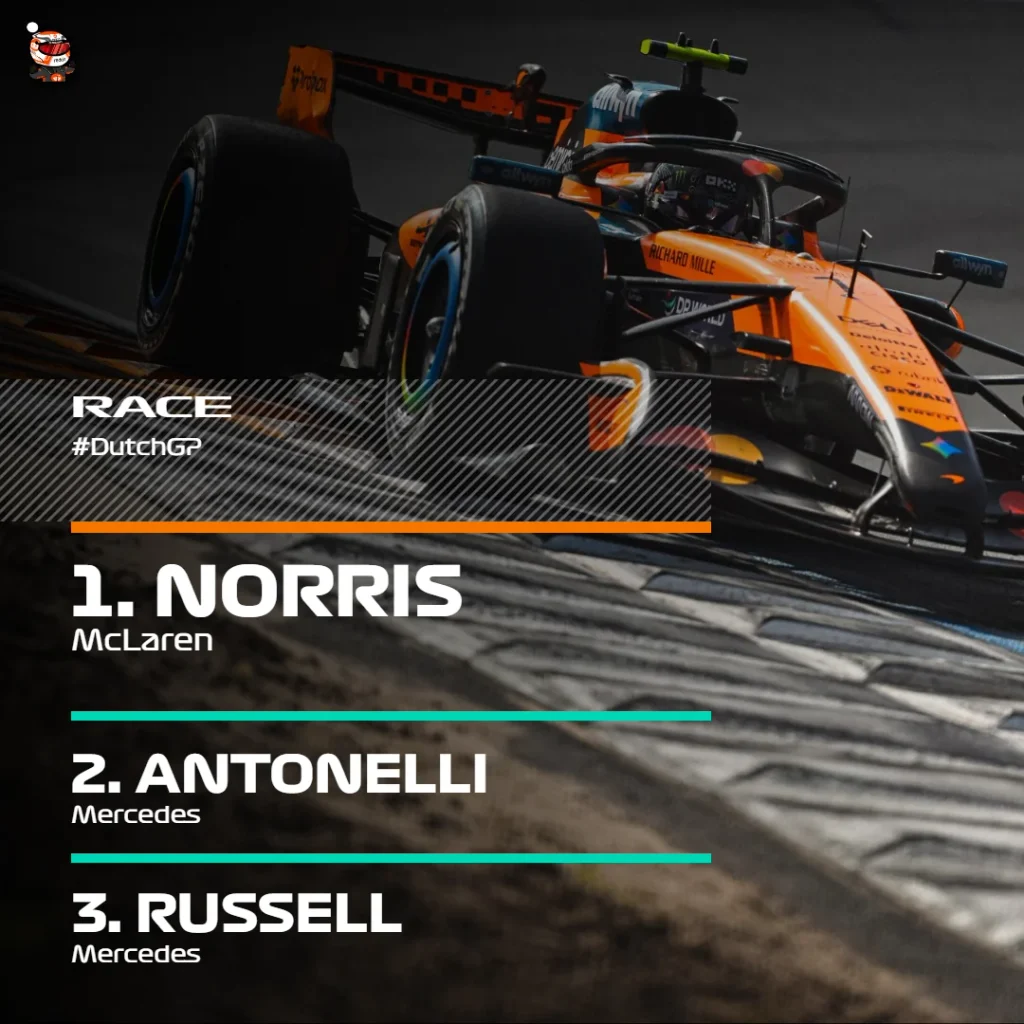
While Piastri struggled, Norris increasingly took control.
His final stint was particularly devastating. After stopping, Norris began taking enormous chunks of time out of Antonelli, at points approaching two seconds per lap. He didn’t merely rely on strategy to return to the front either. When the opportunity came, he completed the overtake and took control of the race himself. That matters.
This wasn’t a victory handed to Norris by Verstappen’s retirement or somebody else’s pit wall. The chaos changed the complexion of the race, but Norris still had to execute through it, manage his tires and produce the speed necessary to recover the lead. His pace while chasing Antonelli was arguably the clearest demonstration of the difference between the two McLarens on Sunday. Norris eventually won, giving McLaren a P1-P6 result that looks respectable on paper but doesn’t remotely capture how different the two sides of the garage experienced the afternoon. For Norris, it was another excellent weekend and a second consecutive victory.
For Piastri, it was another race that raises questions about how quickly he can rediscover the form that previously made him such a formidable threat.
Ferrari Somehow Finds a Way to Hurt Both Drivers
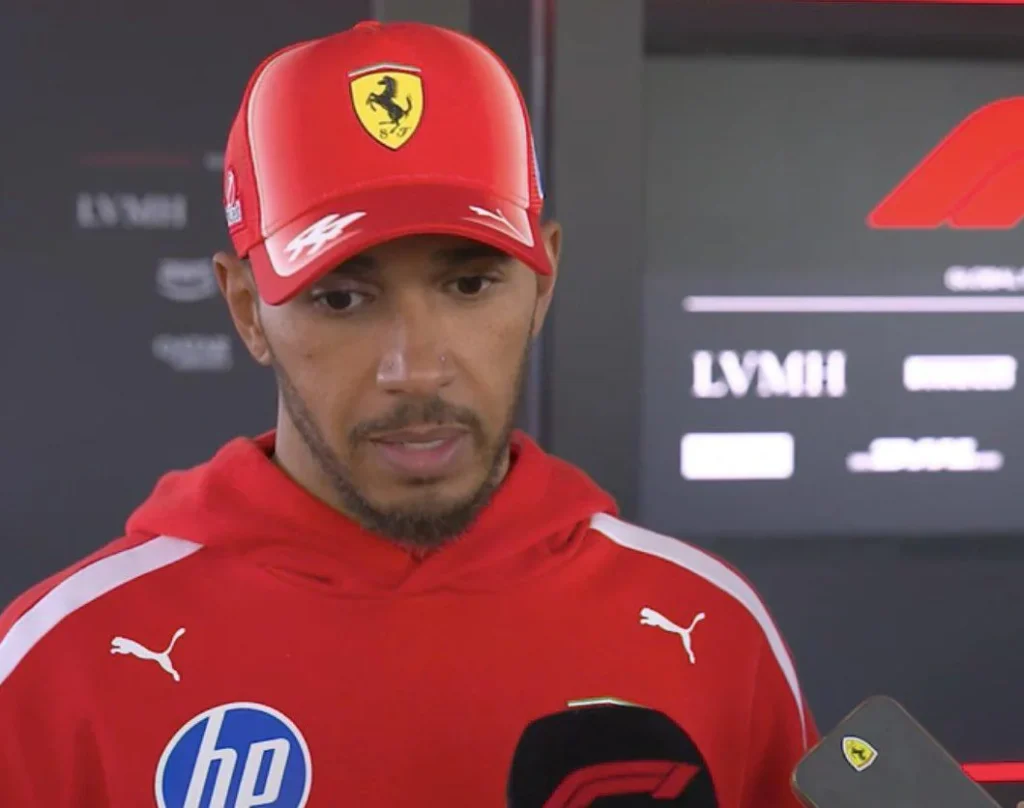
If McLaren had questions to answer about Piastri’s strategy, Ferrari provided an entire case study in how indecision can turn a promising race into frustration.
Hamilton was running a different strategy from Leclerc and eventually caught his teammate while lapping significantly faster. That should have created a relatively simple decision. Let Hamilton through. Allow him to use his tire advantage and chase the cars ahead. Let Leclerc extend his stint, build an offset and pursue his own strategy.
Ferrari instead appeared desperate to avoid explicitly making that decision. Rather than simply ordering a swap, Ferrari told Leclerc to pit. Leclerc questioned why he should stop when his tires were only two laps newer than Russell’s. Ferrari didn’t provide a satisfactory immediate explanation, and Leclerc stayed out before eventually pitting later. Meanwhile, Hamilton sat behind him losing time.
This wasn’t fundamentally a Leclerc problem. If Ferrari wanted its drivers swapped, it needed to tell them to swap. Drivers are competitors. Expecting one to independently surrender position because the pit wall is uncomfortable issuing a direct instruction is not strategy. It’s avoidance. Ferrari managed to compromise both sides of the equation. Hamilton lost time behind Leclerc, while Leclerc wasn’t allowed to extend his stint enough to create the largest possible tire offset against Russell.
It was the worst of both worlds.
“You Guys Have Got the Data, So Figure It Out”
Hamilton’s frustration became increasingly obvious.
At one point he sarcastically congratulated Ferrari for wasting time. Later, when discussing tire options, the exchange became even more revealing. Ferrari suggested a new set of mediums. Hamilton asked whether the compound had looked poor on Leclerc and whether it was slower. The response was that Ferrari wasn’t sure.
Hamilton’s answer was simple: Ferrari had the data, so it needed to figure it out. That exchange encapsulated the problem. There were legitimate complications in interpreting Leclerc’s medium stint. He had spent time in traffic behind Piastri, meaning it wasn’t necessarily straightforward to determine how much of his pace came from the compound itself and how much came from dirty air and tire degradation.
But uncertainty is precisely why an F1 strategy department exists. Hamilton eventually received seven-lap-old softs rather than the fresh mediums that were available. The decision wasn’t completely indefensible. Hamilton himself had questioned the mediums because of what he had seen from Leclerc, and used softs could potentially provide immediate performance. The soft compound had also demonstrated an ability to survive a significant number of laps during the weekend.
But the choice dramatically limited Hamilton’s ability to attack for the remainder of the stint. Used softs weren’t going to suddenly fall off a cliff immediately, but degradation meant he couldn’t exploit them in the same way he potentially could have attacked on fresh rubber. Ferrari briefly looked clever when a Virtual Safety Car helped Hamilton.
Then the race found another way to turn against him.
Mercedes Makes the Call Ferrari Wouldn’t
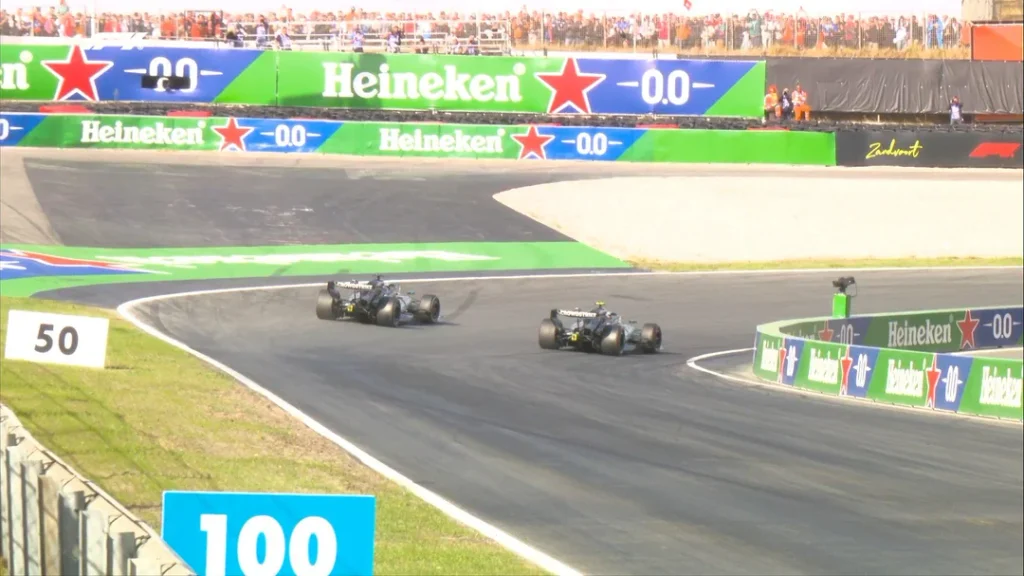
The contrast became especially uncomfortable for Ferrari when Mercedes encountered its own intra-team dilemma.
Antonelli was faster than Russell and closing. Mercedes told Russell to let him through. Russell complied.
There are plenty of reasons to dislike the decision from a championship perspective. Antonelli and Russell are not merely teammates collecting constructors’ points; they are championship rivals. Asking one to surrender position to the other inevitably creates the impression that a hierarchy is beginning to form. But strategically, there was also logic. Antonelli had the tire advantage and enough pace that he was likely to get past Russell eventually. If Russell spent several laps defending, he would consume what remained of his tires and bring Hamilton directly into the fight. Mercedes risked turning one difficult situation into two vulnerable cars.
Russell himself had wanted the team to find a solution rather than waste time fighting. So Mercedes made a decision. That alone separated it from Ferrari. The call could be criticized. The timing could be questioned. Mercedes might even have moved Antonelli through slightly earlier than necessary. But there was no ambiguity about what it wanted.
Russell moved aside, Antonelli drove away, and Russell was left to deal with Hamilton.
Russell Somehow Survives
Mercedes’ decision very nearly cost Russell his podium.
Hamilton attacked relentlessly on the fresher soft tires, and Russell produced an excellent defensive drive to keep the Ferrari behind. The situation became increasingly uncomfortable because Antonelli wasn’t hanging around to provide Russell with assistance. Once released, he disappeared up the road. There is an argument that keeping Antonelli closer could have helped Russell through overtake assistance, although doing so might also have created dirty-air problems or provided Hamilton with an even more useful tow. Either way, Russell was effectively left to survive.
And he did. The final VSC arrived at the perfect moment for Mercedes and the worst possible moment for Hamilton. Hamilton appeared to have finally maneuvered Russell into a vulnerable position and was preparing his best opportunity to pass when the race was neutralized. Without it, Russell may well have lost the position.
But he deserves enormous credit for lasting long enough for that luck to matter. Even Mercedes appeared surprised that he had managed to keep Hamilton behind for as long as he did. Mercedes therefore emerged with both cars on the podium. The decision worked.
That doesn’t mean it wasn’t risky.
Hamilton Makes His Frustration Public

After the race, Hamilton didn’t hide what bothered him.
“I want to win! I want to win! I’m here to win!” he said while discussing Ferrari’s management of the race.
The comparison with Mercedes was explicit. Hamilton had watched his former team make the call between Russell and Antonelli, watched the drivers execute it immediately and watched Mercedes maximize the situation. Ferrari hadn’t done the same. Hamilton said the issue would be discussed privately with the team, but his point was already clear.
This isn’t necessarily about Ferrari declaring Hamilton or Leclerc its number one driver. It doesn’t need to be. A much simpler rule would solve most of the problem: when the cars are on clearly different strategies and one is significantly faster, don’t allow them to destroy each other’s races. Ferrari’s reluctance to make a hard call may have been intended to treat its drivers fairly. Instead, it left both disadvantaged. The irony is that Ferrari had enough pace to threaten Mercedes. Yet it finished with both cars behind the Mercedes pair.
That’s not a car problem.
Sainz Creates the Final VSC — By Hitting Albon

Hamilton’s last opportunity disappeared because of an incident elsewhere.
Carlos Sainz made contact with his own Williams teammate Alex Albon. It was another ugly moment for Sainz, whose wheel-to-wheel judgment has increasingly come under scrutiny. The incident also revived criticism surrounding his spatial awareness and tendency to find himself involved in avoidable contact. And this one came with an added layer of absurdity: the Williams drivers managed to interfere with a fight for the podium while battling elsewhere on the road.
The resulting VSC effectively froze Hamilton’s attack on Russell. For Ferrari, it was one final piece of terrible timing. For Russell, it was salvation.
And for Williams, it was the kind of intra-team incident that will require an uncomfortable debrief regardless of who ultimately shoulders the blame.
Alonso Quietly Steals a Point
Away from the podium drama, Fernando Alonso produced one of the more impressive strategic results of the race.
Aston Martin simply stopped stopping. Alonso made one fewer pit stop, jumped both Gasly and Yuki Tsunoda through strategy rather than an on-track pass and then managed the tires well enough to keep the position. Gasly eventually got within a second but couldn’t find a way through.
The strategy involved risk, and Aston Martin had less to lose than the leading teams by attempting something unconventional. The VSC periods also helped reduce the stress on the tires. But the car still needed enough pace to make it work, and Alonso still had to deliver at the end. He finished ninth.
Considering how poorly the car was regarded during the race, extracting points from it was another classic Alonso exercise in maximizing whatever opportunity was available.
Tsunoda Returns and Immediately Gets Tsunoda’d
Yuki Tsunoda’s cameo was another entertaining subplot.
After a year and a half away, he returned and immediately demonstrated that he could still race, producing several overtakes through the middle portion of the Grand Prix. Then strategy intervened. Tsunoda was put onto soft tires with a long final stint remaining, despite appearing much happier on the hards. Alonso’s one-stop approach ultimately jumped him, and Tsunoda finished 11th. It was almost comically familiar: Yuki Tsunoda, questionable strategy, P11.
Afterward, his message was direct: “F1 teams, call me please!”
Whether anyone does remains another question entirely. There was immediate speculation about possible openings elsewhere, but his Zandvoort appearance at least demonstrated that he could return after a lengthy absence and immediately participate in the fight.
A Race That Made Almost No Sense — Until Norris Won It
The strangest thing about the 2026 Dutch Grand Prix is that after all of that chaos, the finishing order still contained plenty of familiar names near the front.
The rain never delivered the mixed-condition strategic lottery many had hoped for. It didn’t need to. The teams created enough uncertainty themselves.
McLaren compromised Piastri with a combination of questionable strategy, a poor stop and his own lack of pace. Ferrari seemingly constructed its strategy around avoiding an uncomfortable team order and ended up compromising both cars. Mercedes issued the exact kind of instruction Ferrari avoided and nearly sacrificed Russell in the process, only for Russell’s defense and the final VSC to rescue the double podium. Williams’ drivers hit each other. Tsunoda was sent onto a questionable final tire strategy. Aston Martin did the opposite of almost everyone else and made it work. It felt at times as though the entire grid had returned from summer break having forgotten how pit stops and race management worked. Except Norris.
While everyone else was creating complications, Norris kept driving faster. His pace in the final phase was exceptional. His pursuit of Antonelli was relentless. When he needed to make the pass, he made it. And when the race finally stopped throwing new variables at everyone, Norris was exactly where he needed to be. First.
The 2026 Dutch Grand Prix will probably be remembered initially for Verstappen’s shocking first-lap exit and the strategic chaos that followed it. But underneath all of that was a very simple story.
Lando Norris was the fastest driver when it mattered, and while almost everyone around him found a way to make the afternoon harder, he found a way to win.