

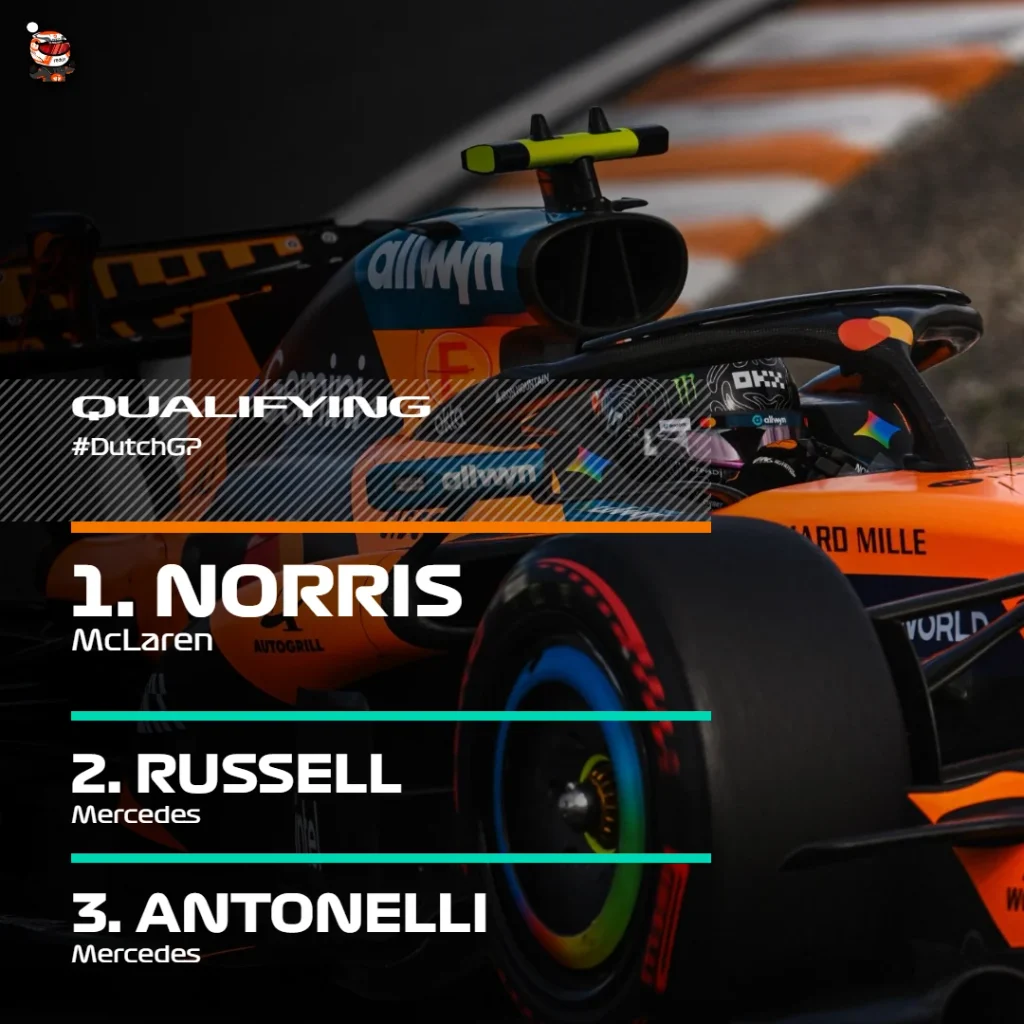
Lando Norris will start the 2026 Dutch Grand Prix from pole position after beating George Russell and Andrea Kimi Antonelli in a remarkably tight qualifying session at Zandvoort, while Oscar Piastri could manage only fourth.
Behind the leading quartet came a sight that has become painfully familiar for Ferrari: Lewis Hamilton fifth and Charles Leclerc sixth. Max Verstappen was only seventh at his home Grand Prix, but perhaps the biggest story behind him was Liam Lawson. Drafted back into Red Bull for the weekend, Lawson qualified eighth and finished just 0.115 seconds behind Verstappen. Gabriel Bortoleto and Arvid Lindblad completed the top 10. The full top 10 starting order is Norris, Russell, Antonelli, Piastri, Hamilton, Leclerc, Verstappen, Lawson, Bortoleto and Lindblad.
And after a Sprint that produced precious little action, qualifying finally gave Zandvoort something to talk about.
Norris beats Russell in a battle decided by tenths
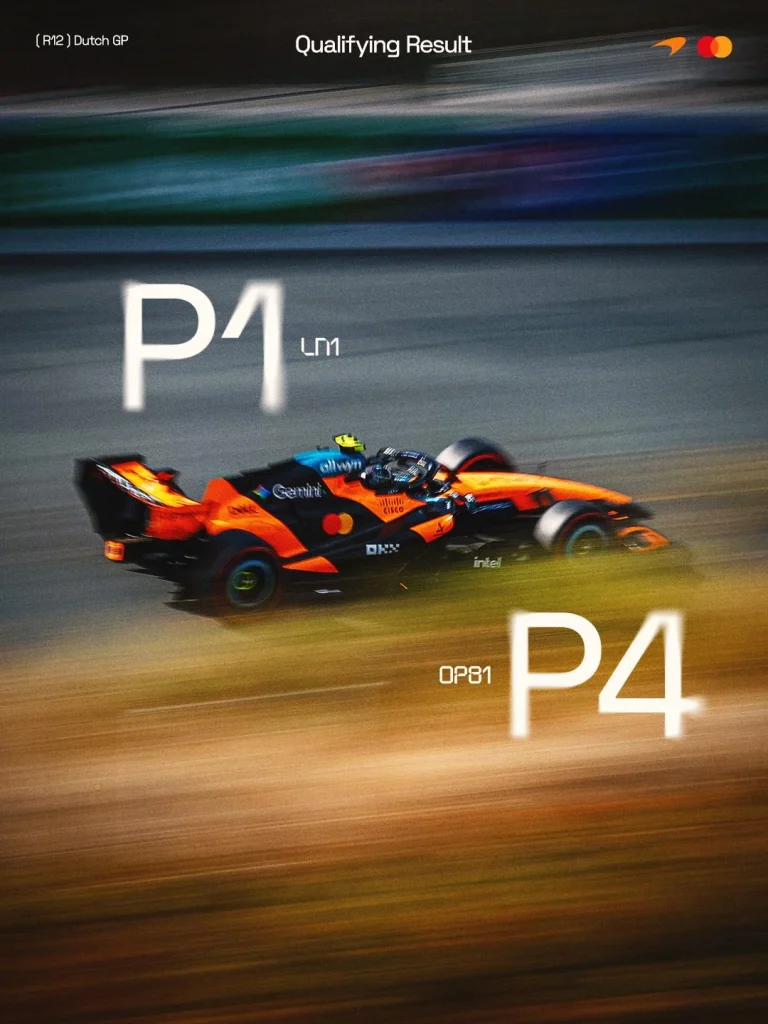
Norris’ pole lap was a 1:11.163, with Russell only 0.102 seconds behind him.
Antonelli was another 0.031 seconds back in third, while Piastri was fourth at +0.142. Hamilton finished +0.331 behind Norris, Leclerc +0.395 and Verstappen +0.455. That means the first four cars were separated by just 0.142 seconds. The Norris-Russell comparison was particularly interesting because their advantages weren’t simply a case of McLaren being better in the corners and Mercedes being better on the straights.
Mercedes appeared particularly effective in several slower corners, while McLaren had an advantage through much of the high-speed running. Russell was still quicker through some faster sections, including Turns 2 and 13, while Norris had an advantage at Turn 10. McLaren was also competitive with Mercedes on more than one of the straights. Norris himself offered a somewhat less technical explanation for his high-speed performance.
“Our car is certainly the best in high speed, no doubt, or I have the biggest balls, I don’t know,” Norris said.
Whatever the explanation, Norris has rediscovered the qualifying form that once seemed one of the most dependable parts of his game. His Q3 performances were considerably less reassuring in 2025, making his current form feel like a return to the Norris of 2024. Even during last year’s struggles he still collected seven poles, but the uncertainty around whether he would put everything together in Q3 made Saturdays much more stressful than they had previously been. Now the confidence appears to be back as well. We’ve already seen glimpses of that attitude in his radio messages this season, and his comments after qualifying fit the same pattern. World champion Norris increasingly sounds like a driver who expects himself to deliver.
He did exactly that at Zandvoort.
But Norris may have a difficult Sunday ahead
Pole doesn’t necessarily make Norris the overwhelming favorite.
McLaren’s Sprint race pace and tire degradation raised questions, and overtaking at Zandvoort is notoriously difficult. That could actually work in Norris’ favor if he retains the lead, but it makes the start and energy management particularly important. One possible approach would be to control the field where possible and preserve enough battery to protect himself on the pit straight, which could offer Russell his clearest overtaking opportunity. Norris also gained some useful experience fighting Charles Leclerc and Antonelli during Saturday’s Sprint. If Sunday’s race becomes another track-position contest, those lessons could matter.
Clean air should also make tire management easier than it was in traffic. There is another wrinkle at the start. Russell is scheduled to line up on the dirtier side of the grid, while Antonelli behind Norris will also start from the cleaner side. Rain before the race, however, could alter how meaningful that advantage is. And then there is McLaren strategy.
Given some of the team’s previous missed opportunities, simply converting the speed of the car into the maximum possible result remains part of the equation.
Piastri’s strange qualifying problem continues
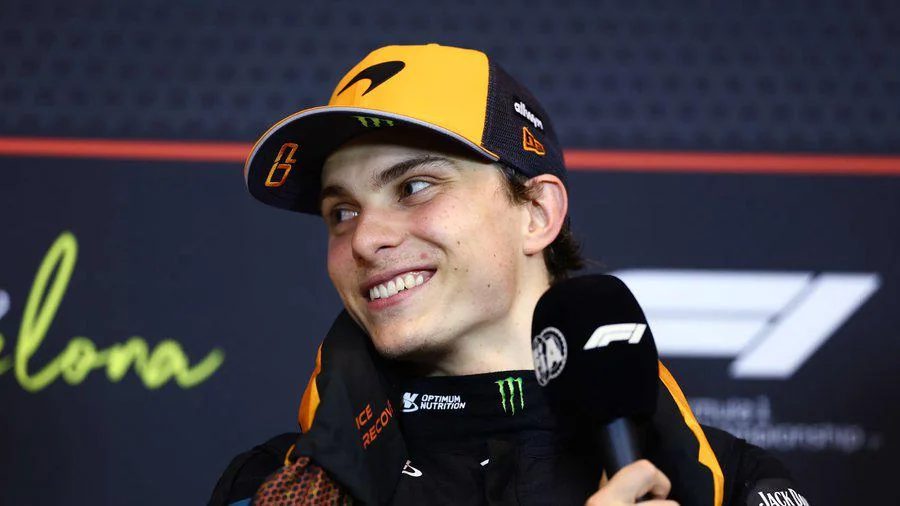
Piastri being fourth isn’t a disastrous result when he’s only 0.142 seconds away from pole.
But once again, the frustrating part is how close he was without actually converting that pace into a front-row result. Piastri has repeatedly produced impressive pace earlier in qualifying before leaving something on the table when the decisive Q3 laps arrive. Zandvoort was another example: close enough to demonstrate that the speed was there, but behind both Mercedes drivers when it mattered. There’s an interesting statistical contrast here.
Piastri has now reportedly reached Q3 in 74 of his 82 qualifying appearances, giving him a 90.24% Q3 appearance rate — fractionally ahead of Verstappen’s 90.20%. That’s an extraordinary level of consistency. It also needs context. Piastri has a much smaller career sample than drivers such as Verstappen and Hamilton and has spent much of his career with a car capable of comfortably reaching Q3. But having the machinery doesn’t guarantee actually converting every opportunity. Mechanical problems, traffic, mistakes and badly timed incidents can all destroy a qualifying session.
Valtteri Bottas’ famous run of more than 100 consecutive Q3 appearances is a good illustration. A dominant or competitive car creates the opportunity, but the driver still has to avoid an enormous number of ways a Saturday can go wrong. Piastri’s consistency deserves credit. His problem right now isn’t getting into Q3.
It’s maximizing it.
Lawson’s Red Bull return could hardly have gone much better
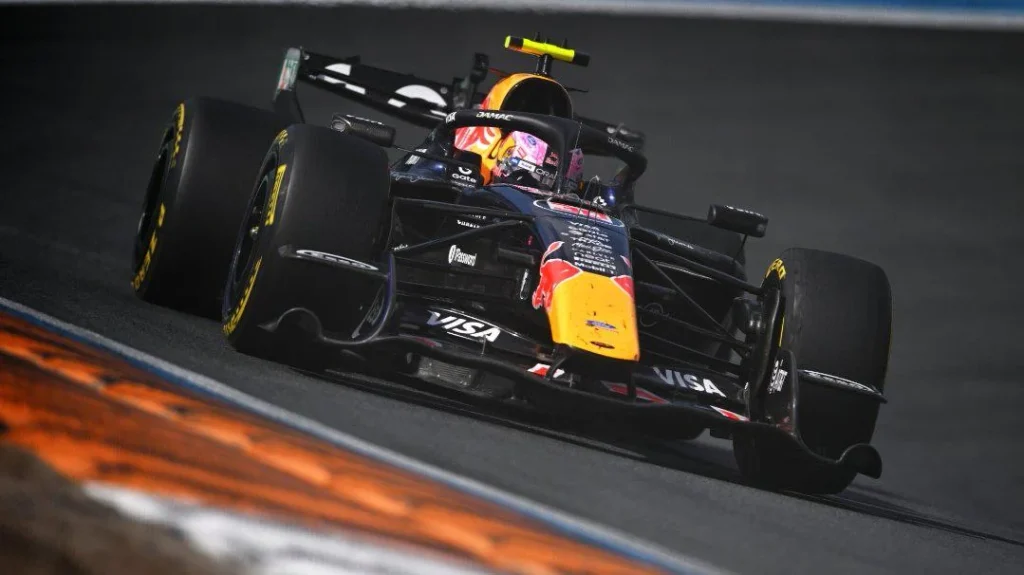
If Norris was the star at the front, Lawson produced perhaps the most intriguing performance further back.
P8 doesn’t normally sound spectacular. Being P8 while just 0.115 seconds behind Verstappen does. Lawson entered the weekend with extremely limited preparation in the 2026 Red Bull and immediately put himself on the same row as Verstappen. The gap between the two was even smaller than the gap separating Norris and Piastri.
It also provides some context for Lawson’s strange Sprint qualifying. He had actually beaten Verstappen in SQ1 before falling considerably further behind in SQ2. His conventional qualifying performance suggests SQ2 wasn’t necessarily representative of his underlying pace. More importantly, this was dramatically better than the disastrous picture surrounding Lawson during his brief Red Bull stint last season. There are two ways to interpret that.
One is that Lawson has simply become a significantly better and more confident driver since 2025. The other is that the 2026 Red Bull is fundamentally less hostile to its second driver than its predecessor. The most reasonable answer may be some combination of both.
Lawson has had time to develop, rebuild his confidence and establish himself. But his ability to jump into this car and immediately operate relatively close to Verstappen also strengthens the argument that last year’s machinery played a significant role in destroying the confidence of Red Bull’s other drivers. It also complicates comparisons between Lawson and Isack Hadjar. Hadjar has been impressive, but Lawson’s performance makes it harder to simply conclude that Hadjar is obviously a substantially superior driver because he has looked better alongside Verstappen in a different generation of Red Bull.
Lawson and Hadjar have previously appeared relatively closely matched. Perhaps the major variable wasn’t simply which driver occupied the second seat. Perhaps it was which Red Bull they were asked to drive. That doesn’t diminish Hadjar’s performances. It rehabilitates Lawson’s.
And if Lawson can follow qualifying with a clean race and respectable long-run performance, his stock should rise considerably. There has been speculation about Red Bull’s future driver lineup with more junior talent coming through, but dropping Lawson while he’s producing this kind of performance would become increasingly difficult to justify.
His temporary promotion might have inadvertently become one of the strongest auditions he could have asked for.
Verstappen’s Red Bull isn’t a disaster — but it isn’t quick enough
The other side of Lawson’s performance is Verstappen qualifying seventh.
Red Bull clearly isn’t particularly strong at Zandvoort this weekend, although describing the car as hopeless probably goes too far. Verstappen was comfortably ahead of Lindblad in the Sprint and remained within range of the leading cars, but qualifying exposed the deficit more clearly. At +0.455 seconds, he was more than three times as far from Norris as Piastri was. That leaves Verstappen starting immediately behind the Ferraris, setting up a potentially entertaining fight with Leclerc and Hamilton. There was already some entertainment before the race even began.
After a close pit release involving Russell, Verstappen joked: “We’ll probably have George crying on the radio about the pit release, but it was nothing unsafe.”
The problem? Apparently Russell hadn’t complained. Verstappen was effectively getting annoyed at a Russell complaint that hadn’t happened, while GP reportedly corrected him with a simple negative response. Russell, meanwhile, was apparently more interested in asking about the weather before going out and qualifying second.
It’s difficult to catch a more impressive stray than being criticized for something you didn’t even say.
Ferrari returns to its natural habitat: P5 and P6
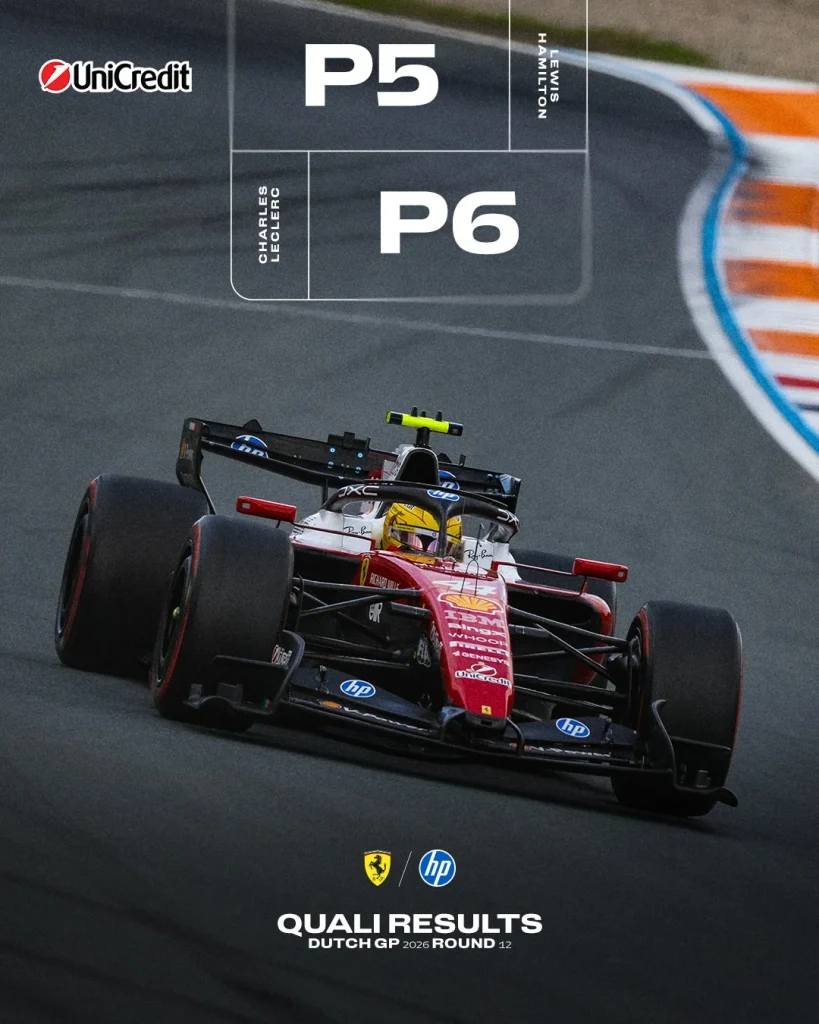
Ferrari provided its fans with hope.
Ferrari produced encouraging results. Ferrari arrived at qualifying. Ferrari qualified fifth and sixth.
The cycle remains undefeated. Hamilton will start fifth with Leclerc sixth after the two finished only 0.064 seconds apart. In isolation, that’s hardly catastrophic. Both drivers are ahead of Verstappen, and Hamilton in particular salvaged a session that had looked considerably uglier at various stages. But expectations had risen.
Zandvoort was supposed to offer Ferrari an opportunity, and the Sprint suggested its race pace could be stronger than McLaren’s. Leclerc had even managed impressive longevity on his soft tires. Instead, McLaren appears to have found another level while Ferrari is once again staring at the third row. That has revived the concern that Ferrari may have been outdeveloped.
McLaren’s ability to improve during a season has become one of its defining strengths, and if its earlier power-unit-related compromises are becoming less problematic at circuits later in the calendar, Ferrari could find itself under increasing pressure. There is at least an argument that P5 and P6 accurately reflect what the car could achieve. Hamilton and Leclerc being separated by barely half a tenth suggests neither was leaving an enormous amount unused. The broader season numbers reinforce how closely matched they have been.
In the supplied teammate qualifying-gap analysis, Leclerc is the faster Ferrari driver, but the mean gap including Sprint sessions is only 0.034 seconds, with a 0.031-second median. Excluding Sprints, the mean is 0.033 seconds and median 0.059. Ferrari has one of the tightest driver pairings on the grid. That’s great if you’re evaluating the drivers.
It’s less comforting when both are fighting over fifth.
Hamilton is praying for chaos
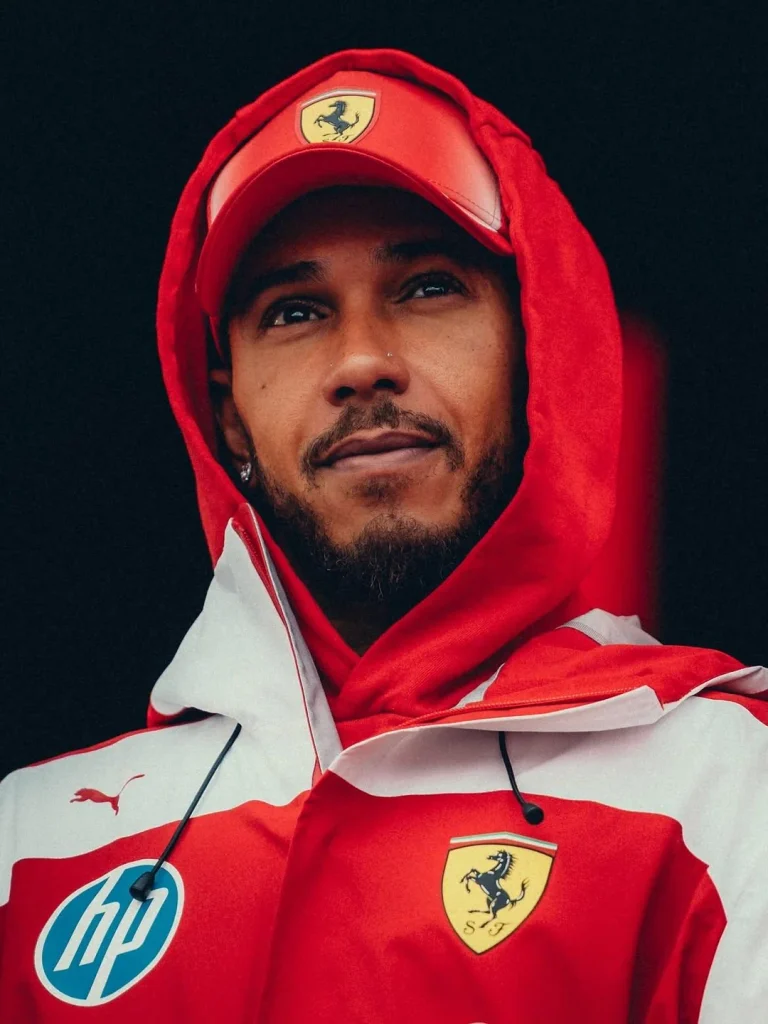
Hamilton knows Ferrari may need something unusual on Sunday.
“We have a massive fight ahead of us tomorrow, one the team and I really looking forward to,” he said. “Send good vibes, pray for some rain.”
After what happened during the Sprint, he may want to specify when. Rain arrived almost immediately after the Sprint finished, producing the rather cruel spectacle of exactly the weather everyone wanted showing up once it could no longer affect anything. Ferrari’s recent wet-weather history doesn’t necessarily inspire confidence either. But from Hamilton’s perspective, unpredictability may still offer more upside than another conventional dry race from fifth. If the dry-weather hierarchy remains what qualifying suggested, Ferrari has Mercedes and McLaren ahead and Verstappen immediately behind.
A curveball might be worth the risk.
Mercedes suddenly has two cars in the top three
Russell’s P2 is impressive enough.
Antonelli joining him in P3 makes Mercedes’ result considerably more significant. Both drivers had appeared uncomfortable earlier in the weekend, yet when qualifying reached its decisive stage they recovered spectacularly. Russell missed pole by 0.102 seconds and Antonelli by only 0.133. That puts Antonelli just 0.031 seconds behind his teammate.
The season-long teammate numbers also underline just how strong Mercedes’ pairing has been. Antonelli is listed as the faster driver in the supplied averages, with a 0.062-second mean gap including Sprints and only 0.031 seconds on the median. Excluding Sprints, the mean gap is 0.075 seconds. Alongside Ferrari, Mercedes has one of the most closely matched qualifying pairings on the grid.
And unlike Ferrari at Zandvoort, both Mercedes drivers are starting in the top three. The television broadcast unfortunately didn’t make Antonelli’s final effort particularly easy to follow. Viewers were left watching other cars while Antonelli was on a potentially significant lap, at points without even having his sector information clearly available. It continued a weekend of complaints about the TV direction after several midfield battles and overtakes were missed during the Sprint. For a Sprint that offered very little overtaking, missing some of the action that did happen was particularly frustrating.
Then qualifying finally produced a genuinely exciting conclusion — and the broadcast still managed to leave viewers wondering what some of the most important cars were doing.
Aston Martin’s Q1 disaster
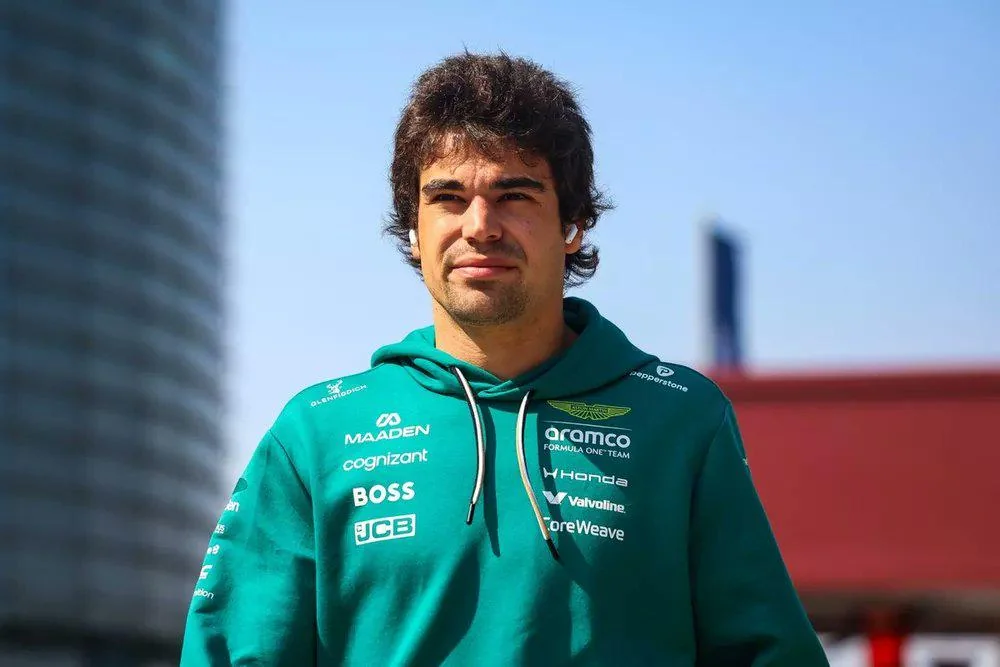
The first qualifying segment eliminated Sergio Perez, Valtteri Bottas, Oliver Bearman, Lance Stroll, Fernando Alonso and Carlos Sainz.
For Aston Martin, losing both cars immediately was a particularly painful result. There was debate over how much was down to the car and how much came from execution. Alonso appeared capable of reaching Q2, but his final attempt did not produce the necessary improvement, with a mistake one plausible explanation. Stroll, meanwhile, completed an important lap comparatively early despite substantial track evolution, and traffic further complicated matters.
The field was extremely compressed, which magnified every error. Still, after the optimism surrounding Aston Martin’s recent progress, a double Q1 elimination is a brutal reminder that the team hasn’t suddenly escaped the midfield. There may have been genuine improvement in the car without Zandvoort producing the result to demonstrate it.
For Stroll, there is also an extraordinary statistic approaching. He is now reportedly one Q1 elimination away from becoming the first F1 driver to reach 100 Q1 eliminations. Which means Monza could provide history of a very different kind. It’s almost too perfectly Lance Stroll: a driver with enough longevity to accumulate a record that most drivers struggling that frequently in qualifying would never remain in Formula 1 long enough to approach.
Of course, the most Stroll outcome possible would now be to randomly produce a spectacular qualifying performance at Monza and delay No. 100.
Sainz’s nightmare continues while Albon gets one back
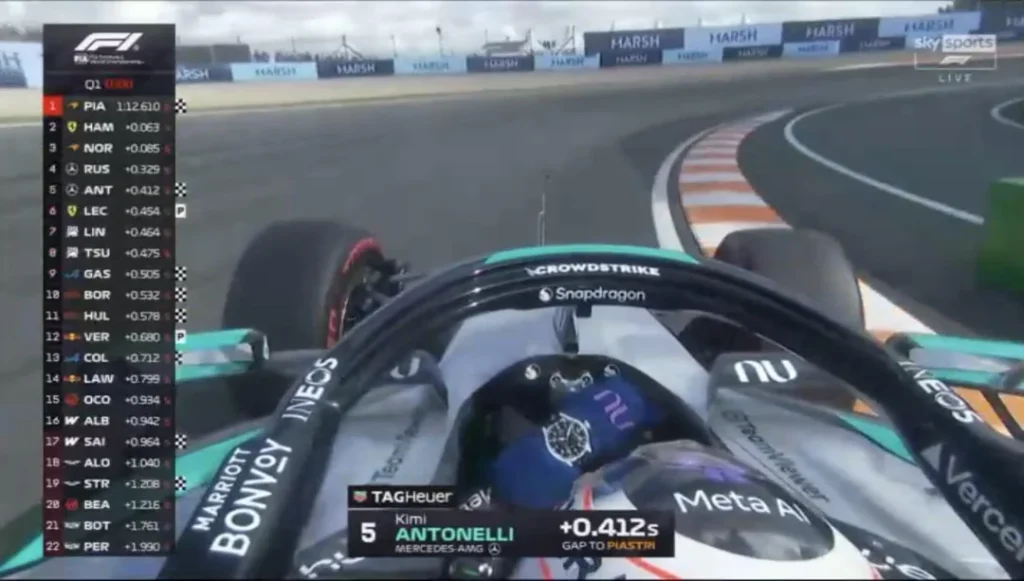
Williams had another difficult Saturday.
Sainz disappeared in Q1, while Alex Albon at least progressed into Q2 before being eliminated there. For Albon, there is some satisfaction in finally beating his teammate after a difficult first half of the season. But the bigger problem is that Williams simply doesn’t appear capable of turning those internal victories into much externally. That creates an awkward dynamic.
A driver can beat his teammate and still disappear from the wider conversation because both cars are too far down the field to score significant points. The same issue applies to Esteban Ocon at Haas. Ocon once again outqualified Bearman, but if the car isn’t capable of fighting near the points, repeatedly winning that internal battle won’t necessarily allow him to erase a points deficit accumulated earlier in the season. Teams should have enough internal data to understand the difference between driver performance and championship points.
Public perception rarely has that patience.
Bortoleto quietly puts Audi into Q3
One of the less celebrated results was Bortoleto reaching Q3 and qualifying ninth.
That continues an impressive run of qualifying performances from a driver operating without anything resembling the salary or profile of some of the names eliminated before him. The Audi teammate comparison is also a useful demonstration of why raw averages can be deceptive. Bortoleto’s brake failure in Miami produced a Q2 lap roughly four seconds slower than Hülkenberg’s. Include that result and it distorts the mean dramatically. Remove it and the picture changes substantially.
With Miami included, the Sprint-inclusive Audi mean gap is listed at 0.157 seconds in Hülkenberg’s favor, while the median is only 0.027 seconds and favors Bortoleto. Remove Miami and the Sprint-inclusive mean falls to 0.105 seconds, with a median of just 0.020. It’s a useful warning against treating any single teammate-gap statistic as definitive.
Means capture everything but can be distorted by freak results. Medians resist those outliers but can conceal other information. Percentage differences help account for different lap lengths and speeds. The numbers need context.
Bortoleto putting the car into Q3 at Zandvoort requires much less explanation.
Norris has pole. Now comes the difficult part.
The 2026 Dutch Grand Prix grid has produced several fascinating matchups.
Norris has Russell alongside him, with Antonelli directly behind and Piastri starting fourth. Ferrari occupies the entire third row. Verstappen and Lawson share the fourth.
And after a Sprint that could probably have been summarized in considerably less than its six-minute highlights package, qualifying finally injected some uncertainty into the weekend. Norris has the best starting position and believes McLaren may have the best high-speed car. Russell was only 0.102 seconds slower.
Antonelli was only 0.031 behind Russell. Piastri was only 0.009 behind Antonelli. Hamilton and Leclerc may have stronger race pace than their grid positions suggest.
Verstappen is lurking immediately behind them. And Lawson has suddenly demonstrated that putting somebody else in the Red Bull doesn’t necessarily have to end in psychological trauma. If Sunday’s race is dry and processional, track position could make Norris extremely difficult to beat. If the tire degradation seen in the Sprint returns, McLaren has a problem.
And if Hamilton’s prayers actually work, everyone should probably hope the rain remembers to arrive before the checkered flag this time.