

Kyle Kirkwood won the 2026 Freedom 250 Grand Prix of Washington, D.C., delivering a dominant drive on one of the biggest stages of the IndyCar season while Alex Palou’s crash gave the championship fight at least a little more life.
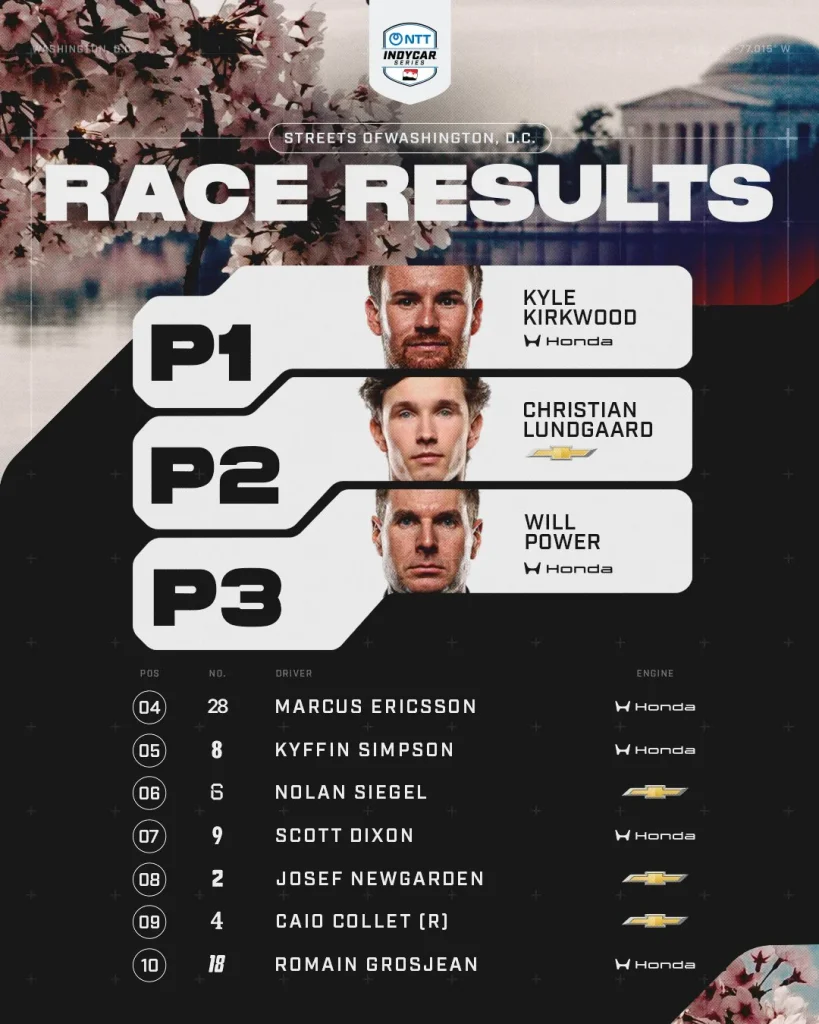
Kirkwood led Christian Lundgaard across the line, while Will Power completed the podium and Marcus Ericsson finished fourth to give Andretti three cars inside the top four. Kyffin Simpson produced an excellent fifth-place finish ahead of Nolan Siegel in sixth, Scott Dixon in seventh, Josef Newgarden in eighth, rookie Caio Collet in ninth and Romain Grosjean in 10th. The final top 10:
- Kyle Kirkwood
- Christian Lundgaard
- Will Power
- Marcus Ericsson
- Kyffin Simpson
- Nolan Siegel
- Scott Dixon
- Josef Newgarden
- Caio Collet — rookie
- Romain Grosjean
For an event that spent so much of its buildup focused on everything surrounding the race — Washington itself, the political backdrop, security, crowds, grandstands and whether this circuit would actually produce worthwhile racing — the inaugural Freedom 250 ultimately gave us plenty to talk about on the track.
And nobody took advantage of the occasion better than Kirkwood.
Kirkwood Does His Best Alex Palou Impression
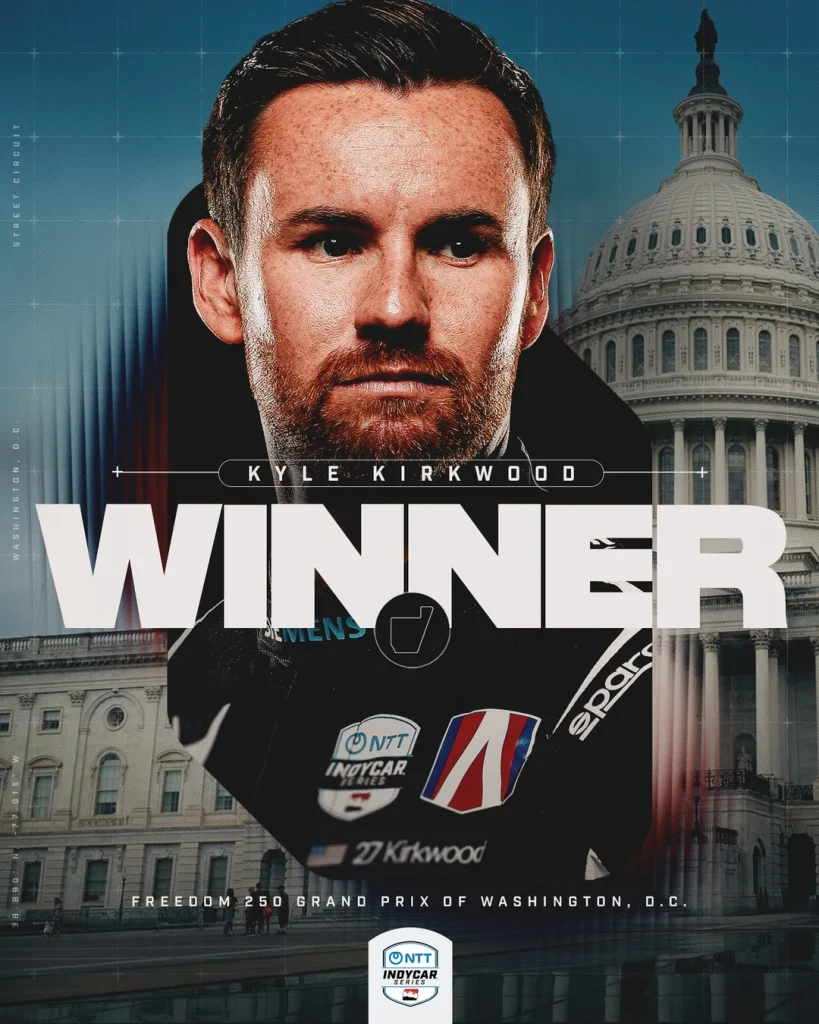
There was something strangely appropriate about the way Kirkwood won this race.
He drove like Palou. Kirkwood managed the race from beginning to end, remaining in control even as cautions complicated proceedings. It was the sort of composed, controlled performance we’ve become accustomed to seeing from Palou. Except this time, Palou was the one having the messy afternoon.
Kirkwood didn’t merely survive Washington. He controlled it. That made the contrast with the championship leader even more striking. One spectator was only feet away from Palou’s crash at Turn 4 and could hardly believe what had happened. On a day when Kirkwood needed virtually everything to go his way if he wanted to preserve even a remote championship possibility, Palou made the kind of mistake that has been so unusual from him.
For once, it was different. Kirkwood looked like Palou. Palou didn’t look like Palou.
And Kirkwood took full advantage.
The Championship Is Alive — Technically
Naturally, Palou’s crash immediately generated talk about championship implications.
There are implications. There probably isn’t much of a championship fight. Palou remains 91 points ahead with three races remaining.
That means Kirkwood needs to recover an average of more than 30 points per race. One scenario raised after Washington illustrates just how enormous the task remains: three Kirkwood victories combined with three Palou finishes outside the top 10 could cover the deficit. Possible? Yes.
Something anyone should expect? Probably not. Palou could still wrap this up very quickly.
There’s also some useful perspective when looking back at Markham. Kirkwood crashed there. Palou crashed here. If you imagine both drivers instead finishing approximately where they appeared capable of finishing in those respective races, the championship picture might not look dramatically different from where it stands now. Washington therefore shouldn’t suddenly be treated as the moment the championship swung wide open. What Kirkwood did was keep it alive.
Considering the alternative, that’s enough.
Andretti Goes 1-3-4
The bigger story coming out of Washington might actually be Andretti.
Kirkwood won. Power finished third. Ericsson finished fourth.
That’s three Andretti cars in the top four. And it adds more evidence to one of the increasingly interesting stories of this season: the effect Power appears to be having on the organization. Power’s move from Penske generated questions earlier in the season, particularly when his first few races didn’t go smoothly. Those judgments are looking increasingly premature.
Another podium in Washington continues an impressive turnaround. More importantly, the discussion around Andretti isn’t simply that Power himself is producing results. There is a growing sense that his presence has helped the entire program move in the same direction. The three-driver combination appears to work remarkably well.
Kirkwood provides the outright performance at the front. Power brings enormous experience. Ericsson adds his own experience and Indianapolis 500 pedigree. There also appears to be genuine chemistry between them. Ericsson has previously discussed how well the three drivers get along and how Power’s driving style has helped influence the direction of the car. Perhaps even more importantly, Power and Ericsson have apparently provided similar setup feedback.
That’s potentially significant. Instead of different drivers pulling development in different directions, Andretti appears to have a lineup increasingly aligned around what it needs from the car. For an organization whose operational problems have been criticized for years, having three experienced drivers swimming in the same direction could be enormously valuable. Washington certainly didn’t make an argument for changing anything.
It made an argument for keeping this group together.
Has Will Power Helped Transform Andretti?
It’s always dangerous to assign an entire team’s improvement to one person.
But it’s getting harder to ignore the timing. Power arrived at Andretti and spoke about the organization becoming a genuine championship contender again over the coming years. Now Andretti has finished first, third and fourth in Washington.
Kirkwood produced a drive worthy of the championship leader. Power is collecting podiums. Ericsson finished directly behind him.
Earlier criticism that Andretti might have made a mistake bringing Power aboard now looks very different. There was even an argument after the race that, outside the short ovals, being in an Andretti might currently be preferable to being in a Penske. That’s quite a statement considering where these organizations have traditionally sat in the IndyCar hierarchy.
And while Kirkwood was unquestionably the star in Washington, Power’s influence may ultimately prove to be one of the more consequential parts of Andretti’s season.
Christian Lundgaard Quietly Finishes Second
Lost slightly amid the Andretti celebration was Christian Lundgaard finishing second.
That’s an enormous result on a day dominated by discussion about Kirkwood, Power and Andretti. It also inevitably adds another layer to the ongoing McLaren conversation. The immediate reaction was predictable: does McLaren regret moving on from Lundgaard?
Whether it does or not, Washington produced an amusing result when viewed through that lens. There was already plenty of discussion after the race about outgoing McLaren drivers finishing ahead of their replacements — and even ahead of the driver McLaren is keeping. Then there’s Nolan Siegel.
Because somehow, in the middle of all this, Siegel finished sixth.
Nolan Siegel Is Quietly Putting Together a Much Better Second Half
A Siegel P6 would have sounded considerably more surprising earlier in the season.
Now? Maybe it shouldn’t. There is a growing argument that Siegel’s second half has actually been pretty solid.
His results haven’t necessarily reflected all of his performances, either. At Road America, the belief was that he was heading toward approximately seventh before being taken out by Newgarden. At Markham, he appeared to have top-five pace before a caution worked against him. Strategy has also gone badly against him on multiple occasions. None of that changes the results that actually happened, but it provides context for why a sixth-place finish in Washington might not be as random as it initially appears.
There is also an interesting developmental question. Perhaps Siegel was simply promoted too quickly. Being moved up midseason potentially deprived him of development time that might have made the transition easier. Now, later in his IndyCar tenure, we’re beginning to see signs that the experience is paying off. Whether that improvement arrived soon enough to alter his future is another question.
But P6 in Washington deserves credit.
Kyffin Simpson Deserves Credit Too
Then there’s Kyffin Simpson.
Fifth. And perhaps it’s time to reconsider some of the assumptions surrounding him as well. Simpson’s funding inevitably shapes how people evaluate his place on the grid, but being a funded driver doesn’t automatically mean being a bad driver.
The more important question is whether the driver improves. Simpson has. There has been tangible year-over-year progress, and Washington provided another example.
He’s developed into a more dependable pair of hands and has shown encouraging form on street circuits. The argument isn’t necessarily that Ganassi couldn’t find a faster driver. It’s that Simpson is increasingly doing enough on track that his funding and performance together can make him a valuable third-car option. Maybe he was promoted before he was completely ready. Seat time matters.
Now that he has accumulated more of it, we’re beginning to see what that development can produce. Fifth in the Freedom 250 is difficult to dismiss. And when you combine Simpson P5, Siegel P6 and rookie Collet P9, Washington became a pretty encouraging afternoon for some of IndyCar’s younger drivers.
On a stage this large, they delivered.
Caio Collet Completes an Impressive Weekend
Collet deserves his own mention.
The rookie finished ninth. He had already put himself eighth in warmup Sunday morning, so the top-10 race finish didn’t arrive completely without warning. But warmup pace and surviving 147 laps around a new street circuit are very different things.
Collet did both. With Simpson fifth and Siegel sixth, it meant three younger drivers who have faced varying degrees of scrutiny finished inside the top nine.
That’s one of the more encouraging secondary stories to emerge from Washington.
David Malukas Takes Responsibility
Not everyone enjoyed a successful afternoon.
David Malukas and Sting Ray Robb ended up in trouble after contact, but this was one of those rare occasions when the immediate instinct to blame Robb proved unfair. Robb appeared to have essentially nowhere to go. The timing of the yellow added another layer of confusion. The yellow flags apparently came out immediately after Robb hit Malukas, while the flag station near the accident initially displayed green before changing to yellow. The electronic panels also apparently remained green immediately after the crash.
Whatever confusion existed around the signaling, the important part was that Robb seemed to arrive at the incident without enough warning or room to avoid it. Malukas took responsibility. And his response afterward earned considerable respect.
Rather than focusing on himself after climbing from the crash, he apologized for letting people down and committed to improving. That accountability matters. There are plenty of jokes to make whenever Robb ends up involved in an IndyCar incident. This wasn’t really the occasion for them.
Even some of the people whose first reaction was effectively, “Of course it’s Sting Ray,” quickly realized they’d gotten this one wrong.
For once, Robb deserved the apology.
The FP1Will Curse Strikes Again
There was, however, another culprit available.
FP1Will. The running joke quickly became that his attendance had cursed the drivers he liked, with both Robb and Malukas apparently among his favorites. At least Juncos apparently wouldn’t mind having him back.
Despite the chaos, he reportedly described it as the best weekend of his life. So perhaps the curse isn’t strong enough to keep him away.
IndyCar drivers may feel differently.
Scott McLaughlin’s Slide Is Becoming Harder to Ignore
One of the more concerning post-race conversations centered on Scott McLaughlin.
There was a moment when the broadcast began to announce that McLaughlin had taken the lead. That excitement didn’t ultimately translate into a result worth celebrating. He didn’t finish inside the top 10.
And the broader trend is becoming difficult to ignore. McLaughlin entered IndyCar with enormous expectations and initially showed the sort of progression that suggested there was considerably more to come. Instead, the perception now is almost the reverse: rather than steadily improving with additional experience, his trajectory appears to have moved backward.
That has naturally led to speculation about how secure his Penske future might be if the trend continues. We’ve discussed McLaughlin’s seat previously in this project, including the pressure created by Penske’s other options.
Washington won’t quiet that conversation.
A Race That Needed a Hairpin — Obviously
We apparently cannot get through a Freedom 250 session without somebody demanding a hairpin.
So yes: The track needs a hairpin. The joke has followed this circuit throughout the weekend, and after finally seeing an entire race here, there might actually be a more serious version of the argument.
The verdict on the race itself was reasonably positive considering the layout. It wasn’t necessarily a classic, but it was a decent race around a circuit that many people questioned before the weekend even began. A few changes could potentially make it considerably better. And sure.
Maybe throw a hairpin in there.
Washington Delivered the Spectacle
Before the green flag, the Freedom 250 continued leaning heavily into the occasion.
The race was scheduled for 147 laps and 249.9 miles, with the green flag set for 1:17 p.m. EDT. There was a B-2 flyover that proved particularly popular. There were dignitaries. There were American history segments. There were civics questions. And some of those civics answers perhaps demonstrated why quizzing racing drivers on American history on television can be dangerous.
The segment was clearly intended to be quirky and relatable, but watching American IndyCar drivers struggle with civics knowledge at an event built around the country’s 250th anniversary created its own comedy. Maybe next time ask the naturalized citizens. There was also an Uncle Sam segment that produced the memorable line that someone hadn’t discovered electricity — they’d simply electrocuted themselves.
The pre-race presentation wasn’t universally loved. Chris Myers’ presence generated criticism, continuing broader frustration with FOX’s motorsports presentation. Those complaints didn’t disappear once the race started. The broadcast itself received harsh criticism, while the repeated Kalshi integration became impossible for viewers not to notice.
The line that the broadcast didn’t have to go to commercial “thanks to Kalshi” produced the obvious response: prediction markets may not be called gambling, but the distinction can feel pretty thin to the audience.
At least the Rossi-Rasmussen commercial apparently became an instant classic.
The Freedom 250’s Political Debate Didn’t Disappear
As we’ve seen throughout this weekend, the Freedom 250 couldn’t entirely separate itself from the political arguments surrounding it.
Even during the pre-race show, the focus on American history generated disagreement about who should be presenting that history and what the event itself represents. One side viewed the 250th anniversary framing as central to the occasion and questioned why American broadcaster Townsend Bell wasn’t handling more of the historical discussion. The counterargument was much harsher: that the Freedom 250 branding and President Donald Trump’s involvement made the event feel more like a political showcase than a neutral celebration of the country’s anniversary.
Those arguments were never going to disappear when the green flag waved. But the race weekend also produced something independent of that debate:
A lot of people wanted to see IndyCars race through Washington.
Great Event, But the Spectator Experience Needs Work
Warmup morning gave us the first major indication of just how strong that demand was.
Gates opened at 8 a.m. Reports had grandstands full by somewhere between 8:30 and 8:50. People sprinted for seats.
That was an incredible visual for IndyCar. The post-race reaction, however, provided an important reality check. One first-time IndyCar attendee loved the fundamental experience of watching race cars scream through a major city like Washington, D.C.
But the logistical criticism was substantial. Four small grandstands were viewed as nowhere near sufficient for a crowd of this scale. Food options were limited enough that spectators could miss significant portions of the race simply waiting to eat.
There were calls for sunscreen stations. And perhaps most frustratingly, spectators were apparently told they could bring plastic water bottles, only for security to then tell some people they couldn’t bring in the same type of plastic bottle they’d been allowed to carry the previous day. That’s exactly the sort of inconsistency an event needs to fix.
The demand is clearly there. The challenge now is making the venue work for that demand. More viewing capacity, better food availability and clear, consistent policies could make a huge difference if Washington returns.
Because the difficult part — convincing people they want to attend — doesn’t appear to be the problem.
From “Can This Really Happen?” to a Completed Freedom 250
That’s perhaps the biggest takeaway from the entire weekend.
We spent the buildup questioning this event. Even during the construction phase, there were legitimate reasons for skepticism. Then we arrived in Washington and saw the course taking shape.
By warmup, spectators were sprinting toward grandstands. And by Sunday afternoon, Kyle Kirkwood had won an IndyCar race through the streets of Washington, D.C. The event wasn’t perfect.
The spectator infrastructure needs work. The broadcast frustrated viewers. The politics surrounding the race remain impossible to ignore.
And yes, apparently the circuit still needs a hairpin. But the actual race happened. It produced crashes, strategy, young drivers delivering career-encouraging performances, a huge Andretti result and a championship leader making the sort of mistake we rarely see from him.
Most importantly, Kirkwood delivered when he absolutely had to. Palou remains overwhelmingly in control of the championship with a 91-point advantage and three races remaining. But Washington belonged to Kirkwood.
Andretti went first, third and fourth. Lundgaard split them with second. Simpson and Siegel stunned with fifth and sixth.
Collet put a rookie inside the top 10. And the inaugural Freedom 250 produced something that seemed almost unimaginable when this event was first discussed: IndyCars racing through Washington, D.C., in front of grandstands that people were sprinting to claim.
For all the arguments about what the Freedom 250 was supposed to be, Sunday finally gave us the answer that mattered most. It was an IndyCar race.
And Kyle Kirkwood won it.