
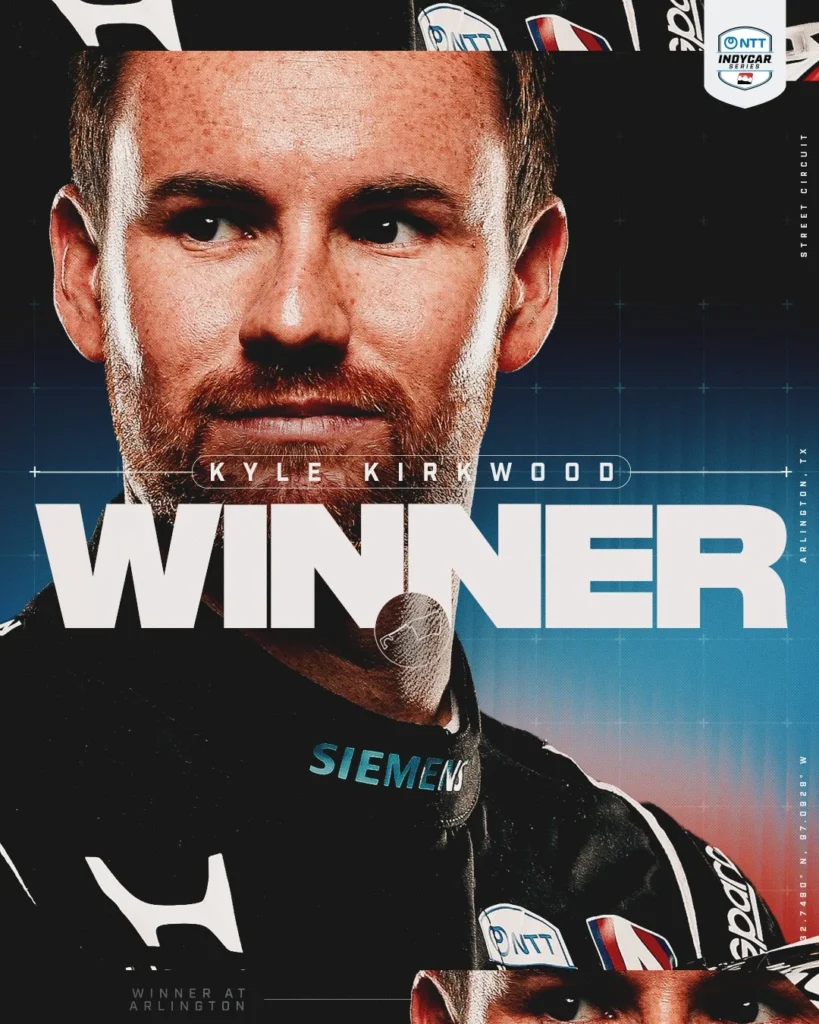
Kyle Kirkwood claimed victory in the 2026 Java House Grand Prix of Arlington, delivering a commanding performance on the new street circuit and fending off championship contender Álex Palou in a race that showcased both Andretti Global’s raw pace and its continuing operational struggles.
Across 70 laps and 191.1 miles through Arlington’s winding street layout, Kirkwood emerged at the front of a tightly contested field, followed by Palou and Will Power. Marcus Ericsson finished fourth, with Pato O’Ward completing the top five. Behind them, David Malukas, Christian Rasmussen, Scott Dixon, Alexander Rossi, and Marcus Armstrong rounded out the top ten.
The result reflected a race defined by aggressive overtakes, chaotic restarts, strategy gambles, and a final classification reshuffle after the checkered flag.
Andretti’s Speed Shines, Despite Pit Lane Struggles
Andretti Global’s pace throughout the weekend was unmistakable. The team secured pole position and placed three cars in the top four by the end of the race, underscoring the outright performance of their package on Arlington’s street layout.
Yet the story of the race quickly became the contrast between Andretti’s speed and its pit execution. Throughout the event, pit stop issues repeatedly threatened to undo the progress made on track.
Even with those setbacks, the team still managed to secure victory and a podium finish. That outcome led many observers to conclude that the cars themselves were simply too fast for operational mistakes to fully derail.
At one point during the race, Kirkwood had built a gap of roughly 25 seconds over Pato O’Ward in fifth before a caution closed the field again, an indication of just how dominant the Andretti machines were during long green-flag runs.
The performance raised an obvious question: if the team can clean up its pit work, the championship fight could become far more dangerous for the rest of the field.
Kirkwood’s Statement Drive
Kirkwood’s victory was not simply the result of strategy or circumstance. It was built around decisive racecraft, particularly a bold overtake on Palou that ultimately swung the race.
The pass, an aggressive dive under braking, became one of the defining moments of the afternoon. While risky, it illustrated the level of commitment required to beat Palou in wheel-to-wheel combat.
In recent seasons, Palou has been nearly impossible to defeat in direct fights at the front. Kirkwood’s willingness to attack aggressively demonstrated a clear shift in approach among the drivers chasing the reigning benchmark of the series.
Beyond the headline overtake, Kirkwood’s drive also showed maturity. Despite minor moments, including a small slide during a restart, he maintained control of the race and executed the closing stages with the composure expected of a title contender.
Power’s Strategy Masterclass
If Kirkwood delivered the highlight drive, Will Power delivered the strategic masterclass.
Power’s race was built around an extended stint on the red tires that allowed him to remain competitive while others cycled through pit sequences. The strategy gave the team flexibility and kept Power firmly in contention for a podium result.
Although Power entered the weekend deep in the standings, the Arlington performance reinforced the idea that he remains a threat whenever strategy and tire management become decisive.
His Phoenix race earlier in the season had already hinted at this form. In Arlington, that pace translated into a podium finish.
Dixon Does Dixon Things
Further down the field, Scott Dixon once again reminded the paddock why he remains one of IndyCar’s most feared strategists on track.
After struggling in qualifying, Dixon recovered to eighth place using a four-stop strategy, a move that allowed him to push aggressively in clear air while others conserved fuel and tires.
The approach reflected a familiar Dixon pattern: sacrificing track position early, then clawing back positions through consistent pace and strategic flexibility.
While questions remain about whether Dixon still has the raw pace to dominate week after week, his racecraft continues to keep him firmly in contention.
A Chaotic Final Restart
The race’s closing moments were defined by confusion and contact in the midfield.
A crash on the final restart, captured on Sting Ray Robb’s onboard camera, was ultimately attributed to Kyffin Simpson, who ran into the back of Nolan Siegel while attempting to position his car for a move before the restart line.
The incident triggered a wave of debate over pay drivers, racecraft, and decision-making in the pack. While early reactions had blamed Siegel, later footage suggested Simpson initiated the contact, highlighting how quickly narratives can shift once additional camera angles emerge.
The crash prevented a true late-race showdown at the front, leaving the race to finish under caution.
Rosenqvist’s Costly Mistake
As if the closing stages were not dramatic enough, the finishing order changed after the checkered flag.
Felix Rosenqvist, who had originally crossed the line in sixth, was dropped to the bottom of the running order after officials determined he illegally overtook David Malukas before the restart line on the final lap.
The decision was harsh but straightforward under the rules. With the race ending under caution and most of the field on the lead lap, a time penalty would not have meaningfully adjusted the order, forcing officials to apply a more severe classification penalty.
The moment illustrated how unforgiving restart rules can be, particularly in chaotic late-race situations.
A Circuit That Delivered
For a brand-new street circuit, the Arlington layout proved unexpectedly entertaining.
Long straights feeding into tight technical sections created overtaking opportunities throughout the field. Drivers had to balance braking precision with traction through the slower sections, producing the kind of calculated risk-taking that fans associate with classic street racing.
The race also reinforced how much momentum the series has gained in 2026. With three races in three consecutive weeks, the championship has maintained a steady rhythm, avoiding the long gaps that previously disrupted early-season momentum.
The Arlington race itself embodied that energy: fast, unpredictable, and full of storylines from front to back.
Final Results Top 10
- Kyle Kirkwood
- Álex Palou
- Will Power
- Marcus Ericsson
- Pato O’Ward
- David Malukas
- Christian Rasmussen
- Scott Dixon
- Alexander Rossi
- Marcus Armstrong
Momentum Builds for 2026
If the Arlington race offered any early lessons about the 2026 IndyCar season, it’s that the field appears more competitive than in recent years.
Andretti’s speed on street circuits, Penske’s strength on ovals, Palou’s consistency on road courses, and the strategic brilliance of veterans like Dixon have created a championship landscape that feels wide open.
For now, however, the headlines belong to Kyle Kirkwood, who delivered one of the strongest performances of his career, proving that even Andretti’s own pit lane chaos was not enough to stop him from conquering Arlington.