

The Month of May is supposed to be the time when INDYCAR locks in its biggest audiences, biggest storylines, and biggest moments. Instead, heading into the Indianapolis road course weekend, the series suddenly found itself dealing with a fresh wave of scrutiny surrounding Push-to-Pass software issues, rule changes, and questions about how much the paddock really knows behind the scenes.
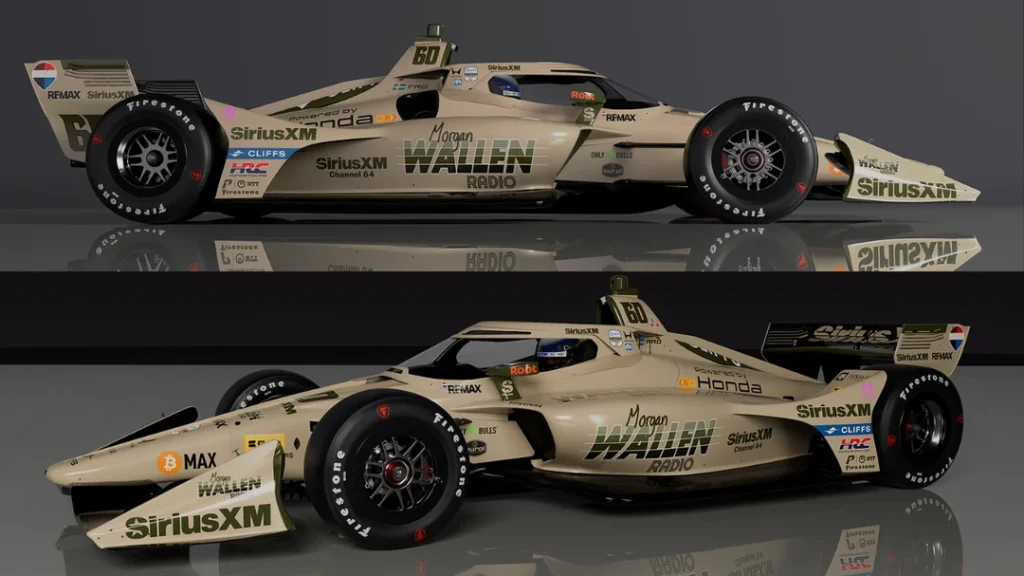
And somehow, in the middle of all of that, Meyer Shank Racing unveiled one of the most divisive liveries of the season.
The week began with Meyer Shank Racing announcing that SiriusXM’s Morgan Wallen Radio would join the team for the Month of May. But instead of excitement over the partnership, much of the reaction immediately focused on the car itself — specifically its muted beige and sand-colored appearance.
While a handful of fans appreciated the unconventional color palette, many felt the design lacked the visual impact expected for the Indianapolis 500. The criticism became especially sharp because INDYCAR fans have grown accustomed to SiriusXM-themed liveries being bold, colorful, and highly stylized. Compared to previous schemes tied to artists and music channels, many described this one as oddly lifeless.
The contrast became a major talking point. Fans compared the car unfavorably to recent special liveries such as the Grateful Dead and Green Day entries, with some describing the Morgan Wallen design as a dramatic downgrade. Others joked that the car looked intentionally bland because it matched the artist attached to it, while several comments focused less on the livery and more on Wallen himself, whose controversies and public image quickly became part of the discussion.
At the same time, there were still pockets of appreciation for the aesthetic direction. Some longtime fans said the sand-colored tones reminded them of Panther Racing’s old National Guard desert camouflage schemes, which remain fan favorites from a previous INDYCAR era. Others argued beige could work well as an accent color, just not as the dominant visual identity for the biggest race of the year.
One thing nearly everyone agreed on, however, was that at least the entry stood out in a field often saturated with blue liveries during the Month of May.
But while the Morgan Wallen car generated debate over aesthetics and sponsorship choices, the far bigger conversation centered around INDYCAR’s Push-to-Pass system.
It started when Bob Pockrass reported that INDYCAR suffered a software issue during the Long Beach race that failed to deactivate Push-to-Pass for much of the initial lap following a restart. Twelve drivers reportedly used the system before it should have been available.
No penalties were issued because the malfunction originated from INDYCAR itself, and because the only overtake completed during the period involved two drivers who both had access to the system at the same time.
Immediately, fans connected the incident to last year’s Penske Push-to-Pass controversy, reopening one of the most polarizing debates the series has faced in recent seasons.
That comparison quickly became the central argument online. Many fans insisted the situations were fundamentally different. In the Penske case, the controversy revolved around modified software configurations that only affected specific Penske entries. Here, the failure impacted the entire field because it originated from INDYCAR’s system itself.
That distinction became the foundation of much of the defense surrounding the Long Beach incident. Fans repeatedly pointed out that if every driver had access to the system, then the competitive imbalance that existed in the Penske controversy simply was not present here.
Others were far less convinced.
The revelation that drivers had access to Push-to-Pass when they should not have immediately fueled conspiracy theories that the series has experienced more software problems than publicly acknowledged. Some fans openly speculated that teams had already learned to monitor the system during cautions and probe whether Push-to-Pass had accidentally become active. Others suggested the latest rule changes were effectively an attempt to eliminate future controversy before another major malfunction embarrassed the series again.
That speculation only intensified when INDYCAR announced a major procedural adjustment shortly afterward: Push-to-Pass will now be available full-time on all road and street courses once cars cross the alternate start-finish line after the green flag.
Under the previous system, Push-to-Pass was unavailable during restart laps. Now, that restriction has effectively been removed.
The timing was impossible for fans to ignore.
To many, the change looked like a direct response to the Long Beach issue. Some viewed it as a sensible simplification designed to eliminate unnecessary controversy and reduce the chance of future software errors. Others saw it as evidence that the system itself may have been more fragile than INDYCAR previously admitted.
The fanbase quickly split into several camps.
One side argued the solution was obvious all along: if Push-to-Pass availability creates confusion, software vulnerabilities, and officiating headaches, simply make it available at all times after the race begins. From that perspective, the previous restart restriction only introduced unnecessary complexity into an already highly technical system.
Others pushed back by pointing out why the original rule existed in the first place. If every driver has Push-to-Pass available on every restart, opening laps could become even more chaotic and aggressive, increasing the risk of divebombs and first-corner incidents. Several fans suggested the series originally wanted to prevent restart situations where only some drivers chose to deploy Push-to-Pass defensively while others attacked.
There were also strategic concerns raised about fuel consumption. Fans noted that unlimited availability does not mean unlimited usage, since Push-to-Pass still burns additional fuel and remains constrained by total time allocation. Drivers who overuse it could compromise fuel strategy later in races.
Meanwhile, another layer of discourse centered around Alex Palou.
Because Palou and Felix Rosenqvist logged some of the highest unauthorized usage totals during the Long Beach malfunction, conspiracy theories immediately exploded online. Some sarcastically joked that Palou’s dominant pace suddenly “made sense,” while others leaned into increasingly absurd speculation that Ganassi had somehow secretly mastered the system.
But many fans pushed back against those claims almost immediately. Several pointed out that if teams were truly manipulating Push-to-Pass usage illegally over long periods, the publicly available usage data would likely expose obvious anomalies. Others emphasized that the Penske controversy involved entirely different circumstances related to hybrid testing software and ECU configurations rather than a race-control communication failure.
That nuance became a recurring theme throughout the discussion. A large portion of the fanbase appeared frustrated not necessarily by the Long Beach malfunction itself, but by the growing complexity of the system and the lack of transparency surrounding how Push-to-Pass is monitored and controlled.
At the same time, there was also clear exhaustion with how quickly accusations of cheating spread whenever technical controversies emerge in INDYCAR. Several fans argued that motorsport has always existed in gray areas where teams constantly probe rules and systems for advantages. Others felt the outrage directed toward individual drivers was misplaced when the malfunction itself originated from race control.
Still, the broader optics remain difficult for the series.
The Month of May is supposed to showcase INDYCAR at its strongest. Instead, the conversation entering Indianapolis has become dominated by software protocols, ECU logic, restart activation rules, and debates over officiating consistency. Even fans attempting to defend the series often did so while acknowledging that the situation looked messy from the outside.
And in a way, that may be the biggest takeaway from the entire week.
What started as a relatively isolated software malfunction quickly spiraled into a referendum on trust, transparency, and competitive integrity within the series. The fact that so many fans immediately assumed there were deeper issues lurking beneath the surface says a great deal about the current atmosphere around INDYCAR officiating and governance.
At the same time, the reaction also showed how deeply engaged the fanbase remains. Even discussions about software architecture, CAN errors, ECU configurations, and restart procedures generated enormous debate because fans care intensely about competitive fairness and technical consistency.
Now INDYCAR heads into Indianapolis with a revised Push-to-Pass rulebook, lingering skepticism from portions of the fanbase, and one very beige race car that nobody can seem to stop arguing about.