

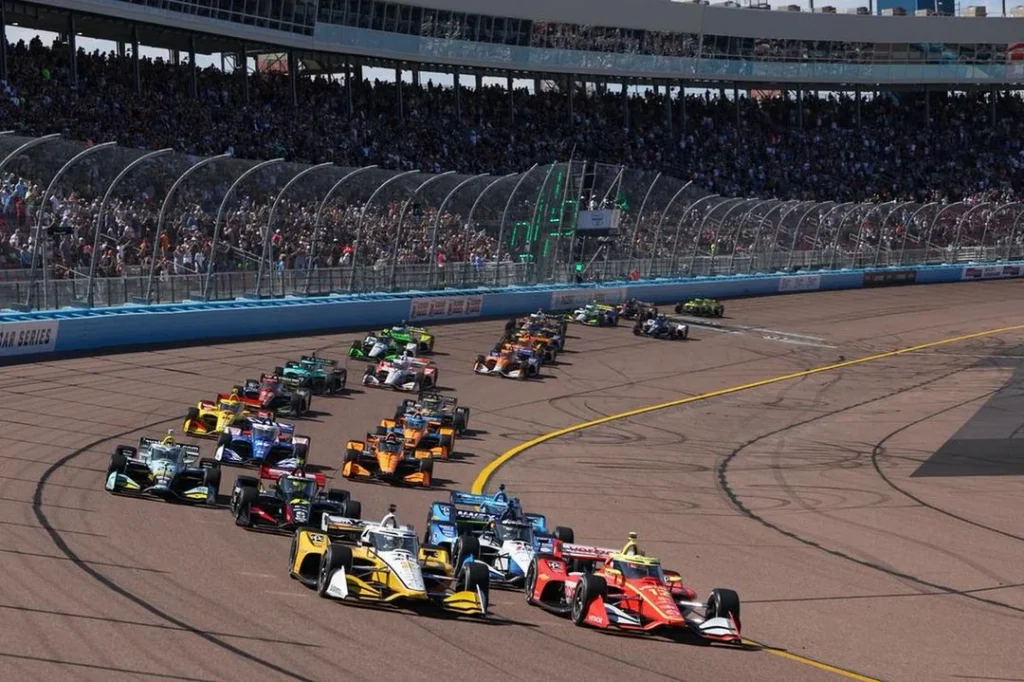
The prospect of more IndyCar and NASCAR doubleheaders raises a bigger question than which track might host the next shared weekend: What should IndyCar’s schedule become?
Joey Barnes’ report, headlined “‘There’s more to come’ as IndyCar and NASCAR leaders eye future doubleheaders,” points toward further cooperation. That creates opportunities to strengthen the oval calendar, introduce each championship to a different audience, and potentially build something more ambitious internationally.
But adding races is only part of the challenge. IndyCar needs a schedule that reflects its competitive variety while giving people compelling reasons to attend. That means weighing the appeal of Michigan against the business case for Detroit, the possibilities of Long Beach against its physical limitations, and international ambitions against the practical demands of getting teams overseas.
A perfect calendar will always depend on what someone values most about IndyCar. A stronger one needs to make those competing priorities work together.
NASCAR Partnerships Need to Benefit Both Sides
The attraction of a shared weekend is straightforward. Two major championships give spectators more racing to watch and promoters more opportunities to keep people at the venue. For IndyCar, a NASCAR partnership could also provide a route to oval events that would be harder to establish independently.
A strong Saturday IndyCar race could be a valuable part of that package. It gives the weekend another headline attraction, particularly if the event can secure a desirable television window. However, these arrangements must make commercial sense for NASCAR as well. IndyCar cannot build its plans around the assumption that another championship will provide access to its venues without considering its own interests. That is especially relevant when discussing tracks whose existing NASCAR weekends already work. Adding IndyCar would bring additional activity, but also more scheduling and operational demands. The relevant question is how much extra value the combined event creates. Shared broadcasting can help align those interests. FOX provides an obvious connection, although a common broadcaster should be treated as an advantage rather than the foundation of IndyCar’s long-term strategy. The calendar needs to remain viable if television arrangements or NASCAR’s priorities change.
Selective cooperation could strengthen IndyCar. Depending too heavily on it would leave too much of the series’ future tied to decisions made elsewhere.
More Ovals Should Also Mean More Variety
The schedule debate becomes more useful when IndyCar’s venues are divided into four categories: street circuits, permanent road courses, short ovals, and superspeedways.
Putting every oval into one category obscures the variety that supporters want to see. Adding another short-oval race does not necessarily satisfy the desire for another superspeedway, just as adding a street circuit does not replace the appeal of a permanent road course. One proposed 20-race balance—five street races, seven road-course races, five short-oval races, and three superspeedway races—illustrates that distinction. A more evenly divided calendar between oval and road/street competition offers another possible approach. Neither formula needs to become a rigid target. The important point is that schedule balance involves more than counting how many races require turning in both directions. Michigan is an obvious candidate within that discussion, with Texas, Chicagoland, Kansas, and Pocono also entering the conversation. Milwaukee offers a different kind of oval challenge and should be evaluated accordingly.
Those possibilities also raise a question about the racing itself. A desire for more ovals can come with a desire for more off-throttle time and greater emphasis on how drivers manage each corner. Venue selection and the kind of racing the cars produce belong in the same discussion, even if changing one does not automatically solve the other.
Michigan and Detroit Are Different Propositions
Pairing IndyCar with NASCAR at Michigan has an immediate appeal: a shared weekend that could also address demand for another superspeedway.
It is tempting to turn that into a simple exchange—remove Detroit and move the race to Michigan—but the two events represent different choices about where and how IndyCar reaches its audience. The case for Michigan centers on the racing and the potential partnership. The case for retaining Detroit needs to be considered through the value of its city presence and the interests of the partners supporting it. Those priorities cannot be settled solely by deciding which layout produces the more appealing hypothetical race. A return to Belle Isle offers another vision for Detroit, but it belongs in the category of possibilities, not established plans. Timing adds another complication. A shared Michigan weekend would have to fit the championships’ calendars and television commitments, with weather also part of any discussion about moving it earlier in the year.
Pocono presents a similar opportunity to imagine a larger combined event, although any proposal would also need to address safety concerns directly. Nostalgia can explain why a venue remains desirable; it cannot complete the case for bringing it back.
Long Beach Is an Attractive Idea With Difficult Trade-Offs
Long Beach makes sense as a talking point because it offers a recognizable event in Southern California. A NASCAR appearance alongside IndyCar would be an attention-grabbing proposition.
The difficulty is fitting it into the weekend. Paddock capacity is central to the discussion. Bringing in Cup would require a credible plan for accommodating another major field alongside the existing program. Replacing IMSA is one hypothetical solution, but that would change the character of the event rather than simply add to it. The headline race slots would also require agreement. IndyCar has a strong reason to protect its Sunday position at Long Beach. Whether NASCAR would accept Saturday is a negotiating question, not something that can be assumed.
Then there is the circuit itself. The tight final hairpin would warrant particular scrutiny when considering a full stock-car field. Suggestions to relocate IMSA to San Diego or Chicago, or to retain the Long Beach circuit for another weekend, demonstrate how quickly an apparently straightforward addition becomes a much larger exercise. Each option introduces another event, another operational decision, or another negotiation.
A shared oval weekend may offer a more direct route to further cooperation. Long Beach deserves consideration, but its name alone does not resolve the practical obstacles.
Two Kinds of Doubleheader, Two Different Purposes
There is an important distinction between IndyCar sharing an event with NASCAR and IndyCar running two of its own races at the same track.
The first can introduce the series to another audience. The second adds a championship round without adding a destination. That distinction matters at Milwaukee. Keeping two races there can help preserve oval representation while the calendar has limited alternatives. Removing one before securing a replacement would reduce the very type of racing that an expanded oval program is intended to support.
However, if IndyCar can establish more successful races at different oval venues, the argument changes. A second Milwaukee race would then need to be weighed against the competitive and geographic variety offered by another track. The sensible sequence is to build those alternatives first. Milwaukee’s placement also exposes a familiar tension between tradition and scheduling strategy. Putting it immediately after the Indianapolis 500 has an emotional appeal. Separating major regional events may offer a different advantage by giving spectators more time between trips and ticket purchases.
Neither consideration should automatically outweigh the other. Tradition has value, but it works best when the event can sustain it.
International Expansion Needs More Than a Wish List
The international possibilities are ambitious: Europe, Mexico, South America, Australia, New Zealand, and Japan all feature in visions of a broader IndyCar calendar.
A combined IndyCar–NASCAR event overseas could be particularly compelling. An American motorsports festival would give spectators a chance to experience both championships while potentially creating shared promotional and logistical opportunities. Barcelona and Spa feature in that discussion, as do destinations in Australia and Japan. Monterrey offers another appealing concept, with the hometown connection to Pato O’Ward and Daniel Suárez providing a clear narrative for a joint event. But a compelling story is only the beginning. A suitable venue, an interested promoter, workable dates, and the resources to deliver the event would all be necessary.
The same applies to a proposed Pacific stretch involving Surfers Paradise, a New Zealand race, and a Japanese venue such as Okayama, Fuji, or Motegi’s oval. These are distinct possibilities with different requirements. They should not be treated as interchangeable options that can simply be placed into open calendar slots. South American proposals involving Buenos Aires, Rio de Janeiro, or Goiânia broaden the possibilities further. They also make prioritization unavoidable if the aim is to keep the championship around 20 races. Travel planning needs similar discipline. Grouping Brazil and Barcelona into one international trip might appear more efficient than making separate journeys from the United States. Whether it actually saves money depends on freight arrangements, timing, and the demands placed on teams—not just the shape of the route on a map.
International expansion could give IndyCar a wider audience. The strongest approach would be to establish events that can endure, rather than pursue the largest possible collection of destinations.
The Indy GP and Finale Debate Reflect Different Priorities
The Indianapolis road-course race is another example of why no calendar will satisfy everyone.
Removing it would free a date for a new venue. Keeping it preserves another competitive event at Indianapolis during May and offers value on its own racing merits. The argument for retaining it does not need to rest entirely on tradition. If the race is delivering the kind of competition the championship wants, that deserves weight alongside the desire to visit somewhere new. A proposed Nashville night-race finale addresses a different priority: how the season ends.
Finishing under the lights on an oval offers a strong visual identity and a sense of occasion. But the appeal of that setting does not establish whether the necessary date and promotional arrangement are available. Nor should the finale be selected primarily to avoid a venue perceived as favorable to one driver. Frustration with the prospect of another Álex Palou-controlled race at Laguna Seca is understandable as a sporting preference, but a championship cannot reasonably design its calendar around preventing someone from excelling.
The finale should offer a compelling event. It cannot guarantee a particular competitive outcome.
Growth Should Preserve the Reasons People Attend
The most important measure of a schedule is whether its events work.
A return to Watkins Glen, another superspeedway, or an overseas street race may look excellent on paper. That does not automatically make it more valuable than an established event capable of attracting and retaining an audience. Fan access belongs in that evaluation, too. Shared weekends should not be judged only by the racing program or the size of the crowd. If accommodating another championship reduces paddock access, that is a meaningful trade-off for an audience that values getting close to IndyCar’s teams and drivers. Some compromises may be worthwhile. They should be deliberate. IndyCar’s opportunity is to use NASCAR cooperation to strengthen selected events, build greater oval variety, and pursue international races with a credible foundation. The goal should be a calendar whose individual rounds justify their place while collectively showing the full range of the championship.
That would be more valuable than a perfect-looking schedule that cannot support itself.