

IndyCar may be heading toward one of its most unusual race weekends of the year in Washington, D.C., but some of the bigger stories surrounding the series are already stretching well beyond the next green flag.
A new street race is drawing enormous promotional attention, even as fans debate whether its simple layout will produce the same kind of chaos that made Markham so memorable. At the same time, Meyer Shank Racing is emerging as one of the most interesting players in the 2027 driver market, with Mick Schumacher, Caio Collet and now Yuki Tsunoda all entering the conversation around its future lineup. Elsewhere, Alexander Rossi and Ed Carpenter Racing continue to find new and increasingly creative ways to have their season go wrong, while one of motorsport’s longest-running print publications has reached the end of the road.
There is a lot happening around IndyCar right now, and much of it points toward a series that is changing both on and off the track.
Washington Is Getting the Full IndyCar Treatment
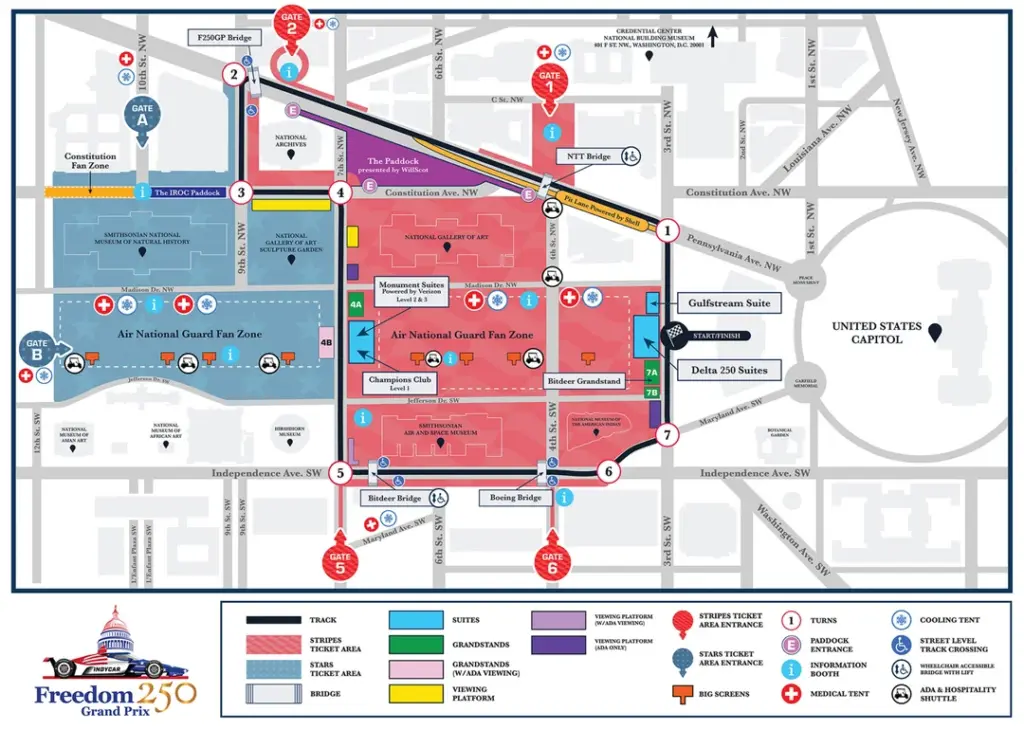
If there was any question about how seriously IndyCar and FOX are taking the upcoming Washington race, the answer appears to be: very.
Promotion around the event has stretched beyond normal race-week advertising. Drivers have reportedly been in New York for media appearances and activations, while even the White House joined in by posting a video of the presidential limousine transforming into an IndyCar accompanied by Talladega Nights voiceovers. The amount of exposure surrounding the event has reportedly approached $500 million. That is an extraordinary amount of attention for a race that has not even happened yet.
The challenge now is turning curiosity into something that actually helps IndyCar beyond one weekend. A high-profile event in the nation’s capital can create casual viewers, sponsors and potential new fans, but only if the racing gives those people a reason to come back. And that is where there is still some uncertainty. The Washington circuit does not immediately look like the type of layout designed to terrify drivers. Its simplicity has already prompted questions about whether there will be enough opportunities to differentiate lap times.
Then again, expectations were hardly sky-high before Markham either. That race ultimately turned into exactly the kind of unpredictable street-course chaos that IndyCar does particularly well, to the point where what initially looked like an awkward new addition to the calendar quickly generated enthusiasm for another visit. Washington may benefit from the same phenomenon.
A straightforward circuit can encourage drivers to search for smaller margins elsewhere. That may mean more aggressive braking, later moves, lockups, overshoots and mistakes. With 147 laps scheduled, even a relatively simple track could become much more complicated once traffic, tire strategy and repeated restarts are layered on top of it. After Markham, it may be worth resisting the temptation to judge an IndyCar street circuit purely from the map. Although, if organizers happen to have an incorrectly constructed hairpin lying around somewhere, it apparently worked pretty well last time.
The race has also produced unusually intense ticket demand. General admission tickets were distributed for free, but fans looking for last-minute access have discovered that unused tickets cannot simply be transferred. Unless ticket holders enter together, there appears to be little opportunity to pass tickets along. That has created the odd scenario where some potential attendees are searching for tickets to a free event while premium hospitality options have reportedly been listed at roughly $3,700 each.
Even the autograph sessions have been adjusted, with a combined format involving portions of the IndyCar and IROC grids split between “Stars” and “Stripes” sections beginning at 11:25.
It all makes the weekend feel less like another street race and more like a large-scale motorsport showcase.
Whether the actual racing can live up to the promotion is now the important part.
Meyer Shank Suddenly Has Too Many Interesting Options
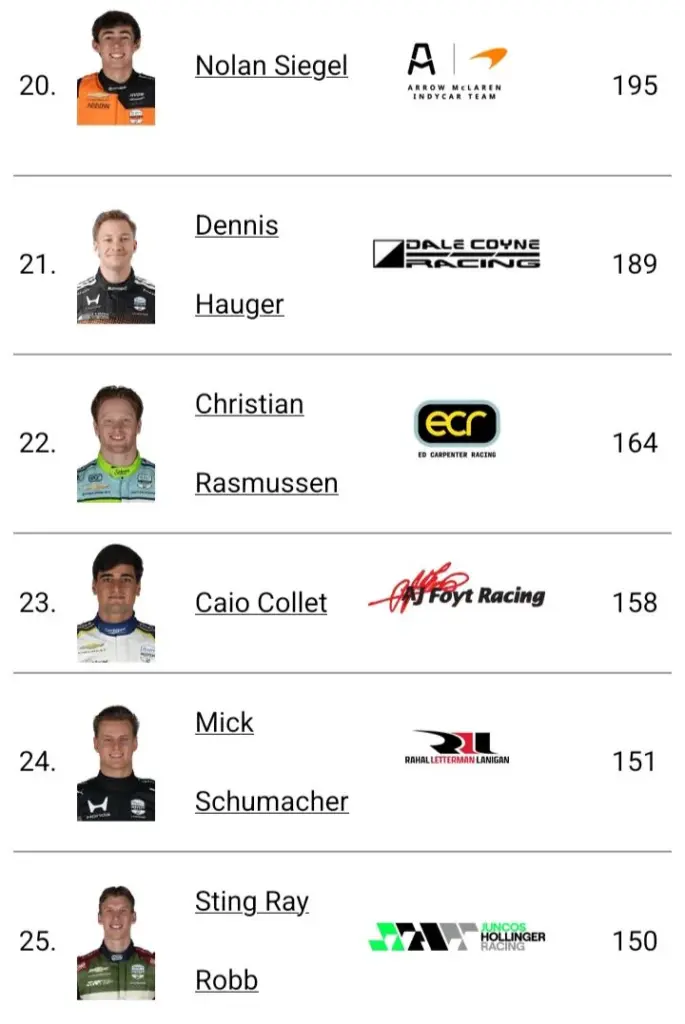
The 2027 IndyCar driver market is becoming particularly intriguing around Meyer Shank Racing.
Much of the recent discussion has centered on the No. 66 seat, with Mick Schumacher and Caio Collet both viewed as potential candidates. Now Yuki Tsunoda has reportedly entered the conversation. The F1 veteran is in talks regarding a potential 2027 IndyCar seat with Meyer Shank, creating an unusually complicated comparison between drivers whose strengths, experience and commercial appeal are all very different.
And it makes the debate around this year’s IndyCar rookies even more relevant. Dennis Hauger currently leads that group with 189 points, followed by Collet with 158 and Schumacher with 151. Those numbers alone do not tell the entire story.
Hauger has arguably made the strongest case for another season. There has been enough pace and enough progress to suggest that he deserves additional time, particularly given the limitations surrounding his current situation. Collet is perhaps the more fascinating evaluation. He has shown raw speed, occasionally enough to make people take notice even when compared with more experienced drivers. The issue is that the speed has arrived alongside mistakes and incidents.
That creates the classic racing-development dilemma. It is generally easier to teach a quick driver how to stop crashing than it is to teach a consistently slow driver how to become genuinely fast. The problem is that philosophy becomes considerably less romantic when somebody has to pay for all the damaged race cars.
Still, Collet has demonstrated enough underlying pace that dismissing him after one season would feel premature. His ceiling remains unclear, but that is partly the point. There is still something worth investigating. Schumacher is a different case entirely. His 151 points place him behind both Hauger and Collet, but evaluating his IndyCar season requires balancing his rookie status against his enormous previous experience.
He arrived after winning Formula 2, competing in Formula 1 and racing in WEC. That naturally creates expectations that would not necessarily be applied to somebody progressing directly from Indy NXT. At the same time, IndyCar presents its own learning curve. Hauger and Collet had already competed on many of these circuits through the series’ feeder system. Schumacher entered without that same IndyCar-specific familiarity.
His season has also included injury complications, and Rahal Letterman Lanigan Racing has hardly provided the easiest environment in which to establish a clear baseline. Perhaps the most interesting part of Schumacher’s campaign has been his oval performance. While his road and street-course adaptation has remained uneven, he has shown enough speed on ovals to become a particularly logical candidate if Meyer Shank truly prioritizes somebody already comfortable with that side of IndyCar.
That could matter substantially in a direct comparison with Tsunoda.
Tsunoda Versus Schumacher Is a Fascinating IndyCar Question
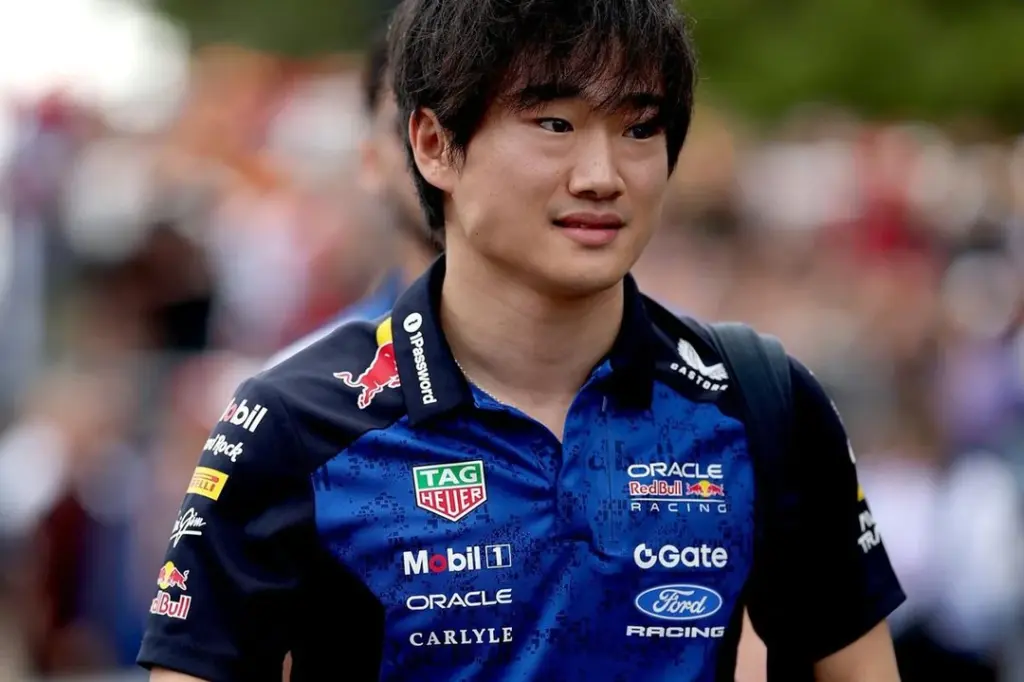
Tsunoda creates almost the inverse argument.
His street-circuit racecraft is arguably the more obvious strength, while his ability to adapt to ovals would remain an unknown. Schumacher has already demonstrated that he can be quick on them. Tsunoda, meanwhile, would bring his own commercial advantages. He has personal sponsors and longstanding Honda connections, making him an especially interesting possibility for a Meyer Shank organization increasingly associated with Honda.
There has also been speculation around Honda’s future charter positioning, although that does not take effect until 2028 and has been associated with other future driver possibilities as well. For 2027, the decision may ultimately be much simpler. Which driver gives Meyer Shank the best combination of funding, speed and adaptability?
Schumacher would not necessarily be competing against Tsunoda purely on lap time. He would be competing as an entire package. The same applies to Tsunoda.
That is an important distinction because the current IndyCar driver market cannot really be analyzed using the word “deserves” alone.
Seats are not distributed according to a standings table. Funding matters. Sponsors matter.
Commercial value matters. Continuity matters. A driver can be talented enough for IndyCar and still lose a seat to somebody who brings a stronger financial package. Conversely, a driver with significant backing does not automatically lack merit simply because money helped open the door.
That tension is particularly visible around Meyer Shank. Marcus Armstrong had previously brought funding but is being moved into a different role within the lineup, while the organization has shown a willingness to pay established drivers when it believes doing so is worthwhile. That means the eventual No. 66 decision could reveal quite a lot about what MSR actually values.
If Schumacher gets it, oval readiness, development potential and his broader commercial package likely mattered. If Tsunoda gets it, Honda connections, established F1 experience, street-course ability and his own sponsorship network may have tipped the equation. If Collet gets it, Meyer Shank would effectively be betting on raw IndyCar-specific potential over international résumé. And there may still be other possibilities.
What increasingly appears unlikely is that the decision will be made simply by looking at who has the most points.
Sting Ray Robb Accidentally Makes the Rookie Debate More Interesting
The standings have also produced one particularly awkward comparison.
After Sting Ray Robb finished 11th at Markham while Collet and Schumacher crashed, he moved surprisingly close to both drivers in points. That does not necessarily make the comparison flattering for Robb. If anything, it demonstrates how misleading the standings can become when used without context.
Robb has now had several seasons in IndyCar, and there is little indication that his underlying pace has developed dramatically. He can occasionally benefit from attrition or strategy, and he has produced at least one legitimate top-10 result, but those moments have not translated into the kind of sustained performance that suggests a major breakthrough is coming. Hauger and Collet, by contrast, have already shown flashes of speed that imply their best IndyCar performances may still be ahead of them. That does not mean every rookie deserves unlimited time.
At some point, potential has to become results. But there is a meaningful difference between a driver still discovering his ceiling and one who may already have reached it. Collet’s biggest task is learning to remain within the limit often enough to capitalize on the speed he clearly possesses.
Hauger simply needs another opportunity to continue developing. Schumacher has to demonstrate that the promise seen on ovals and in isolated moments can become consistent across an entire IndyCar season.
And all three are doing this while navigating a marketplace where funding may matter just as much as any of those improvements.
Rossi’s Season Somehow Finds Another Anvil
If there is one team that might be happy to stop talking about 2026 entirely, it is Ed Carpenter Racing.
Alexander Rossi’s latest setback at Markham perfectly summarized the season. Álex Palou moved alongside Rossi at the hairpin, contact followed and Rossi suffered a front-right puncture. The frustrating part was not necessarily the contact itself.
Similar moves had occurred throughout the race without producing punctures. For Rossi, naturally, this one did. It was another bizarre entry in what has started to feel like an endless collection of ECR misfortune.
Earlier in the year, the cars were literally catching fire. Now at least they are apparently finding more conventional ways to ruin races. Progress.
There was little reason to blame Palou. The move looked significantly different from incidents involving drivers arriving far too deep into corners and using another car to complete the maneuver. Palou was sufficiently alongside Rossi that calling it a racing incident was reasonable, and race control ultimately did not issue a penalty. The puncture was simply the cruel part.
Rossi’s onboard made that particularly obvious, which makes IndyCar’s initial social media description of the incident even funnier. The series reportedly posted the video claiming Rossi had suffered a lockup. Rossi responded that he thought they were finished with fake news.
The post was subsequently deleted. Rossi may not be collecting many breaks this season, but at least the sarcasm remains fully operational. The moment also renewed discussion around IndyCar’s rotating onboard cameras.
The concept theoretically allows viewers to see more of what is happening around the car. In practice, there are moments when the camera seems determined to rotate away from the exact thing viewers actually want to see. When damage occurs at the front of the car, spinning the camera toward the rear is not particularly helpful.
A fixed forward-facing view — or eventually a better 360-degree solution — would often provide more useful information.
ECR’s Problems Are Bigger Than One Puncture
The Rossi incident would be easier to laugh off if it existed in isolation.
It does not. ECR’s two cars currently sit 17th and 22nd in the standings, with one of them only six points ahead of Collet around the Leaders’ Circle cutoff. That is not simply bad luck.
There have certainly been circumstances outside the team’s control, and Rossi’s puncture at Markham qualifies. But ECR has also created enough of its own problems that the season cannot be explained entirely through misfortune. That combination is what makes the year feel so brutal.
When a team is already struggling, even genuine racing incidents begin to feel like part of a larger pattern. For Rossi especially, it is becoming difficult to identify the last stretch where things consistently went his way.
The fact that fans can jokingly trace his supply of good fortune all the way back to the 2016 Indianapolis 500 probably says enough.
RACER Magazine Reaches the End After 34 Years
While IndyCar prepares for one of its most heavily promoted events, the motorsport media landscape is losing something far more traditional.
David Malsher-Lopez announced that RACER Magazine has been discontinued immediately after 34 years and 341 issues. The decision also ends Malsher-Lopez’s latest full-time chapter with Racer Media & Marketing, although he indicated that occasional contributions to Racer.com remain possible. His final assignment as a full-time employee was covering IndyCar at Markham.
For longtime motorsport readers, the news carries a particular weight. Print racing magazines once occupied a central place in how fans followed the sport. Now simply surviving for 34 years feels remarkable.
The decline did not happen because people suddenly stopped caring about motorsport journalism. The way people consume it changed. Readers who once waited for a magazine to arrive now refresh websites several times per day. Social media provides immediate news. YouTube gives reporters direct access to audiences. Long-form analysis still exists, but there is no longer a requirement that it be printed, bound and physically shipped to somebody’s mailbox.
That makes a publication like RACER increasingly difficult to sustain. One explanation offered around the magazine’s decline was that physical distribution became significantly harder as bookstores and grocery stores reduced the space devoted to magazines. Rack placement reportedly provided much of the publication’s revenue, meaning subscriptions alone were never going to fully replace shrinking retail circulation. Bundling the magazine with other RACER products helped extend its life, but ultimately there are limits to how long a business can subsidize declining print economics.
The website appears to remain separate from the print decision, and there is no indication from the announcement that Racer.com itself is shutting down. That distinction matters. This is not necessarily the end of RACER.
It is the end of RACER Magazine. Still, something will be lost. A website can publish the same words, and in many cases can publish more of them.
But a physical magazine becomes an archive in a way a homepage rarely does. You can keep it on a shelf. You can rediscover an issue years later.
You can flip through an old race preview and immediately remember what the sport felt like at that moment. For the readers who continued subscribing partly out of nostalgia — and sometimes partly because they wanted to support the broader operation — that experience is difficult to replace. The comparisons to the disappearance of SPEED are understandable. Different circumstances, same feeling.
Another familiar piece of American motorsprt culture has disappeared.
IndyCar Is Moving Forward, Whether Everyone Is Ready or Not
Taken together, this week’s stories paint an interesting picture of where IndyCar currently stands.
Washington represents the modern growth strategy: huge promotion, mainstream exposure, social media activations and an event designed to reach people who may not ordinarily watch the series. The 2027 driver market represents the modern economic reality: performance still matters enormously, but so do sponsorship, manufacturer relationships and commercial value. Rossi and ECR represent the timeless racing reality that sometimes a season simply refuses to cooperate.
And the end of RACER Magazine represents what the sport is leaving behind as its media ecosystem changes. None of those stories exists completely independently. IndyCar wants more viewers.
Teams need more sponsors. Drivers need stronger commercial packages. Media organizations need audiences that increasingly consume racing through phones, websites and video rather than printed pages.
The entire ecosystem is evolving at once. Washington may provide a glimpse of where IndyCar hopes to go next. Meyer Shank’s eventual driver decision may show what teams believe they need to compete there.
And somewhere, after 341 issues, one fewer motorsport magazine will be waiting in the mailbox to explain what happened afterward.