

IndyCar has spent much of the past several seasons searching for momentum. Recent indicators suggest the series may finally be finding it, both in the United States and abroad.
A combination of strong television ratings for the Phoenix race, growing international viewership in Brazil, and continued debate surrounding the upcoming Freedom 250 in Washington, D.C. highlights a championship that remains firmly in the spotlight. While the conversations around IndyCar can be contentious, the numbers increasingly point to a sport attracting attention across multiple fronts.
Phoenix Delivers Strong Television Audience
The latest evidence of that momentum came with 1.247 million viewers tuning in for the Phoenix race on a Saturday afternoon, a figure that exceeded many expectations for the time slot.
Observers widely viewed the number as a significant success. Many believed that anything above roughly the mid-hundreds of thousands would have been a solid result, making the final total particularly encouraging.
The timing of the race likely helped. Early spring represents a relatively favorable window in the American sports calendar: the NFL season is finished, the Olympics are not competing for attention, and the NBA and NHL playoffs have not yet begun. That positioning can give motorsport broadcasts more room to capture casual viewers.
For IndyCar, the result continues a run of strong numbers early in the season, with fans noting the significance of seeing back-to-back races surpassing one million viewers. It also represents the strongest Saturday audience the series has recorded in several years, comparable to the Texas race in 2020 that drew roughly the same viewership.
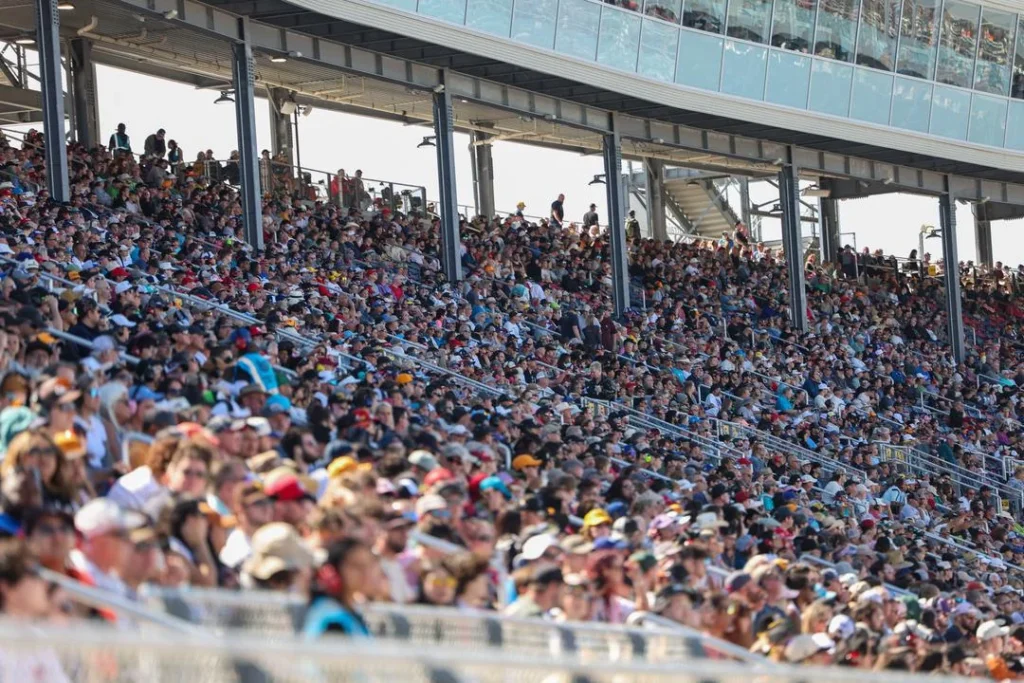
Beyond television, fans attending the event reported healthy attendance in the grandstands, describing sections that felt full throughout the race. Combined with the strong broadcast numbers, the Phoenix weekend created the sense that the event resonated both in person and on television.
Momentum from Scheduling and Promotion
Some observers credited IndyCar’s improved momentum to scheduling decisions. Racing again quickly after the season opener, rather than leaving weeks between events, appears to have helped maintain audience interest.
Promotion also played a role. Viewers noted that advertisements for upcoming races were appearing during other broadcasts, including international sports coverage. In particular, the upcoming Arlington race has received heavy promotion, with advertisements appearing frequently during other sporting events.
In the Dallas–Fort Worth region, local television stations have been actively promoting the Arlington event. Multiple broadcasters have covered the race extensively, treating it as a major regional happening and helping build anticipation across the market.
This level of local promotion has stood out. Observers noted that several major television stations in the area have been independently highlighting the event despite competing network affiliations, suggesting a broader push to embed the race within the region’s sports calendar.
The partnership behind the Arlington race, linking major local sports organizations with the event, has also sparked speculation that similar collaborations could lead to future races in other cities.
The Oval Debate Continues
The Phoenix result also revived a long-running debate within IndyCar circles: the role of oval racing in driving audience interest.
Some fans believe oval races are inherently easier for viewers to follow on television. The ability for cameras to zoom out and capture multiple cars in a single frame can make strategy and position changes clearer than on road or street circuits.
Others argue that ovals also tend to produce more overtaking opportunities, particularly when multiple racing lines develop across the track surface. Those factors, in their view, can create more dynamic racing.
Not everyone agrees with that assessment. Critics counter that there is little concrete evidence that oval events consistently deliver higher ratings, suggesting that the perceived advantage may be overstated within online communities.
Regardless of the explanation, the Phoenix race appears to have delivered both a compelling on-track show and a strong audience response.
Brazil Emerges as a Key International Market
IndyCar’s growing viewership is not limited to the United States.
In Brazil, the opening two races of the season attracted an estimated 550,000 viewers for St. Petersburg and roughly 700,000 for Phoenix, effectively doubling the series’ average audience in the country compared to the previous year.
For many observers, the size of the Brazilian audience came as a surprise. While the country has long had ties to IndyCar through its drivers, the scale of the television numbers highlighted just how significant the market can be.
Brazil’s connection to the championship stretches back decades. Since Emerson Fittipaldi began racing full-time in American open-wheel competition in the mid-1980s, Brazilian drivers have been a regular presence in the series. That continuity helped cultivate a dedicated fan base that has persisted across multiple eras of the sport.
Broadcast distribution also appears to be playing a major role in the recent increase. The championship recently returned to a larger Brazilian network that provides far broader national reach than the smaller broadcaster previously carrying the races. Because cable television penetration remains relatively limited in Brazil, access to free-to-air channels can dramatically expand the potential audience.
With wider availability, IndyCar races have climbed into the upper tier of programming on the network’s daily viewership rankings, an encouraging sign for the series’ international profile.
The timing of IndyCar races may also help attract Brazilian viewers. Many events occur during hours that are relatively convenient for South American audiences, making the series easier to follow than some other international championships.
Renewed Interest in a Brazilian Race
The surge in Brazilian viewership has naturally revived speculation about a potential return to racing in the country.
Fans have pointed to multiple possible venues, including Interlagos in São Paulo and the Autódromo Ayrton Senna circuit in Goiânia, which has undergone significant upgrades in recent years. Both locations have been discussed in connection with future events, though no concrete plans have materialized.
Others have expressed nostalgia for Brazil’s distinctive oval tracks, particularly the trapezoid-shaped circuit that once hosted memorable IndyCar races before being demolished.
Whether or not a race returns to Brazil, the strong television numbers demonstrate that the country remains one of IndyCar’s most historically important international markets.
Freedom 250 Debate Shows IndyCar’s Polarizing Side
While ratings and viewership growth provide reasons for optimism, IndyCar’s off-track discussions remain as lively as ever.
The announcement of the Freedom 250, a race planned for Washington, D.C., has sparked significant debate among fans. Some see the event as an exciting opportunity to stage a race in a highly visible national setting. Others worry that the circumstances surrounding the event could create political controversy.
Despite the heated arguments, many longtime followers believe the reaction is unlikely to have lasting consequences for the series.
IndyCar has experienced numerous controversies over the decades, from internal splits to controversial races, and yet the championship has consistently endured. Because of that history, many expect the debate around the Freedom 250 to generate headlines and online discussion before eventually fading as the season progresses.
For some fans, the bigger issue is simply expanding the schedule. They argue that the series should focus on adding more races overall rather than centering attention on one-off events.
A Sport That Continues to Draw Attention
Taken together, the recent developments paint a picture of a championship that is still capable of commanding attention.
Strong television numbers in the United States, a growing international audience in Brazil, and a highly visible upcoming event in Washington have all kept IndyCar in the conversation.
The discussions may be divided, sometimes sharply so, but they also underscore something important: people are paying attention.
And for a series that has spent years trying to rebuild momentum, that attention may be the most valuable signal of all.