

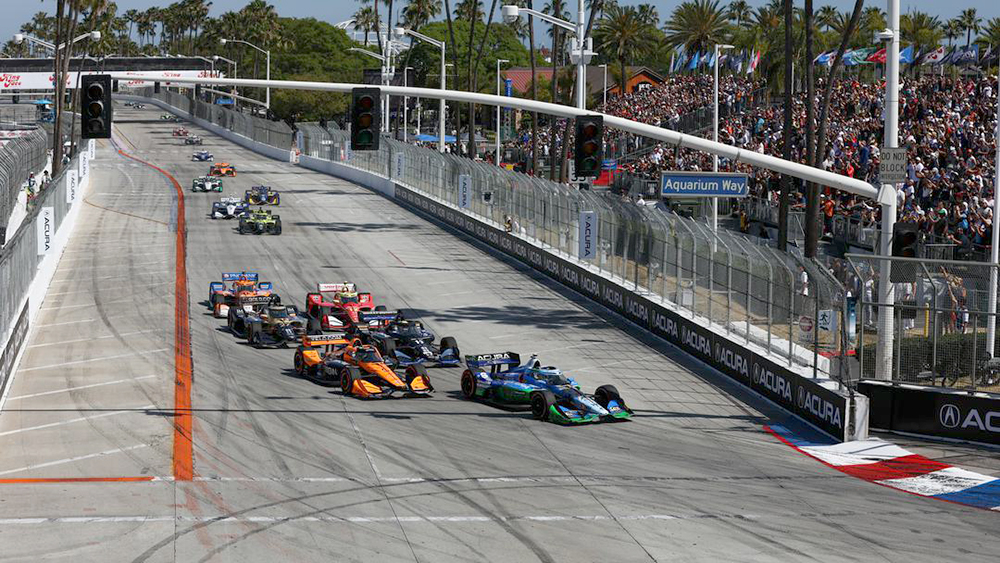
IndyCar’s on-track product is facing an increasingly clear—and increasingly urgent—problem. What drivers are experiencing in the cockpit is now aligning almost perfectly with what fans are seeing from the outside: races, particularly on road and street circuits, are becoming harder to fight through, harder to pass in, and ultimately harder to animate.
At the center of it is a combination that was always expected to be delicate: added hybrid weight and evolving tire behavior. But as recent races have shown, the interaction between the two is doing more than just subtly shifting racecraft—it’s fundamentally reshaping how races unfold.
The “Yo-Yo Effect” Killing Overtakes
The issue, as described, is not a lack of driver skill or willingness to attack—it’s an aerodynamic and mechanical ceiling that prevents drivers from even getting close enough to attempt a move.
The current dynamic creates a consistent pattern: drivers can close to within roughly six to seven tenths of a second, but that’s where the system breaks down. At that distance, turbulent air and added weight begin to overwork the tires, causing overheating and surface-level sliding. Instead of continuing to close, drivers are forced to back off, allowing temperatures to recover—only to repeat the cycle.
The result is what can best be described as a “yo-yo effect.” Cars oscillate between closing and retreating, but never actually reach the gearbox of the car ahead. Without that final step, overtaking becomes almost impossible.
Recent race scenarios have reinforced this limitation. Even when one driver is saving fuel or another is on a preferred tire strategy, the expected pace advantage isn’t translating into passes. The ceiling is structural, not situational.
Tire Conservatism: From Chaos to Stability—and Now Stagnation
Compounding the issue is a dramatic shift in tire philosophy.
After a series of tire delamination concerns in the previous season, Firestone has taken a far more conservative approach to compound selection. The result is a tire that is more durable and predictable—but significantly less dynamic.
Where alternate compounds previously degraded rapidly—sometimes within just a handful of laps—the current versions can now last an entire stint. That durability removes a key overtaking lever: performance delta.
Without aggressive degradation, there’s less strategic divergence. Without divergence, there’s less field spread. And without that spread, the already fragile ability to follow closely becomes even less useful.
There’s a growing consensus that the series may have overcorrected. The intent was stability and safety, but the side effect has been a flattening of race dynamics. Even observations that tire performance remains relatively stable deep into stints—well past 20 laps—reinforce the idea that variability has been engineered out of the system.
A Car Outgrowing Itself
Underpinning all of this is a more structural critique: the DW12 chassis is being asked to do more than it was ever designed for.
Over time, the car has absorbed multiple major additions—most notably the aeroscreen and now the hybrid system. Each has added weight and complexity, and more importantly, altered the car’s balance and sensitivity.
The prevailing view is not that any one addition is flawed in isolation. The aeroscreen is here to stay. The hybrid system is effectively non-negotiable given manufacturer expectations. But together, they have pushed the chassis beyond its optimal operating window.
Weight distribution is now a recurring concern. Drivers are dealing with a platform that is heavier, more temperature-sensitive, and less forgiving when following closely. The result is a car that struggles in exactly the scenarios that produce compelling racing.
There’s also a broader acknowledgment that this is the natural lifecycle of a long-serving chassis. What once delivered consistently strong racing—through multiple aero configurations—has gradually lost its adaptability under new technical demands.
Fewer Mistakes, Fewer Cautions, Fewer Opportunities
An unintended consequence of this evolution is a reduction in race interruptions.
Modern IndyCar reliability is high, and driver error rates are low. But crucially, many cautions historically came from side-by-side racing—attempted overtakes that went wrong. With fewer overtaking attempts, those incidents naturally decline.
Layer on additional factors—like the introduction of onboard starters reducing stall-related cautions—and races are increasingly running uninterrupted.
While cleaner races might seem beneficial on paper, they remove another key variable: unpredictability. Without cautions to bunch the field or reset strategies, races can settle into extended, static runs where track position becomes nearly absolute.
The Hybrid Trade-Off
Despite the criticism, there’s an important counterweight: the hybrid system itself is not optional.
Manufacturer involvement—particularly from Honda—has been closely tied to hybridization. Without it, the series risks losing critical support, which would create far larger structural challenges than on-track product concerns alone.
This reality reframes the issue. The hybrid isn’t simply a performance variable—it’s a business necessity. That makes removing it unrealistic, even if some believe the racing would immediately improve without the added weight.
Instead, the focus shifts to mitigation: how to adapt the rest of the package to coexist with the hybrid rather than fight against it.
Why Some Drivers Are Thriving Anyway
Interestingly, while the system is widely viewed as restrictive, it hasn’t impacted all drivers equally.
There’s a strong belief that the current package places a premium on tire management—more than ever before. With overheating being the primary limiting factor, drivers who can operate within that narrow window gain a disproportionate advantage.
That has led to suggestions that certain front-runners have adapted faster—or that the new demands align more naturally with their driving style. The hybrid era hasn’t just changed racing—it’s reshaped the competitive hierarchy by emphasizing a different skill set.
Short-Term Fixes vs. Long-Term Solutions
In the immediate term, most solutions revolve around tires.
A softer compound with higher degradation could reintroduce variability and create overtaking opportunities through pace differentials. Even modest increases in tire fall-off could disrupt the current equilibrium.
But there’s also recognition that tires alone may not be enough. Alternative ideas—adjusting race formats, limiting tire allocations, or even introducing aerodynamic tweaks—have surfaced as potential levers to improve racing within the current constraints.
Still, these are incremental adjustments to a broader structural issue.
The Clock Is Ticking on the New Car
Ultimately, the clearest solution is also the most significant: a new chassis.
There’s widespread agreement that the next-generation car must be designed from the ground up to handle the realities of modern IndyCar—hybrid systems, aeroscreen weight, and all. It’s not just about reducing weight, but about optimizing distribution and drivability for a package that drivers can consistently race with.
Crucially, there’s little appetite for delays. The current trajectory has made the new car less of a future upgrade and more of an urgent necessity.
A Critical Moment for the Series
The timing adds another layer of pressure.
With increased visibility and promotion around the series, the gap between expectation and on-track product becomes more consequential. High-profile races, especially those tied to major events or broader audiences, carry the risk of showcasing the sport at a moment when its racing limitations are most apparent.
That raises the stakes for getting the balance right—not just eventually, but soon.
The Bottom Line
IndyCar’s current challenge isn’t rooted in a single failure. It’s the cumulative effect of technical evolution outpacing platform design.
The hybrid system, heavier cars, and conservative tires have combined to create a racing environment where drivers can’t get close enough to race. Without proximity, there’s no overtaking. Without overtaking, there’s little tension. And without tension, the product begins to flatten.
The path forward is clear in principle but complex in execution: rebalance the relationship between car, tire, and weight—or accelerate the arrival of a platform built to handle all three.
Until then, the “yo-yo” may remain the defining feature of IndyCar’s hybrid era.