

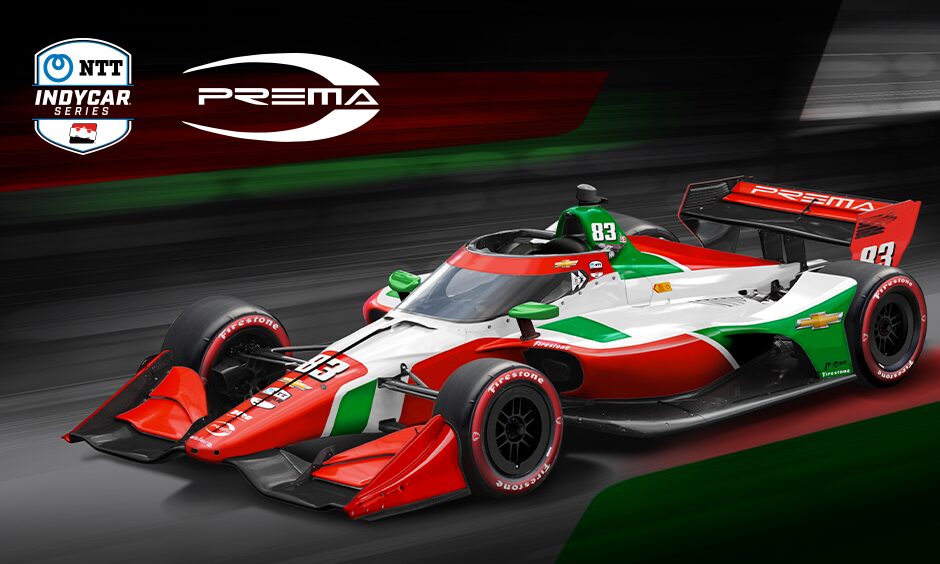
Two separate developments have sharpened the same underlying concern around IndyCar’s immediate future: the field is not exactly bursting at the seams.
On one side, Prema Racing is still searching for new ownership or an investor and is not fully done with IndyCar yet. On the other, Andretti Global’s latest update suggests the team is no longer pursuing the fourth Indy 500 car that had been floated earlier in the season. Taken together, the result is a paddock conversation that feels less like speculation about who might join the Indy 500 grid and more like a debate over whether the series can comfortably get to its traditional number at all.
The Andretti update was straightforward enough. While Dan Towriss had mentioned the possibility of a fourth car earlier this season, that effort now appears off the table, at least for this year’s Indy 500, with the team instead focusing on its current three-driver lineup now that the extra entry will not be for Colton Herta. The immediate reaction was obvious: if Andretti is out on a fourth car, then 34 entries suddenly looks highly unlikely.
That matters because a great deal of the surrounding conversation has not really been about who could win the race, but whether there will be enough extra cars to preserve the kind of drama the event is supposed to generate before the green flag even drops. The sense emerging from the discussion is that 34 cars was the minimum threshold for genuine tension, and once that possibility fades, so does much of the intrigue around bumping. A 34-car field would already feel thin to many, because it would mean only one driver goes home. Anything at or below 33 shifts the conversation away from qualifying jeopardy and toward basic field-filling.
That is why the Andretti decision was met with frustration beyond just the loss of one entry. There was disappointment because it likely ends hopes for a meaningful Bump Day this year, and perhaps even for an over-subscribed field at all. The mood was not simply that a fourth Andretti would have been interesting, but that it may have been one of the few realistic paths to keeping pre-race elimination relevant.
That frustration also spilled into driver wish-casting. The absence of an extra Andretti seat triggered immediate lament over opportunities that now likely disappear with it, whether that means Katherine Legge, Linus Lundqvist, or some other late-arriving one-off entry. There was a sense that if Herta is not doing it, then the appetite to create a fourth car for someone else is not nearly as strong. Even the sponsor logic was read through that lens. The assumption from some was that the sponsorship would likely have been internal to the TWG orbit anyway, making this less about scrambling for outside backing and more about whether the organization wanted the car badly enough for someone other than Herta. That is what gave the decision its sting: it was interpreted less as impossibility and more as preference.
At the same time, this Andretti update landed in an environment already saturated with concern about how difficult it has become for non-full-time or extra entries to exist in IndyCar at all. The repeated mention of a third engine manufacturer was not random nostalgia. It reflected a broader view that one of the biggest obstacles to one-offs is now engine supply. The number 34 itself was discussed less as a target and more as a constraint, with the suggestion that 34 is effectively the present engine cap. That turns every hypothetical extra entry into a game of musical chairs.
Some still believe that for the right names, exceptions could be made. Former Formula 1 drivers, current F1 names, or a driver like Katherine Legge were viewed as the kind of special cases who might convince the system to stretch. But even that optimism was narrow and conditional. The broader point remained that a healthy Indy 500 entry list should not depend on whether a promoter deems a driver famous enough to justify finding another engine.
That same structural anxiety runs directly into the Prema story, which feels even more precarious.
Prema Racing is still looking for new ownership or investment, and the language around that situation has become increasingly bleak. The framing now is not about how to keep a two-car program viable for the full season. It is about whether there is a buyer, whether there is enough staff left to do anything meaningful, and whether the team can even bridge the gap to the next event that matters. Some read the situation as effectively over already, with only the possibility of an Indy 500 appearance left on the table. Others still hold out hope that Prema can survive as something, even if it is reduced to a much smaller operation. But the prevailing tone is grim.
That pessimism is partly rooted in timing. Earlier, the expectation had reportedly been that the team could make it to Long Beach. Now, discussion has shifted toward whether it can make it to the 500. That alone reads as a retreat. When a team’s survival horizon starts moving from “next race” to “maybe the marquee race,” it becomes hard to argue that stability still exists.
There was also a practical layer to the discussion that made the story feel even more severe. One view held that the team has the staff on hand to run one car if it can find the cash, especially if a pay driver can help fund the effort. Another view pushed back sharply, arguing that the organization has already been stripped down to a bare-bones crew and that even a successful sale would still leave the new owners scrambling to assemble enough people to get to Long Beach. That difference of opinion was revealing in itself. Even the more optimistic version of Prema’s future was not about continuity or competitiveness. It was about finding just enough money and manpower to field a single car.
The financial read on the situation was equally unforgiving. There was little sympathy for the idea that performance alone might determine anything. The blunt interpretation was that funding drives these seats, full stop. That was extended beyond Prema to the wider paddock as well. Pay drivers were described not as some shocking exception, but as a sad necessity in modern racing. The broader implication was that if Prema survives in any form, it will likely do so only because someone arrives with funding attached, not because the sporting project itself is strong enough to stand on its own.
At the same time, there was no consensus on what exactly has made selling Prema so difficult. One line of argument was that the lack of charters has badly damaged the team’s attractiveness to buyers and investors. In that reading, the problem is not that charters caused the team’s financial distress, but that they now reduce the upside for anyone considering buying in. Without a charter, there is less protection for the investment, less certainty in the long-term value of the entry, and less access to the financial ecosystem around the series. That view was bolstered by claims that potential interest existed, including rumors that Trackhouse had been interested, but that the lack of charter certainty turned the deal into a non-starter.
Another view rejected that almost entirely. In that version, charters are being made into a scapegoat for a much more basic problem: Prema’s main financier went under, the team struggled to chase sponsorship, and the asking price is too high. According to that interpretation, the team could sell if it were willing to accept what the market thinks it is worth. The real obstacle is that Prema wants too much money, perhaps because it is trying to recover losses from an IndyCar program that has become financially painful. From that perspective, the charter debate misses the point. The business problem came first, and it would still exist either way.
The sharpest version of that argument insisted that the lack of charters had nothing to do with the original collapse. A financier getting in over their head would not have been rescued by leader circle money or future charter stability. IndyCar did not cause that. But even some who agreed with that premise still arrived at a different conclusion about the present. They accepted that charters did not create the crisis while arguing that they now make the exit harder. Those two things are not contradictory. A team can be sunk by one issue and prevented from selling cleanly by another.
That distinction matters, because it gets to the heart of how the paddock seems to view value right now. Without a charter, a buyer may be purchasing equipment at a discount but without the kind of institutional support that protects the investment. Even if entry to most non-500 races is not the immediate problem, the absence of broader financial and structural upside changes the equation. Equipment alone is a much less compelling asset package than equipment plus long-term series protection.
There is also a more existential concern underneath all of this: if manufacturer charters are incoming, and if the field limits at non-500 races remain tight, then what exactly is the pathway for a team like Prema to re-establish itself? Some took that to its logical conclusion and argued that the only plausible future may be a one-off Indy 500 entry rather than a full-time return. If space is increasingly scarce and the economics reward entrenched operations, then marginal teams are not merely struggling; they are being squeezed out of relevance.
That helps explain why the discussion around Prema so quickly expanded beyond Prema itself. It became a proxy for a larger argument about the direction of IndyCar. One side sees charters and tighter entry economics as a stabilizing force that protects serious investment and keeps teams from operating on a knife edge. The other sees those same mechanisms as reducing flexibility, discouraging one-offs, and making it harder for new blood to enter the series in any meaningful way. The fear is that the series may be becoming more secure for insiders while becoming less open, less spontaneous, and less capable of producing the sort of oversized Indy 500 entry list that has long been part of the event’s mythology.
That mythology is clearly still powerful. The conversation about 33 entries made that obvious. There was a split over whether 34 is even desirable if it only sends one driver home, but almost nobody treated the number 33 as meaningless. Some mocked the idea of preserving tradition for its own sake, yet others pushed back hard, arguing that the Field of 33 remains one of the race’s defining symbols, right alongside the milk and “Back Home Again in Indiana.” In that view, you do not casually tamper with that standard just because the modern grid can occasionally make it look awkward.
What is telling is that even those who dislike a 34-car scenario as a weak version of bumping still implicitly recognize the symbolic importance of 33. The disagreement is not over whether the number matters. It is over whether the spectacle around it still works when the field hovers so close to the minimum. One extra entry feels cruelly insufficient; zero extra entries feels flat; and anything below 33 would feel like a public embarrassment for a race that still sees itself as one of motorsport’s biggest stages.
That is why there was confidence from some that the series or Penske would find a way to get the field to 33 if necessary. The belief was not necessarily that the market will produce that outcome naturally, but that the optics are too important to ignore. Whether that means encouraging an existing team to add a one-off, leaning on a funded driver opportunity, or simply making the right calls behind the scenes, the assumption is that 33 will be reached somehow. But that belief itself is revealing. It suggests that hitting 33 is increasingly seen as something that may need intervention rather than something the ecosystem easily generates on its own.
And that is where the Prema and Andretti stories converge most clearly.
Andretti backing away from a fourth Indy 500 car removes one of the cleaner, more obvious ways to add depth to the field. Prema’s instability removes another potential source of entries and adds more uncertainty about whether struggling teams can realistically continue in the current environment. Meanwhile, the arguments around charters, engine limits, and investor appeal all point in the same direction: IndyCar may be stabilizing certain parts of its business model, but the cost could be a grid that feels less elastic and less capable of producing the kind of entry-list drama fans still associate with the Indy 500.
There is still hope threaded through the conversation. Some think Prema can survive in reduced form. Some think 33 cars will be secured no matter what. Some think a future third engine manufacturer would unlock much of the pent-up interest and restore room for one-offs. Some think the final year of the DW12 could tempt owners to use up old chassis and take a shot next year. But those are all pathways being discussed because the present situation feels constrained, not because it feels abundant.
Right now, the atmosphere around IndyCar’s biggest race is not defined by an overflowing garage area or a surge of ambitious outsiders trying to make the show. It is defined by caution, by arithmetic, and by the uneasy sense that the series is having to work harder than it should just to preserve the image of abundance.
That may be the most important takeaway from both updates. Prema is not done, but its future looks fragile. Andretti is not expanding, and that decision narrows the Indy 500 picture even further. The result is a grid conversation dominated less by opportunity than by limits — limits on engines, limits on space, limits on funding, and perhaps limits on how open IndyCar still feels to those trying to carve out a place in it.