

IndyCar continues to signal ambition without delivering certainty, and the latest update only reinforces a pattern that fans have come to recognize all too well.
According to RACER, a range of potential additions — including races in the U.S. Northeast, Brazil, and Japan — remain “on the radar.” At face value, that reads like a championship exploring growth opportunities across key markets. In practice, it feels more like a familiar holding pattern, where ideas circulate without ever materializing into a finalized calendar.
The most tangible movement comes not from new markets, but from shifting dynamics within the existing U.S. racing ecosystem. NASCAR’s decision to move its annual race at Watkins Glen International to the same May weekend as IndyCar’s Indianapolis Grand Prix — while IMSA also maintains a presence there later in June — introduces a potential opening. Both events could benefit from stronger attendance, and that overlap creates a scenario where collaboration, particularly doubleheader-style weekends, becomes strategically appealing.
That possibility has not gone unnoticed. There is a growing sense that shared weekends with NASCAR could represent one of the more realistic paths forward for IndyCar expansion. The logic is straightforward: leverage existing infrastructure, tap into established fanbases, and create destination race weekends that justify travel and attendance. Recent optimism around Phoenix-style events has only fueled that thinking, reinforcing the idea that “a rising tide lifts all boats” when both series align effectively.
At the same time, this approach comes with trade-offs. If collaboration with NASCAR ultimately results in adding yet another road course rather than diversifying the schedule — particularly with ovals — it risks disappointing a segment of the fanbase that already feels underserved. The appetite for variety remains strong, and any perceived imbalance in track types quickly becomes a point of friction.
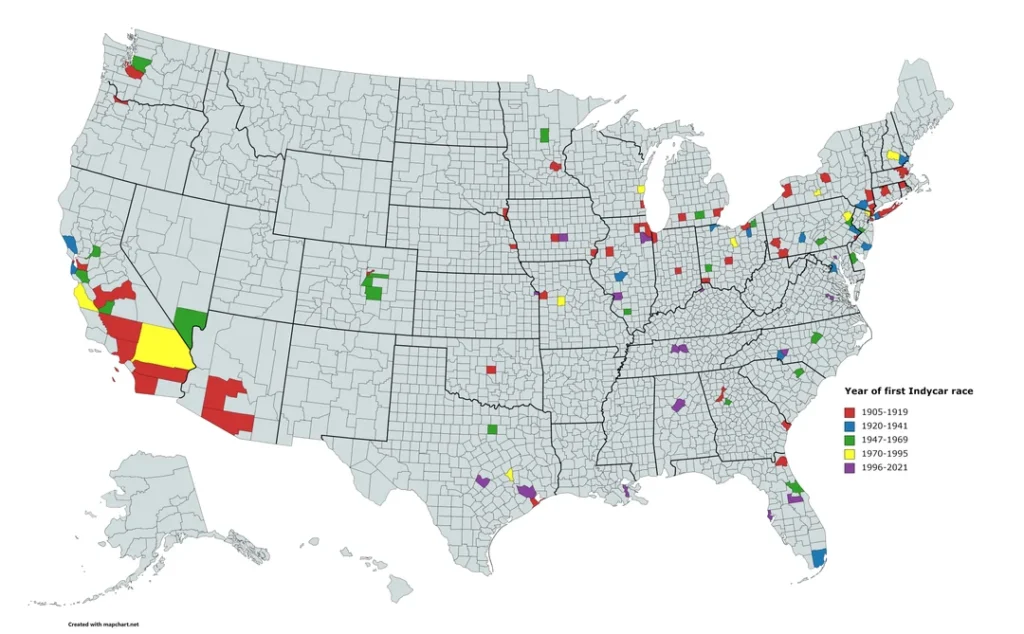
Nowhere is that tension more evident than in discussions around the Northeast. On paper, the region offers multiple viable venues: Watkins Glen, Loudon, Pocono, and even more speculative options like Circuit Gilles Villeneuve. In reality, each comes with its own complications — from infrastructure limitations and local government constraints to historical attendance challenges and strained relationships with promoters.
Watkins Glen, for instance, carries both prestige and baggage. While it is widely regarded as an iconic circuit, its previous IndyCar outings suffered from circumstances that undercut attendance, including last-minute scheduling and unfavorable weather. That has led to a cautious outlook: fans are willing to return, but there is lingering concern that history could repeat itself if conditions aren’t carefully managed.
Loudon, by contrast, represents a different kind of opportunity. Its proximity to Boston offers a more accessible population base, and the idea of pairing an IndyCar race with a NASCAR weekend has gained traction as a way to maximize turnout. The concept of a full weekend motorsport festival — spanning multiple series — aligns with how fans already engage with these events, making it one of the more practical proposals currently circulating.
Still, skepticism remains the dominant tone. The repeated cycle of “on the radar” announcements has conditioned fans to expect little change when the schedule is finally released. There is a prevailing belief that, despite ongoing discussions, future calendars will look largely identical to the present — at least in the near term. Even the most optimistic timelines push any meaningful additions out several years, reinforcing the idea that these concepts are long-term aspirations rather than imminent plans.
That sense of inertia extends beyond the Northeast. International ambitions, particularly in Mexico, have also cooled significantly. A race at Autódromo Hermanos Rodríguez — once viewed as a natural fit given the popularity of Pato O’Ward — has lost momentum. While not officially ruled out, there are currently no plans to include Mexico on the 2027 calendar, marking a notable shift from the strong push seen just a year prior.
Elsewhere, discussions around Brazil and Japan remain just that — discussions. Even more speculative ideas, such as returning to Motegi in a meaningful way or exploring entirely new markets, continue to surface without clear pathways to execution. The gap between concept and commitment remains wide.
In that context, fan reaction has trended toward fatigue. The constant rotation of the same talking points — international expansion, additional manufacturers, future teams — has started to feel repetitive, especially in the absence of concrete developments. For many, these updates no longer signal progress, but rather a lack of it.
And yet, beneath the skepticism, there is still genuine enthusiasm for what could be. The idea of a Northeast revival, a successful NASCAR-IndyCar partnership, or a return to international venues like Brazil carries real appeal. The challenge for IndyCar isn’t generating interest — it’s converting that interest into action.
Until that happens, the series finds itself in a familiar position: full of potential, but short on delivery.