

IndyCar’s 2027 driver market was already complicated. Yuki Tsunoda’s management may have just made it considerably more interesting.
Marshall Pruett reports that Tsunoda’s management is probing the IndyCar paddock for potential opportunities, while Meyer Shank Racing has yet to make a final decision on its expected move for Mick Schumacher. At the same time, AJ Foyt Racing is understood to be closing in on a very different solution to its own financial needs: Indy NXT driver Josh Pierson and the enormous budget reportedly attached to him. Elsewhere, Christian Lundgaard continues to be expected to take over Chip Ganassi Racing’s No. 9, progress is being made toward an ownership change at Juncos Hollinger Racing, Andretti could potentially change engine manufacturers, and the approaching Washington D.C. race continues to generate plenty of attention before a car has even turned a competitive lap.
There is a lot happening in IndyCar right now.
Yuki Tsunoda Is Looking at IndyCar
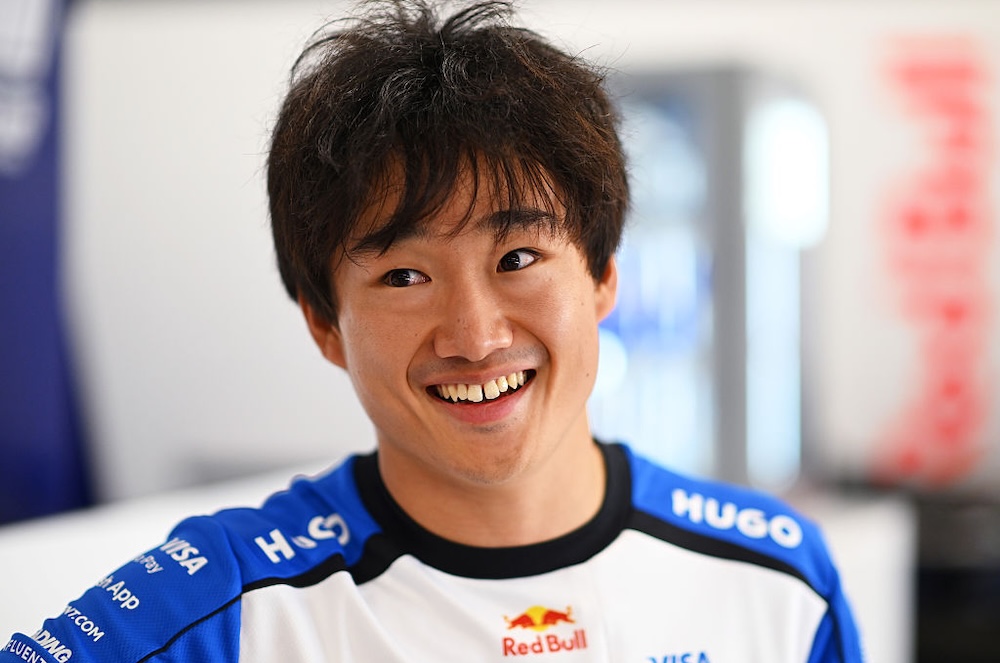
The most intriguing new name in the IndyCar driver market is Tsunoda.
According to Pruett, Tsunoda’s management is probing for IndyCar opportunities. That doesn’t mean a deal has been reached, but it introduces another legitimate candidate into a market already being shaped heavily by available funding. And Tsunoda is only 26. That alone makes this more interesting than a veteran simply looking for somewhere to extend a career. If Tsunoda does make the move, there is potentially plenty of time for him to establish himself in IndyCar.
The immediate question is where he could actually go. Meyer Shank Racing is an obvious team to watch because Schumacher has not yet been finalized there. Schumacher remains the main candidate, but what had begun to feel like an inevitable move suddenly appears less certain. One possibility discussed around the situation is that Schumacher could still join MSR for 2027, while Tsunoda becomes more relevant to the team’s longer-term plans.
MSR is expected to have a third Honda charter entry in 2028, and Tsunoda, Kakunoshin Ohta and Linus Lundqvist have all been discussed as candidates for it. There had also been a plan for MSR to run a third car part-time in 2027 before non-chartered entries outside the Indianapolis 500 were banned. That creates a problem. If MSR wants Tsunoda or Ohta in its eventual third car, throwing that driver into a new entry in 2028 would mean simultaneously learning IndyCar while helping establish a new team operation. Using the No. 66 in 2027 could instead provide a year of preparation.
That appears to be part of what is complicating the Schumacher decision. Schumacher still makes considerable sense, particularly if his presence helps MSR financially ahead of the introduction of the new car. But Tsunoda introduces an alternative with his own commercial possibilities. Fans immediately questioned whether Tsunoda could bring enough sponsorship for a full-time IndyCar program, but there are reasons to believe opportunities could exist. Tsunoda has previously worked with U.S.-based companies with Japanese or European connections, while the large number of Japanese manufacturing and construction companies doing business in America creates other potential commercial avenues.
Honda inevitably hangs over the conversation as well. Even if Tsunoda’s formal relationship with the manufacturer has changed, it is difficult to imagine years of connections simply disappearing. Ohta could offer another Honda-linked path, while Lundqvist remains the fascinating alternative: an experienced IndyCar driver who has already demonstrated that he belongs at this level but continues to face the same problem that increasingly defines the series’ driver market. Money.
Tsunoda’s management merely asking around does not mean he is coming to IndyCar. But his availability gives teams another option, and MSR suddenly has several very different ways it could approach both 2027 and 2028.
The $25 Million Josh Pierson Question

If the Tsunoda situation demonstrates the commercial component of IndyCar’s driver market, the reported Josh Pierson-to-Foyt move puts it under a giant spotlight.
Pruett reports that AJ Foyt Racing needs funding and is understood to have decided on Pierson, who is reportedly shopping a two-year budget worth $25 million. That money would help Foyt keep Santino Ferrucci. The reaction to the possibility has been overwhelmingly focused on one question: is Pierson remotely ready for IndyCar?
The numbers supplied in the discussion do not make a particularly compelling case. Pierson has gone four seasons in Indy NXT without a victory and has never finished better than sixth. Across 85 Road to Indy starts through the 2026 Portland Indy NXT race, he has no wins. One analysis put his overall head-to-head record against teammates at 152-157, or 49.191 percent. Against teammates who have made at least one start in F1, Formula E, IndyCar or Super Formula, that record falls to 3-39. Those comparisons were listed as:
- Nolan Siegel: 3-6
- Kyffin Simpson: 0-4
- Christian Rasmussen: 0-5
- Caio Collet: 0-24
Against Indy NXT race winners, his listed record is 24-72. Pierson has raced for HMD and Andretti, making it difficult to simply blame a lack of competitive equipment for the absence of results. That explains why some fans are already comparing the potential move unfavorably with Sting Ray Robb.
Whatever anyone thinks of Robb’s IndyCar results, he at least entered the series after finishing second in Indy Lights and challenging Linus Lundqvist. Pierson’s junior record does not offer the same obvious justification. Even comparisons with Nolan Siegel need some context. One claim that Siegel had been leading the Indy NXT championship when he was called up was quickly challenged: he was reportedly third and 44 points behind Jacob Abel at the time. None of this guarantees Pierson would fail in IndyCar. Junior formulas do not perfectly predict how every driver will perform after moving up.
But $25 million over two seasons buys a lot of patience. And if Foyt genuinely needs that money, the team’s calculation becomes much easier to understand even if it remains frustrating from a purely competitive perspective. That is the uncomfortable reality of IndyCar’s current silly season. Teams do not make driver decisions in a vacuum. A driver bringing enough funding can help keep another competitive driver employed, fund development and potentially strengthen the organization as a whole.
The reported Pierson deal could effectively be the price Foyt pays to maintain the rest of its operation.
Lundgaard Still Expected at Ganassi, While JHR Could Change
Christian Lundgaard is still expected to move into Chip Ganassi Racing’s No. 9.
Meanwhile, there has reportedly been progress in the Juncos Hollinger Racing ownership transfer. If that transaction is completed, Pruett expects Caio Collet to take the second seat alongside Rinus VeeKay. A potential McLaren partnership is also in the picture. That would give JHR a dramatically different complexion going forward and would provide Collet with the IndyCar opportunity many fans have been hoping he would receive. It also further demonstrates just how interconnected this silly season has become. Funding, ownership, manufacturer relationships and technical partnerships are moving alongside the drivers themselves.
And there could be another significant manufacturer change.
Could Andretti Switch to Chevrolet?
Andretti could potentially switch from Honda to Chevrolet.
There is an obvious logic to the possibility given the broader General Motors connections among TWG’s racing operations, but the competitive implications are more complicated. If Andretti leaves Honda, Chip Ganassi Racing would have an even clearer position at the top of Honda’s IndyCar hierarchy. Meyer Shank Racing, Rahal Letterman Lanigan Racing and Dale Coyne Racing would also move up the order simply by virtue of Andretti leaving. On the Chevrolet side, Andretti would be joining an environment that already includes Penske and McLaren.
Would Andretti really gain enough by making the move? That question could also look very different by 2028 with new engines coming, so a decision made now cannot necessarily be judged entirely on the current competitive balance.
It is another situation worth watching rather than treating as settled.
Meanwhile, IndyCar Has Taken Over the D.C. Metro
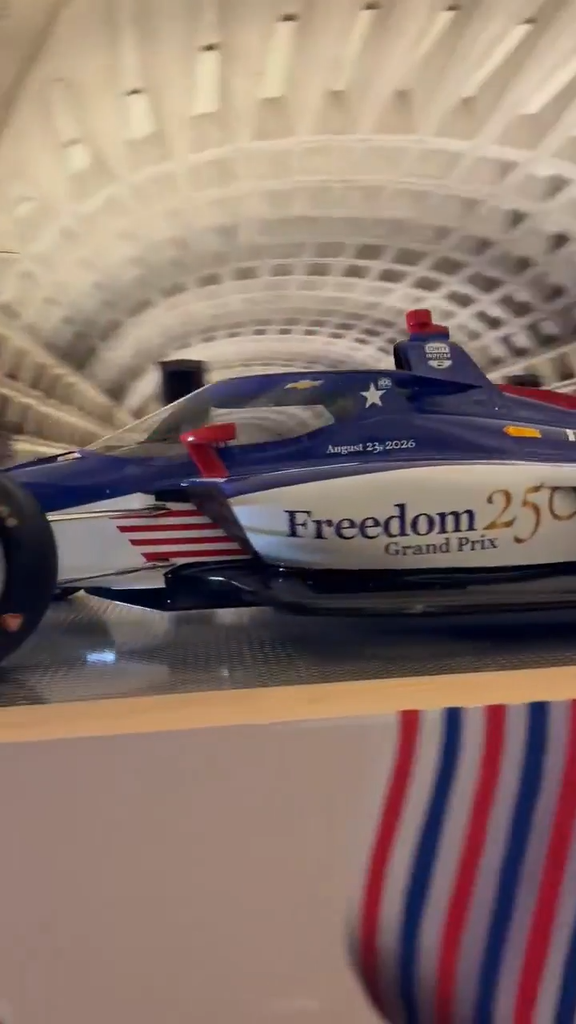
While the driver market churns, IndyCar is preparing for one of the strangest events on its calendar.
That apparently includes sending an IndyCar display car through the Washington D.C. Metro system. For a series trying to make its presence felt in the city, putting an IndyCar on public transportation is certainly one way to do it. The stunt quickly became as much a discussion about the Metro itself as IndyCar. Occasional visitors praised the system’s accessibility, cleanliness and ability to get people around D.C. without a car, while current and former daily commuters debated just how much the service has improved.
Several regular riders argued that today’s Metro is substantially better than it was five or six years ago, particularly following major maintenance and rehabilitation work. And, yes, people noticed that the IndyCar initially appeared to be facing backward. The explanation is considerably less exciting: Metro trains can reverse direction, so a car facing backward during one portion of the journey can end up facing forward on the return. As one fan essentially pointed out, trains aren’t particularly good at three-point turns.
The larger takeaway is that IndyCar is visibly embedding itself into D.C. ahead of the event. A display car riding the Metro is exactly the sort of weird, city-specific promotional stunt that gets people who aren’t already following IndyCar to notice that something unusual is happening.
About Those 200 MPH Claims…
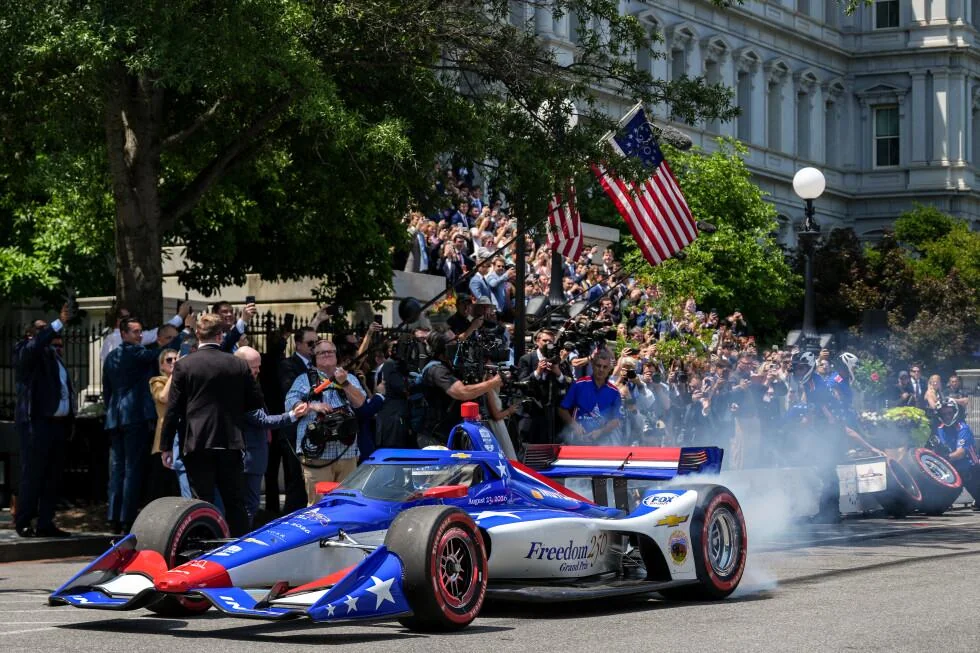
The D.C. event’s projected speeds also seem to increase every time somebody writes about it.
First 170 mph. Then 180. Then 190.
Now an Associated Press headline is talking about doing 200 mph in a 25 mph zone. At this rate, IndyCar may achieve ludicrous speed before race weekend. There is at least some theoretical room for very high speeds depending on setup, push-to-pass and a tow, but the continually escalating numbers have become their own running joke.
The more serious concern is underneath the cars. There are reportedly more than 220 manhole covers around the D.C. course that need to be addressed, including welding and ensuring they sit at the proper height. Street racing has repeatedly demonstrated why that work matters.
Formula 1’s Las Vegas event had a notorious issue involving Carlos Sainz, while a manhole cover also caused a major problem at NASCAR’s Naval Base Coronado event earlier this year, ending up in the engine bay and damaging Corey Day’s car. NASCAR stopped the race to inspect the other covers and allowed repairs under the unusual circumstances. D.C. therefore has plenty of recent reminders of what happens when street furniture meets racing-car aerodynamics.
The track-preparation work may be less glamorous than putting an IndyCar on the Metro, but it is considerably more important.
Will the Presidential Limo Actually Pace the IndyCars?
Another curiosity surrounding the D.C. event is the presidential limousine.
Rather than attempting to lead an IndyCar field all the way to the green flag, the current understanding is that the limo could participate in one or two initial parade laps before the field transitions to the standard IndyCar starting procedure. That sounds considerably more realistic. A massive armored limousine trying to properly pace a field of IndyCars was always an entertaining mental image, particularly if someone were cruel enough to add the Markham hairpin. The important distinction is between participating in the ceremonial opening and actually controlling the field for the race start.
If it is merely the former, the limo becomes another unusual visual attached to what is already an unusual IndyCar event.
Want More Ovals? Milwaukee Fans Say Prove It
While D.C. represents IndyCar trying something completely different, next weekend offers an important test for one of the oldest parts of the sport.
The Milwaukee Mile hosts racing August 28-30, and one fan’s analysis estimates that approximately 71.5 percent of the available seats are sold per day. That works out to roughly 17,900 of 25,000 main-grandstand seats, based on the reserved 300 and 400 levels and an assumption that the 100 and 200 general-admission sections are selling at a similar rate. That’s respectable.
But the argument being made is that respectable isn’t enough if fans genuinely want IndyCar to protect oval racing. Wisconsin currently hosts one out of every six races on the IndyCar schedule, and Milwaukee offers a particularly accessible case for attending. The track is approximately two hours from Chicago, five from Indianapolis, five from Minneapolis, five from Grand Rapids and six from St. Louis. Weekend tickets reportedly range from $88 to $240 and cover two IndyCar races, an Indy NXT race and an Indy Pro 2000 race.
The venue also has something that matters when trying to convince a casual fan to attend: things to do beyond sitting in a grandstand. Wisconsin State Fair Park offers outdoor bars and food close to the grandstands, while parking is relatively straightforward. That combination makes Milwaukee an easier event to sell to somebody who hasn’t already decided that spending an entire weekend at a racetrack sounds fun. And that is arguably where the future of oval racing actually gets decided.
Fans can ask for more ovals online every offseason. Promoters and series officials ultimately see how many people bought tickets. Some supporters are traveling significant distances for Milwaukee. One fan said they were flying from California with four college friends, all of whom would be attending their first race. Another in Italy is already considering making Milwaukee their first IndyCar event in 2028 if it remains on the schedule. One Australian fan checked the journey from Surfers Paradise and found a slightly less persuasive proposition: 31 hours and three flights.
We’ll excuse that one. For everyone within driving distance, though, the argument is harder to avoid.
If fans want Milwaukee — and more events like Milwaukee — attendance is the clearest vote they have.
Auto Club Speedway Offers a Warning
That discussion arrives alongside some sad news from California.
California Speedway LLC no longer owns any parcels at Auto Club Speedway. The property is now fully owned by a development company. For anyone still holding onto hope that racing could somehow return there, this feels like the final confirmation. Fans who attended CART’s Marlboro 500 in 2000 still remember Gil de Ferran’s closed-course qualifying record, engines failing throughout the race, cars hitting the wall and even an unexpected rain delay.
Those memories now belong to a circuit whose land simply became too valuable for its original purpose. That is the brutal economic problem facing major racetracks in growing metropolitan areas. One analysis of the Fontana situation made the point clearly: even if a race is successful, a racetrack primarily generates its biggest economic value during limited event weekends. If developers are willing to pay hundreds of millions of dollars for the underlying land, motorsport has to compete against an entirely different scale of financial return.
The loss also raises a broader question about where future generations of racers are supposed to develop. Street circuits can bring major racing directly into city centers, and Long Beach demonstrates how successful that model can be. But street races do not replace local permanent tracks where young drivers can actually learn their craft. Southern California has not stopped being a motorsports market. The economics of maintaining racing facilities there have simply become increasingly difficult.
That makes the Milwaukee discussion feel particularly timely. Fans cannot control California real-estate prices. They cannot make every racetrack economically viable forever. But when a historic oval is still operating, still hosting IndyCar and still has thousands of seats available, they can control whether they show up.
Auto Club Speedway is a reminder that tracks are much easier to mourn after they’re gone than they are to save once the economics stop making sense. Milwaukee isn’t gone.
Next weekend, IndyCar fans have an opportunity to make sure everyone involved knows they want it to stay that way.