

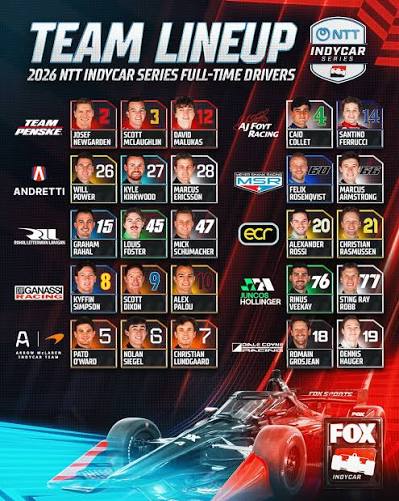
IndyCar’s 2027 driver market is beginning to take shape, but the picture remains far from settled.
Several major teams already have at least part of their lineups secured, while others are facing difficult decisions involving performance, funding, long-term potential, and internal ownership changes. At the same time, Arrow McLaren has come under renewed criticism after Tony Kanaan openly framed several former drivers’ departures as moves that helped them find better situations elsewhere. That tension has created a strange contrast across the paddock. Some drivers are fighting to remain in IndyCar, others are trying to return, and Colton Herta is discovering just how difficult it can be to leave an established IndyCar career behind in pursuit of Formula One.
Meanwhile, Juan Pablo Montoya’s extraordinary first stint in American open-wheel racing offers a reminder of what it looks like when a driver successfully crosses between racing worlds and immediately proves he belongs.
Andretti’s final seat could become one of the biggest battles of the offseason
Andretti Global already has Will Power and Kyle Kirkwood signed through 2027, leaving one open seat.
Marcus Ericsson’s position remains under pressure, although his recent performances have given him an opportunity to strengthen his case. He is currently competing with Dennis Hauger, Christian Lundgaard, and Colton Herta for the final place in the lineup. That list immediately makes Andretti one of the most important teams to watch. Ericsson offers experience and recent momentum, while Hauger represents younger potential. Lundgaard would bring proven IndyCar performance, and Herta’s presence on the list creates the possibility of a return if his Formula Two experiment ends sooner than expected. The Herta possibility is especially interesting because his current F2 results have not strengthened the argument that he should move directly into Formula One. Five consecutive races without a point have intensified scrutiny around his performance, and his struggles have become difficult to dismiss as merely the product of a bad team.
Hitech finished second in the teams’ championship last season, while previous drivers have achieved strong individual results with the organization. Miyata, Herta’s current teammate, finished 17th and 19th in his previous two F2 campaigns, yet is currently ahead of Herta. Herta is 17th in a 22-driver field. Three drivers ahead of him have missed races, and among the five drivers behind him, only one has a worse season-best finish. His best result is fifth, which is the second-lowest season-best result on the grid. The head-to-head record is also troubling. Herta trails Miyata 1-6 in qualifying, 2-5 in sprint races, and 2-5 in feature races.
There are legitimate reasons why the adjustment is difficult. F2 offers limited practice, uses Pirelli tires that demand a very different driving style from IndyCar’s Firestones, and places enormous importance on extracting performance within a narrow qualifying window. A technical problem in practice can ruin an entire weekend before qualifying even begins. Herta also entered F2 with less familiarity with the tires, cars, tracks, and working structure than many drivers arriving from Formula Three. His IndyCar style often relied on driving aggressively and muscling the car, while F2 appears to demand greater precision and more controlled tire management. However, the adjustment itself does not fully excuse the results. New circuits are no longer an insurmountable disadvantage in an era of advanced simulators, and several F2 drivers have also encountered tracks they had not raced previously. The strongest case in Herta’s defense is not that the results are acceptable, but that the learning curve is unusually steep.
His response to the adversity has been more encouraging than his results. Herta has not publicly blamed Hitech, attacked F2, or tried to distance himself from responsibility. He has acknowledged that he is learning, that the speed is not where he wants it to be, and that he needs to improve. That mentality matters. His current ceiling remains uncertain, but his willingness to absorb difficult results without deflecting blame gives him a chance to recover. A second F2 season may ultimately make more sense than rushing him into a struggling Cadillac Formula One car. Cadillac was never realistically likely to become a front-running operation immediately, and the team’s early season has been more consistent with the normal difficulties of building an entirely new organization.
The team has reportedly reduced its deficit from approximately four seconds to around 2.5 seconds. Reaching approximately 1.5 seconds by the end of the season would represent meaningful progress toward the midfield.
That still does not mean Herta should be placed into the car before he is ready. Joining an uncompetitive F1 team while still learning how to manage Pirelli tires could make an already difficult transition even harsher.
Foyt faces pressure over both performance and funding
AJ Foyt Enterprises has two open seats.
The team wants to retain Caio Collet, but there is a high likelihood that another organization could sign him. Collet is competing with Nolan Siegel, Sting Ray Robb, Kyffin Simpson, and Sebastian Montoya. That group illustrates the balance teams must strike between performance and funding. Collet has generated interest through his results, while several alternatives bring varying levels of financial support. Sebastian Montoya’s name has drawn particular skepticism. His father has reportedly been shopping him to teams, but the younger Montoya has not yet created widespread confidence that he is ready for IndyCar.
He has shown speed, but his racecraft has been questioned. The concern is not necessarily that he lacks talent, but that talent alone may not justify the cost of moving through Formula Two and then paying for an IndyCar opportunity. The second Foyt seat places Santino Ferrucci under significant pressure. The team wants to see a meaningful improvement in results, and Ferrucci is competing with Ericsson, Rinus VeeKay, Conor Daly, Myles Rowe, and Felipe Nasr.
Ferrucci’s status appears increasingly dependent on performance rather than reputation. The team is not simply looking for occasional flashes; it wants evidence that the current arrangement can produce better results consistently.
Dale Coyne Racing could once again reshape the market
Dale Coyne Racing has two open seats, and predictability is rarely part of the equation.
Romain Grosjean is well-liked inside the organization, but Coyne has a reputation for making unexpected decisions. Grosjean is competing with Kyffin Simpson and Dennis Hauger. The second seat appears likely to require funding. Simpson currently brings the strongest financial package, while Hauger appears less likely. Simpson is competing with Hauger and Yuki Tsunoda. Funding could become decisive as teams prepare budgets for the new car and engine expected in 2028. A reported two-year, $25 million package would be extremely difficult for smaller teams to ignore.
That creates an uncomfortable situation for drivers such as Hauger. IndyCar may currently have one of its strongest Indy NXT fields in years, but the quality of the talent pool does not guarantee that the best-performing drivers will receive the available seats. Recent history has often produced space for the Indy NXT champion through scholarship support, along with another driver capable of bringing substantial funding. The problem is that funding alone does not automatically make a driver attractive if the competitive level is too low. A driver who cannot maintain sufficient oval speed or consistently perform on road courses may ultimately cost a team more than the funding provides. Even so, the scale of a major package can overwhelm sporting concerns, especially for teams facing the cost of a major technical transition.
Hauger’s IndyCar future therefore remains uncertain. His best chance may require an outside partner or manufacturer willing to help keep him in the series.
Ganassi’s open seat raises questions about experience, upside, and Indianapolis
Chip Ganassi Racing is expected to retain Kyffin Simpson, although official confirmation is still pending. Álex Palou is signed through 2029, leaving one open seat.
Ganassi is not rushing the decision, and the list of candidates is expected to grow. Christian Lundgaard and Rinus VeeKay are currently under consideration, while Luke Browning, Leonardo Fornaroli, and Paul Aron have also reportedly been mentioned. The central question is what Ganassi wants from the seat. The team’s priorities are clear: keep Palou winning and remain capable of winning the Indianapolis 500. That may make a driver with direct IndyCar experience more valuable than an outsider from Formula Two or Formula One.
A newcomer would enter Indianapolis with no prior experience and would spend much of the season learning the car, tracks, tires, and team. With Simpson also still developing, that could leave Ganassi overly dependent on Palou during the most important month of the season. Lundgaard and VeeKay therefore make obvious sense. Both understand IndyCar and could contribute immediately. Marcus Ericsson’s absence from the current Ganassi list is notable given his previous history with the team and his proven Indianapolis record, although his name may simply not have appeared in the current paddock information rather than being completely excluded.
Simpson’s expected retention has also created debate, but keeping him is defensible. He brings funding, is reportedly well-liked within the team, and has shown clear improvement. He does not frequently damage equipment, generally finishes in the top half of the field, and is increasingly capable of reaching the top ten. He was also close to securing another podium at Road America before the timing of the final caution worked against him. At Nashville last year, he spent much of the closing stages fighting Scott McLaughlin for third.
Marcus Armstrong may have shown higher peaks in Ganassi equipment, but Simpson’s combination of progress, financial value, team fit, and age makes him an ideal third driver. At only 21, his current trajectory may matter more than his present limitations.
Meyer Shank Racing has the seat almost every free agent wants
Meyer Shank Racing has Marcus Armstrong signed through 2028 and one open seat.
The team is in no rush to fill it, and almost every major free agent appears interested. The current list includes Collet, VeeKay, Lundgaard, Ericsson, Hauger, Jimmie Johnson, and Kakunoshin Ohta. MSR’s appeal is obvious. The organization has become capable of winning major races and providing a stable platform without the turbulence seen at some larger teams. Collet would represent a high-upside choice. VeeKay and Lundgaard would offer immediate performance. Ericsson would bring experience. Hauger would bring development potential. Ohta would fit into the wider Honda conversation.
The seat could become the pivot point for the entire market. A decision by MSR could trigger movement across Andretti, Ganassi, Foyt, Coyne, Rahal Letterman Lanigan, and Juncos Hollinger.
Rahal Letterman Lanigan is losing patience with Mick Schumacher
Rahal Letterman Lanigan Racing has Graham Rahal and Louis Foster signed through 2027, leaving one open seat.
The likelihood of Mick Schumacher remaining with the team is dropping by the day. A clear improvement in results could still secure his place, but he is competing with Callum Ilott, Linus Lundqvist, Ericsson, and Collet. Schumacher’s situation mirrors Herta’s in reverse. Herta moved from IndyCar into F2 and is struggling to adapt to a more precise, tire-sensitive formula. Schumacher entered IndyCar from European racing and has struggled with a car that requires more physicality, aggression, and comfort operating at the edge.
Both may need an entire season before their progress can be judged fairly. However, teams are not obligated to provide unlimited time, especially when stronger alternatives are available.
Lundqvist is a particularly frustrating example. He remains one of the drivers whose IndyCar career appears to have stalled despite clear promise. Hauger’s uncertain position has created similar concern, with both drivers at risk of having their opportunities end before they are able to establish themselves.
Juncos Hollinger’s ownership struggle could transform its driver strategy
Juncos Hollinger Racing has two open seats, but the team’s future depends heavily on its ownership situation.
Brad Hollinger is attempting to obtain full control, with a new co-owner or investor potentially replacing Ricardo Juncos. Dreyer & Reinbold Racing and McLaren have been rumored as possible investors. If Hollinger gains full ownership, the team may no longer need a pay driver in the second car. VeeKay’s growing popularity has made it increasingly likely that Juncos Hollinger will need to examine other options. He is competing with Daly, Ericsson, and Ilott.
For the second seat, the candidate list includes Ericsson, Ilott, Lundqvist, Daly, Robb, Siegel, and Simpson. Whether that seat goes to a funded driver will depend on how the ownership saga is resolved.
A fully financed team with a new investor could pursue the strongest available lineup rather than the largest available check. That would make Juncos Hollinger one of the most attractive opportunities for established free agents who might otherwise be pushed toward smaller teams.
Arrow McLaren’s lineup is settled, but its reputation is not
Arrow McLaren has Pato O’Ward signed through 2027, Felix Rosenqvist through 2028, and Scott Dixon through 2028.
On paper, the lineup is complete and formidable. Off track, however, Tony Kanaan has created another controversy. Speaking on Off Track with Hinch and Rossi, Kanaan said:
“We hire Malukas and we let Malukas go to Penske. We let Rossi go to much better things and now he’s actually found his home. We let Felix go win the Indy 500. We took Christian out of his misery that he was in the team before, RLL, and now we’re letting him fly much higher.”
The comments may have been delivered playfully, but they reinforce the perception that Arrow McLaren has become a development program for other teams. Malukas was released and later signed by Penske. Rosenqvist moved to Meyer Shank Racing and won the Indianapolis 500. Rossi appears to have found a better fit elsewhere. Lundgaard is now also leaving for a stronger opportunity. That is not the story a team aspiring to become one of IndyCar’s dominant organizations should want to tell.
Kanaan’s phrasing made it sound as though McLaren had generously allowed each driver to graduate into a better situation. In reality, several of those departures reflected instability, poor timing, or decisions that now look much worse in hindsight. The Malukas situation remains especially painful. McLaren could have had a lineup of O’Ward, Malukas, and Lundgaard. That would have combined two elite oval drivers with a strong road-course performer. Instead, the team spent years cycling through drivers.
Malukas had family backing, a strong Indy NXT record, and intriguing early IndyCar results. At the time, his ceiling remained uncertain, but there was enough evidence to justify patience or a renegotiated arrangement. His oval ability was already visible. He had earned podiums on short ovals and demonstrated the car control needed to save loose cars at high speed. Lundgaard’s departure creates the same question. If McLaren believes he is capable of “flying much higher,” why could he not do that at McLaren?
The comments also risk diminishing former drivers. Even when the underlying reasoning is understandable, publicly describing a driver as having been rescued from “misery” or presenting a firing as an act of generosity is unlikely to build trust. Kanaan’s candidness can be entertaining, and the full interview may be less severe than isolated quotes suggest. However, he repeatedly speaks in a way that forces the organization to explain itself afterward. There is also a broader leadership question. Kanaan may prove capable as a team principal, but he does not always sound like the best public spokesperson for the team. Ryan Hunter-Reay could potentially communicate the same decisions with less collateral damage.
At some point, Arrow McLaren must decide whether this style reflects the organization’s intended identity. If Kanaan remains in place and continues speaking this openly, it is reasonable to assume that Zak Brown accepts both the sentiment and the approach.
The most damaging interpretation is not that McLaren wishes former drivers well. It is that the team appears proud of being the place where drivers pass through before becoming more successful elsewhere.
Herta’s struggle also reopens the question of how IndyCar drivers are judged
Herta’s difficult F2 season has produced two competing reactions.
One view is that he has been overrated for years. He won only one oval race, never finished higher than eighth at Indianapolis, and went winless in two of his final three IndyCar seasons. Based on that record, his enormous contract and continued F1 attention were not fully justified. The other view is that changing disciplines is extraordinarily difficult, and that most drivers would struggle when asked to simultaneously learn a new car, tire, team structure, and set of circuits. Both can be true.
Herta may have been overvalued in IndyCar, and his F2 challenge may still be uniquely difficult. The standard should not be Juan Pablo Montoya, Nigel Mansell, or Jacques Villeneuve. Drivers capable of immediately winning across completely different disciplines are rare. Michael Andretti struggled when he moved to Formula One despite extensive preparation. Jimmie Johnson found IndyCar difficult, particularly because of the tires. Mick Schumacher is currently experiencing his own adaptation problems in IndyCar.
The difficulty of switching does not erase poor results, but it does explain why a driver’s first season in a new discipline may not represent his final level. Herta deserves credit for accepting the challenge. He could have remained in a race-winning IndyCar environment. Instead, he took the risk required to pursue Formula One. Whether that decision was wise will depend on what happens next.
He may eventually earn a Cadillac seat after a second F2 season and enter Formula One once both he and the team are better prepared. He may return to Andretti and resume his IndyCar career. He may discover that his strengths were better suited to American open-wheel racing.
None of those outcomes would erase what he has already accomplished, but his current form does challenge the assumption that IndyCar success automatically translates into European ladder success.
Montoya remains the standard for immediate adaptation
Juan Pablo Montoya’s first American open-wheel stint provides the opposite example.
Montoya spent only two seasons with Ganassi in 1999 and 2000 before moving to Formula One with Williams. In that short period, he recorded 14 poles, 14 podiums, 11 victories, the 1999 CART championship, and the 2000 Indianapolis 500. He was nearly untouchable in 1999. Although he tied Dario Franchitti in the championship, Montoya won the title through his superior number of race victories, seven compared with Franchitti’s three. He also led more laps, won more races, and took more poles than anyone else.
He was the dominant driver of the season even if the points table required a tiebreaker. His 2000 Indianapolis 500 performance was even more emphatic. Montoya adapted immediately and looked completely comfortable at the Speedway. Sarah Fisher later recalled that he was flat by his third lap. Her father returned and told her that she was going to get “smoked.”
That description captures Montoya’s impact. He did not merely adapt; he redefined expectations. His car control was extraordinary on both road courses and ovals. At Mid-Ohio in wet qualifying, his ability to control the car through Thunder Valley and into the carousel stood out even among elite drivers. At Gateway in 1999, a fuel miscalculation dropped him a lap down. His attempt to recover showed the same qualities. He placed the car in positions that seemed unavailable and repeatedly attacked Turns 1 and 2 with remarkable confidence.
Montoya appeared physically aggressive outside the car, but behind the wheel he could be extraordinarily precise. He combined brutality with finesse. He was immediately compared with Jacques Villeneuve and Alex Zanardi, but he may have been faster than both. Villeneuve was tactically clever, Zanardi was electric, and Montoya combined speed with a complete absence of intimidation. Even Michael Schumacher did not seem to affect him psychologically. Where Schumacher’s presence could influence other drivers, Montoya appeared indifferent.
Had he remained in the United States, it is reasonable to wonder how many records he might have broken. Ganassi’s equipment decisions also shaped what followed. The team had previously succeeded by moving from Chevrolet to Ford, then to Reynard, Honda, and Firestone. The switch back to Lola and the Toyota relationship did not immediately produce the same level of success, although the Toyota connection later helped bring Scott Dixon to the team and provided Ganassi with the leading IRL engine in 2003. Montoya’s departure for Williams prevented the full potential of his IndyCar career from being measured.
Even so, he returned nearly 15 years later and continued winning. Across only five full-time seasons in CART and IndyCar, he earned 15 victories and won at least once in every season. His career remains a warning against assuming that success in one discipline must remain limited to that discipline. Very few drivers can move between IndyCar, Formula One, NASCAR, and major endurance racing without being exposed somewhere.
Montoya did not simply survive the changes. He won across them.
The 2027 market will reward more than raw speed
The current IndyCar market is not being shaped by one factor.
Speed matters. Results matter. Funding matters. Experience matters. Team stability matters. Timing may matter more than all of them. A driver such as Collet could lose a seat despite strong performance because another team moves first. Hauger could disappear after one season because a larger funding package becomes available. Lundqvist could remain outside the grid despite having already shown enough promise to deserve another opportunity. Ericsson could move from fighting to keep his Andretti seat to becoming one of the most desirable veterans available. VeeKay and Lundgaard could determine whether Ganassi, MSR, or Juncos Hollinger emerges with the strongest offseason result.
Herta could return from F2 and immediately become one of the most valuable names on the market, even after a difficult European campaign. Arrow McLaren, meanwhile, already has its drivers but still must repair the perception that it repeatedly makes other teams stronger. And hovering over the entire discussion is Montoya’s example.
Every team wants to find the next driver capable of stepping into a new environment and instantly transforming it. The problem is that drivers like Montoya are exceptionally rare.
Most need time. Some need money. Others simply need the right team to believe in them before the market closes.