

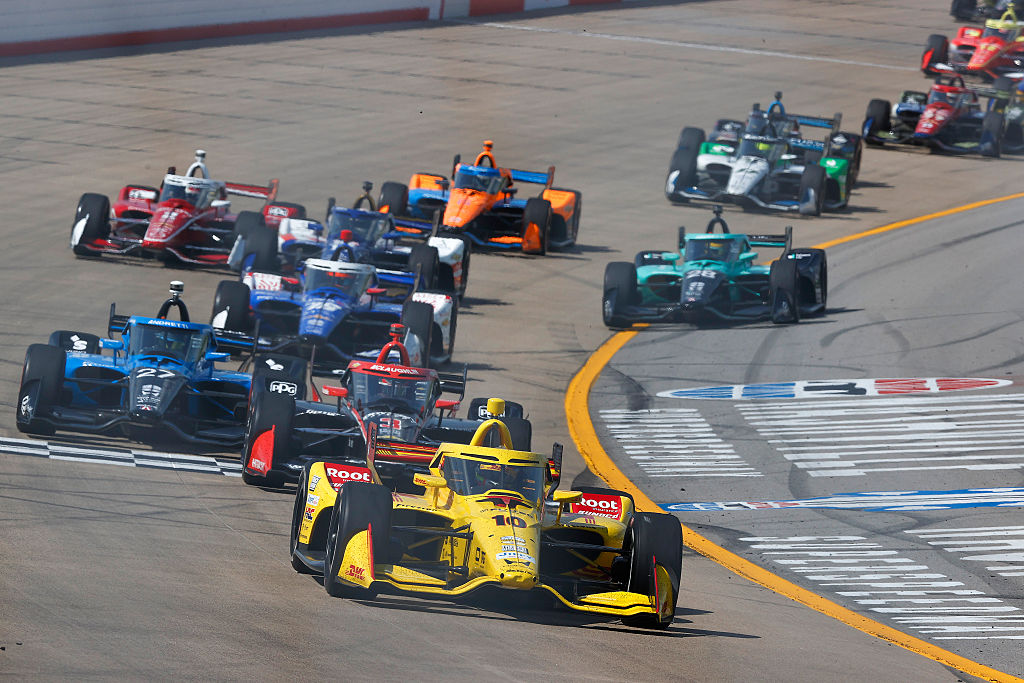
IndyCar has a strange way of welcoming new fans.
It does not always give them an obvious team to support. It does not consistently hand them a simple rivalry to follow. It does not even benefit from widespread public understanding of what the series is called. And yet, for many people coming from Formula 1, that uncertainty may be part of the appeal. A new fan preparing to attend the Grand Prix of St. Petersburg recently asked whether IndyCar supporters tend to follow the series itself or attach themselves to individual drivers and teams. It is a reasonable question for someone arriving from Formula 1, where team identity, driver branding and long-running rivalries can heavily shape the viewing experience.
The answer appears to be that IndyCar fandom often develops in reverse. You do not necessarily choose a driver and then begin caring about the series. You watch the racing, become invested in the competition, encounter a few personalities and eventually realize you have started rooting for someone. Sometimes the connection is based on nationality. Sometimes it comes from a sponsor, an employer or an existing relationship with a team. Sometimes it is inherited from an earlier era of American open-wheel racing. Sometimes it is nothing more complicated than discovering that one driver is entertaining.
And sometimes the only real allegiance is to anyone who can stop Alex Palou or Team Penske from winning again. That may sound unserious, but it reflects one of IndyCar’s greatest strengths: the series can be enjoyed before a viewer fully understands its personalities, politics and history. There is enough variety in the racing that the event itself can carry the show.
A fan can arrive without knowing every driver and still be entertained by the strategies, pit sequences, track types and constant possibility that a race will move in an unexpected direction. Once the personalities become familiar, the experience becomes richer, but they are not always required as an entry point. That is different from Formula 1, where following a team or driver can sometimes feel essential to sustaining interest through a predictable season. For a new IndyCar viewer, the most useful advice may be not to force the comparison.
The cars may look similar. Some drivers have crossed between the two worlds. Both are forms of top-level open-wheel racing. But the rhythms of an IndyCar weekend, the pit strategies, the track variety and the competitive dynamics are different enough that constantly measuring one against the other may prevent a new fan from appreciating either properly. IndyCar is not Formula 1 with different liveries.
It is its own sport, with its own logic.
Let the Favorite Driver Find You
Many IndyCar fans appear to build their loyalties through a chain of accidents, associations and personal connections.
One fan’s route began with Juan Pablo Montoya and Chip Ganassi Racing, followed Montoya to Williams and McLaren in Formula 1, shifted toward Lewis Hamilton after Montoya’s departure and eventually returned to IndyCar through Dario Franchitti and Scott Dixon. That kind of fandom is not clean or easily branded. It follows drivers, teams and memories across decades. Another fan became attached to Meyer Shank Racing because of an employer partnership. Seeing a company logo on the car created the initial connection. Remaining loyal through difficult seasons made later success feel more meaningful.
Others simply gravitate toward personality. Will Power is an easy example. He can be thoughtful, introspective and philosophical, then suddenly become one of the most volatile figures in the paddock when frustration takes over. That contrast is part of what makes him compelling. He has the achievements of a legend, including championships, an Indianapolis 500 victory and a record number of poles, but he also carries the unpredictability of someone who might transform from calm veteran to furious competitor in a matter of seconds. David Malukas attracts a different kind of support. He is young, entertaining and still chasing the breakthrough that could permanently change how he is viewed. That makes him an easy underdog for newer fans to adopt.
Scott Dixon and Power represent the established generation. Josef Newgarden has increasingly occupied something closer to a villainous or heel role. Palou is the dominant force many fans respect while simultaneously hoping someone defeats him. There is no correct route into the sport. A fan can follow a driver because of talent, personality, nationality, age, sponsorship or pure instinct. They can follow a team because of history, business relationships or aesthetics. They can also decline to choose at all and simply watch the series for the racing.
That flexibility may be one reason IndyCar can absorb new fans even when it struggles to explain itself to the wider public.
The Sport That Everyone Calls the Indy 500
One recent opinion piece demonstrated how difficult that explanation remains.
The article referred to a planned IndyCar event as an “Indy 500 car race” and raised concerns that vibrations from the cars could damage nearby buildings. The reaction from established fans was predictable. First came the jokes.
Perhaps an “Indy 500” race meant 500 cars would be competing at once. Perhaps Palou would be driving all of them. Perhaps the cars would be fitted with a superspeedway package. Perhaps the vibrations would destroy monuments, damage reflecting pools or summon a giant undead George Washington. The humor worked because it exposed the central problem immediately: the article appeared to be discussing a sport its author did not understand at even the most basic level. The Indianapolis 500 is a race.
IndyCar is the series. Confusing the two is the motorsport equivalent of referring to every Formula 1 event as the Monaco Grand Prix. It is a mistake that occurs often enough to reveal something deeper about the category’s public identity. People outside motorsport frequently use “Indy 500” as a generic term for American open-wheel racing because it is the only name they recognize.
A social-media post from a Nashville street-race weekend once celebrated that the “Indy 500” had arrived in town. Public officials have made the same mistake when discussing other races. At a certain point, fans almost become grateful that an outsider at least identified the event as something related to IndyCar rather than calling it Formula 1 or NASCAR. But the building-vibration argument created a larger issue than simple terminology.
The central criticism was not that an opinion piece expressed opposition to a street race. There are legitimate reasons to question whether a temporary circuit belongs in a particular city. Fans can dislike the course, resent its late addition to the schedule or believe the race is unnecessary. The problem was using speculation in place of research. Similar fears appeared before NASCAR’s Chicago street race. Residents worried about road damage, public safety and the kind of crowd the event would attract. Much of that anxiety turned out to be overstated.
That history does not automatically prove every concern about every street race is wrong. It does, however, provide an obvious case study for anyone preparing to publish a warning about structural damage caused by race-car vibrations. An opinion does not become more persuasive because it appears beneath an op-ed label. The writer may be free to express it, but readers are equally free to notice when the argument lacks evidence, context or a basic understanding of the subject.
There is a broader lesson here for IndyCar. The series remains caught between wanting mainstream attention and being repeatedly misrepresented by the mainstream outlets that notice it. Fans want the sport to grow. They also know that growth brings coverage from people who may not understand the difference between the series and its most famous race.
That tension can be frustrating, but it also shows how much work remains to be done. IndyCar may be easy to enjoy once someone watches it.
The challenge is getting them to understand what they are watching.
Palou Likes the New Car, Which Is Terrible News for Everyone Else
While outsiders are still learning what to call the series, Alex Palou is already preparing to rewrite its record book.
After testing IndyCar’s new car, Palou offered an assessment that should excite nearly everyone except the drivers who have to race against him.
“I don’t know, maybe I’m talking too early, but I think we’re going to break a lot of IndyCar records on all kinds of tracks,” Palou said. “So, it just feels like it’s a faster car. It feels like it’s a car that is more capable.”
The immediate fan interpretation was obvious.
When Palou says “we,” there is a reasonable chance he means himself.
The current dominant driver feeling comfortable in a faster and more capable car is not necessarily the development the rest of the field wanted to hear. Palou has become so consistently successful that some fans have started reacting to his optimism with mock despair. They respect the talent. They understand the results are earned. They may even believe his achievements will be appreciated more fully in the future. They would still prefer someone else to win occasionally.
There is an interesting divide in the way his dominance is viewed. One side sees it as exhausting. Palou’s consistency creates the same sense of inevitability once associated with Scott Dixon, except Palou’s win rate has at times felt even more oppressive. The other side sees something worth appreciating. A driver should not be blamed for being exceptionally talented, prepared and consistent. Dominance may reduce suspense, but it can also be evidence that fans are watching a historic period in real time.
That tension will become even more prominent if the new car is as strong as Palou believes.
Faster Is Good, but What Does a Record Mean?
The possibility of broken track records has also reopened an old question.
How much should pure speed matter in a spec series? Some fans care less about record laps than they do about close racing. A car could be dramatically slower and still produce an excellent race. Spec machinery can create competition without making speed records especially meaningful. Others argue that racing at the highest level should still be about speed.
Drivers want the fastest cars. Engineers want to build them. Fans want to watch machinery that feels extraordinary. Good racing and extreme performance do not have to be opposites. That is the ideal IndyCar should pursue.
The complication is that modern records are partly controlled by regulation. Boost levels, aerodynamic configurations and series decisions can determine whether a car has the opportunity to break an existing mark. That makes a modern record different from one set during an era of greater technical freedom. If the series increases performance enough, the new car may produce faster laps. That does not necessarily mean the engineering competition is deeper than it was in the past. It may simply mean IndyCar chose to unlock more speed.
Still, the emotional value of a record cannot be dismissed entirely. A 250-mph lap would be terrifying, controversial and almost impossible to ignore. Even people who question the relevance of spec-car records would understand the spectacle. The deeper issue is whether speed improves the product without compromising the qualities that make IndyCar worth watching. A faster car is exciting.
A faster car that also races well would be transformative.
The Power-Steering Question
The new car has also prompted discussion about driver comfort and whether IndyCar may eventually consider some form of power steering.
That possibility has already divided fans. The lack of power steering is one of the series’ defining physical characteristics. It contributes to the image of IndyCar as a demanding form of racing in which drivers are visibly fighting the car. Adding assistance could reduce that physicality and change the feedback drivers receive through the steering wheel. It would also add another component that must be maintained and could potentially fail.
At the same time, there may be situations where limited assistance would benefit a driver recovering from a hand or arm injury. Palou appeared open to keeping the current system in most cases while allowing flexibility in specific medical circumstances. That may be the most sensible balance.
IndyCar should be careful about removing one of its distinctive traits simply in the name of comfort. But it should also be willing to consider accommodations that allow an injured driver to compete safely. The new car does not need to preserve every hardship of the old one merely for tradition’s sake.
It does, however, need to remain recognizably IndyCar.
A Series That Rewards Patience
Taken together, these conversations reveal a sport with two very different identities.
To the people inside its world, IndyCar is rich with history, personality and technical debate. Fans argue about Palou’s dominance, power steering, track records, team loyalty and whether pure speed matters as much as racing quality. To many people outside that world, every race is apparently the Indy 500. That gap can make the series feel small, misunderstood and occasionally invisible.
But it may also be part of what makes discovering IndyCar so rewarding. New fans do not need to arrive with a favorite driver. They do not need to understand the split, memorize every team history or immediately select someone to support. They can begin with the racing.
They can attend St. Petersburg, buy a paddock pass, meet drivers, watch the pit strategy develop and see which personalities hold their attention. Over time, the loyalties will come. Maybe they will become attached to an underdog.
Maybe they will admire Will Power’s speed and volatility. Maybe they will appreciate Palou’s excellence while desperately hoping he loses. Maybe they will follow a sponsor, a team or a driver from another series.
Or maybe they will remain fans of IndyCar itself. That may be the clearest difference for someone arriving from Formula 1.
IndyCar does not always require you to choose a side before it gives you a reason to care.