

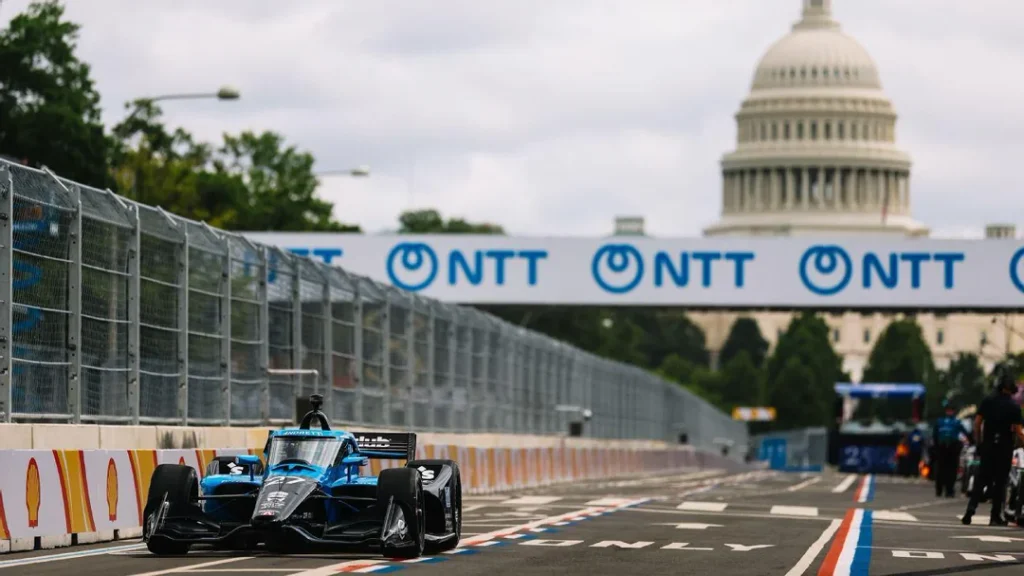
IndyCar’s trip to Washington, D.C. was always going to be unusual.
A 250-mile street race around wide roads in the nation’s capital, with a course that drew plenty of skepticism before cars ever raced on it, was hardly a conventional addition to the schedule. Even after the event began, there were legitimate questions about the spectator experience, the length of the race and whether the layout would actually produce good racing. Then the Freedom 250 happened. Kyle Kirkwood won. There was passing. The anticipated demolition derby never really materialized. Fans who attended largely came away impressed. And now we know 3,282,000 people watched it.
That number changes the conversation considerably.
3.282 Million Viewers Is a Massive Number for IndyCar
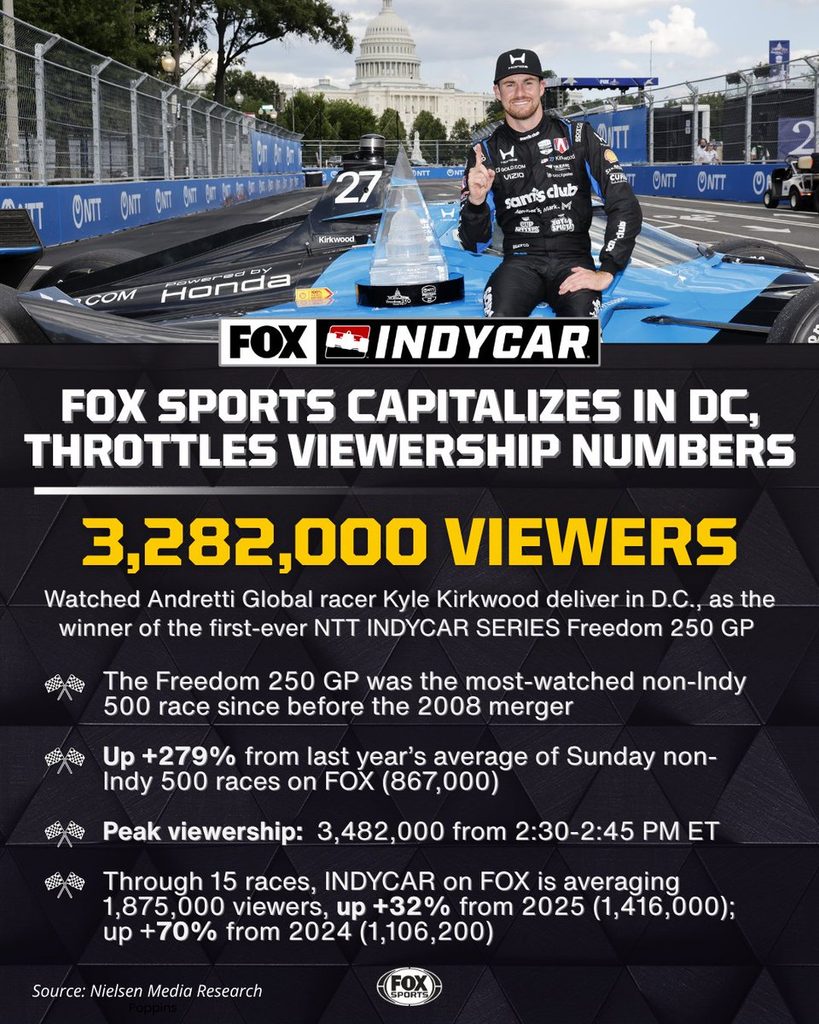
The immediate reaction to the television audience was basically disbelief.
IndyCar fans have become accustomed to celebrating incremental growth. A solid audience is good. Maintaining an audience in a difficult time slot is good. Building a dependable base that follows the series from race to race is arguably even more important. But 3.282 million? That’s different.
Fans immediately began trying to determine just how far back you would have to go to find a comparable non-Indy 500 audience. The discussion eventually centered around the Michigan 500, with 1995 and 2000 both coming up depending on exactly how the historical numbers are compared. Regardless of where the precise historical cutoff falls, the bigger point is obvious: IndyCar just produced a television number for a non-Indy 500 event that looks completely foreign compared with what the series has been accustomed to seeing in the modern era. And perhaps more importantly, it validates the idea behind creating a major event like D.C. in the first place.
There was understandably disappointment over Nashville’s 775,000 viewers, particularly after expectations surrounding the race. But even that number looks different when viewed alongside D.C. There is something valuable about having roughly three-quarters of a million people willing to find and watch IndyCar even when a race lands in an unusual midday Monday window. Longtime fans remember when a Saturday night race drawing around 335,000 viewers on NBCSN didn’t seem extraordinary. Against that backdrop, having a core audience capable of producing numbers around 750,000 in a compromised situation while simultaneously demonstrating the ability to explode past three million for a major event represents real progress. D.C. also gives FOX evidence that swinging big with IndyCar can work. Not every race is going to draw 3.282 million viewers, and expecting that would miss the point. Special events are special precisely because they aren’t ordinary. What matters is whether IndyCar can use them to put the series in front of people who otherwise wouldn’t watch.
Based on what fans saw on the ground in Washington, that’s exactly what happened.
D.C. Put IndyCar in Front of a Different Audience
One of the most encouraging observations from attendees had little to do with the racing itself.
Look around the crowd, and much of the motorsports apparel wasn’t IndyCar merchandise. It was Formula 1 and NASCAR gear. That’s an opportunity. The Freedom 250 brought people into an IndyCar environment who apparently had relatively little previous exposure to the series. They got to see the cars in person, experience the speed and watch an actual competitive race rather than simply being marketed to.
For a series trying to expand its audience, there aren’t many better outcomes. And despite the political backdrop surrounding an event in Washington, several attendees described the actual experience as far less political than they had expected. One attendee even polled followers on X and Instagram about whether they could simply enjoy the race as a race; “yes” reportedly beat “no” by roughly two-to-one on both platforms. Opinions of the FOX broadcast were much more divided. Some viewers thought it leaned excessively into patriotic presentation, while others saw little actual politics and viewed it more as an unapologetically American sporting event. The full-screen interview with Melania Trump during green-flag racing drew particular criticism, with picture-in-picture looking like the obvious alternative if an interview had to happen during the race. But inside the event itself, the dominant story from fans appears to have been racing.
And many of them had a very good time.
The Track Was Better Than Many Expected
The D.C. circuit wasn’t exactly universally beloved when people first saw it.
But the race exposed one of the problems with judging a circuit primarily on how interesting it looks on a map. Wide streets and hard braking zones might not create the most visually beautiful street course in motorsports, but they can create places where IndyCars can actually race each other. That’s what matters.
There was passing, and drivers could still get themselves into trouble trying to make those passes. Walls punished mistakes without turning the entire race into the caution-filled mess many expected. Turn 1 had looked like a candidate for an enormous opening-lap pileup. The small chicane around Turn 6 generated similar fears. After qualifying, there was plenty of reason to think Sunday’s race could become chaotic. Instead, it was surprisingly controlled.
The bump that had caused concern was reportedly shaved down between qualifying and the race, which may have helped. With the weekend running on a condensed schedule and no Friday practice, organizers had very little time to discover and address problems before racing began. The length of the race may have played a role as well. Rather than treating every early opportunity like the final lap, drivers knew they had 250 miles ahead of them. That potentially encouraged a degree of patience before the closing stages.
There is an argument, however, that IndyCar went too far in that direction.
The Freedom 250 Probably Didn’t Need to Be 250 Miles
The race lasted 2 hours, 40 minutes and 42.9548 seconds.
For the occasion, the distance made sense. The United States’ 250th birthday provided the obvious reason for a 250-mile race. As a one-off concept, it worked. As the permanent format for a potential return to Washington? That’s much harder to justify.
A number of fans who enjoyed the race still thought it was simply too long, with suggestions generally clustering around 105 to 110 laps. Others pointed toward the originally scheduled 125 laps. A shorter race could potentially preserve everything that worked about the circuit while increasing urgency. Drivers wouldn’t have quite as much incentive to settle in for an endurance-style afternoon before attacking late. There were people who enjoyed the additional distance, of course. And compared with NASCAR, a race lasting less than three hours isn’t particularly remarkable.
But IndyCar generally operates on a different standard. Outside special events and the Indianapolis 500, fans are accustomed to something closer to the roughly 1-hour-40-minute to 2-hour-20-minute range. D.C. had a reason to be different this time. It doesn’t necessarily need to be different next time.
And there are plenty of fans who now hope there is a next time.
The Biggest Problem Was Watching the Race From the Race
This is where the Freedom 250 has considerable room for improvement.
We had already seen complaints about general admission viewing during the weekend, and the post-race feedback reinforced them. The event itself could be excellent while the actual ability to see the event was frustratingly limited. One attendee described it as essentially a watch party in a great park. Another said there needed to be far more grandstands along with screens positioned around the circuit so fans could follow what happened once the cars disappeared from their immediate field of view.
The demand was clearly there. One fan arrived at 7:45 a.m. Sunday for an 8 a.m. gate opening specifically to secure a grandstand seat. By around 9 a.m., the grandstand was estimated to be approximately 80 percent full. By roughly 10:30 a.m., the line was estimated at around 200 people, with only a handful being admitted each minute as other spectators left. At 12:20 p.m., Stars ticket holders reportedly received an email saying Grandstand 4A was full and no additional spectators would be admitted.
For a free event, some compromises are understandable. But if IndyCar wants people exposed to the series in D.C. to become paying customers elsewhere—or eventually in Washington itself—the spectator experience matters. The encouraging part is that people still came away happy.
One attendee entered with low expectations, encountered no traffic, got through the entrance without a line around 9 a.m. and described event and security personnel as pleasant. Even when a ticket incorrectly scanned as deactivated, staff quickly verified the attendee’s identity and resolved the issue. Others weren’t as fortunate. There were complaints about guest-experience staff being unfamiliar with common race equipment such as headsets and scanners. More seriously, one disabled attendee said they were removed from an ADA viewing platform despite providing a permanent handicap placard and later reported the incident. Another person who said they worked the event responded that staff had specifically been trained not to demand proof of disability and should provide accommodations when requested.
Those are exactly the kinds of operational problems that should be examined if the event returns. But they don’t erase the broader reaction.
People had fun.
Washington Also Made Markham Look Worse
Unfortunately for IndyCar, demonstrating that a complicated street race can be successfully executed naturally brings attention back to what happened at Markham.
The debate over responsibility remains. Some fans place the failure squarely on Green Savoree, arguing that hiring an outside promoter exists specifically to transfer much of the logistical burden, cost and liability of running an event away from Penske Entertainment. Others think that’s too easy an escape for IndyCar.
Even if Green Savoree was responsible for execution, it’s still IndyCar’s championship, IndyCar’s drivers, IndyCar’s teams and ultimately IndyCar’s reputation being placed in front of spectators and television viewers. From that perspective, the series should have enough oversight to know whether construction is progressing appropriately rather than reaching Friday evening with fundamental questions hanging over the event. Both things can be true. A promoter can fail at its job while IndyCar simultaneously learns that it needs stronger oversight of the product carrying its name.
D.C. only strengthens that argument because the logistical challenges of racing in Washington were hardly insignificant. One marshal described the hoops the D.C. Region SCCA had to jump through, including an instance where it reportedly took three hours to work through security restrictions simply to deliver lunch to Turn 1. Yet the race happened.
And by Sunday evening, the conversation was mostly about how surprisingly good it had been.
Meanwhile, Scott McLaughlin Has a Very Different Problem
While IndyCar celebrates the success of D.C., Scott McLaughlin’s situation at Team Penske continues to become more uncomfortable.
The simplest version of the question is harsh: What happened? McLaughlin once looked like one of IndyCar’s emerging stars. Now his future is being discussed as though he’s the potential odd man out at Penske. But reducing his season to “McLaughlin suddenly isn’t good anymore” doesn’t really fit what we’ve seen.
He has qualified third in three of the last four races and has been inside the top six in six of the last eight. We’ve also seen reminders of his ability to move forward, including going from ninth to third in two laps at Indy and from 12th to fourth in 20 laps at Nashville. The speed hasn’t simply disappeared. What has changed is the environment around him.
Penske isn’t dominating in the way people became accustomed to seeing, and when the equipment advantage shrinks, every weakness becomes more visible. McLaughlin has to race more cars, and the pressure of fighting for his Penske future magnifies every error. D.C. was a brutal example. If his gamble on Kirkwood had produced the victory, perhaps we’re discussing it as the moment that saved his seat. Instead, the move became another piece of evidence for critics who question his racecraft.
And even the hypothetical deserves scrutiny. Kirkwood appeared to have the faster car. Second place might have been the best realistic outcome available. Going for the win is admirable, particularly for a driver whose future may depend on producing something spectacular, but desperation can turn an aggressive move into a costly one. That’s the trap McLaughlin may currently be in.
Driving conservatively and finishing second might not feel sufficient when you’re fighting for your career at Team Penske. Going for the result that could change the entire narrative creates exactly the opportunity to make the mistake that reinforces it.
Penske’s Problem Is Bigger Than McLaughlin
There is also a danger in treating McLaughlin’s results entirely as an individual failure.
Chevrolet’s fuel mileage has become a recurring part of the conversation around its teams. On road and street circuits where passing is difficult and tire warmup makes the overcut powerful, poorer fuel consumption can create a compounding disadvantage. A Chevrolet driver can lose flexibility on strategy and potentially surrender track position through pit cycles. The impact isn’t necessarily identical everywhere. Shorter ovals can become so tire-limited that a powerful undercut reduces the importance of fuel mileage, while drafting can also normalize consumption to some degree.
But a disadvantage is still a disadvantage. And Penske is operating in an IndyCar where Andretti and Arrow McLaren have recently looked increasingly formidable while Álex Palou and the No. 10 Ganassi have spent years making almost everyone else look ordinary. That creates an interesting question: Has Penske actually fallen dramatically, or has the competitive reference point moved?
Maybe it’s some of both. David Malukas hasn’t suddenly started winning everything either. He’s shown promise and appears to have a bright future, but the actual gap between Malukas and McLaughlin in points and performance isn’t enormous enough to make this a simple comparison between one thriving driver and one collapsing driver. By Penske standards, the broader operation is underperforming. The organization has also lost leadership and Will Power’s input, adding another variable to a team already under pressure.
There is even concern about what comes after McLaughlin. If the team’s trajectory doesn’t change, questions about Josef Newgarden’s future after next season could eventually become just as significant.
McLaughlin Still Has Time
The most important thing for McLaughlin is that his story isn’t finished.
He still has two ovals and Laguna Seca to change the conversation, and the upcoming doubleheader comes at a track where he has won before. The underlying pace suggests there is still something to work with. There are also moments that inevitably become part of the psychological discussion around a driver. McLaughlin’s Indy 500 warmup-lap crash is one of them. Nobody outside the car can know how much an incident like that continues to affect a driver, but it’s understandable why fans wonder whether it lingers.
Pressure certainly appears to be the larger theme. And that pressure could make the Indianapolis 500 particularly fascinating going forward.
Because despite everything happening right now, McLaughlin remains one of the drivers fans can realistically imagine winning it.
Who Wins the Indy 500 Next?
That question generated an enormous range of possibilities—which is probably the best answer in itself.
Pato O’Ward is an obvious candidate. David Malukas is there. Rasmussen was mentioned. McLaughlin absolutely remains in the conversation. Rinus VeeKay could potentially do it if the equipment allows him to fight at the front. Then there are drivers who have already demonstrated they can win the race or contend at that level: Palou, Newgarden and Ericsson. Kyle Kirkwood’s D.C. victory naturally puts additional attention on him as well. If Andretti can give him what he needs at Indianapolis, his current trajectory makes it easy to imagine him eventually adding a 500 to his résumé.
Lundgaard winning next year would also create one of the more entertaining possible storylines considering his history with McLaren. And Felix Rosenqvist’s victory this year is a useful reminder about trying to predict Indianapolis too confidently. At the same time, describing Rosenqvist as coming completely out of nowhere ignores that he had repeatedly shown speed at IMS, including multiple fourth-place finishes and previous races in which he was a legitimate contender. The Miles Rowe suggestion is much more speculative. Until we actually see what he can do in an IndyCar, much less at Indianapolis, there’s simply no evidence provided here to put him alongside established 500 contenders yet.
But the breadth of plausible names illustrates where IndyCar currently finds itself.
IndyCar Has Something to Build On
The Freedom 250 didn’t solve everything.
General admission viewing needs serious work if Washington returns. More grandstands and more screens should be high on the list. ADA and guest-service training needs to translate consistently from a manual into actual execution. The race probably doesn’t need to remain 250 miles long. And the broadcast can find better ways to accommodate interviews without taking green-flag racing completely off screen. Penske has its own problems to solve, and McLaughlin has only a few races remaining to alter the perception of his season. But zoom out from all of that.
IndyCar put race cars on the streets of Washington, D.C. in front of the Capitol. Fans expected chaos and got a surprisingly competitive race. People who arrived skeptical left talking about how much fun they had. Spectators wearing F1 and NASCAR merchandise were suddenly standing next to an IndyCar circuit. Then 3,282,000 people watched it on television. That’s the number IndyCar should remember.
The Freedom 250 didn’t need to be perfect to matter. It needed to prove that IndyCar can create an event big enough to attract people who aren’t already watching.
For at least one weekend in Washington, it did exactly that.