

As the NTT IndyCar Series turns its attention toward the 2026 Bommarito Automotive Group 500 at World Wide Technology Raceway, conversation throughout the paddock and fan community remains firmly centered on the aftermath of Detroit. From officiating controversies and simmering driver rivalries to broadcast frustrations and growing concerns surrounding Team Penske, the Chevrolet Detroit Grand Prix generated days of discussion that extended well beyond the checkered flag.
The upcoming race at World Wide Technology Raceway offers a sharp contrast to Detroit. The 1.25-mile short oval in Madison, Illinois will host 260 laps and 325 miles of racing under the lights, a format many fans continue to view as one of IndyCar’s strongest products.
While excitement for oval racing remains high, one aspect of the event drew mixed reactions: the 9:25 PM EDT green flag. For some fans, particularly those in Europe, the late start creates a difficult viewing experience. Others welcomed the unusual schedule, arguing that night racing on an oval remains one of the most visually spectacular experiences the series offers.
Memories from last year’s event only added to the anticipation. Fans recalled the sunset skies, fireworks, dramatic racing, and atmosphere that developed as darkness fell over the circuit. The combination of close racing and a nighttime setting led many to describe oval racing under the lights as “peak IndyCar,” with some calling for even more oval events on the calendar.
Yet while Gateway approaches, Detroit continues to dominate discussions.
Race Control Finds Itself Under Scrutiny Again
One of the biggest topics following Detroit involved IndyCar’s handling of caution periods.
Many fans entered the weekend expecting race control to react differently following criticism directed at the series after the Indianapolis Motor Speedway road course event. Instead, some felt officials overcorrected.
Several incidents prompted immediate full-course cautions despite drivers appearing capable of continuing almost instantly. The result was a debate over whether IndyCar had swung too far from one extreme to the other.
The central argument emerging from the discussion was not that safety should be compromised, but that there must be a balance between protecting drivers and unnecessarily disrupting competition.
Many observers argued that Detroit’s unique characteristics complicated the issue. The circuit’s numerous blind corners and narrow sections make stranded cars significantly more dangerous than they would be at many permanent road courses. Under those circumstances, race control’s conservative approach was viewed by some as understandable.
Others questioned whether the current approach undermines one of the hybrid system’s benefits. If a stalled car can be restarted almost immediately, some wondered what purpose that capability serves if a full-course caution is called before drivers have an opportunity to recover.
The debate ultimately highlighted a broader challenge facing IndyCar. Fans overwhelmingly agreed that leaving disabled cars in dangerous locations is unacceptable. At the same time, many questioned whether every incident requires the same response.
Suggestions ranged from stricter, objective standards for cautions to the implementation of a Formula 1-style Virtual Safety Car system that could slow the field without triggering a lengthy full-course yellow procedure.
What emerged most clearly was a belief that the series is still searching for the proper balance between safety and competition.
Detroit’s Frustration Boils Over
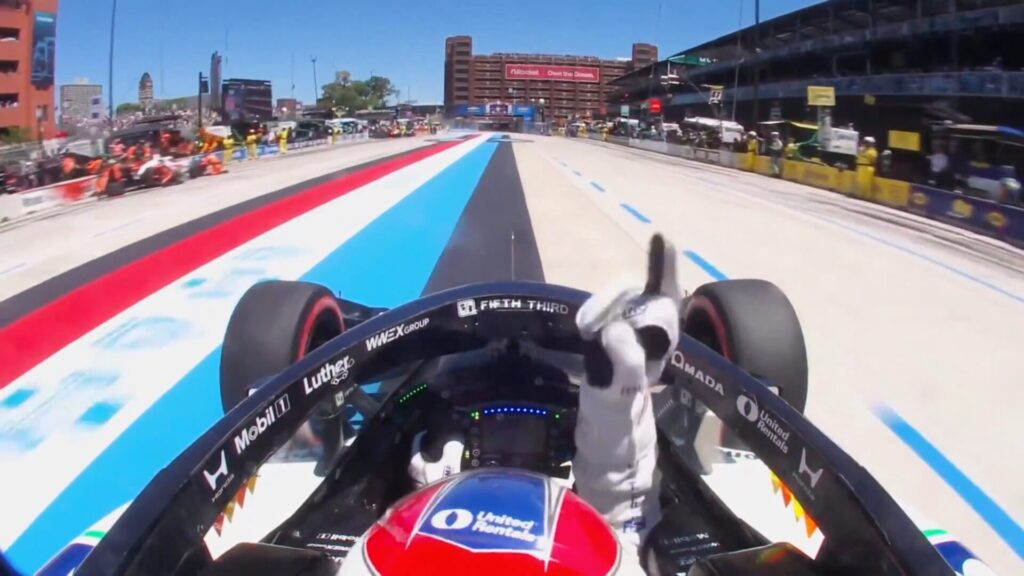
If there was a defining emotion from Detroit, it may have been frustration.
The race generated a remarkable number of heated exchanges, gestures, and confrontations, becoming one of the most emotionally charged events of the season.
That atmosphere was perfectly encapsulated by Graham Rahal’s now widely discussed salute toward Kyffin Simpson’s crew while entering pit lane. The gesture quickly became one of the weekend’s most shared moments and inspired a wave of jokes, memes, and commentary.
Many observers noted that nearly everyone seemed angry at some point during the race weekend.
Some attributed the tension to what has become known as the “Indy 500 hangover,” with drivers coming directly off the intensity of the sport’s biggest event before immediately tackling one of the most physically demanding street circuits on the calendar.
Others pointed directly at Detroit itself.
The circuit’s narrow confines, rough surface, and unforgiving walls continue to create a unique environment where tempers frequently flare. One recurring comparison described the track as dozens of DW12s attempting a Death Star trench run simultaneously, an image that resonated with many fans who watched drivers constantly flirt with disaster.
The rough nature of the circuit also contributed to a broader perception that Detroit simply brings out aggression in competitors. By the end of the weekend, middle-finger gestures, radio frustration, and post-race grievances had become almost as memorable as the racing itself.
Will Power and Scott McLaughlin Add Another Chapter

No rivalry generated more attention than the latest confrontation between Will Power and Scott McLaughlin.
Discussion intensified after additional footage surfaced showing the full sequence of events between the two Team Penske drivers.
Many fans were surprised to learn that portions of the incident were either missed or only partially shown during the live broadcast. As more angles emerged, the conversation quickly shifted toward officiating, intent, retaliation, and whether penalties should have been assessed.
One side argued that McLaughlin should have been penalized for the original contact that sent Power into trouble.
Others focused on Power’s response, pointing out that deliberate retaliation presents a separate issue regardless of what initiated the conflict.
A common viewpoint suggested that both incidents warranted punishment if consistency was the objective.
The incident also reinforced Power’s reputation as one of IndyCar’s most unpredictable and entertaining personalities. Many fans openly admitted that, regardless of whether they agreed with his actions, the drama added another memorable chapter to a rivalry that already includes several previous clashes.
The broader takeaway was simple: Detroit once again delivered the kind of driver conflict that keeps fans talking long after the race ends.
FOX Faces Growing Criticism
The Power-McLaughlin feud also exposed another major source of frustration: the television broadcast.
Fans repeatedly criticized FOX for missing key moments throughout the race, particularly during commercial breaks.
One discussion centered on a sequence of action that occurred while the race was shown in a picture-in-picture box during advertisements. While some viewers acknowledged that the action technically remained visible, many argued that critical moments deserve full-screen coverage and proper commentary.
Others expressed frustration that major incidents often seemed to occur during commercials, only for broadcasts to briefly acknowledge them before returning to advertisements.
The criticism extended beyond a single moment.
Many fans argued that FOX’s production frequently struggles to capture developing storylines, with some pointing to the Power-McLaughlin conflict as a prime example. Several viewers felt the broadcast missed one of the most compelling narratives of the race.
Not everyone agreed with the criticism. Some pointed out that previous broadcast partners received similar complaints and argued that viewers often overlook improvements that have been made.
Still, the dominant sentiment centered on a familiar complaint among American motorsports fans: too much racing is interrupted by advertising.
International viewers added another layer to the discussion. Those watching alternative feeds often reported seeing uninterrupted racing while hearing FOX’s commentary return from commercial breaks. The contrast only amplified frustrations among American viewers.
A Surprisingly Popular Detroit Circuit
Perhaps the most surprising conversation emerging from Detroit involved the track itself.
Despite frequent criticism of its rough surface and tight layout, many fans increasingly view the downtown Detroit circuit as one of the best street races on the schedule.
The numbers supported that argument, with fans noting that the event featured 173 passes, the highest total of any street race this season.
Observers admitted that the track seems to defy conventional wisdom. On paper, a narrow concrete canyon filled with bumps should not produce excellent racing. Yet year after year, Detroit continues delivering overtaking opportunities throughout the field.
Several explanations were offered.
Some pointed to the abundance of slow-speed corners and heavy braking zones. Others highlighted the circuit’s long straights, hairpin-style turns, and subtle elevation changes that create overtaking opportunities despite the confined layout.
Comparisons with Belle Isle surfaced repeatedly. While many still view Belle Isle as the more picturesque venue, some argued that nostalgia has obscured the reality that many races there were significantly less eventful than what downtown Detroit has consistently produced.
The result is a growing appreciation for a circuit that drivers may not enjoy driving but fans increasingly enjoy watching.
Questions Continue Surrounding Team Penske
Away from Detroit’s on-track drama, another major topic centered on Team Penske and Scott McLaughlin’s ongoing winless streak.
McLaughlin has now gone 26 races without a victory since Milwaukee Race 2 in 2024, prompting comparisons with other notable Penske droughts.
While the number itself generated discussion, many fans focused on what it might represent.
Some argued that McLaughlin has simply suffered from poor luck and organizational instability.
Others countered that many of his setbacks have been self-inflicted, pointing to incidents in practice and qualifying that have forced him to recover from difficult starting positions.
The hybrid era emerged as another popular talking point. Several observers noted that Penske’s overall performance appears to have declined since the introduction of the hybrid system, raising questions about whether the team has fully adapted to the new package.
Leadership changes following Penske’s well-publicized controversies also entered the discussion. Some wondered whether management restructuring disrupted the organization’s dominance.
At the same time, many cautioned against reading too much into the numbers during an era largely defined by Álex Palou’s dominance.
When one driver continues winning at an extraordinary rate, everyone else’s statistics naturally appear worse.
Even so, comparisons between McLaughlin and teammate David Malukas became increasingly common. With Malukas enjoying a strong campaign, some fans believe the internal benchmark within Penske has shifted significantly.
For now, most observers expect Penske’s driver lineup to remain intact. But the conversation illustrates how quickly expectations can change inside one of IndyCar’s most successful organizations.
Why IndyCar Continues To Connect
Amid the debates about officiating, broadcasting, rivalries, and team performance, one recurring theme surfaced repeatedly throughout the week.
Fans continue to find IndyCar fun.
Multiple discussions featured supporters describing how they arrived from Formula 1, NASCAR, or other racing disciplines before discovering IndyCar’s unique appeal.
Some praised the series for combining elements they love from multiple forms of motorsport. Others highlighted the accessibility of drivers, paddock experiences, and the unpredictability that often defines race weekends.
Even conversations about angry drivers, missed broadcasts, controversial cautions, and rough street circuits often circled back to the same conclusion.
IndyCar remains messy, emotional, unpredictable, and occasionally chaotic.
And for many fans, that’s exactly why they can’t stop watching.
As the series heads to World Wide Technology Raceway for another night of oval racing, Detroit has once again proven that some race weekends leave an impact long after the results are finalized.