

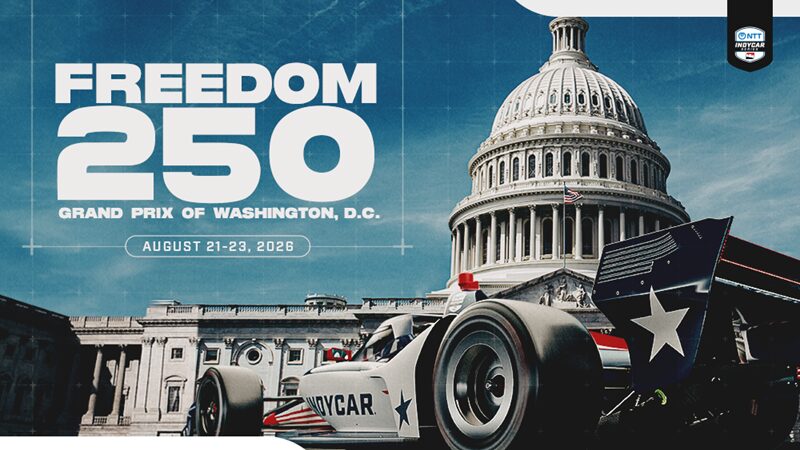
IndyCar fans had plenty to dissect this week, from the delayed unveiling of the Washington, D.C. street circuit for the Freedom 250 to a broader philosophical debate about how the sport should present itself to the world. While the topics were separate, the conversation around them shared a common thread: what IndyCar should be, and how it fits into the wider motorsport landscape.
The first flashpoint came after journalist Marshall Pruett reported that IndyCar will unveil the “brand-new Freedom 250 Grand Prix race course layout” on Monday. The announcement immediately prompted questions about timing, particularly because the executive order tied to the event originally referenced a 14-day window following its signing on January 30.
Some observers argued that the timeline meant the series was already behind schedule, pointing out that new street circuits are typically announced far earlier. In most cases, layouts are made public a year or more before a new event debuts. Others pushed back, noting that the executive order only required federal agencies to designate a route internally within two weeks, not to publicly release it. From that perspective, the announcement arriving now may simply reflect the difference between government coordination and public communication.
There was also a strong sense that the paddock itself has been aware of the route for some time. The belief among fans is that teams and drivers may have known the layout since mid-February, suggesting that the public rollout is merely the final step in a process that has been underway quietly behind the scenes.
Still, skepticism around the event remains widespread. Even among committed fans, there is uncertainty about how the race will come together given the logistical challenges of staging a street race through areas tied to the National Park Service and major monuments. Some supporters expressed confidence that IndyCar will ultimately make the event work, even if preparations come down to the wire, while others remain unconvinced the race will actually happen.
The name of the race itself has also drawn mixed reactions. While “Freedom 250” has a precedent within IndyCar history, many longtime fans remember the Freedom 100 Indy Lights race at Indianapolis, others feel the branding is heavy-handed or politically loaded. Some fans pointed out that the name is tied to Freedom 250, a fundraising arm connected to broader U.S. semiquincentennial celebrations planned for 2026, which include a wide range of events beyond motorsport.
For some observers, the name is the least controversial part of the plan. Others see the event as a one-off spectacle rather than the foundation for a long-term race on the calendar, which raises questions about how much the series should compromise in order to stage a race tied to government celebrations.
If the Freedom 250 debate focused on the future of IndyCar events, the conversation surrounding broadcaster Will Buxton turned to the sport’s identity.
Buxton recently weighed in on comments made by Pato O’Ward regarding the optics of IndyCar sharing race weekends with NASCAR. His remarks sparked a wave of discussion among fans, with many agreeing with his central premise that motorsport fandom should be less fragmented.
The argument resonated with a number of fans who feel the sport often suffers from unnecessary tribalism between series. In their view, encouraging crossover between fanbases, whether through doubleheaders or collaborative events, can only help racing as a whole.
Others framed the issue more bluntly: motorsport ultimately exists to entertain the public. From that perspective, anything that improves the experience for fans, whether it is joint race weekends or broader collaboration between series, should take priority over internal politics or prestige.
Yet not everyone is convinced that unity between racing audiences is realistic. Some longtime followers believe that motorsport fans tend to identify strongly with one particular series, Formula 1, NASCAR, IndyCar, or others, and that those loyalties rarely change. The phenomenon is often compared to sports leagues such as the NFL, where fans follow a specific team or competition rather than the broader sport.
The divide is particularly visible when discussing Formula 1’s modern popularity. Many observers believe a large portion of new F1 viewers are drawn as much by the spectacle surrounding the sport, the personalities, luxury lifestyle, and off-track narratives, as by the racing itself. That dynamic, they argue, makes Formula 1 appealing to audiences who may never develop interest in other forms of motorsport.
IndyCar, by contrast, has traditionally positioned itself as a driver-focused championship with a different structure and culture. That distinction also surfaced in discussions about one of Buxton’s other ideas: introducing a team championship to the series.
Supporters see the concept as a natural addition that could give teams another meaningful objective throughout the season. Critics, however, argue that IndyCar’s competitive structure has always revolved around drivers rather than teams, making a team championship feel like an unnecessary imitation of Formula 1.
Some fans also question whether teams would treat such a title seriously if it did not carry financial implications. In Formula 1, the constructors’ championship directly affects prize money and therefore shapes how teams prioritize their strategies. Without a similar incentive, skeptics believe a team championship in IndyCar could become little more than a statistical curiosity.
For all the disagreements, the discussions surrounding both topics reveal the same underlying tension. IndyCar is constantly balancing its traditions with the realities of a modern motorsport environment that includes larger global series, evolving fan expectations, and increasing pressure to attract new audiences.
Whether the debate is about a new street race in Washington, D.C., or the broader philosophy of how racing should be presented to fans, the passion of the community remains unmistakable. If anything, the sheer volume of opinions highlights a simple truth: even when fans disagree about the direction of the sport, they care deeply about where it goes next.