

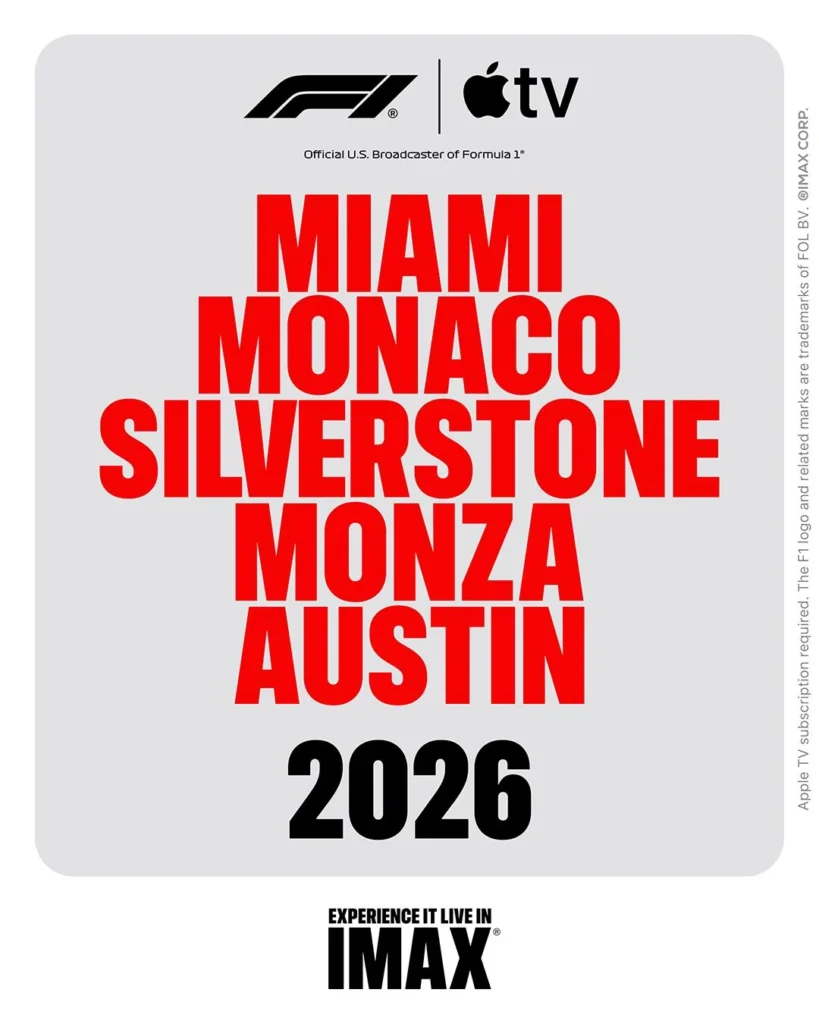
Formula 1 is pushing deeper into experiential viewing with a new initiative tied to the Miami Grand Prix: a live race broadcast in IMAX theaters across the United States, distributed through Apple TV. With tickets set to go on sale April 10, the concept is straightforward—bring the race to the big screen, surround it with premium audio, and turn what is typically a solo or small-group viewing experience into something closer to a shared event.
But while the announcement itself is relatively simple, the fan reaction reveals something more layered: a mix of excitement, curiosity, skepticism, and—perhaps most notably—a clear signal about how underserved parts of the F1 fanbase still feel, particularly in the U.S.
A “Watch Party” Moment for a Growing U.S. Audience
At its core, the IMAX concept is being received as more than just a different way to watch a race. For many fans, especially in the United States, it represents a rare opportunity to actually be around other fans.
The reaction consistently frames this as a large-scale communal viewing experience—essentially a “watch party” with upgraded production value. The appeal isn’t just the screen size or audio fidelity, but the chance to engage with a community that can otherwise feel invisible.
That sentiment comes through strongly: fans describe how uncommon it is to encounter other F1 followers in everyday life, with even chance encounters—like spotting someone wearing the same team merchandise—standing out as memorable moments. The IMAX rollout is being interpreted as a solution to that isolation, a structured way to bring dispersed fans together.
Even in regions where F1 has a stronger footprint, accessibility isn’t guaranteed. Some fans note that finding a venue—like a pub—that not only shows the race but does so with sound and proper attention is still inconsistent. In that context, a dedicated theater screening removes friction: no competing broadcasts, no muted TVs, no guesswork.
The Social Layer: From Scarcity to Community
A recurring theme across reactions is the idea that F1 fandom, particularly in certain geographies, operates in pockets rather than networks. Fans describe the experience as “rare,” even going as far as joking that “there are dozens of us,” underscoring how fragmented the audience can feel.
That fragmentation is exactly what makes the IMAX concept compelling. It’s not just about watching the race—it’s about validating the presence of a broader fan community. For some, it’s framed as a way to make actual friends within the sport, something that doesn’t easily happen through traditional viewing setups.
At the same time, there’s an acknowledgment that alternative in-person experiences already exist—such as F1-themed venues or bars that open early for European race times—but these often come with trade-offs. Entry fees, expensive packages, or limited availability mean they’re not always accessible. IMAX, in theory, offers a more standardized and potentially scalable version of that experience.
The Sensory Appeal—and Nostalgia Factor
Beyond the social element, there’s clear enthusiasm around the technical upside of an IMAX presentation.
Fans are drawn to the idea of experiencing Formula 1 with enhanced audio—particularly the immersive qualities associated with formats like Dolby Atmos. The expectation is that the sound design alone could elevate the experience, even if some remain cautious about whether the broadcast will truly match the fidelity of a traditional IMAX film.
Interestingly, this also taps into nostalgia. The mention of older engine eras—especially V10s—highlights how audio remains a central part of F1’s emotional appeal. For some, the idea of hearing that kind of raw engine sound in a theater setting is almost therapeutic, reinforcing how much of the sport’s identity is tied to sensory immersion.
Even for modern F1, where engine noise is more subdued, the consensus is that a theater environment could still amplify the experience in ways that a standard home setup cannot.
Friction Points: Cost, Access, and Logistics
Despite the enthusiasm, there are clear uncertainties surrounding execution.
One of the most immediate concerns is cost. IMAX tickets are already perceived as premium—approaching $29 before fees in some areas—and that raises questions about value, especially when compared to free or lower-cost alternatives like bars or informal watch parties.
There’s also confusion around the Apple TV integration. The requirement (or perceived requirement) of an Apple TV subscription introduces ambiguity: will attendees need to verify their subscription status? Could ticket access be gated behind an Apple login? Or is this simply a distribution detail that won’t affect the in-theater experience?
The lack of clarity here is creating hesitation. Fans are already speculating about edge cases—whether a free trial would qualify, how verification might work, and whether theaters would enforce any of it at all. That uncertainty could become a barrier if not addressed before tickets go live.
The Bigger Question: Is F1 the Right Product for This Format?
Perhaps the most nuanced reaction centers on the product itself—Formula 1 racing in its current form.
While the IMAX concept is broadly appealing, some fans question whether the on-track action consistently justifies a premium, in-person viewing experience. The concern isn’t about the format, but about the variability of the racing product: if a race lacks overtakes or excitement at the front, does it still feel worth the effort and cost of attending a theater screening?
At the same time, there’s a counterpoint emerging: that the theater setting might actually enhance races that would otherwise feel underwhelming at home. The scale, the shared reactions, and the unpredictability of “chaos moments” could make even less dynamic races more engaging in a live, communal environment.
A Test Case for the Future of F1 Viewing
What emerges from this reaction set is a clear signal: the IMAX Miami Grand Prix screening isn’t just a novelty—it’s a test of how Formula 1 can evolve its viewing experience, particularly in markets where the fanbase is still consolidating.
The demand for community is unmistakable. Fans aren’t just looking for better screens or louder audio—they’re looking for connection, for shared moments, and for spaces where F1 fandom feels visible and collective rather than isolated.
If executed well, this initiative could redefine how races are consumed outside the home. If not, it risks being seen as an expensive experiment layered with unnecessary complexity.
Either way, the response makes one thing clear: the appetite for something more than traditional viewing is already there.